This lesson was created using the latest AQA A-Level Specification (published June 2019) although content and activities may be useful for other specifications.
Key content covered in this Lesson:
Key Questions
The Cognitive Approach
Key Assumptions
Theoretical Models
Computer Models
Video: Are brains like computers?
The Role of Schema
Example of a schema for a chair
The Emergence of Cognitive Neuroscience
Exam practice with Mark Scheme: Short answer questions
Evaluation worksheet
Evaluation points
Exam practice with Mark Scheme: Evaluation question
Plenary: Consolidation Question
To request lessons, provide feedback or if you have had any issues opening any resources of my resources, please feel free to contact jb_resources@outlook.com.
Reviews and feedback are always welcome.
This bundle includes a complete lesson and activities for the A-Level Topic Cognition and Development:
The 7 lessons are included in this bundle are:
Piaget’s Theory of Cognitive Development
Piaget’s Stages of Intellectual Development
Vygotsky’s Theory of Cognitive Development
Baillargeon’s Explanation of Infant Abilities
Selman’s Levels of Perspective-taking
Theory of Mind
The Mirror Neuron System
*Please see individual lessons for further details of included content.
This lesson was created using the latest AQA A-Level Specification (published June 2019) although content and activities may be useful for other specifications.
Key content covered in this Lesson:
Key questions
Level of Moral Reasoning
The Heinz Dilemma
Kohlberg’s Model of Moral Development
Video: Kohlberg’s Model of Moral Development
Activity: Explain each stage of Kohlberg’s Model
Kohlberg’s Model and Criminality
Cognitive Distortions
Hostile Attribution Bias
Minimalisation
Exam practice with Mark Scheme: Short Answer Question
Evaluation worksheet
Evaluation points
Exam practice with Mark Scheme: Evaluation Question
Plenary: Consolidation question
To request lessons, provide feedback or if you have had any issues opening any resources of my resources, please feel free to contact jb_resources@outlook.com.
Reviews and feedback are always welcome.
This is a collection of exam questions for the new AQA Psychology specification (2016) focused on the topic of cognitive psych/ memory. I also have made workbooks for attachment, social psych and psychopathology - if you liked this then don’t miss them - linked below!!
The questions are usefully grouped so that once you have revised the topic you can test yourself on a range of questions that have appeared in the past, giving you ample opportunities to get familiar with the types of questions the exam board have asked in the past and no doubt will again.
Even students who can recite their notes off by heart may struggle to achieve the top grades because they have poor exam technique, but this workbook is the ideal resource to improve exam technique simply by practicing!
I have meticulously gone through past papers for the old specification and carefully selected the most relevant questions to the new spec, allowing students to prepare for exam questions that are likely to reappear. I found this very useful on the way to getting an A*.
I also have these workbooks for attachment, social psychology and psychopathology-
https://www.tes.com/teaching-resource/attachment-exam-question-booklet-a-level-psychology-aqa-new-spec-11684162
https://www.tes.com/teaching-resource/social-psychology-exam-question-booklet-a-level-psychology-aqa-new-spec-11684168
https://www.tes.com/teaching-resource/psychopathology-revision-exam-question-booklet-a-level-psychology-aqa-new-spec-11684165
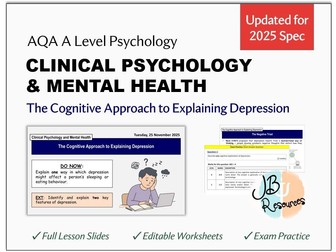
Updated for AQA 2025 Spec – Teaching from SEPTEMBER 2025 onwards
This resource is designed for teaching The Cognitive Approach to Explaining Depression under the AQA A-Level Psychology (2025 Specification). It has been fully updated to reflect the revised requirements within the Clinical Psychology and Mental Health topic, which expect students to describe, apply, and evaluate Beck’s cognitive theory and Ellis’s ABC model as explanations of depression, including key concepts such as negative schemas, faulty information processing, the negative triad, irrational beliefs, and activating events.
If you’re looking for the 2019 specification version of this topic, please visit my shop.
This fully editable lesson guides students through Beck’s and Ellis’s cognitive explanations, supporting the development of secure AO1 knowledge through clear explanations, structured notes, and visual diagrams. Students then apply the theories to real-world examples and case material, before developing AO3 evaluation skills through guided discussion, structured activities, and critical comparison tasks.
What’s Included:
Fully Editable Lesson Slides – Introduce Beck’s and Ellis’s cognitive explanations of depression through clear explanations, diagrams, structured note sections, and worked examples. Includes retrieval starters, success criteria, Think–Pair–Share questions, scenario prompts, guided reading, discussion activities, application checkpoints, and a structured plenary.
AO2 Application Worksheet – Students apply cognitive theory to a real-life scenario involving Yasmin’s redundancy, identifying activating events, irrational beliefs, consequences, and cognitive vulnerabilities. Designed to build confidence with exam-style application questions.
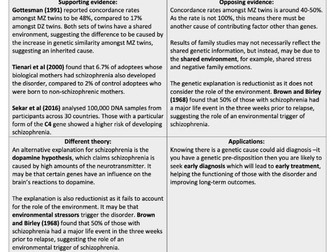
Evaluation Worksheet – Printable activity enabling students to examine key strengths and limitations of the cognitive explanations, including research support, CBT effectiveness, explanatory breadth, cognitive primacy, and developmental influences. Features classification prompts, explanation boxes, and stretch questions to support higher-level reasoning.
Exam Practice Question Sheet – Includes a 4-mark AO1 question assessing students’ ability to describe one cognitive explanation of depression, with clear response space suited for classwork, homework, or formative assessment.
How This Resource Reflects the 2025 Specification Changes:
Fully aligned with AQA 2025 content under Clinical Psychology and Mental Health
Covers updated sub-topic: The Cognitive Approach to Explaining Depression
Supports AO1, AO2, and AO3 objectives through explanation, application, and evaluation
Incorporates scenario-based reasoning and clinical examples, as emphasised in the revised specification
Suitable for classroom teaching, independent learning, cover lessons, homework, or revision
All materials are fully editable, allowing teachers to adapt the lesson to student ability, pacing, and teaching style.
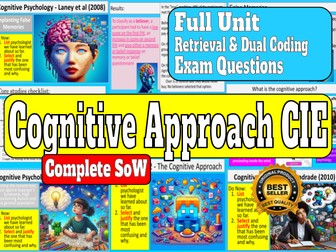
Cognitive Approach - Psychology Core - Y12 (AS) CIE (Full Unit)
Leave a review for a FREE single resource
Cognitive Approach
This SoW has been meticulously crafted, offering a differentiated and engaging approach that enables efficient progression through content.
Built to the highest standards and grounded in current research, the unit incorporates dual coding and retrieval practices at its core. A consistent color scheme is also utilized to enhance both your delivery and students’ comprehension.
Cognitive Approach
Cognitive Approach CIE
Andrade 2010 Psychology CIE
Baron Cohen et al 2001 CIE
Laney et al (2008) Psychology CIE
By leaving a review of any of our resources, you can claim a FREE single resource from our ever-expanding library. Just send a message to the email above, which is checked daily.
upsidelearning1@gmail.com
Best FREE Resources (Upside Learning)
FREE - Computer Safety - https://www.tes.com/teaching-resource/-13121810
FREE - Coraline Neil Gaiman (Lesson 1) - https://www.tes.com/teaching-resource/resource-13108829
FREE - Gothic Literature (Lesson 1) - https://www.tes.com/teaching-resource/-13109342
FREE - Physics IGCSE (Lesson 1) - https://www.tes.com/teaching-resource/-13118154
Cognitive Approach
A comprehensive revision guide covering all aspects of the Clinical Psychology A Level unit, suitable for the Edexcel A Level Psychology 2015 specification.
Optional disorder included: Anorexia nervosa.
Contemporary study included: Guardia.
Revision guides are also available for Cognitive, Biological, Learning, Social and Criminal units.
Former A Level student: “I am so grateful for the hours and hours that you put into making those revision guides, because they were the most helpful thing to use, and you should sell them because they are far better than any textbook I have bought!”
This lesson was created using the latest AQA A-Level Specification (published June 2019) although content and activities may be useful for other specifications.
Key content covered in this Lesson:
Key Questions
What is Cognitive Behavioural Therapy (CBT)?
CBT: Beck’s Cognitive Therapy
Thought Diary for CBT
Refresher: Ellis’s ABC Model
CBT: Ellis’s Rational Emotive Behavioural Therapy (REBT)
Behavioural Activation
Evaluation worksheet
Evaluation points
Activity: If this is the answer what is the question?
Exam Practice with Mark Scheme: Planning 16 Mark Questions
Plenary: Consolidation Question
To request lessons, provide feedback or if you have had any issues opening any resources of my resources, please feel free to contact jb_resources@outlook.com.
Reviews and feedback are always welcome.
Full topic covering the following lessons
1: Symptoms and features of depression
2: Issues and debates - nature vs nurture
3: Cognitive theory of depression
4: Genetic explanation of addiction
5: Genetic explanation of depression
6: Learning theories of addiction
7: Treatments of addiction
8: Treatments of depression
9: symptoms and features of depression
10: Young et al study
11: Caspi et al study
This fully editable lesson on Piaget’s Theory of Cognitive Development introduces students to key concepts of cognitive growth, focusing on schemas, assimilation, accommodation, and stages of development. Aligned with the AQA GCSE Psychology Specification, this resource explores how children’s thinking evolves through interaction with their environment and developmental stages. The lesson integrates engaging activities, critical thinking tasks, and exam practice to consolidate understanding.
Comprehensive Lesson Slides: The slides provide detailed explanations of Piaget’s key theories, including the processes of assimilation and accommodation, and the concept of schemas. Key topics include the differences between child and adult cognition, a brief introduction to Piaget’s stages of cognitive development, and the influence of these stages on children’s learning processes. The slides also critically evaluate Piaget’s work, discussing its impact on education and cultural limitations.
Interactive Activities: Students are engaged through Do Now tasks and thought-provoking questions, such as exploring how cultural differences might influence cognitive development. Activities include summarising Piaget’s stages, discussing real-life applications like activity-based learning in classrooms, and matching key terms with their definitions to reinforce comprehension.
Exam Practice and Assessment: Students are provided with an exam-style question to assess their understanding of Piaget’s theory. Tasks include structured evaluation questions to identify strengths and weaknesses, such as the role of research evidence and criticisms of cultural bias. Worksheets guide students in explaining concepts like assimilation and accommodation and developing critical responses using the AO1 and AO3 criteria.
WHOLE BTEC APPLIED PSYCHOLOGY EXTENDED CERTIFICATE UNIT
UNIT 1 PSYCHOLOGICAL APPROACHES AND APPLICATION
REVISION TO COVER:
THE BIOLOGICAL APPROACH
THE LEARNING APPROACH
THE SOCIAL APPROACH
THE COGNITIVE APPROACH
& APPLICATION TO GENDER, CONSUMER BEHAVIOUR AND AGGRESSION
Includes:
KEY ASSUMPTIONS
EVALUATION OF EACH APPROACH
KEY STUDIES & EVALUATION
APPLICATION TO GENDER, CONSUMER BEHAVIOUR AND AGGRESION
EXAM QUESTIONS WITH RESPONSES FROM PAST PAPERS
Included is a powerpoint covering the Cognitive approach in line with the AQA syllabus
starter slides and specification links
topics covered: introduction to cognitive approach, real life examples of cognition in action, schema, inferences, computer model, case studies and experiements, AO3
gap fills, true or false, discussion opportunities, links to videos, match up
This powerpoint can be spread across 2 lessons
A comprehensive revision guide covering all aspects of the Cognitive Psychology A Level unit, suitable for the Edexcel A Level Psychology 2015 specification.
Contemporary study included: Schmolck.
Revision guides are also available for Social, Biological, Learning, Clinical and Criminal units.
Former A Level student: “I am so grateful for the hours and hours that you put into making those revision guides, because they were the most helpful thing to use, and you should sell them because they are far better than any textbook I have bought!”
This bundle was created using the latest AQA A-Level Specification (published June 2019) although content and activities may be useful for other specifications.
This bundle includes 8 complete lessons (.ppt) with activities:
Origins of Psychology
The Behaviourist Approach
Social Learning Theory
The Cognitive Approach
The Biological Approach
The Psychodynamic Approach
The Humanistic Approach
Comparison of Approaches
Please see individual lessons for further details of included content.
To request lessons, provide feedback or if you have had any issues opening any resources of my resources, please feel free to contact jb_resources@outlook.com.
Reviews and feedback are always welcome.
This large pack of model answers covers the following topics from Cognitive Psychology, written by an Expert Examiner who has taught Psychology A Level for over 16 years. Many include notes on structure and highlight key terms. The set includes model answers for these questions:
Q: Give 2 strengths and 2 weaknesses of Tulving’s theory of long-term memory (8m)
Q: Evaluate the Multi-Store Model as an explanation of memory (8m)
Q: Evaluate Baddeley 1966b (8m) model answer
Q: Evaluate Field experiments as used in cognitive psychology 8m model answer
Q:Evaluate Sebastian and Hernandez-Gil (2012) (8m) model answer
Q: Evaluate the Working Memory Model (8m)
Q: Evaluate Lab experiments as used in cognitive psychology 8m
Q: Describe schema theory (4m)
Q: Evaluate Baddeley’s 1966b study in terms of validity and reliability (8m)
Q: Assess Sebastian and Hernandez-Gil’s study in terms of validity and generalisability (8m)
Q: Evaluate the use of the case study, as used in cognitive psychology (8m)
Q Evaluate the theory of reconstructive memory (8m)
Q: Jenny is a teacher trying to talk to a parent on the phone. Suddenly, a student comes into her office and starts talking to her. Jenny tells the student to come back, as she can’t listen to two people at once. Explain why Jenny cannot listen to the student and the parent at the same time, using the Working Memory Model (4m)
This bundle was created using the latest AQA A-Level Specification (published June 2019) although content and activities may be useful for other specifications.
This bundle includes a complete lesson and activities for the A-Level Forensic Psychology Topic.
The 13 lessons are included in this bundle are:
Defining and Measuring Crime
The Top-Down Approach to Offender Profiling
The Bottom-Up Approach to Offender Profiling
Lombroso’s Atavistic Form
Genetic and Neural Explanations
Eysenck’s Theory of the Criminal Personality
Cognitive Theory
Differential Association Theory
Psychodynamic Explanations for Offending
Custodial Sentencing
Behavioural Modification in Custody
Anger Management
Restorative Justice
Please see individual lessons for further details of the content included.
This contains all 14 lessons in the Psychological Problems topic for AQA GCSE Psychology. It also contains a Homework booklet, a Starter booklet and the entire Development Workbooklet.
An introduction to mental health. How the incidence of significant mental health problems changes over time
Characteristics of mental health, eg positive engagement with society, effective coping with challenges.
Cultural variations in beliefs about mental health problems.
Increased challenges of modern living, eg isolation.
Increased recognition of the nature of mental health problems and lessening of social stigma.
Effects of significant mental health problems on individuals and society
Individual effects, eg damage to relationships, difficulties coping with day to day life, negative impact on physical wellbeing.
Social effects, eg need for more social care, increased crime rates, implications for the economy.
Characteristics of clinical depression. Differences between unipolar depression, bipolar depression and sadness.
The use of International Classification of Diseases in diagnosing unipolar depression: number and severity of symptoms including low mood, reduced energy levels, changes in sleep patterns and appetite levels, decrease in self-confidence.
Theories of depression. Interventions or therapies for depression
Biological explanation (influence of nature): imbalance of neurotransmitters, eg serotonin in the brain.
Psychological explanation (influence of nurture): negative schemas and attributions.
Use of antidepressant medications.
Cognitive behaviour therapy (CBT).
How these improve mental health, reductionist and holistic perspectives. Wiles’ study of the effectiveness of CBT.
Characteristics of addiction. The difference between addiction/dependence and substance misuse/abuse.
The use of International Classification of Diseases in diagnosing addiction (dependence syndrome), including a strong desire to use substance(s) despite harmful consequences, difficulty in controlling use, a higher priority given to the substance(s) than to other activities or obligations.
Theories of addiction. Interventions or therapies for addiction
Biological explanation (influence of nature): hereditary factors/genetic vulnerability. Kaij’s twin study of alcohol abuse.
Psychological explanation (influence of nurture): Peer influence.
Aversion therapy.
Self-management programmes, eg self-help groups, 12 step recovery programmes.
How these improve mental health, reductionist and holistic perspectives.
To request lessons, provide feedback or if you have had any issues opening any resources of my resources, please feel free to contact me on jb_resources@outlook.com (responses are usually very prompt).
Key content covered in this Lesson:
Key Questions
Selman’s work on Perspective-taking
Perspective-taking Research (1971; 1976) - Procedure and Findings
Selman’s Stages of Development (1976)
Level 0 - Socially Egocentric
Level 1 - Social Information role-taking
Level 2 - Self-reflective role-taking
Level 3 - Mutual role-taking
Level 4 - Societal and conventional role-taking
Summary Table of Selman’s Levels of Perspective-taking
Activity: Spenny and Lauren’s Computer time
Later Developments to Selman’s Theory
Evaluation worksheet
Evaluation points
Exam practice with Mark Scheme: Planning 8 Mark with Application Questions
Plenary: Consolidation Question
Thank you for downloading this free resource. Let us know how we are doing and leave us a review.
Suitable for 14-19-year olds (secondary and high schools, and college), this article and accompanying activity sheet can be used in the classroom, STEM clubs and at home.
This resource links to KS4 and KS5 Psychology and Careers.
It can also be used as a careers resource and links to Gatsby Benchmarks:
Gatsby Benchmark 2: Learning from career and labour market information
Gatsby Benchmark 4: Linking curriculum learning to careers
• This PowerPoint explains the work of Dr Jonathan Grainger, a cognitive psychologist who is using experimental techniques to determine how skilled readers process words and sentences.
• This resource also contains an interview with Dr Grainger and advice about careers in this field. If you or your students have a question for him, you can submit it online – go to the article using the Futurum link below and scroll to the bottom of the page. Dr Grainger will reply!
• The Ppt. contains ‘talking points’ to prompt students to reflect on Dr Grainger’s work, career path and the tips he offers.
This resource was first published on Futurum Careers, a free online resource and magazine aimed at encouraging 14-19-year-olds worldwide to pursue careers in science, tech, engineering, maths, medicine (STEM) and social sciences, humanities and the arts for people and the economy (SHAPE).
If you like these free resources – or have suggestions for improvements –, please let us know and leave us some feedback. Thank you!


![A-Level Psychology - THE COGNITIVE APPROACH [Approaches in Psychology]](https://l.imgt.es/resource-preview-imgs/51661229-95b8-4ef0-b919-bf6454860502%2FScreenshot20240327130416.png?profile=res-img-med-legacy-v2) Quick View
Quick View![A-LEVEL PSYCHOLOGY - COGNITION AND DEVELOPMENT [COMPLETE TOPIC]](https://l.imgt.es/resource-preview-imgs/b61bec42-e4b6-4f30-8d21-13c7125a2af4%2FUntitled121.crop_1599x1200_0%2C0.preview.jpg?profile=res-img-med-legacy-v2)
![A-Level Psychology - COGNITIVE EXPLANATIONS FOR OFFENDING BEHAVIOUR [Forensic Psychology]](https://l.imgt.es/resource-preview-imgs/0f59e7e3-e83b-46ca-8adf-ce1a64998338%2Fl7fp.png?profile=res-img-med-legacy-v2)
![A-Level Psychology - THE COGNITIVE APPROACH TO TREATING DEPRESSION [Psychopathology Topic]](https://l.imgt.es/resource-preview-imgs/306adb5d-1153-4400-9c63-ec4ceb5df89a%2FScreenshot20240314195426.crop_983x738_1%2C0.preview.png?profile=res-img-med-legacy-v2)
![AQA GCSE Psychology: INTRODUCTION TO PIAGET'S THEORY OF COGNITIVE DEVELOPMENT [Development Topic]](https://l.imgt.es/resource-preview-imgs/0d7d1a02-23ff-4eea-843d-c31fa3bba44f%2FL2devtes.crop_869x651_1%2C0.preview.jpg?profile=res-img-med-legacy-v2)
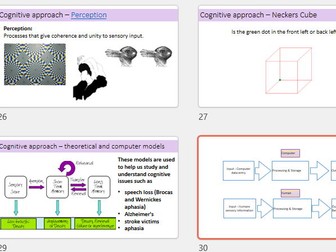
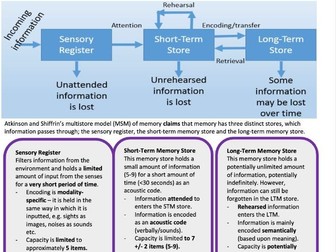
![A-LEVEL PSYCHOLOGY - APPROACHES IN PSYCHOLOGY [COMPLETE TOPIC - Includes Slides and Worksheets]](https://l.imgt.es/resource-preview-imgs/08280360-b8cd-4818-9dd2-7878a524650f%2FScreenshot20240401152139.crop_984x738_2%2C0.preview.png?profile=res-img-med-legacy-v2)
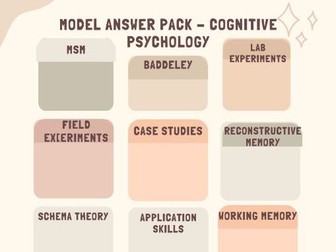
![A-LEVEL PSYCHOLOGY - FORENSIC PSYCHOLOGY [COMPLETE TOPIC - Includes Slides and Worksheets]](https://l.imgt.es/resource-preview-imgs/1f014844-89e9-49a8-8ae3-c58d6143fc32%2FScreenshot20240424190450.crop_988x741_0%2C1.preview.png?profile=res-img-med-legacy-v2)
![A-Level Psychology - SELMAN'S LEVELS OF PERSPECTIVE-TAKING [Cognition and Development Topic]](https://l.imgt.es/resource-preview-imgs/371ace82-ca05-40f7-9ba9-0d87dd615199%2Fl537.jpg?profile=res-img-med-legacy-v2)