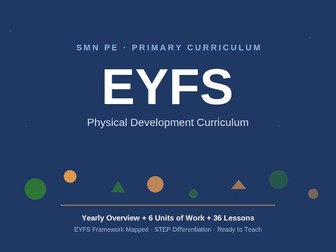
A complete, ready-to-teach EYFS Physical Development curriculum, yearly overview plus 6 full units of work, mapped to the EYFS Framework.
Stop building PE from scratch every week. This bundle gives you everything you need to deliver a structured, progressive Physical Development curriculum across the whole of Reception, perfect for EYFS leads, PE coordinators, and non-specialist teachers who want high-quality provision without the planning time.
What’s included:
1 Yearly Overview (Intent/Implementation/Impact + full term-by-term plan)
6 Units of Work: Fundamental Movement Skills 1, Gymnastics & Balance, Ball Skills, Dance & Music, Fundamental Movement Skills 2, Team Games
36 fully resourced lessons (6 per unit), each with: clear objectives, equipment & key vocabulary, warm-up, 4 main activities, plenary, planned questions, assessment guidance, and SEN/G&T differentiation using the STEP framework
Every lesson is written to fill a full session and guide even non-specialist staff through confident delivery. No extra prep needed.
This bundle includes everything you need to set up your Reception curriculum.
Includes:
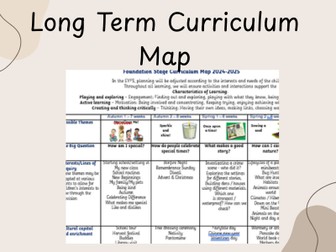
Long Term Planning
Progression of Skills
Termly Checkpoints
Tiered Vocabulary Progression
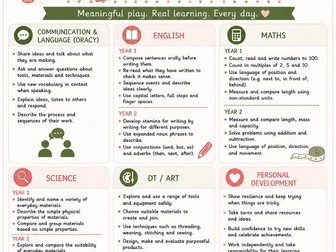
Characteristics of Effective Learning (I Can Statements)
Learning Area Posters (for the classroom)
What Does EYFS Look Like - National Curriculum Links Document
All this should be £33.50 when brought individually, but reduced to £25 when purchased altogether! Your Reception curriculum, sorted!
Are you searching for a full-length, structured, progressive music theory curriculum? Moving beyond the basics and aimed at secondary-age or older beginners, this series of products takes students from no music theory knowledge gradually and progressively through to more complex topics. Workbooks, student reflection tasks, answer schemes, assessments and slideshows are included, covering 6 units, each with 10 topics. Upgrade your current theory worksheets to this all-in-one, no-prep music theory curriculum!
What is it?
6x printable theory workbooks: 10 pages in each, with a new topic & 2 written tasks per page
6x slideshows: in PowerPoint and Google Slides formats, to display on the board as the students use the workbooks, with answers appearing on click
6x answer schemes: one for each workbook
18x printable quizzes: 3 per workbook, to be used as homework or assessments
Answer schemes for quizzes
Tell me more!
As a teacher of older students, they got bored of cutesy coloring sheets and babyish music literacy work and I was frustrated with a lack of theory resources which moved beyond the basics of treble clef notes and note values. I wanted to design a full curriculum which recalled previous knowledge, introduced new topics clearly with written tasks, and allowed students to move gradually onto more advanced ideas such as chord inversions, circle of fifths and transposing. No more patching together worksheets from multiple sources or writing everything on the whiteboard each lesson; this curriculum has allowed me to print the workbooks and teach from the screen and integrate theory more meaningfully into my Music lessons.
Other “bundles” of worksheets exist; what sets this curriculum apart is its progressive nature, with each lesson building on what has already been done. For example, once bass clef or a new key signature/time signature/Italian term has been introduced, it features frequently in the following exercises. This recall means concepts are firmly established rather than doing a stand-alone lesson or worksheet and never revisiting.
See the previews for a full list of topics covered, but this curriculum includes:
Treble and bass staff notes, including leger lines
Note and rest values, including dotted notes and triplets
Time signatures, including simple, compound and irregular
Italian terms, performance directions, tempo, signs and symbols
Triads, chords and cadences
Easy printing - black & white/grayscale and A4 or letter size
US and UK versions included (eighth notes/quavers, staff/stave)
Units 1-3 cover approximately:
AB grade 1 theory
Trinity grade 1 theory
LCM grade 1 theory
RCM Canada grade 1-2
AMEB Australia grade 1
Scottish SQA National 5
England/Wales pre-GCSE (year 8-9)
Units 4-6 cover approximately:
AB grade 2 theory
Trinity grade 2 theory
LCM grade 2 theory
RCM Canada grade 3
AMEB Australia grade 2
Scottish SQA Higher and Advanced Higher
England/Wales GCSE
This year long Programme of Study is based on a study of the new linear GCSE English Course. This long term plan reflects the new GCSE Linear Exam Assessment Objectives.
Students will be assessed on:
Responding to GCSE fiction and non-fiction text extracts exploring creative writing based upon GCSE literary non-fiction text extracts
Exploring Shakespearean tragedy: the study ofeither Macbeth or Merchant of Venice
Exploring contemporary poetry: contemporary poetry (AQA Anthology)
The study of the 19th century novel - the teacher’s choice
Exploring and developing a viewpoint
A mock GCSE summer exams
It also includes:
activity suggestions
lesson content suggestions
exam structures
a map of the assessment objectives for the whole year
links to AQA’s GCSE exam frame and criteria
It is ideal for new HoD, departments without a HoD, or HoDs who are seeking a fresh perspective or Programme of Study.
Enjoy!
Curriculum links documents for every area in a KS1 continuous provision classroom. Simple and easy to refer to. Great for planning and perfect for support staff.
reading, writing, maths, construction, art, sewing, woodwork, fine motor, sand, water, big building, loose parts, playdough, role play,
Behaviour curriculum for Secondary Schools - Slides to be used in tutor time / form time or assemblies as well as pupil reflection sheets for when expectations are not met, allowing you to develop a whole school approach to behaviour. Ideal for use with KS3 or KS4 and all resources are editable to allow you to adapt to the rules and behaviour consequences in your own setting.
You can also purchase these resources as part of our complete package offer. Please email us at youcantknoweverything@gmail.com if you need more information.
Pupils could additionally be given slides to work through independently with the reflection sheet.
For FREE resources as well as support and guidance, please join our Facebook group here.
Please follow us on Facebook, X and Instagram to be the first to know about our latest free and premium RE, PSHE, Citizenship, Behaviour, Assembly and Awareness Day resources.
If for any reason you are unhappy or have technical problems with this resource please email youcantknoweverything@gmail.com and we will do our best to resolve any problems for you.
Youcantknoweverything Education
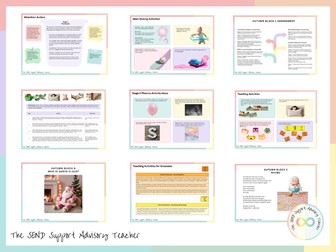
This is the first unit of my English planning. It is intended to support staff working children with high and complex support needs in mainstream schools. It can be delivered to an individual or a small group of learners by a teacher or an LSA.
Free sample of English/Literacy planning https://www.tes.com/teaching-resource/-13241635
The activities are motivating and attention grabbing. The first two blocks are based on the principles of Attention Autism to build the required attention to focus on the activities. Timings are not included, spend as long on a block as you feel your learner needs and revisit if necessary.
At the end of each of the 6 blocks you will find assessment objectives linked to my Special Needs Skills Ranges and Objectives for Assessment https://www.tes.com/teaching-resource/special-needs-skills-ranges-and-objectives-for-assessment-13234289
All printable resources such as symbols and ALD’s (Aided Language Displays) are included.
A tool used to track the PSHE Curriculum, across Key Stage 3 and Key Stage 4.
This can be used as a checklist, or sequencing document, for any PSHE or SLT leader, who needs to track the PSHE (RSE/Health 2025, British Values and Statutory Citizenship) curriculum against the statutory expectations. This includes all content from the new 2025 PSHE guidance, ready for 2026 delivery.
You can edit this document, to suit your school model. I personally will be adding into the boxes, the hyperlink for each lesson where the content is delivered. I will also be adding a further column on the right, for Cross-curricular links (where PSHE content is being delivered outside of the PSHE curriculum time e.g. Science lessons), when I have met with all middle leaders. You may also want to add onto the document, assemblies.
If you find this useful, please review.
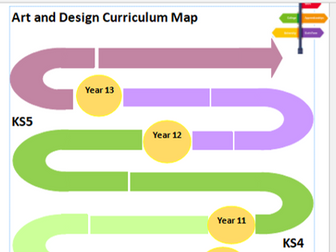
Editable KS3-KS5 curriculum road map for Head of Departments/Subject Leaders to edit and adapt to suit your curriculum needs.
Visual tool to assist in providing clear subject progression. Helpful for use with SLT, students and parents.
Can be printed and used in planning meetings, for department/classroom displays, on websites, or within departments.
Includes indicators for Y7-Y13.
Download includes PDF and PowerPoint versions.
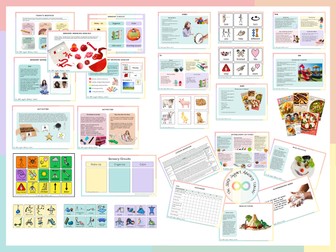
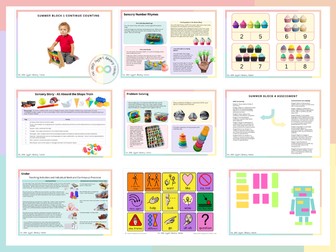
A bundle of ten of my planning and assessment resources to support the delivery of a sensory curriculum for learners with high / complex support needs who are still developing joint attention skills.
Saves planning time for teachers and SENCo’s and can be delivered by a teacher or LSA / TA to a small group or an individual.
Includes:
Complex and Sensory Support Needs - Skills Ranges and Objectives for Assessment*
Foundational Maths Skills
An Introduction to Sensory Stories
Core Word Activities
Morning Hello Session
Sensory Rhymes
Sensory Food Play
Open Ended Activities for Engagement- Sensory Exploration Curriculum Pathway
Snack Time With a Communication Focus - Sensory Exploration Curriculum Pathway
Independent Exploration
Sensory Circuits Activity Choosing Board
A PowerPoint with starters suitable for KS2.
Starters based on riddles, maths and English questions. Number, logic, problem solving, grammar questions.
Based on the New Curriculum.
These can be used daily during registration or as starters before lessons.
These can be worked out independently or in groups and require challenging and critical thinking.
In PowerPoint so you can easily adapt if differentiation is required.
Extra riddles included at the end of the PowerPoint,
If you need any assistance my email is included in the last slide of the PowerPoint.
See my shop for more resources
https://www.tes.com/teaching-resources/shop/TopmarksEd
My three planning units for both Maths and English covering lessons for the autumn, spring and summer terms. All activities are motivating and based on an attention grabbing sensory curriculum.
Activities can be carried out in a group or an an individual basis by a teacher or an LSA. Assessment pages are included at the end of each individual block, linking to my Skills Ranges and Objectives Assessment Tool. Each unit contains printable resources.
Free sample of English/Literacy planning https://www.tes.com/teaching-resource/-13241635
This is an overview of the Year 1 National Curriculum objectives that could be taught through direct teaching or in continuous provision. HIghlighted in red are some suggestions of how the objectives could be taught in CP- easily adaptable for your setting and the areas you can provide.
This document has been created to show the NC Year 2 Objectives that can be met through direct teaching and ones that can be met within areas of Continuous Provision. I have written suggestions of how these may be met in CP too- these can be edited easily by yourselves for your setting.
Electrical Fundamentals Level I course will provide a basic knowledge of the fundamentals of electricity and electrical engineering. The course contains such subjects as: Electron theory, static electricity and conduction, generation and sources of electricity. It also includes engineering mathematics, and power. In order to facilitate this, students will be engaged in a multitude of practical tasks which will reinforce the classroom based theory work. In addition, a variety of electrical laws are studied and applied to the various aircraft systems to calculate power, voltage, resistance and current.
Furthermore, an aviation workshop is used to conduct most lessons. The workshop environment and equipment provides the opportunity and necessary foundation for students to become involved in authentic activities and equipment used in the aviation field. Assessment takes place ‘on the job’, or ‘off the job’ or can be a combination of both. Where assessment occurs off the job, an appropriate simulation is used where the range of conditions reflect realistic workplace situations. Competency will be demonstrated by students working either alone or as part of a team and the assessment environment helps to further reinforce the typical aviation workplace and is an ideal start to a career in aviation.
The learner will be able to:
• Discuss the sources of DC Voltage.
• Recognize the Effects of an Electric Current and Resistance Technology
• Investigate Kirchoff’s Current and voltage laws and perform resistance network measurements.
• Recognize the very important effects and uses of magnetism and electromagnetism in electrical field.
• Recognize the basic constructions and applications of a Capacitor
• Discuss the types of lighting technologies used on aircraft.
This is a PowerPoint slideshow that covers the 'Waves' topic from the new 2014 KS3 curriculum. It covers water waves, transverse and longitudinal waves, frequencies and speed of sound, auditory ranges, pressure waves, light waves, reflection and refraction, diffuse scattering and specular reflection, ray diagrams, pinhole cameras, how the eye works and colours of light.
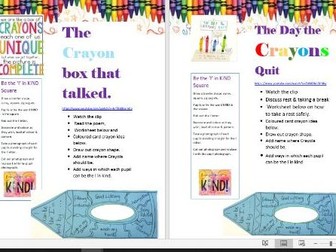
An art activity linked to outside Youtube animation readings from two different books.
The Crayon Box that talked & The day the Crayons quit.
Great as part of recovery curriculum & leads to good classroom display.
Templates and links all included.
A curriculum Map to enable administration and planning for an English Year 9 class it includes Reading, Writing and Speaking and Listening aspects of the curriculum.


 Quick View