ECT Journal
Organised into - Weekly planner, Mentor Meetings, Lesson observation feedback, Observing others and CPD session notes.
Mentor Meetings page is broken down into, “what went well this week”, “reflection on the week”, “next steps”
The journal allows ECTs to organise their learning journey.
Designed to elevate classroom practices, this 40-minute session offers valuable strategies and real-world examples to optimize teaching methodologies. Perfect for Continuing Professional Development (CPD) or Early Career Teacher (ECT) training, our resource provides a succinct background overview along with actionable insights to support diverse learners.
The session is designed as engaging and interactive. The slides are not overloaded with information. Notes are provided where further explanation might be needed for the presented. It’s the perfect concise presentation. I received great feedback following this session.
Starting your first teaching job can feel overwhelming. University prepares you to teach lessons, but many of the practical realities of the classroom are learned the hard way. Nobody Told Me… bridges that gap, giving Early Career Teachers the practical knowledge, routines and confidence they need to start September successfully.
Whether you’re preparing independently over the summer or delivering induction training as a school or trust, this complete CPD programme provides a structured roadmap through the first year of teaching.
This resource includes four fully integrated components:
• a ten module self-study guide
• a 27-slide presentation
• a comprehensive participant workbook with reflection activities, planning tools and action points
• 11 bonus resources linked to the modules
It can be used independently by an individual ECT working through it in their own time, or delivered as a guided CPD session by a school, trust, or teacher training provider.
What the ten modules cover:
1. What actually matters in your first year (and what doesn’t)
2. How to build curriculum knowledge before creating a single resource
3. What to find out about your school before September
4. Setting up a classroom that supports behaviour and belonging
5. Establishing routines in the first six weeks
6. Writing behaviour scripts so you always know what to say
7. Lesson planning that is sustainable, not exhausting
8. Building positive relationships with parents
9. Building professional relationships with colleagues
10. Protecting yourself from burnout from day one
Developed from extensive classroom and leadership experience, this programme focuses on the practical elements that make the greatest difference during an ECT’s first year: curriculum knowledge, classroom routines, behaviour, and professional organisation.
Tailored for primary school ECTs. Ideal for use during the summer term, over the summer holidays, or as part of an NQT/ECT induction programme.
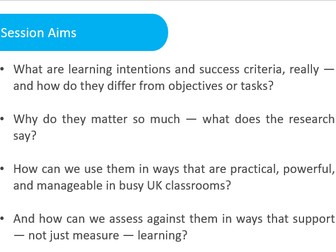
A practical, research-informed CPD session exploring how learning intentions and success criteria can improve clarity, challenge, and student outcomes — without becoming a tick-box exercise. Originally presented at ResearchEd Kent, this session examines the difference between purposeful lesson design and performative classroom routines, helping teachers rethink how success is communicated in the classroom.
Inside this resource you’ll find:
Full conference presentation slides
Research-informed discussion points
Practical classroom examples
Strategies for improving student understanding of success
Reflection prompts for departments or whole-school CPD
Ideal for:
Teachers across all key stages
Instructional coaches and middle leaders
Whole-school CPD sessions
ECT and teacher development programmes
The session challenges common misconceptions around learning objectives while offering realistic, classroom-ready approaches grounded in evidence and day-to-day teaching practice.
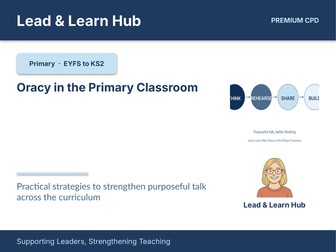
A complete primary oracy CPD pack helping teachers strengthen purposeful classroom talk, pupil participation and curriculum learning across EYFS to KS2.
This ready-to-deliver professional development pack supports primary teachers and school leaders to develop oracy in a practical, purposeful and manageable way.
The training focuses on helping pupils think, explain, listen and communicate more effectively through well-structured classroom talk. It moves beyond simply giving pupils more opportunities to speak and instead explores how teachers can design talk with a clear learning purpose.
The session includes practical strategies for:
giving classroom talk a clear purpose
teaching the behaviours of effective speaking and listening
increasing participation beyond the quickest or most confident pupils
giving pupils time to think and rehearse before responding
helping pupils build on, clarify and challenge ideas
supporting curriculum vocabulary and increasingly precise language
using sentence stems without permanently scripting pupil responses
gradually reducing talk scaffolds as pupils become more confident
embedding purposeful talk across the primary curriculum
avoiding common problems such as unstructured discussion, the same pupils dominating and talk becoming disconnected from learning
The CPD includes examples and activities suitable for EYFS, KS1 and KS2, with applications across reading, writing, maths, science, history, geography and wider curriculum learning.
The complete pack includes:
editable 26-slide PowerPoint presentation
detailed Full Presenter Guide
Presenter Quick Guide
Staff Workbook
Oracy Quick Reference
Talk or Learning? starter activity
Purposeful Talk Planner
Turn a Question into a Discussion activity
Build On, Clarify, Challenge resource
Who Gets to Speak? reflection tool
Sentence Stem: Support or Script? activity
Talk Across the Curriculum Strategy Bank
Oracy Classroom Audit
7-Day Talk Plan
Evaluation Form
Certificate of Completion
The main session is designed for approximately 90 minutes, with a shorter 60-minute delivery pathway also provided.
This makes the resource suitable for:
whole-school CPD
INSET
staff meetings
phase meetings
teaching and learning development
ECT development
leadership-led professional learning
The materials are editable so schools can adapt them to their own context and priorities.
The approach is practical, evidence-informed and designed specifically for primary classrooms.
Suitable for EYFS, KS1 and KS2.
Lead & Learn Hub
Supporting Leaders, Strengthening Teaching
Keywords: oracy, primary oracy, oracy CPD, primary CPD, classroom talk, purposeful talk, speaking and listening, pupil discussion, classroom discussion, teacher CPD, staff training, INSET, EYFS, KS1, KS2
Ideal for intensive, expert CPD sessions on literacy and oracy across the curriculum for trainees, ECTs, and experienced members of staff!
What is literacy?
What is oracy?
Links to the teaching standards
The importance of reading and literacy
What does the research say?
EEF findings
Tiers 1-3 vocabulary and explicitly vocabulary teaching
Modelling and scaffolding literacy (with examples)
What does Alex Quigley say?
The importance of oracy
Using Talking Points and explicit oracy strategies
Personal inquiry classroom intervention results and impact
Printable PDF Planner for ECT Teachers. Includes September overview page, weekly overview planner page, weekly CPD/Briefing notes page, ECT Training page, a page to jot down things to plan, print, ask and organise and lastly, a page for a weekly check in. Print and reprint as many pages of notes you want - this way you are not limited to 1 page for notes! Message for more monthly overview pages.
This is a whole staff CPD focused on the theme of positive and assertive language. It took around 45 minutes but could have been the whole hour if we had time. The PowerPoint includes:
What does assertive / positive mean?
Definition of positive language
Definition of assertiveness
How to use assertive language
Examples of assertive language
Hallmarks of being assertive / positive
Techniques and strategies
Group task based around the theme
Role play
Everyone really enjoyed the session and took away useful tips for the classroom. ECTs have also had this session and said it was very useful!
This is a CPD session focused on the theme of de-escalation. It took around 45 minutes, but could have taken the whole hour if we had the time. The PowerPoint is 15 slides including:
What is de-escalation?
A definition of de-escalation
Stages of escalation
De-escalation strategies
De-escalation strategies if things have escalated
Reframing language including examples
Reflecting on reframing language
Role playing
This has been tried and tested and works really well, year on year. ECTs really enjoyed this session too!
I have put together a CPD session on how to create impactful seating plans. This CPD is perfect for trainees, ECTs and those that are struggling with getting it right in their classroom. This PPT includes:
The importance of a seating plan
Different types of seating plan
Advantages and Disadvantages of different seating arrangements
How to use seating plans to help with tackling poor behaviour
How to use seating plans to help develop student progress
The importance of seating plans in supporting PP/SEN students
Practical ways of implementing seating plans
I hope this helps you to structure your classrooms, reduce disruptive behaviour, make the best use of your TA and promote progress in your classrooms.
A ready-to-deliver staff CPD presentation exploring why vocabulary matters and what teachers can do to develop it.
This 25 slide Vocabulary Development CPD presentation is designed to support primary teachers in reflecting on the importance of vocabulary and developing practical approaches that can be embedded across everyday classroom practice.
The presentation begins by exploring the relationship between vocabulary, language development and educational outcomes, prompting staff to consider how differences in children’s opportunities to encounter and use language can affect their learning. The session then moves from “Why does vocabulary matter?” to “What are we going to do about it?”, giving staff practical strategies they can discuss, adapt and implement within their own classrooms.
Ideal for:Primary CPD
Staff Meetings
English Subject Leadership
Vocabulary Development
Oracy
Reading & Writing
Talk for Writing
Closing the Vocabulary Gap
ECT Development
Whole-School English Improvement
A practical CPD resource that combines the rationale for prioritising vocabulary with achievable classroom strategies teachers can begin using straight away.
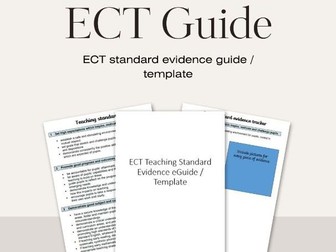
Are you an Early Career Teacher (ECT) looking to stay organised and confidently showcase your progress? Our comprehensive ECT Standards Evidence eGuide and Template is designed specifically for you! This resource provides clear examples and tips on gathering and presenting evidence aligned with teaching standards.
You’ll get:
Structured Template: Easily track and organise your evidence with our ready-made template.
Detailed Examples: Discover what types of evidence to include for each standard, such as classroom setups, lesson plans, observation feedback, and pupil progress.
Visual Guidance: Learn how to use pictures and color coding effectively to present your evidence clearly.
Proven Strategies: Find practical advice on gathering evidence from real-life scenarios—like parent feedback, behavior tracking, and CPD activities.
This guide is your go-to companion to make your ECT journey smoother, ensuring you’re prepared when it’s time to demonstrate your growth and meet the required teaching standards.
Includes some useful documents for ECTs and/or ECT mentors/tutors to track.
Including:
CPD tracker
ECT programme planner (plans out ECT time, weekly tutor/mentor meeting plan, actions for ECt and/or mentor, and CPD)
ECT target setting document to be used half termly/termly dependent on school policy
Blank meeting minutes document for mentor/tutor and ECT meetings.
All document templates that are editable.
Adaptive Teaching for Mainstream Schools
A ready-to-use professional development presentation for schools exploring adaptive teaching and SEND within the mainstream classroom.
The presentation begins with the SEND Code of Practice and the relationship between high-quality teaching and special educational provision before moving into practical approaches teachers can use within everyday classroom practice, using the EEF 5 a day SEND Recommendations.
The presentation covers
The SEND Code of Practice and the definition of special educational provision
The importance of making high-quality teaching ordinarily available to pupils
What adaptive teaching means in practice
Taking account of prior knowledge, skills, barriers and misconceptions
Flexible grouping
Cognitive and metacognitive strategies
Explicit instruction
Effective use of technology
Scaffolding
Practical classroom examples for each approach
Questions for staff and whole-school reflection.
Examples include temporary and purposeful grouping, pre-teaching vocabulary, chunking tasks, checklists and prompts, worked examples, teacher modelling, visualisers, writing frames, knowledge organisers and strategies for supporting classroom routines.
The final section provides reflection questions that can be used to support professional discussion about whether adaptive teaching is understood and used consistently across a school.
Suitable for
Whole-school staff meetings
SEND CPD
SENCO-led professional development
Teacher development
ECT development
Teaching assistant development
Inclusion-focused training
Mainstream primary and secondary schools.
The presentation can be used as a complete staff-development session or adapted by the SENCO or school leader to suit the context of their school.
13-slide editable PowerPoint presentation.
Created by Ordinary Classrooms Educational Consultancy
Effective Teaching Strategies: A CPD Toolkit for Schools and Educators
Looking to answer questions like “What is effective teaching?”, “Why is teaching important?”, or “How can teaching be improved?” This CPD bundle is your complete, research-informed training solution for whole-school development.
Designed for teachers, senior leaders, and instructional coaches, this toolkit explores the difference between teaching and learning, how teaching can be improved, and the strategies that define high-quality instruction. With real-world application and evidence-based methods, it supports both new and experienced educators in boosting classroom impact.
Whether you’re planning a CPD session, staff INSET day, or instructional coaching programme, this bundle saves you time and ensures your training is rooted in the latest research and most asked teaching questions.
Frequently Asked Questions (FAQs)
What are effective teaching strategies?
Effective teaching strategies are evidence-based methods that enhance student understanding, engagement, and outcomes. This toolkit includes six core strategies such as retrieval practice, modelling, scaffolding, and feedback techniques – all supported by research from Rosenshine, Wiliam, and the EEF.
Who is this CPD toolkit for?
This resource is designed for classroom teachers, middle leaders, senior leaders, and CPD coordinators who want to improve teaching practice, support staff development, and lead whole-school training sessions.
How can this CPD toolkit improve teaching?
By providing structured, research-informed content, practical planning templates, and ready-to-use reflection tools, the toolkit helps educators translate theory into action. It encourages critical thinking, self-audit, and strategic planning for classroom delivery.
4 Can this resource be used for teacher induction or NPQ support?
Yes. The toolkit aligns well with National Professional Qualification (NPQ) frameworks and teacher standards. It’s suitable for mentoring, coaching, early career teacher (ECT) induction, or as a foundation for more advanced leadership development.
Is this resource suitable for international schools?
Absolutely. Although aligned to UK frameworks, the principles of effective teaching in this toolkit are universal and easily adaptable for international or bilingual education settings.
Is this a printable or digital-only resource?
The resource is fully digital (editable in PowerPoint, Word, or Google formats) and includes printable PDFs for classroom display and in-person CPD delivery.
NOT for redistribution
Supporting Students with ADHD: A Practical Teacher Toolkit (Editable SEND Resource)
This professionally designed ADHD Teacher Toolkit is an essential resource for any primary or secondary educator seeking practical, inclusive strategies to support learners with ADHD in the classroom. Created by a SEND-aware practitioner, this resource offers evidence-informed approaches tailored to both Key Stage 1–4 students.
Whether you’re preparing for Ofsted, developing inclusive provision, or delivering CPD, this resource is fully editable and ready to use immediately.
What’s Included:
Clear explanation of ADHD: Understand types, traits, and common myths
In-school impact guidance: Practical examples for both primary and secondary settings
Quick-reference teacher strategies: Straightforward tools you can implement tomorrow
Daily support tools: Editable planners, visual timetables, fidget-friendly lists, movement breaks
ADHD pupil passport template: Customisable to support EHCPs and pupil profiles
Home–school collaboration tips: Improve communication and reduce homework stress
Real-life case studies: Two detailed examples showing effective support in action
Group CPD discussion slide: Ready-made questions for training or SEND team meetings
Further reading list: Signposting to trusted ADHD resources and support
Who Is This For?
Class teachers (KS1–KS4)
SENDCos and inclusion leads
Teaching assistants
Senior leaders preparing for Ofsted
ECTs seeking behaviour and SEND guidance
Why It Sells:
Fully editable to suit your context
Clear, concise layout — ideal for CPD or staffrooms
Ofsted- and EHCP-ready content
Supports your whole-school approach to SEND inclusion
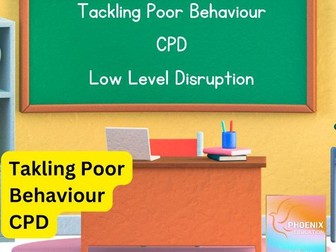
I have put together a CPD PowerPoint and Help Sheet that you can use in your teams to help staff with tackling Low Level Disruption and poor behaviour. This includes what different types of Low Level Disruption are, from experience why this happens, strategies to use to de-escalate and how to move forward from these issues.
I have also included a handy step by step help sheet that provides example strategies to use in the classroom when poor behaviour presents itself and what the next steps can be to resolve them. This may help a trainee or ECT too.
Enjoy!
A PowerPoint for CPD for art departments wanting to further link literacy into art. A look over how to include ideas around how art uses reading as a tool and how to incorperate this into 39 weeks of planning each year.
Ideally for Heads of Department or Literacy leads using the information to further enhance planning in ECT or early stage career staff.
Free CPD guide for Early Career Teachers | Surviving your first week in teaching | ECT self-study resource
A free, practical guide from the Nobody Told Me… series to help newly qualified teachers prepare for and survive their first week in the classroom - covering systems, relationships and wellbeing in three short modules.
Written by experienced teachers with over twenty years of classroom practice.
What the three modules cover:
Module 1: The practical things that save you time. How to prioritise systems over content, avoid over-preparation, and keep your first lessons simple, clear and effective.
Module 2: The relationships that make the week easier. Meet colleagues, build the right classroom dynamic from day one, and ask for help before you need it.
Module 3: Looking after yourself through the week. How to protect your evenings and build a habit of noticing what went well.
This resource is completely free and intended to be shared. Print it, pass it on to colleagues, or use it as part of your school’s ECT induction - the only conditions are that it is shared complete, unmodified, and with Highlight Teaching’s branding intact.
Suitable for all primary ECTs. A standalone resource that works equally well on its own or as a companion to the wider Nobody Told Me… CPD series.
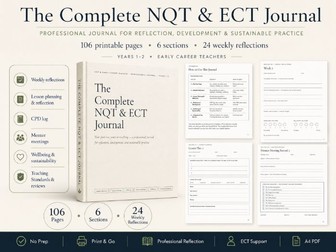
Support new teachers through their first two years in the classroom with this complete printable NQT & ECT professional journal.
This structured journal is designed for early career teachers and includes reflection pages, weekly check-ins, lesson planning templates, post-lesson reflections, CPD records, observation notes, mentor meeting records, professional targets, wellbeing pages and Teaching Standards review tools.
The journal can be used throughout the school year for induction, mentoring, professional development, lesson reflection, workload awareness and sustainable teaching practice.
The journal includes 6 structured sections:
The First Days
Weekly Reflections
Lesson Planning & Reflection
Professional Development
Wellbeing & Sustainability
Progress & Year Review
What’s included:
106 printable pages
24 weekly reflection pages
8 lesson plan templates
8 post-lesson reflection pages
CPD log pages
Observation notes
Mentor meeting records
Professional target pages
Key contacts page
Classroom setup checklist
Induction checklist
Timetable and room planner
Year groups and classes overview
Teacher values reflection
Strengths and development areas
Workload and wellbeing check-ins
Teacher stress and boundaries pages
Monthly wellbeing check-ins
Support network pages
Teaching Standards self-assessment
Half-term review pages
Term review pages
End of year one reflection
Year two goal setting pages
Additional meeting and notes pages
Perfect for:
NQT teachers
ECT teachers
Early career teachers
Teacher induction
Mentor meetings
Professional development
CPD evidence
Lesson reflection
Teaching Standards evidence
School-based mentoring
ITT/NQT/ECT support
Teacher wellbeing
Workload reflection
New teacher organisation
Skills and areas supported:
Professional reflection
Lesson planning
Post-lesson evaluation
CPD tracking
Mentor meeting preparation
Teaching Standards review
Target setting
Classroom organisation
Workload awareness
Wellbeing and sustainability
Professional confidence
Year one and year two development
Format:
Printable PDF
106 pages
6 structured sections
A4 size
Black-and-white interior
Print-and-go
No preparation required
Instant download
Effective Scaffolding Made Simple – Primary Teacher CPD Toolkit
Transform your teaching and training with practical scaffolding strategies
you can apply tomorrow.
What’s Included
This CPD pack gives you everything you need to develop effective scaffolding strategies in your classroom — or across your whole school.
Scaffolding Made Simple – A Teacher’s Guide (PDF) – A clear and practical introduction to scaffolding, perfect for busy teachers.
Scaffolding Strategies for Effective Teaching (PowerPoint) – Ready-to-use training slides for staff meetings, INSET, or CPD workshops.
Scaffolding Strategies FAQs (PDF) – Answers to the most common questions about scaffolding, ideal as a handout.
Why It’s Teacher-Friendly
✔ Practical & ready-to-use – No extra preparation needed.
✔ Evidence-informed – Based on proven approaches to scaffolding in primary classrooms.
✔ Flexible – Perfect for individual teachers, phase leaders, or whole-school training.
✔ Time-saving – Strategies are explained simply, with clear examples.
How It Can Be Used
Staff meetings or INSET days
CPD workshops and coaching sessions
Teacher self-study or professional reflection
Classroom planning support
Who It’s For
Primary teachers (KS1–KS2)
NQTs / ECTs looking for practical support
Phase leaders or CPD leads running training sessions
Pricing & Licence
This resource is free for whole-school use – once downloaded, all teachers at your school may use it as it can be easily copied and distributed among all teachers and support staff.


 Quick View