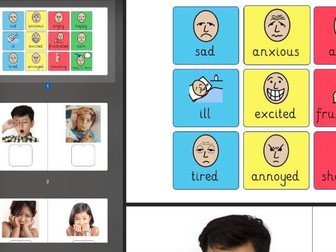
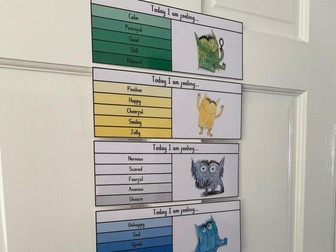
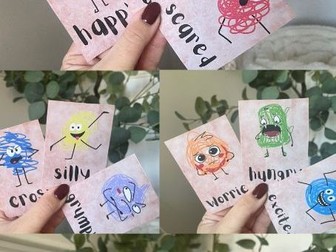
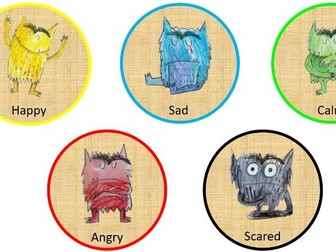
This resource includes images for the colour monster story using real images from the story itself. The resource includes images of ‘happy, sad, calm, angry, scared, love and confused.’ This resource could be used to retell the story, to discuss emotions and feelings or in a calm corner or tinker box. Great for SEN children in particular. This resource just needs to be printed and laminated for longevity. They could also then be hole punched to hang up in your classroom or home too.
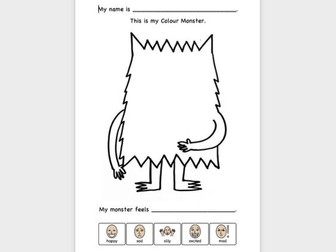
Useful worksheet to accompany the ‘Colour Monster’ story. Children can practise name writing and recognising and discussing feelings.
Useful for back to school or discussing emotions. Supports non-verbal children to express how they feel.
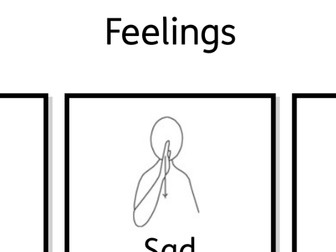
This is a handy resource with 12 Makaton signs about feelings on a A4 sheet.
The signs include:
Sad
Happy
Scared
Tired
Angry
Excited
Worried
Ill
Cold
Hot
Hungry
Thirsty
Please check out my other Makaton resources to learn more Makaton signs, all on one side of A4 for easy reading.
Please leave me a review, if you like my resources. If there is a resource you would find particular helpful please let me know and I can make it.
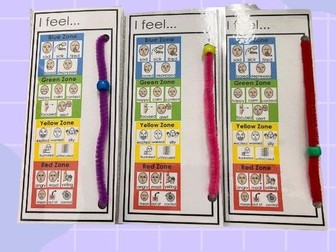
This hands-on activity helps children explore their main feelings while learning about the “zones of regulation.” Learners cut out different emotion cards and match them to the correct zone—such as calm, happy, worried, or angry—before sticking or attaching them with Velcro to a visual chart. The interactive format encourages discussion about how emotions feel in the body and what zone they belong to, supporting emotional awareness and self-regulation skills. By physically sorting and placing each feeling, children build a clearer understanding of how their emotions can change and what strategies might help them move between zones.
Print, Cut, Laminate, Hole Punch and thread a bead on to a pipe cleaner. Tie at the back. Children use this to share their zone to help talk about their current emotion.
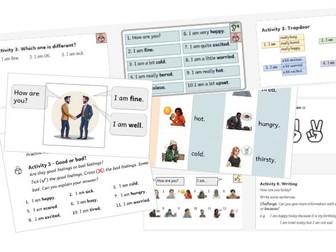
2 linked lessons on describing feelings and emotions for emerging Entry 1 / A1 ESOL / ESL / EFL students.
Lesson 1 covers adjectives to describe feelings.
Lesson 2 covers the intensifiers very, really, quite, a bit, a little
Each lesson features a 2 page worksheet and an accompanying PowerPoint which includes additional speaking & listening activities.
All activities are explained in the Speaker Notes.
A reference Sentence Builder is also included.
The resources are intended to be used flexibly, choosing the activities which are most useful and relevant to your students.
Suitable for classroom use. Students could work through the worksheets independently, but some activities need a partner.
Depending on the level of the students and which of the activities you choose to use, these resources provide approximately up to 2 hours of learning.
Many activities are taken from Gianfranco Conti’s EPI approach.
The specific feelings featured and recycled throughout the lesson are:
hot; cold; fine; well; happy; sad; tired; bored; hungry; thirsty; busy; worried; scared; anxious; excited; upset; ill; sick.
These seven colour monster inspired feeling cards are a great way to assess how the children are feeling throughout the day. It is another great way of getting children to use synonyms for words such as ‘happy’ or ‘sad’. There are seven characters available - can either peg children’s names on or put them in a jar etc.
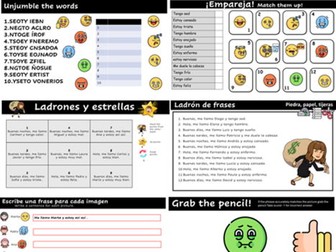
This resource is to talk about feelings in Spanish. It has different Conti approach activities and games. IT IS EDITABLE:
Vocabulary
Where is the button? game
What is missing? Game
match the word with the picture
Which is the correct spelling?
Write the words
Unjumble the words
Vocabulary
Splat
Read my mind
Beat the teacher
Sentence stealer
Sentence bingo
Find the treasure (speaking game)
Stars and stealers (game)
Grab the pencil (game)
Sentence race (mini whiteboard game)
Write the sentences following the pictures
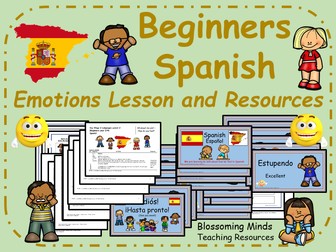
This is a plan and resources for a beginner’s Spanish lesson to use with KS2. It would be perfect to use as a second Spanish lesson, after children have learnt to say hello. The focus in this lesson is how to ask ‘how are you’ and reply.
The plan gives details of a starter, how to teach the ‘feelings’ vocabulary, a speaking and listening activity, paired game, reading/writing activity and plenary discussion. It is highly interactive and allows children to practise a range of language skills.
All the resources needed for the lesson are included in the price. They are in a zip file. These are:
The 4 page PDF Lesson plan
A 21 Slide animated PowerPoint presentation (This is not editable. Click the ‘Read Only’ button in the centre of the page to open it. Some of the images only appear when the PowerPoint is played as a slideshow.)
5 PDF pages of resources for the speaking activity
2 PDF pages for the paired game
3 PDF pages for the Reading/Writing activity. There is a colour and black & white version of the worksheet and an answers sheet.
No further preparation needed.
This is lesson 2 of Unit 1 Spanish designed by Blossoming Minds.
Unit 1 Spanish Greetings and Introductions Bundle is available here:
https://www.tes.com/teaching-resource/resource-11651388
Unit 2 Spanish All About Me 5 lesson bundle is available here:
https://www.tes.com/teaching-resource/resource-11706377
Units 1 and 2 are available here:
https://www.tes.com/teaching-resource/spanish-lesson-bundle-1-term-beginners-11710541
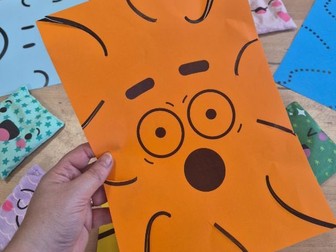
How do you feel? Editable check in worksheet using the Inside Out characters.
Children can label the emotion they are feeling and have an option to share any addition worries.
There is also an option for children to request a follow up from an adult.
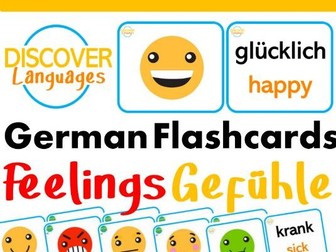
German flash cards for learning feelings and emotions to answer “Wie gehts?” - Perfect for games, matching activities, display in the classroom, or for self-study!
This PDF document contains 18 A4 pages of picture flashcards to print. Each page contains 6 square images. This PDF document includes:
Double-sided version with the picture, German word and English
Double-sided version with the pictures and German only
Single-sided version with the German word under the picture on the same image
English and German words only version, without pictures
Topic: Feelings and Emotions / How are you?
Vocabulary included:
gut - well
glücklich - happy
night gut - not good
wütend - angry
traurig - sad
müde - tired
krank - sick
aufgeregt - excited
verängstigt - scared
so und so - so-so
verwirrt - confused
überrascht - surprised
beschämt - embarrassed
unangenehm - uncomfortable
gelangweilt - bored
Can be printed on card or paper. By folding each sheet down the vertical center before laminating, you can create double-sided cards to review. Alternatively, images can be used separately, for matching activities, noticeboard displays etc.
German Animal Flashcards available here:
https://www.tes.com/teaching-resource/german-picture-flash-cards-animals-tiere-12708047
German / English Beginner Flashcard Set - 100+ cards
https://www.tes.com/teaching-resource/german-english-flashcards-10-topics-for-beginners-12597848
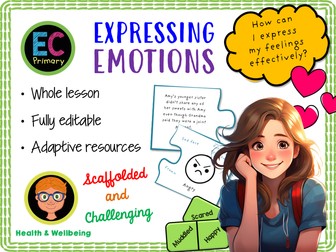
Emotions + Feelings KS2 Primary PSHE
1-2 hour, very detailed, fully resourced PSHE lesson suitable for KS2 which allows students to explore the different ways we express our feelings, how we can decipher different emotions and how we can express them using varied vocabulary. Created to fit the new DfE and PSHE Association statutory 2020 guidelines.
The lesson has been left editable and is filled with engaging, well differentiated and fun activities. It is designed to be ‘no prep’, so you can just pick it up and use it, although it is still adaptable should you wish to.
Who are EC Resources?
EC Resources are the top TES PSHE providers and are a group of teachers who work together to create easy to use, high quality and editable lessons and units of work. We have created lessons for The bank of England, The Children’s Commissioner, The Bank of England, MACS Charity, Tes, LikeToBe Careers, the Criminal Cases Review Commission (UK Gov) and have also completed PSHE and Citizenship commissions for schools across the UK.
You can contact us at info@ecpublishing.co.uk
Teaching PSHE, RE or Citizenship GCSE next year? Why not join our Citizenship and PSHE teachers Facebook group, with 7000 other teachers, for guidance, advice and resource sharing.
*Licenced to use, produce and sell resources using Boardmaker symbols.
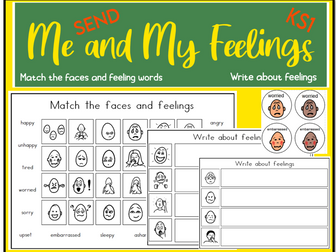
A resource designed with SEND pupils in mind that works well too, for KS1 children.
Links to PSHE, Me, Ourselves, Emotions, Anti - Bullying week, Behaviour Management, Communication, as well as speaking and listening, reading and writing.
Sheet 1 shows 24 colour pictures with emotion words written above.
Sheet 2 shows 24 black and white pictures with words around it. Pupils can identify the facial expressions and find the correct matching words. There is more than one option for this e.g. glad and happy might apply equally well to the same picture.
Sheets 3 -8, each show 4 black and white pictures and children can write a word, phrase or sentence to describe the feelings or emotions.
This is a pre-intermediate (CEFR B1, IELTS 5.0) EFL Speaking class about feelings. Students begin the lesson by reading four sentences and describing how they would feel in each situation. Students then look at six images, each of which shows a feeling (lonely, bored, stressed, shy, proud, confident). The pronunciation and form of each word is then drilled. Students then read a short text about a girl called Danielle and her first day at a new job. Students use the target language by confirming their understanding of the text. Two free discussion activities are then completed.
This is an advanced (CEFR C1, IELTS 7.0) EFL Speaking class about feelings. Students begin the class by reading four situations and discussing how they would feel in each. Next, target language (petrified, livid, dejected, invigorated, indifferent, suspicious) is introduced using photographs of people. Students then match the new vocabulary to a more basic definition. Students then drill the pronunciation and form of the target language. Next, students discuss what makes them feel of each the new words with a partner. After that, students match the target language to a basic synonym e.g. livid - angry. A reading article about the Buy Nothing movement, emphasis on the feeling of indifference, is introduced using pictures. Students then read the article and discuss the ideas in the text. Finally, students end the class by discussing the last time they felt each of the newly-learned emotions.


 Quick View