Lessons are arranged in the order of the specification:
3.1 Introduction to Globalisation and Development
3.2 Key Players and Organisations in Globalisation
3.3 The Role of TNCs and Those Switched Off
3.4 Costs and Benefits of Globalisation Deindustrialisation
3.5 Global Economic Migration
3.6 Cultural Diffusion and Anti-Globalisation
3.7 Data in Globalisation
3.8 Controlling and Managing Globalisation
3.9 Localism and Ethical Consumption
Comprehensive examination of the increasingly complex and interdependent world in which we are living.
This is the first of a series of lessons from The Knowledge House that links to Chapter 2 of the new Edexcel specification on Global Politics - The state and globalisation.
This introductory lesson to globalisation introduces students to key terms, developments and factors in the development of the nation-state and in the processes of globalisation.
This is done in an engaging and student-friendly manner, with interactive worksheets and an accompanying PPT that guides both teacher and student through the content.
There are two examination questions that come with this lesson.
Please email info@theknowledgehouse.co.uk if you have any questions or queries about these resources.
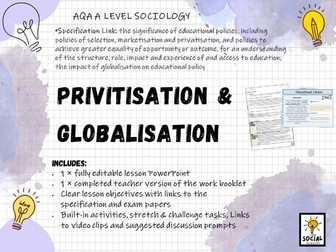
Topic: Education
Specification link: the significance of educational policies, including policies of selection, marketisation and privatisation, and policies to achieve greater equality of opportunity or outcome, for an understanding of the structure, role, impact and experience of and access to education; the impact of globalisation on educational policy
Focus: Privitisation and Globalisation
What’s included:
• 1 × fully editable lesson PowerPoint
• 1 × student work booklet (fillable during lessons)
• 1 × completed teacher version of the work booklet
• A range of engaging tasks including stretch & challenge for differentiation
• Links to video clips and suggested discussion prompts
• Clear lesson objectives with links to the specification and exam papers
Perfect for AQA A-Level Sociology Paper 1: Education, this resource pack covers Privitisation and Globalisation. It’s ideal for teaching the section on the significance of educational policies, including policies of selection, marketisation and privatisation, and policies to achieve greater equality of opportunity or outcome, for an understanding of the structure, role, impact and experience of and access to education; the impact of globalisation on educational policy. With a detailed PowerPoint, a student workbook, and plenty of built-in activities, this lesson is ready to deliver straight away.
The pack includes one lesson PowerPoint, designed for 60–90 minutes of teaching time depending on the number of activities selected. The lesson features a combination of teacher-led tasks, independent student activities, and video clips, along with embedded stretch and challenge opportunities to support differentiation.
The lesson is designed to run alongside a work booklet, provided in two versions:
• a student copy for learners to complete during lessons
• a completed copy for teacher reference or additional student support
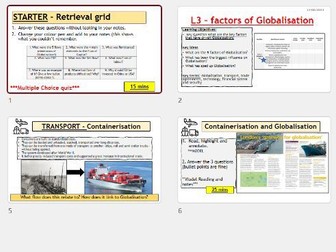
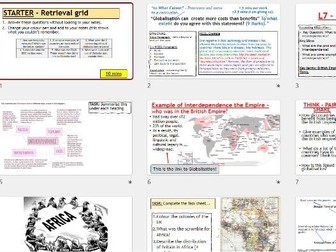
3rd lesson in the SOW looking at the different fators which have influences Globalisation for AQA Globalisation and Global Governance:
KEY IDEA 1.1
Starter - retrieval questions from the previous lesson (L2 Flows/Dimensions of Globalisation).
Addressing the 5 factors - Communication, Security, Financial systens, trade agreements and Transport.
Further detail on Transport using a reading task on containerisation (London Gateway focus).
HOMEWORK - Further reading/research on containerisation.
PowerPoint - Lesson Plans - Worksheets - Modelled work.
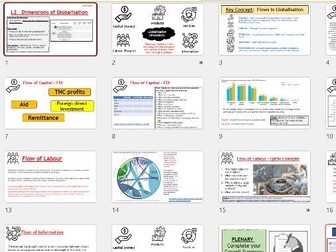
2nd lesson in the SOW on the flows/Dimensions of Globalisation for AQA Globalisation and Global Governance:
KEY IDEA 1.1
Addressing the 5 flows (CLIPS) - Capital, Labour, Information, Products, Services
Adsressing Foriegn Direct investment
HOMEWORK - Further resources on Flow of Labour
PowerPoint - Lesson Plans - Worksheets.
Lesson 6 in the SOW looking at the interdepedence and unequal flows created by Glocalisation and the global shift - Written for the AQA Globalisation and Global Governance Unit:
KEY IDEA 1.2
Starter - Retrieval questions on previous lesson (L5 Positives and negatives of Globalisation).
Exam Q with modelled paragraph following the PEEEL structure.
Example of unequal flows of the British Empire in terms of people, money and ideas.
HOMEWORK - Single product economy work (Building on GCSE case study)
PowerPoint - Worksheets - Lesson - Modelled work.
Complete lesson covering the different players and their role in managing globalisation, with a focus on trade blocs. Lesson was designed for the Edexcel A-level geography globalisation scheme of work but would work well with other specifications. Lesson includes:
Recap Do Now
Explanation of tariffs
Map showing WTO membership
Printable double-sided info sheet on the trade blocs, including pros and cons
Questions for students to complete and mapping activity
Detailed information on ASEAN and the EU trade blocs
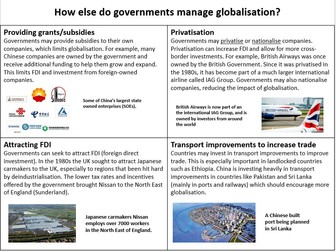
Summary of the other ways governments manage globalisation
12 mark assess question, including model 1st paragraph
This is a lesson on Globalisation and crime.
This lesson consists of four sections;
1.The global criminal economy
2.Global risk consciousness
3.Globalisation, capitalism and crime
4. Patterns of criminal organisation
The lesson time is between 1-2 hours.
Please check the notes section for videos/article links
Activities include;
Mini white-board tasks
Create your own Item task
Exam practice question
Video application tasks
Summary task
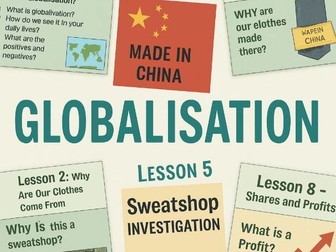
This fully resourced scheme of work explores the complex relationship between globalisation, production chains, and the clothing industry. Designed for KS3 Geography (adaptable for KS4), the pack provides everything you need to teach students about where their clothes come from, the impacts of consumer choices, and the realities of global trade.
What’s Included?
Eight complete, ready-to-teach PowerPoint lessons with engaging activities, case studies, and assessments:
Globalisation Introduction – What is globalisation? Positives and negatives in our daily lives.
Where Our Clothes Come From – Exploring the origins of clothing and mapping global trade links.
Why Are Our Clothes Made in…? – Investigating why production is concentrated in countries like China and Bangladesh.
Sweatshops – Understanding working conditions and ethical concerns in the garment industry.
Sweatshop Investigation – In-depth case study with evidence analysis and critical thinking tasks.
Made in China – Focusing on China’s role in the global clothing industry and its economic impact.
Production Chains – Tracing the journey of a t-shirt from raw material to shop floor.
Shares and Profits – Examining who benefits most from global clothing production.
Learning Objectives & Skills
Define and explain globalisation with real-world examples.
Analyse the geography of production chains and global trade flows.
Explore ethical issues in clothing manufacture, including sweatshops and fair trade.
Develop critical thinking and empathy through case studies (e.g., China, Bangladesh).
Strengthen map, data interpretation, and enquiry skills.
Teaching Features
Engaging starters & plenaries to spark discussion.
Differentiated activities for all ability levels (worksheets, debates, fact files, role-play).
Assessment opportunities built into each lesson.
Cross-curricular links with Economics, Business Studies, and Citizenship.
Encourages reflection on ethical consumerism and students’ own choices.
Perfect For:
KS3 Geography schemes of work.
Adaptation into KS4/GCSE Globalisation units.
Covering cross-curricular PSHE and Citizenship topics.
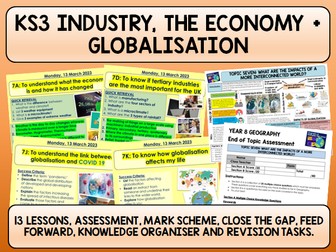
A full series of 13 lessons, assessment, mark scheme, close the gap, feed forward activities and Knowledge organiser and revision tasks.
Lessons:
• 7A. What is the economy?
• 7B. Primary Industries- Farming in the UK
• 7C. Secondary Industries and change
• 7D. Tertiary Industries
• 7E. Quaternary Industries- Humans Needs Not Apply
• 7F. Chocolate Production- From bean to bar
• 7G. Globalisation
• 7H. Advantages and disadvantages of globalisation
• 7I. Impact of fast fashion- The Aral Sea
• 7J. Was globalisation to blame for the spread of COVID 19?
• 7K. How does globalisation affect me?
• 7L. Assessment
• 7M. Assessment Feedback
Knowledge Organiser
Revision Tasks
Full unit of work for Globalisation. This unit explores the why globalisation is happening and its consequences. All lesson are suitable for 50 minutes to 1 hour of teaching time. Includes supporting worksheets for lessons and homeworks - no additional resources are required. Most suitable for KS3.
All lessons have a starter and lesson aim. All PowerPoints in the same signature style.
Lesson sequence:
1 - Globalisation
2 - Where do your clothes come from?
3 - Why are our clothes made in different countries?
4 - What is a sweatshop?
5 - Made in China
6 - Behind the swoosh
7 - Production chains
8 - Fair shares
9 - Mystery cards lesson
10 - TNCs
11 - Is globalisation a good thing?
12 - Coffee documentary
13 - Trade game
14 - Revision
15 - End of unit test
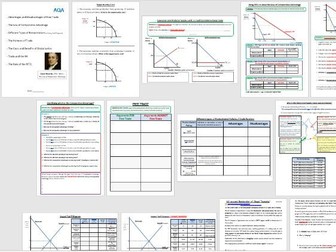
Outstanding Student Work Booklet / Worksheets on the following A-Level Economics topics:
The Law of Comparative Advantage
Costs and Benefits of Free Trade
Protectionism (Tariffs, Quotas, Domestic Subsidies, Import Regulations)
The Patterns of Trade
Globalisation
World Trade Organisation (WTO)
The content is specifically tailored to AQA Students.
Included in the price is a Homework Section, Revision Notes, comprehensive Model Answers section, a list of Key Terms and Definitions, and a list of excellent Video links.
This booklet is of the highest quality! It is aesthetically pleasing, and the tasks are designed to engage and deepen students understanding. Buying this booklet will lead to GREAT LEARNING OUTCOMES and will SAVE YOU HOURS of time!
If you like my work, please follow me for more resources and leave a review!
This 1 hour KS3 lesson introduces the concept of globalisation. Students reflect on why they know so much about celebrities they have never met, can watch sporting events in foreign nations and eat food from around the world.
Check out some of my other products relating to Globalisation:-
What are products and services?
What are producers and consumers?
How has employment structure changed in the UK?
What is globalisation?
What factors have caused globalisation?
Why is Apple such a successful global brand?
How do conflict minerals affect people living in Africa?
Does slavery still exist? (Investigating Apple’s iPhone factories)
If you like my work, please follow me for more resources and leave a review!
This 1 hour KS3 lesson helps pupils to better understand why globalisation occurs. Pupils use images to reflect on why globalisation occurs and engage in a card sort activity, designed to encourage learners to elaborate their ideas! The lesson includes a video link, allowing visual learners to better understand this complex process.
Check out some of my other products relating to Globalisation:-
What are products and services?
What are producers and consumers?
How has employment structure changed in the UK?
What is globalisation?
What factors have caused globalisation?
Why is Apple such a successful global brand?
How do conflict minerals affect people living in Africa?
Does slavery still exist? (Investigating Apple’s iPhone factories)
This bundle introduces students to what globalisation is and how it has impacted countries around the world. Case studies include Nigeria, The UK and The UAE.
A series of short assessment activities with detailed answers aimed at helping pupils with their understanding of the theory surrounding the Edexcel GCSE Business course. Ideal as a topic-by-topic standalone resource or as a revision aid.
Written by an experienced teacher and examiner with over 25 years experience.
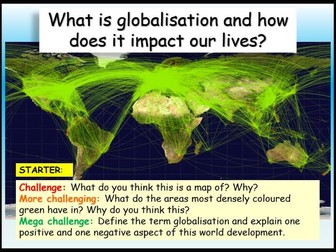
One hour, fully resourced lesson which introduces the concept of globalisation and the positives and negatives of this world development, through the study of economic, cultural and political globalisation.
This resource pack includes an hour long PowerPoint with accompanying worksheets, case studies, well differentiated activities, literacy focus tasks, clip tasks with three-way differentiated questions and information sheets.
The lesson has been left editable and is filled with engaging, well differentiated and fun activities. Can be used for Geography or PSHCE. As with all our lessons, you don’t need any prior knowledge as all the information is included - you can just pick up and teach it.
You can find many more inexpensive and free PSHE, Citizenship and RE resources at my shop: [MORE PSHE RESOURCES](https://www.tes.com/teaching-resources/shop/EC_Resources
Worksheet and video activity that includes questions about globalisation. The activity includes a video for students to watch about the factors that affect globalisation, and then are to answer the questions that relate to what was discussed within the video clip.
This is a quick prep activity that could be used to structure a full lesson, as it asks students to go into detail when explaining their answers. After students complete the activity, the answers could be debated with the whole class.
Before you buy, you could get this resource as well as 7 KS3 schemes of work + more for just £13.99! Thats over 75 KS3 lessons for £13.99!!!
https://www.tes.com/teaching-resource/all-of-my-ks3-resources-12842783
Check out my shop for loads of KS3 and KS4 bargains!
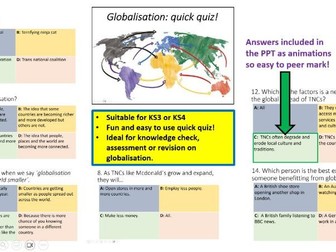
A 15 question Geography quick quiz that asks multiple choice questions about some aspects/examples of globalisation.
The quiz is very easy to use, includes all answers at the end and could be used for either KS3 or KS4 as an informal assessment, revision or just for fun.
There is also a bonus question which prompts a class debate at the end of the quiz.
Please check out my shop where you´ll find lots of other outstanding (free or cheap!) schemes of work and lessons! https://www.tes.com/teaching-resources/shop/ukjoshkelly94
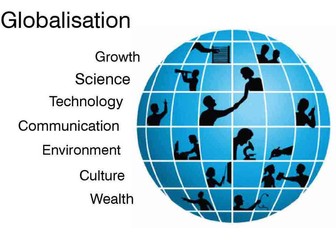
A slide show of pictures to prompt a discussion on globalisation and to introduce the main elements of the topic to year 8 and 9 Global Perspectives / Geography / Citizenship students


 Quick View