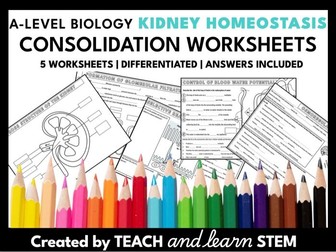
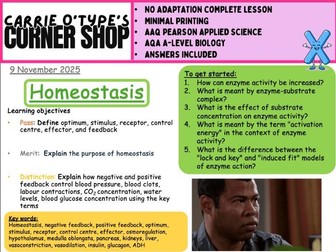
This bundle contains all 7 lessons for the 16th Chapter of the AQA Biology A-Level Spec.
16.1 Principles of Homeostasis
16.2 Feedback Mechanisms
16.3 Hormones & Regulation of Blood Glucose
16.4 Diabetes & its Control
16.5 Control of Blood Water Potential Nephron Structure
16.6 Role of the Nephron in Osmoregulation
16.7 Role of Hormones in Osmoregulation
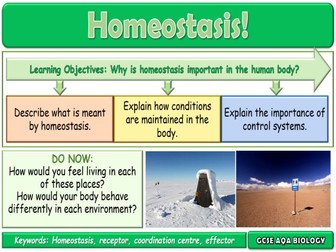
Perfect if you teach AQA GCSE Biology Combined Science or Single Science, this fully differentiated and resourced lesson supports your students in learning about Homeostasis. By the end of the lesson, students will be able to describe what is meant by homeostasis, explain how conditions are maintained in the body, and explain the importance of control systems.
The resource includes a detailed and engaging PowerPoint Presentation with key points, differentiated activities, exam style questions and progress check questions/quizzes for students to complete. A differentiated worksheet is included.
*INCLUDED IN RESOURCE:
21 slide PowerPoint Presentation with key points, progress checks and quizzes.
Differentiated worksheet included. *
Enjoy and feel free to leave a review. For the full set of AQA Biology, Chemistry and Physics topic bundles please visit:
https://www.tes.com/teaching-resources/shop/ychebbout
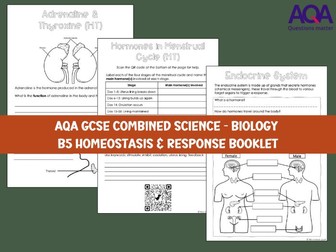
Homeostasis Revision Booklet – AQA GCSE Combined Science (B5 Topic)
Simplify your lesson planning and help your students master homeostasis with this print-and-go 15-page activity booklet!
This comprehensive and engaging digital resource is the perfect way to review the AQA GCSE B5 Homeostasis topic. Whether used for independent revision, homework, or cover lessons, this booklet supports students in consolidating key knowledge and applying it through targeted tasks.
What’s Inside:
This 15-page booklet covers all the core content from the AQA GCSE Combined Science B5 topic, including:
The nervous system
Synapses
Reflex arcs
Investigating reaction time (required practical)
The endocrine system
Control of blood glucose
Treating diabetes
Negative feedback (HT only)
Adrenaline & Thyroxine (HT only)
Puberty & Menstrual Cycle
Hormones in the menstrual cycle (HT only)
IVF (HT only)
Methods of contraception
Each page includes short, focused activities designed to reinforce learning and encourage retrieval practice.
Why Teachers Love This Booklet:
Reduces Workload: Just print and go – perfect for last-minute lessons, homework, or student catch-up.
Boosts Student Confidence: Helps learners recall key facts and make connections between concepts.
Flexible Use: Great for revision, classwork, homework, or cover lessons – no extra resources needed.
Supports Independent Learning: Students can complete it using class notes, textbooks, or online research.
Aligned to AQA Spec: Fully matched to the GCSE Combined Science Biology specification.
Teacher-Tested and Student-Approved:
“I created this booklet after noticing how much my students struggled to retain content weeks after we’d covered it. These short, snappy worksheets made a huge difference – giving them all the key information in one place to revisit anytime.”
Also Available in This Series:
B1 Cell Biology – FREE Revision Booklet
B2 Organisation – Revision Booklet
B3 Infection & Response – Revision Booklet
B4 Bioenergetics – Revision Booklet
C1 Atomic Structure – Revision Booklet
Help your students build knowledge and exam confidence with this Homeostasis overview booklet.
Perfect for both new and experienced teachers looking for ready-to-use, effective science resources.
Grab your copy now and make biology revision easier for everyone!
https://www.tes.com/teaching-resources/shop/DinosaurLaboratory
Be weird, be funny, be gross, have fun, play, stick to your routines and find that little spark of madness we all have and electrocute the class with it!
My style of teaching isn’t for everyone, I’m a dyslexic teacher who’s heard it all, my lessons are all catered towards accessibility (because if they were not I’d never be able to read them myself). Everything is short sharp and to the point, I don’t believe in endless writing, reams of printing, spoon feeding diagrams or pointless activities. Every minute matters!
Be sure to check out all my other resources, as a personal goal I intend to share all my resources at least once because hey, the government isn’t going to make it easier and we both know you are reading this way outside of your work hours.
Enjoy, comment or rate if you can, but most of all hang in there, they need you way more than you realise!
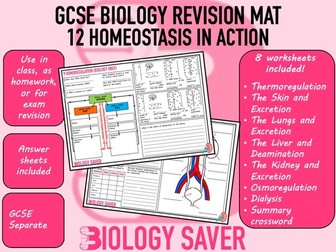
This resource contains revision mats for the Topic 12 Homeostasis in Action
This resource can be printed as an A4 sheet perfect for in class activity or a homework. Recommended for years 9-11 to build their knowledge recall in preparation for their GCSEs. Applicable for AQA, Edexcel and OCR.
Included are 8 revision mats (+answer sheets) which works out at just 50p per worksheet!
Topics included:
Thermoregulation
The Skin and Excretion
The Lungs and Excretion
The Liver and Deamination
The Kidney and Excretion
Osmoregulation
Dialysis
Summary crossword
This resource aligns with other resources such as:
12 Homeostasis in Action AQA Checklist
Paper 1 Revision Mats:
Bundle: https://www.tes.com/teaching-resource/resource-13236335
1.1 Cell Structure
1.2 Transport in Cells
2 Cell Division
3 Organisation and The Digestive System
4 Organising Animals and Plants
5 Communicable Diseases
6 Preventing and Treating Disease
7 Non-Communicable Diseases
8 Photosynthesis
9 Respiration
Paper 2 Revision Mats:
Bundle: https://www.tes.com/teaching-resource/gcse-biology-revision-mats-paper-2-bundle-13242921
10 The Human Nervous System
11 Hormonal Coordination
12 Homeostasis in Action
13 Reproduction
14 Variation and Evolution
15 Genetics and Evolution
16 Adaptations, Interdependence and Competition
17 Organising an Ecosystem
18 Biodiversity and Ecosystems
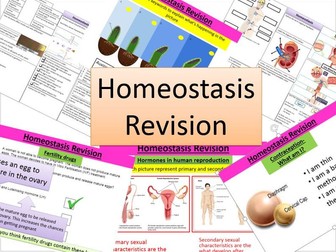
This lesson covers homeostasis content from the new AQA GCSE Biology spec.
Areas of focus are endocrine system, reflex arc, negative feedback, blood sugar control, water and ion control, hormones in reproduction and fertility and plant hormones.
This lesson includes a variety of activities from gap fills to contraception- guess who. Students are able to work independently or part of a group.
This lesson also include 2 accompanying revision worksheets that work alongside the lesson or can be given to students separately as revision homework.
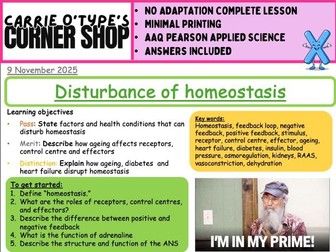
Complete “Ready to go” lesson with no adapting necessary!
New for AAQ Pearson Applied Science BTEC from Sept 2025 Specification and AQA A-Level Biology
///////////////////////////////////////////////////////////////////////////////////////////////////////////////////////////////////////////
This lesson covers:
•Content covered on what a disturbance to homeostasis is and the how ageing affects homeostasis with an example
•Students complete a table comparing homeostasis in a younger and in an older person at different stages of a feedback loop and then apply their knowledge to a mini case study
•Content covered on heart failure
•Comprehension that goes more in depth on how the RAAS system whic is activated to restore optimum blood pressure gives a positive feedback response to heart failure in the long-term
•Content covered on diabetes and they 2 types
•Students draw feedback loops on normal blood glucose regulation with insulin and annotate where the disruption occurs in Type 1 and Type 2 diabetes + application questions
•Content covered on lifestyle choices that can impact homeostasis
•Match the case study to the explanation of their homeostatic disruption
PRINTING REQUIREMENTS: Optional printing on the comprehension however it is also on the slides. You may also wish to print the table comparing old vs young homeostasis however it can be copied and the answer boxes have been numbered
///////////////////////////////////////////////////////////////////////////////////////////////////////////////////////////////////////////
This lesson follows my usual style and contains:
•Recall starter to build retention of previously learned content
•Clear levelled learning objectives and outcomes
•Clear and modern layout utilising GIFS and Youtube
• Variety of tasks and plenaries with self assessment to assess progress
• ANSWERS INCLUDED!
Please leave a rating/ review if this resource was helpful and saved you time!
Designed for WJEC GCSE Biology as an easy-to-use booklet/PowerPoint resource. The booklet follows the Ppt. and covers everything students need to know for this section of the specification. This was done for an adult evening class where time was at a premium, but could be easily adapted for a series of lessons in a standard classroom environment.
I have created similar resources for the whole specification.
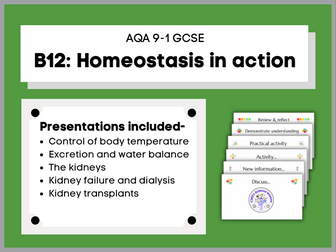
Homeostasis in action contains 5 fully resourced lessons in which GCSE students develop an understanding of controlling body temperature, osmoregulation, the kidneys, and how kidney failure can be treated.
Lessons suitable for teaching-
AQA Spec B5 Homeostasis and response unit.
AQA GCSE Biology OUP Scheme B12 Homeostasis in action chapter.
Each presentation contains-
Teacher and technician notes
Bell work activity
Clear lesson aims, objectives & success criteria
Information slides with differentiated content
Differentiated activities (group work)
Practical activity (if appropriate)
Differentiated questions with answers for self-assessment
Student worksheets / handouts
Aimed at a mixed ability class covering content 1-8.
Level 1: Low demand
Level 2: Standard demand
Level 3: High demand
If you require more assistance, please contact me at-
cmgeducationresources@gmail.com
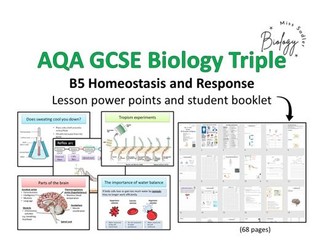
This resource was made for the new AQA scheme of work for Triple science biology.
Included are lessons with full objectives and a student booklet with all the resources you will need ( including a few sheets of lined paper for flexibility.
1. Homeostasis and control of body temperature
1b Sweating investigation
2. Human nervous system - animated reflex arc
3. RPA Reaction times
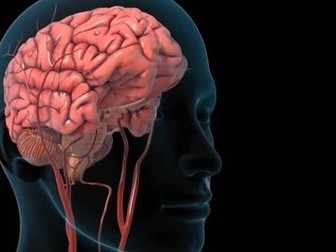
4. The Brain - includes 3D animation of the brain
5. The eye
6. Endocrine system and negative feedback
7. Control of blood glucose
8. Maintaining water and nitrogen balance
9. Hormones in human reproduction
10. Contraception
11. Hormones to treat infertility
12. Plant hormones
13. RPA Investigating the effect of light on the growth of seedlings
14. Summary / revision lesson quick questions activity and podcast(54mins) could be 2 hours.
All other topics available and revision grids for the exam season.
Your feedback is really appreciated
Introducing the perfect solution for students to ace their AQA GCSE Science exams! Our set of 4 revision lessons covering section 5 Homeostasis and Response of the Biology specification has been carefully planned to ensure that students get a comprehensive and easy-to-understand learning experience. Each lesson comes with a PowerPoint presentation that introduces the content gradually, along with plenty of opportunities to check their understanding and apply their knowledge in exam questions. Lessons within this set include:
• Nervous System
• Endocrine System
• Glucose Control
• Human Reproductive Hormones
The lessons provided are appropriate for the following specifications:
• Trilogy
• Synergy
• Separate Science Biology
Note that lesson on the eye, the brain, body temperature, water and nitrogen balance and plant hormones covered within the Separate Science specification can be found in the Separate Science Revision Lesson Pack which can be purchased separately.
Our revision lessons cover everything students need to know, from the nervous system to human reproductive hormones. And the best part? You can access them now at an early bird discounted rate! Please note that at this time, the download includes a lesson PowerPoint to use, but not a worksheet. However, we will be adding worksheets to the download at no additional charge in the near future.
We understand that you may have specific queries or requests for revision activities, resources and bundles. So, please feel free to contact us through instagram, and we’ll be more than happy to assist you.
Chapter 15 unit from the OCR Biology A A-Level all about homeostasis.
*The unit was planned with the intention of carrying out flipped learning whereby students do pre-reading on the topic prior to the lesson so that we can consolidate that learning with activities/exam questions during the lesson.
*
Including:
15.1 Principles of homeostasis
15.2 Thermoregulation in ectotherms
15.3 Thermoregulation in endotherms
15.4 Excretion, homeostasis and the liver
15.5 The structure and function of the mammalian kidney
15.6 The kidney and osmoregulation
15.7 Urine and diagnosis
15.8 Kidney failure
5 kidney summary worksheets for A-level Biology.
What’s included?
Gross structure of the kidney labelling worksheet.
Structure of the nephron & formation of glomerular filtrate.
Selective reabsorption (including co-transport of glucose).
The role of the loop of Henle in water reabsorption (maintenance of a sodium ion gradient) - one version suitable for AQA, one version suitable for OCR (includes chloride ions in the explanation).
Osmoregulation (role of ADH)
Includes differentiated versions of each worksheet (one scaffolded ‘fill in the blank’ style worksheet, and one with completely blank answer spaces).
Full answer sheets are included (both coloured and black and white, where relevant), which could also be used as a handout.
Encourage students to add colour to the worksheets to aid formation of visual memories.
Similar worksheets available for:
Cell structure
Protein Synthesis
Tissue fluid
CO2 transport
Immune response
ELISA tests
Transport in plants
Respiration
Photosynthesis
Photosynthetic pigments
Inheritance
Control of blood glucose concentration
The Kidney
The liver
Energy transfers
Nutrient cycles
Receptors
Epigenetics
In vivo and in vitro cloning
Thank you for viewing and downloading my resources for the KS4 AQA B5 Homeostasis topic. This topic includes the following lessons;
B5.1 Homeostasis and response
B5.2 The Nervous System
B5.3 Synapse and Reflexes
B5.4 Reaction Times RPA (FREE)
B5.5 The Brain
B5.6 The Eye
B5.7 Vision Defects
B5.8 Hormones and Glands
B5.9 Controlling Blood Glucose
B5.10 Kidney and Kidney Failure
B5.11 Puberty and Menstrual Cycle
B5.12 Controlling Fertility
B5.13 IVF
B5.14 Plant Hormones (FREE)
B5.15 Plant Responses
B5.16 Plant Responses RPA
This is a complete lesson with set tasks for the AQA GCSE (9-1) Biology specification. Each lesson within the topic has been carefully written to prevent overloading cognitive function. The lessons have been written to the AQA GCSE Biology specification and include retrieval practice with set tasks to move learning from working to long-term memory. In some instances literacy and oracy tasks as well as breakdown of scientific vocabulary have been included. Crucial whole class feedback is gained through the use of mini white board tasks.
My aim is to make outstanding science lessons based on evidence informed research. I have included detailed teaching notes so that non-specialists and newly qualified science teachers can pick up a lesson and teach straight away. Each high-quality lesson includes step-by-step animated builds, and explanations with answers included for ease of use. I have also included references to key texts.
Bundle packages are also available. Please check my shop for the rest of the lessons within the topic, plus other science lessons to help you build your resources, and remember to leave me a lovely review
Complete “Ready to go” lesson with no adapting necessary!
New for AAQ Pearson Applied Science BTEC from Sept 2025 Specification and AQA A-Level Biology
///////////////////////////////////////////////////////////////////////////////////////////////////////////////////////////////////////////
This lesson covers:
•Short fun practical challenge where students simulate homeostasis using lab equipment
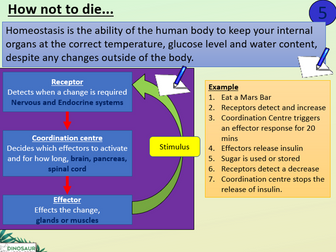
•Content covered on what homeostasis is and the importance of it
•Review questions covering the flow chart and key terms of homeostasis
•Content covered on negative and positive feedback
•Information hunt/ comprehension task where students construct feedback loop flowcharts on blood pressure, osmoregulation, gas concentration, blood sugar levels clotting with additional questions to build understanding and mastery from the task
•Review of video shown at the start of the lesson which students should now be able to explain from what they have learned in lesson
PRINTING REQUIREMENTS: Information sheets need printing but these can be reused for future lessons (1 set of information sheets is 5 pages)
///////////////////////////////////////////////////////////////////////////////////////////////////////////////////////////////////////////
This lesson follows my usual style and contains:
•Recall starter to build retention of previously learned content
•Clear levelled learning objectives and outcomes
•Clear and modern layout utilising GIFS and Youtube
• Variety of tasks and plenaries with self assessment to assess progress
• ANSWERS INCLUDED!
Please leave a rating/ review if this resource was helpful and saved you time!
During this distance learning lesson (B10.1 Principles of homeostasis) GCSE students work through the digital worksheet activities to develop their understanding of what homeostasis is and why it is important. Based on the 1st lesson from the AQA 9-1 GCSE (OUP) Biology B10: The human nervous system chapter.
Ideal for independent & distance learning / home-school / covering missed content after absence / non-specialist cover lesson
Aimed at a mixed ability class covering content 1-8
This resource includes (4 pages):
Teacher guidance and answers
Engage- Self-assessed vocabulary task using Google Sheets (Fact of the day).
Explore- Links to articles, video clips, virtual labs, and simulations for students to explore.
Explain- Embedded Google Slides™ presentation (includes lesson objectives, information slides, self-assessed questions).
Apply- Resources and task in which students apply their knowledge gained during the lesson.
Extend- Resources and task for students to extend their learning.
Important: Students must have access to PC with internet to use this worksheet
This resource works best as a Google Doc™. with Google Classroom™ some tasks will be unavailable in other formats (Word/Excel).
If you require more assistance, please contact me at-
cmgeducationresources@gmail.com
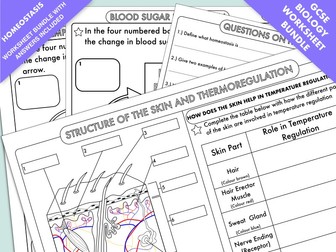
A pack of four visually engaging worksheets for GCSE Biology students studying the homeostasis topic.
The worksheets encourage independent learning as the pupils can work through them following the clear instructions given.
The worksheets are useful for when learning the topic, for revision and/or assessment of knowledge and understanding of the topic.
The pack covers the following:
1.) Skin structure and its role in temperature regulation
2.) Temperature regulation
3.) Blood sugar control
4.) Summary questions on the homeostasis topic
Answers are included to each worksheet, helpful to the non-specialist teaching Biology.
This is a ppt for a lesson revising homeostasis. With slides with information, mixed in with quick activities for the class to do. You will need to add in page references for help pages from your textbook.
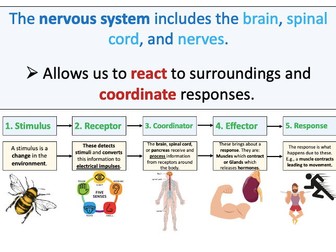
Visual lesson depicting the nervous system for all abilities, works particularly well for LPA/MPAs. The content follows AQA GCSE specification (Homeostasis - Biology Paper 2).


 Quick View