TNCs in India KS3Quick View
helendonovan9

TNCs in India KS3

(0)
This lesson focuses on TNCs in India and is designed to follow on from a lesson focused on Industry Types. It covers what TNCs are, the multiplier effect the reasons why TNCs located in India, the advantages and disadvantages of TNCs and looks at a coca-cola case study leading to a decision based excercise for students. This lesson is designed for Mixed Ability Year 8 students but could be easily adapted for other ages or key stages.
KS3 India Scheme of WorkQuick View
eloise_marner

KS3 India Scheme of Work

(3)
Based on Edexcel A GCSE Geography - Changing Cities & Global Development Complete Scheme of Work with Work Booklets, Full Lesson PPTs and 2x Assessments. Covers topics such as; Mumbai Slums, Impacts of TNCs, Tourism, Economic Development, Globalisation and Population.
The East India CompanyQuick View
Nadiyah123

The East India Company

(0)
Ready to teach! As part of a wider unit on the British Empire, this resource deals with the East India company: What it was, it’s positive and negative impacts and includes a guided reading worksheet on the Indian Mutiny. This lesson has been created for lower ability students. Any feedback greatly appreciated :)
Geography Lesson- Population and introduction to IndiaQuick View
lauriefb8

Geography Lesson- Population and introduction to India

(0)
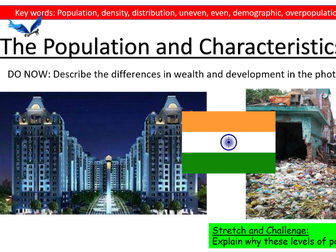
KS3 Geography Lesson. Learning Objectives: To know the population of India. To understand how wealth varies across India. Excellent if we are able to explain the population distribution of India. Range of activities- lots of opportunity for numeracy and graphical skills + locational knowledge. (pie charts, chloropleth maps, population pyramids). Lesson teaches students about the states and population of India- density and distribution. Introduces students to religion and cultures in India and gets them thinking about opportunities and challenges for these areas of overpopulation. Differentiated tasks. Please ask for more info!
Social impact of the 1947 Partition of India.Quick View
History_Resource_Cupboard

Social impact of the 1947 Partition of India.

(0)
** KS3 History Lesson**: What was the social impact of the 1947 Partition of India? A fully resourced lesson exploring change and continuity through the Partition of India This engaging and ready-to-teach KS3 history lesson focuses on the 1947 Partition of India, exploring its social impact and long-term consequences. It develops students’ understanding of the historical concept of change and continuity while building knowledge of migration, empire, and decolonisation. Ideal for teaching topics on: Empire and independence Migration and conflict British India and the end of Empire Historical concepts: change and continuity, cause and consequence ** What’s included:** Clear explanations of key terms (Partition, Refugee, Migration, Independence, Social Impact) Background context on British rule in India and the creation of Pakistan Comprehension and inference questions with sentence starters Historical map analysis with migration patterns Testimony-based task: note-taking from a survivor of Partition Emphasis on how life changed for millions and how some tensions and divisions continued Extension tasks: quiz writing, correcting model answers, and deeper reflection Fully differentiated with built-in scaffolding ** Learning focus:** Apply change and continuity to real historical events Develop historical empathy and critical thinking Understand how Partition reshaped identities, borders, and communities National Curriculum links (KS3 History): Understand how Britain has influenced and been influenced by the wider world Study significant events and developments beyond 1066 that shaped the modern world Examine the impact of empire, including India and decolonisation Develop use of historical concepts such as change, continuity, cause, and consequence Interpret and evaluate historical sources and narratives Perfect for units on Migration Through Time, British Empire, or Post-WWII World History. Ideal for history departments focusing on inclusive and global curriculum.
The British Empire in 1900 - India and Empire - 1 of 5 fully resourced lessonsQuick View
WolseyAcademy

The British Empire in 1900 - India and Empire - 1 of 5 fully resourced lessons

(0)
Indian Independence, Indian Partition and the British Empire – 5 fully resourced Lessons A lesson from a 5-part sequence on the British Empire, Indian independence and Indian Partition. The lessons, and the activities included are seen below. The British Empire in 1900 (5 key theme match up > Round Robin > Class Debate > Paragraph writing skills > retrieval practice). The First World War and Empire (Map questions > Guided Reading > Source Activity > Appositive sentence task > Blooket quiz). Causes of Indian Independence (Cops & Robbers Retrieval > Quiz Quiz Trade > Timeline task > Prioritisation Discussion > Paragraph writing skills) India, Gandhi and the Second World War (Narrative World Building > Comprehension Questions > Gandhi speech analysis > Pamphlet Writing > Extension Reading) Indian Partition (Recap Task > Dual Coding Writing Task > Ms Marvel Case Study > National Archives Source Study > Paragraph Writing skills). Hope they help. Wolsey Academy, a non-profit resource provider, directs all profits to various charities, including refugee support, youth sports, educational programs, and carbon capture, achieving a carbon-negative status. Explore our site for resources and free history role-playing games loved by students. Thank you for your dedication to teaching and for supporting our mission.
The British Empire: The Partition of IndiaQuick View
HistoryMakers

The British Empire: The Partition of India

(0)
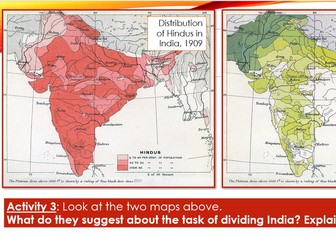
PowerPoint (with 7 slides) and one Word Documents that examine the reasons the partition of India resulted in violence. Activities include Quick quiz starter activity on Gandhi and events in India before 1945. Matching activity on the attitude to Indian independence of the British, the Muslim League and the Indian National Congress after 1945. Analysis activity to identify flaws in Britain’s approach to partition with a focus on the roles of Mountbatten and Radcliffe. Map analysis exercises on why population distributions made the task difficult. Map analysis activity on the problems the final decisions on partition created; East Pakistan, Kashmir, the Radcliffe Line. Discussion based exercise with source prompts on why partition provoked communal violence. Source analysis activity on the causes of Gandhi’s assassination. Designed for teaching an academically able Key Stage 3 class covering aspects of the British Empire. Lesson Length: 1hr depending on pace. Resource reviews are always much appreciated and help others using the site.
Comparison of the UK and India - Geography Knowledge Organiser!Quick View
TandLGuru

Comparison of the UK and India - Geography Knowledge Organiser!

(0)
This clear, detailed and visually-appealing resource offers a complete reference point for students revising knowledge relating to the UK and India, as a part of their study of their place, human and physical geography. It contains comprehensive sections on: Key Facts Overview and Maps; Physical Geography Comparison; Human Geography Comparison; 10 Key Comparison Facts; Key Vocabulary. The organiser is designed to help children to learn the relevant place, human and physical geography knowledge from the Geography National Curriculum: -understand geographical similarities and differences through the study of human and physical geography of a region of the United Kingdom and another non-European country; -physical geography, including: climate zones, rivers, mountains, volcanoes and earthquakes -human geography, including: types of settlement and land use, economic activity including trade links, and the distribution of natural resources including energy. The resource is designed to be printed onto A4 or A3, and is provided as both a PDF and a Word version (so that you can edit if you want to). All images used are licensed for commercial use.
GCSE Geography Rapid Economic Development Case Study: IndiaQuick View
shalomeducation

GCSE Geography Rapid Economic Development Case Study: India

(0)
The “GCSE Geography Rapid Economic Development in LICs and NEEs Case Study: India Location & Importance” resource serves as a comprehensive yet concise guide for students navigating the complex dynamics of economic growth in Lower Income Countries (LICs) and Newly Emerging Economies (NEEs). Centred on India, this case study delves into the geographical significance and the pivotal role the country plays in the global economic landscape. It explores India’s rapid economic advancements, describing its journey from being a lower-income nation to emerging as a new economic powerhouse. This resource is tailored to provide students with a well-rounded understanding, infused with real-world examples, making the topic accessible and easy to grasp for a successful GCSE Geography study session.
Mughal IndiaQuick View
Morma

Mughal India

4 Resources
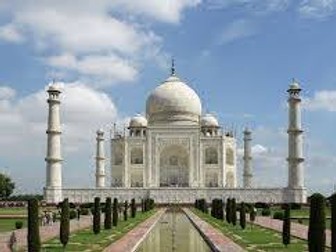
4 lessons which examine the rule of the Mughal Emperors Babur, Humayun, Akbar, Jahangir and Shah Jahan. Designed for use with KS3, these colourful characters are really interesting and of course you can find out why the Taj Mahal was built.
India’s economic trendQuick View
Geo360

India’s economic trend

(0)
This is a GCSE lesson on the economic trends of an emerging country. The case study of India is used. Key facts about the lesson are: 1. The lesson explores the changes in India’s GDP, GDP per capita, economic sectors and trade overtime and how these are affecting it’s development. 2. The lesson will generate lots of discussions on how the economy of a country works and what are the key economic trends associated with emerging countries. 3. The lesson is the second in a series of case study lessons on India’s development as an emerging economy. This is a requirement of the new GCESE specifications. However, it can be adapted for A-level studies as well. 4. The lesson is designed to focus students thinking and discussion skills through the use of graphs and data tables. 5. The lesson has a strong numeracy element which meets the assessment criteria of all the new specifications. 6. The lesson is differentiated through sentence starters, a model answer and challenge tasks throughout. 7. The lesson is a complete one; all the resources you need to deliver it (from starter plenary) are included on the ppt. Download and just teach!
KS3 British Empire: How did Gandhi challenge British rule in India?Quick View
PilgrimHistory

KS3 British Empire: How did Gandhi challenge British rule in India?

(2)
This lesson focuses on the role Mahatma Gandhi played in achieving Indian independence from Britain which ultimately cost him his life. The first part of the lesson looks at why the Indian population were unhappy with British rule, from the Indian Mutiny of 1857, events happening abroad to the Rowlatt Act culminating in the Amritsar Massacre. They are then introduced to Gandhi, his philosophy of non-violent protest (or as he called it satyagraha) and why he set up his Independent Congress Party for Indian independence from the British Empire. This is accompanied with some excellent video footage from the BBC as well as clips from the film ‘Gandhi’ by Sir Richard Attenborough. The second part of the lesson centers around his life and by analysing various sources from which students complete either a table or grid; they then have to decide how big a part Gandhi played in many events leading to Indian Independence and his lasting legacy for India in 1947, with the end of the British control. The lesson comes with retrieval practice activities, suggested teaching and learning strategies, differentiated materials and is linked to the latest historical interpretations, video clips and debate. The lesson is enquiry based with a key question posed at the start of the lesson and revisited at the end to show the progress of learning. The lesson is fully adaptable in PowerPoint format and can be changed to suit.
KS3 British Empire: How did the East India Company expand British power?Quick View
PilgrimHistory

KS3 British Empire: How did the East India Company expand British power?

(0)
This lesson aims to question whether Britain and the East India Company was in India for the right reasons. The subject matter is the East India Company and a study of how it slowly took over the country of India taking with it a precious diamond and making a fortune out of its trade. There are some great video links used here from the BBC and Dan Snow which help bring reasoning and clarity to the East India Company’s rule in India. Students are asked if we should return the Koh-i-Noor diamond to India, the jewel in the British crown, after analysing some important evidence. Students are also given key words to help them with their arguments as to whether the diamond should be returned to India or not. The final activity focuses on the legacy of the East India Company and who benefitted from their rule before the company’s eventual collapse. The lesson comes with retrieval practice activities, suggested teaching and learning strategies and are linked to the latest historical interpretations, video clips and debate. The lesson is enquiry based with a key question of who benefitted from the Empire posed at the start of the lesson and revisited at the end to show the progress of learning. The lesson is fully adaptable in PowerPoint format and can be changed to suit.
An introduction to India, Locating India, Investigating IndiaQuick View
Resourceroom101

An introduction to India, Locating India, Investigating India

(0)
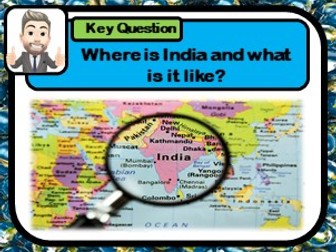
If you like my work, please follow me for more resources and leave a review! This 1 hour KS3 lesson introduces India as the case study for our ‘Plastic Problem’ unit. Pupils use a fun kinaesthetic activity to assess what their peers know about India. Students then use a question compass to reflect on source images. Pupils develop their Geographical skills, learning how to locate India at a range of scales. Peer assessment is utilised to feedback improvements to the class, developing an awareness of assessment criteria. Bundle and save! This lesson is part of a larger bundle:- India & The Plastic Problem Check out some of my other products relating to India & The Plastic Problem:- Why is plastic hazardous? Where is India and what is it like? How does India’s physical Geography influence the location of its major cities? Why does India have a monsoon climate? How do ocean gyres move plastic pollution? How developed is India? Why does India have so many squatter settlements? What are the impacts of marine plastic waste? How can plastic waste be reduced?
IndiaQuick View
blerrickstan

India

(0)
Ready to teach complete unit of work on India that goes with my China and Brazil units of work. Teaching powerpoints and worksheets.
IndiaQuick View
j_sheldon1

India

(1)
Entire unit of work. Lessons with worksheets, printables and power points. Each lesson is planned with video links to each lesson. Planning is based around KS2 / KS3. Can be used to extend KS2 and for SEND and lower ability KS3. Can be extended to suit KS3 (Years 7,8,9) Countries and oceans Focus on India Monsoon climate data drought fact file The River Ganges and pollution Mumbai and New Delhi
IndiaQuick View
YvonneCrawford

India

(0)
PRODUCT DESCRIPTION India, This Kid's Life is a booklet that focuses on how a child lives daily life in a different country, compared to how people live in their own country. This particular book tracks the life of a girl named Anika who lives in the country of India. Included: 1. A pre-test to see what your students know about India 2. A 2 page letter from Anika that describes her life in India 3. Facts about India and discussion questions 4. Word Search Puzzle 5. Secret Code Puzzle 6. 3D India Circle Flag 7. Make an Elephant Puppet Activity 8. Henna Hand Cut-out Activity 9. Postcard Writing Activity 10. If I Had to Ride a Train for Over One Day... Writing Activity 11. Basic Hindi Phrases 12. Crossword Puzzle about India 13. Saffron Information and Coloring Sheet 14. Similarities and Differences Organizer and Writing Activity Check out these other countries from the same series of This Kid's Life: Bundle of all Countries - includes a big discount! China France Germany Japan Mexico Italy India Canada Norway Russia Ireland Brazil England Australia Saudi Arabia Spain South Korea Thailand Morocco New Zealand Netherlands Argentina Peru Ukraine Portugal Finland Tunisia Kenya Scotland Puerto Rico Israel Greece Chile Antarctica Egypt United States Switzerland Hungary Columbia Belgium Wales Venezuela Turkey Dominican Republic Guatemala Costa Rica Cuba All artwork is original and create by myself. Thanks for looking at my products, Yvonne Crawford Total Pages 23 Answer Key N/A Teaching Duration N/A
IndiaQuick View
cassieborodenko

India

(0)
A 36 page resource, looking at life in India, including photos showing city life, village life, traditions, monuments and beautiful scenery. The photos are captioned, to help you use this resource in class as discussion or writing prompts. Of course, the photos would also make a lovely classroom display, or resource for the book corner, if you choose to print them. Please note, this resource is a PDF file.
Symbolau India / Symbols of IndiaQuick View
Mijimoos

Symbolau India / Symbols of India

(0)
Powerpoint yn Gymraeg yn esbonio rhai o brif symbolau India. Powerpoint in Welsh illustrating some fo India's main symbols. Text could easily be taken off or translated.
IndiaQuick View
TheGeographyShopOriginal

India

(1)
India L1: What Defines India’s Energy Mix? FREE Lesson 1: SoW Bundle: https://www.tes.com/teaching-resource/india-12929070 This SoW is designed in detail and is both differentiated and engaging, and allows you to move pupils through content efficiently. Made to the highest standard and constructed using current research, both dual coding and retrieval practices are at the heart of this unit. A colour scheme also runs throughout to ease both your delivery and students comprehension. SoW: What is India’s Place in the World? L1: What Defines India’s Energy Mix? L2: What is Significant About the Indian Military? L3: How Does India Respond to Conflict on its Border? L4: How Significant is the Threat of Religious Conflict Within India? L5: What are the Successes of Healthcare India? L6: Why is India’s Diaspora Significant? L7: How is Waste Managed in India? L8: How is India’s Economy Changing? L9: How Signficant is Sexaul Violence to Women in India? L10: How is Climate Change Impacting India? L11: What is the Scale of Global Trade in India? If you leave a review of any of our resources, you can claim any FREE single resource from our ever growing library. Simply message the above email, which is monitored daily. thegeographyshoporiginal@gmail.com Best FREE Resources (The Geography Shop) https://www.tes.com/teaching-resource/-12899088 (Climate Change SoW) https://www.tes.com/teaching-resource/-12899440 (Development SoW) https://www.tes.com/teaching-resource/-12638984 (Waste SoW) https://www.tes.com/teaching-resource/-12451443 (Britain Globalisation SoW) https://www.tes.com/teaching-resource/-12741793 (Local Area Investigation SoW) https://www.tes.com/teaching-resources/bundler/12949461 (Cambridge International) https://www.tes.com/teaching-resource/-12922653 (Israel & Palestine) https://www.tes.com/teaching-resource/resource-12485457 (What is Geography?) I hope you find this SoW useful. If you have, I have created a series of resources. You can check them out here. https://www.tes.com/teaching-resources/shop/TheGeographyShopOriginal
India on Film: Food in IndiaQuick View
IntoFilm

India on Film: Food in India

(0)
This educational resource based on Nilesh Patel's A Love Supreme encourages pupils to think and talk about film using the French language, and helps them with the technical skill of forming the imperative. Suitable for students aged 10-14, this resource is principally designed for use in the classroom to support French Modern Foreign Language. However, it also encourages engagement with Indian culture through food and with art-house cinema. You can download the accompanying Food in India PowerPoint Presentation, worksheets within the teachers'' notes and the curriculum links document. Watch thousands more archive films for free on BFI Player. Britain on Film is a project to digitise and make accessible 10,000 archive films from the BFI National Archive and the UK's Regional and National Film Archives.