Perfect if you are a course developer, this is a complete 37-page degree proposal for an undergraduate degree in languages and linguistics.
Includes:
Selling points of the degree
Entry requirements
Strands
Suggestions for cultural content
Module progression summary
Language strand summary
Two, three, or “split” year options
Semester(s) abroad option
PLUS 24 module descriptions across levels 4, 5 and 6
This highly flexible degree combines foreign language study, linguistics and vocational modules, and so would appeal to a huge range of students.
This presentation covers a range of topics including language development, connotation, denotation, semantics, language and gender, language and race. It ends up focusing on how words can make such a difference through the meanings we apply to them based on context and culture.
What’s different about Paper 4?
It’s an A Level ONLY paper (not AS). Two sections: Section A – English in the World (global spread, imperialism, World Englishes, language death). Section B – Language and the Self (linguistic relativity, genderlect, identity, standard vs non-standard). You get one unseen text per section. Your job: write a discursive essay that uses the text as a springboard for wider theoretical discussion. This guide teaches exactly how.
What’s inside:
Section A – English in the World
Historical development of English as a global language (colonisation → American power → internet)
Kachru’s Concentric Circles model – and its criticisms
Varieties of English: World Englishes, ELF, pidgins, creoles, decreolisation
Ethical debates: linguistic imperialism (Phillipson) vs empowerment (Crystal)
Language shift, death, and revitalisation (with case studies: Welsh, Hawaiian, Maori)
The future of English – and competing predictions
Section B – Language and the Self
Innateness vs learning: Chomsky, Skinner, Bruner, Vygotsky
Linguistic relativity: Whorf, Sapir, Boroditsky (experimental evidence)
Language and social identity: dialect, sociolect, idiolect, genderlect
Theorists: Labov, Tannen, Lakoff, Cameron, Eckert, Bernstein, Lippi-Green
Prestige, covert/overt prestige, accent discrimination, standard vs non-standard English
Speech communities, communities of practice, performativity (Butler)
Plus:
How to read and annotate the unseen text (5-step framework)
Essay structure: introduction → 3–4 analytical paragraphs (text + wider study integrated) → conclusion
Worked essay openings and analytical paragraphs for BOTH sections
Integration model: text reference → theorist → evaluation → counter-argument
Theorists quick-reference card (20+ theorists with core claims + evaluative points)
Terminology A–Z for both sections
Mark scheme band descriptors decoded (AO1, AO2, AO4)
Predicted topics and text types for 2027–2028
4-week revision plan (knowledge-building + timed essays)
Who is this for?
Teachers delivering A Level English Language (9093) – Paper 4 is often the most essay-heavy and theory-dense paper
Full A Level students (this paper is NOT for AS-only candidates)
Tutors supporting discursive essay writing on linguistic topics
File details:
57 pages
PDF format + Word
Aligned to Cambridge 9093 syllabus for 2027–2028 exams
A small ask: If this guide helps you and your students, please take two minutes to leave a review.
Independently produced by Samata Reviews. Not affiliated with or endorsed by Cambridge Assessment International Education.
#CIE #ALevelEnglishLanguage #9093 #Paper4 #English9093 #LanguageTopics #EnglishInTheWorld #LanguageAndSelf #GlobalEnglish #LinguaFranca #WorldEnglishes #LanguageAndIdentity #GenderAndLanguage #LanguageAndPower #SocialGroups #Syllabus2026 #ExamTechnique #ModelAnswers #AlevelRevision #EnglishTeacher #LinguisticSociology
Lang/Lit courses are often quite vague on which devices and approaches should be explored, and students always want a clear list of what they need to learn.
I have pared back the amount of approaches and devices for my groups to allow them maximum depth of understanding, as opposed to feature-spotting with too broad a palette. This list is not extensive, but suitable for candidates studying Language and Literature combined courses of all abilities.
Used for OCR, but would work for all boards.
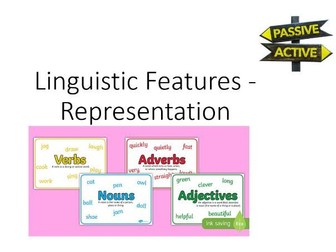
A-Level English Language - Linguistic Representation PowerPoint
Useful for those studying AQA as linguistic features is covered on the exam in the
textual variations and representations section.
The revision material includes slides on all of the following with lots of examples:
Linguistic terms
Nouns
Adjectives
Adverbs
Pronouns
Sentence Type
Clauses
Adjuncts
Analysis
Morphology
Mod
Graphology
Deviant Spelling
30+ page booklet which gives a brief overview of:
• Lexis
• Syntax
• Grammar
• Semantics
• Pragmatics
• Cohesion
• Morphology
• Phonology
• Graphology
Includes some activities and a glossary to be completed by the student.
An interesting lesson for the ‘thinkers’ of your class. This is a free sample resource to get students talking about how language can affect the world around us. The lesson asks them to investigate the linguistic issues around AI and intellectual property.
There are also additional links to Podcasts, videos and the LAMDA script, if you want to explore the topic further.
If you liked the lesson, like our teacher Facebook page : https://www.facebook.com/
If your students want revision tips, they can follow our student Instagram :https://www.instagram.com/gatsbyacademics/
It’s structured, exam-focused, and packed with the theory, terminology, and analytical frameworks they need. Aligned to the 9093 syllabus for 2027 and 2028.
What’s different about Paper 3?
It’s an A Level ONLY paper (not AS). It tests two specialist topics: Language Change (c.1500–present) and Child Language Acquisition (ages 0–8). And crucially, it’s a knowledge paper – you must arrive with theorists, stages, and terminology already in your head. This guide gives you all of it.
What’s inside:
Section A – Language Change (Q1 – 25 marks)
Chronology: Early Modern → Late Modern → Contemporary English (what changed when)
Linguistic levels of change: graphology, morphology, syntax, lexis, semantics, pragmatics
Causes and mechanisms: borrowing, blending, backformation, clipping, semantic shift, etc.
Theorists: Aitchison, Schleicher, Schmidt, Traugott & Dasher, Substratum Theory, Functional Theory
How to read n-gram graphs (Google Books Ngram Viewer style) and corpus word tables
Analytical synthesis framework – bringing historical text + graph + table together in one essay
Worked examples for all three data types
Section B – Child Language Acquisition (Q2 – 25 marks)
Developmental stages: babbling → holophrastic → telegraphic → post-telegraphic → extended
Halliday’s seven functions of child language (instrumental, regulatory, interactional…)
Theorists: Skinner, Chomsky (LAD), Bruner (LASS), Piaget, Vygotsky (ZPD), Halliday
How to read a CLA transcript – transcription key (pauses, overlaps, stress, phonemic notation)
Analytical framework for transcripts: phonology, morphology, syntax, semantics, pragmatics, CDS
Worked transcript analyses for holophrastic, telegraphic, and post-telegraphic stages
Plus:
Terminology reference banks (A–Z for Language Change and CLA)
Mark scheme band descriptors decoded for both questions
Predicted data types and topics for 2027–2028
Theorists quick-reference card (both sections)
4-week revision plan (knowledge-building + data practice + timed essays)
Exam day strategies and timing protocol
Who is this for?
Teachers delivering A Level English Language (9093) – Paper 3 is often the most under-resourced topic
Full A Level students (this paper is NOT for AS-only candidates)
Tutors supporting specialist linguistics revision
File details:
51 pages
PDF format + Word
Aligned to Cambridge 9093 syllabus for 2027–2028 exams
A small ask: If this guide helps you and your students, please take two minutes to leave a review.
Independently produced by Samata Reviews. Not affiliated with or endorsed by Cambridge Assessment International Education.
#CIE #ALevelEnglishLanguage #9093 #Paper3 #English9093 #LanguageAnalysis #LanguageChange #CLA #ChildLanguageAcquisition #LinguisticTheory #Etymology #Grammaticalisation #Sociolinguistics #CognitiveDevelopment #Nativism #Behaviorism #Interactionism #Syllabus2026 #ExamTechnique #ModelAnswers #AlevelRevision #EnglishTeacher #TheoryGuide
A 10 lesson unit comprising a 70 slide PowerPoint, 9 different worksheets (including texts for analysis) exploring the topic of Language Change and a summary terminology and theory sheet.
Each lesson includes a starting discussion prompt which acts as a learning objective, detailed notes on the theories and concepts listed below, a worksheet (with the exception of lesson nine) and activities, and a homework task. The following theories and concepts are covered:
Lexical, Semantic, Phonological, Grammatical and Orthographical processes
David Crystal – A Sea of Language Change and tidal metaphor (1999)
Diachronic and Synchronic Linguistic Change
Origins of Old English and Middle English
Descriptivism and Prescriptivism
Samuel Johnson – Dictionary of the English Language (1755)
Robert Lowth – A Short Introduction to English Grammar (1762)
Jonathan Swift - ‘A Proposal for Correcting, Improving and Ascertaining the English Tongue’ (1712)
John Walker – A Critical Pronouncing Dictionary (1791)
Otto Jespersen – Great Vowel Shift (1909)
William Caxton – Printing Press (1476)
John McWhorter – Textspeak (2013)
Jean Aitchison – Language Change Progress or Decay? (2012)
Vocal Fry and Uptalk
Martin Janssen – Lexical gaps (2012)
Functional view/theory
Linguistic determinism and the Sapir-Whorf Hypothesis
Charles Hockett - Random Fluctuation Theory (1958)
Peter Trudgill – Language Myths (1990)
John Humphrys – Prescriptivist grammatical change
Lynne Truss – Eats, Shoots and Leaves (2003)
Jean Aitchison – A Web of Worries (1996)
Guy Deutscher – The Unfolding of Language (2006)
James Milroy and Lesley Milroy – Complaint tradition (1985)
Robert Lane Greene – You Are What You Speak (2011)
There are some references to AQA-style A Level specification questions, but you can adapt these if needs be. These can be found on slides 59-67. Lesson 9 is based on an AQA A Level question.
The final lesson is a consolidation activity complete with guided revision cards. Alternatively, you could use an app such as Quizlet so that the students could produce digital revision resources.
Check out my other English Language A Level resources!
Language and Gender
Language and Region
Language and Power and Occupation
Language and Global and World Englishes
Language and Technology
Language and Ethnicity
Language and Social Groups
Language Discourses
Child Language Acquisition Speaking
Using as an introductory task, steering students to the finer details of grammar and analysis - in a fun and straightforward way. One note. Three suspects… WHODDUNNIT?
This bundle contains everything you need to teach the core language levels for AS and A Level English Language.
Comprised of 50 lessons, this teaching bundle contains a range of materials for the successful delivery of the fundamentals which every student needs in order to develop their analytical skills in the subject.
Included are: Discourse; Grammar; Graphology; Lexis and Semantics; Phonetics, Phonology and Prosodics; and Pragmatics.
Each unit contains full lessons, with discussion points acting as learning objectives, application of learning through textual analysis and homework tasks. Please see each individual unit for a full list of the terminology and concepts covered.
This bundle is not tied to any particular exam board and can be used to teach any of the major A Level specifications.
Check out my other English Language resources:
Language and Gender
Language and Region
Language and Power and Occupation
Language and Global and World Englishes
Language Change
Language and Technology
Language and Ethnicity
Language and Social Groups
Analysing Spoken Language
Child Language Acquisition - Speech
Child Language Acquisition - Reading and Writing
Language Discourses - Question 4 Opinion Article
Original Writing NEA
Language Investigation
AQA Paper 1 Revision
AQA Paper 2 Revision
A detailed lesson to the concept of 'Textual Analysis'. Follows on from the study of language levels and focuses on the mode, genre and pragmatics of English articles. A clear lesson with accessible activities included. Progress of the lesson follows Bloom's Taxonomy of skills, culminating in self-evaluation. Geared towards AQA 2015 specification but can be used for any examination board.
This is a lesson introducing students to the concepts surrounding political correctness and linguistic reflectionism and determinism.
It explores the Sapir-Whorf Hypothesis, Steven Pinker, The Euphemism Treadmill, Miller and Swift, Fairclough, David Crystal and Deborah Cameron’s views on the issue.
There is a final writing prompt, plus a past paper exemplar from AQA.
It will take approximately 2 hours to cover in enough depth.
Enjoy!
A 9 lesson unit comprising a 65 slide PowerPoint and 9 different worksheets exploring the Original Writing NEA for AQA English Language A Level.
Each lesson includes a starting discussion prompt which acts as a learning objective, detailed guidance on the skills and ideas listed below, a worksheet and activities, worked questions and exemplar responses, and a homework task. The following skills are covered:
Original writing – what is it?
Genre, purpose and audience
How to analyse a text based on its genre, purpose and audience
Information texts and their linguistic features
Persuasive texts and their linguistic features
Storytelling texts and their linguistic features
How to choose and annotate a style model
How to plan and write the first draft of the original writing piece
How to review and edit a second draft of the original writing piece
How to plan and write the commentary
Check out my other English Language resources:
Language Investigation
Language and Gender
Language and Region
Language and Power and Occupation
Language and Global and World Englishes
Language Change
Language and Technology
Language and Ethnicity
Language and Social Groups
Analysing Spoken Language
Child Language Acquisition - Speech
Child Language Acquisition - Reading and Writing
Language Discourses - Section B, Question 3
Language Discourses - Opinion Writing - Section B Question 4
Language Levels
AQA Paper 2 Revision
A lesson that practices linguistic methodology for Year 12s and 13s with a Christmas twist - possibly a nice idea for that difficult last lesson of term!
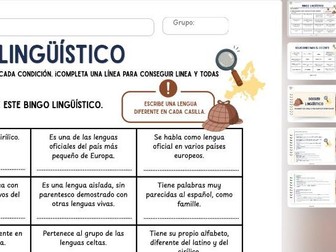
Celebrate the European Day of Languages (September 26)! This engaging linguistic bingo game helps Spanish students explore European languages.
What is this resource?
This material is an interactive, gamified linguistic activity designed specifically to celebrate the European Day of Languages (September 26th) or to enrich any cultural lesson throughout the school year. Tailored for secondary and adult Spanish students, it promotes geolinguistic discovery, teamwork, and critical thinking. It works perfectly as a dynamic cultural challenge (“píldora”) or as an engaging group activity within a broader teaching unit (“unidad didáctica”) about multilingualism in Europe.
What exactly does it contain?
This clear, print-ready PDF provides an interactive classroom game featuring:
Linguistic Bingo Grid: A dynamic 4x4 challenge board where students must investigate and write down a different European language for each specific condition (covering Romance, Germanic, Slavic, Uralic, Celtic, and isolated languages, alphabets, and official territories).
Clear Rules & Objectives: Instructions for completing lines or full cards to crown the winning team.
Answer Key Included: A complete solution guide with correct language examples for every single prompt is provided so teachers can easily verify answers and save time.
Team Header Fields: Includes spaces for team names and group organization.
How can it be used in the classroom?
It is an incredible tool for collaborative, gamified learning. You can use it as a lively competition on September 26th for the European Day of Languages, as a group research task in the computer lab, or as an energetic warm-up activity for a geography and culture lesson. The cooperative format encourages your Spanish students to debate, investigate, and actively discover the linguistic diversity of Europe.
Targeted at developing KS4 and A-Level pupils' clarity of analysis and explanations of language, this comprehensive resource demonstrates how teachers can educate students about how language reflects gender, occupation and social class. In teaching pupils the sociolinguistic perspectives, pupils are more capable to analyse and explain how literary writer's such as Shakespeare and Dickens use language in order to reinforce stereotypes and create characterisation, relationships and plot progression.
An exam for students of introductory linguistics. A total of 8 questions cover some of the main areas of linguistics:
Language classification
Language change
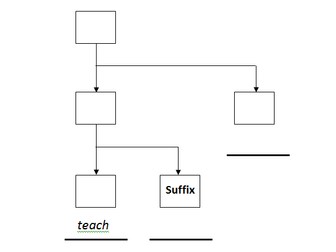
Morphology (including word classes and word building)
Syntax (including complements and word order)
Phonetics
Could work as either a summative assessment or an initial diagnostic.
FREE A Level English Language Glossary – Key Linguistic Terminology for Paper 4 (9093)
Help your students boost their grades with this essential glossary of linguistic terminology.
This printable, student-friendly reference sheet includes precise and formal vocabulary needed to discuss key issues related to:
English as a global language
Language and identity
Language and power
Language imperialism, endangerment, and death
Whether students are writing about bilingual education, World Englishes, language policy, or linguistic discrimination, this glossary supports them in writing sophisticated, theory-informed responses with confidence.


 Quick View
 Quick View
 Quick View
 Quick View
 Quick View
 Quick View
 Quick View
 Quick View
 Quick View
 Quick View
 Quick View
 Quick View