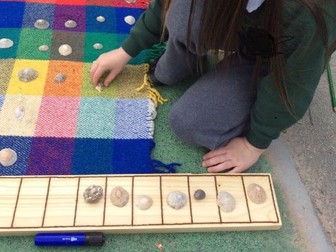
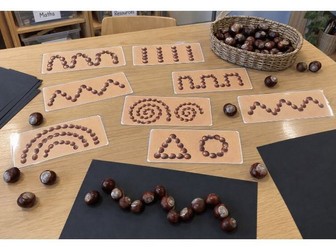
Bring hands-on autumn maths into your provision with these Conker Pattern Cards!
Children choose a card and recreate the pattern using real conkers, making this a simple and engaging way to develop early maths, pattern recognition, visual discrimination, spatial awareness and fine motor skills.
Simply print, cut and laminate, then add real conkers for a ready-to-use autumn maths activity.
Perfect for:
EYFS / Early Years
Nursery & Reception
Autumn continuous provision
Maths areas
Tuff trays & activity tables
Forest School / outdoor learning
Fine motor activities
Independent or adult-led learning
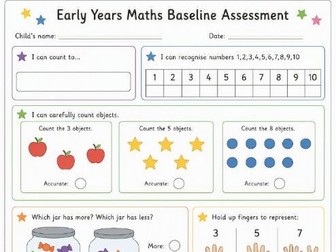
This resource can be used to assess children entering Foundation 2. It includes subitising, number recognition, careful counting, shape recognition, pattern, more/less, careful counting on fingers. A great resource for staff to see progress over the year and use as a baseline when entering EYFS.
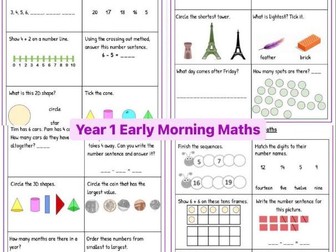
Use these ‘starter’ activities to get your children used to answering a variety a maths questions in an arithmetic way. The questions are mostly designed to recap past learning (taken from the White Rose timetable) as well as teach a few new aspects that come up on assessments (money). There are 12 of these activities, designed to be used once a day.
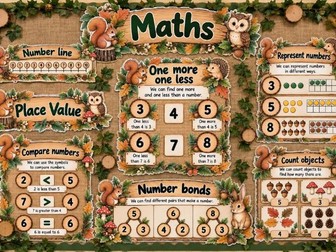
Create an engaging and visually appealing Woodland Maths Working Wall with this beautifully illustrated classroom display. Designed around a warm woodland theme, the display combines friendly forest animals, acorns, mushrooms and rustic wooden signs with clear mathematical vocabulary and representations. Links to Year 1 White Rose Maths Autumn term.
The display covers key early number concepts including:
Number Line – numbers 0–10
Place Value
One More & One Less
Represent Numbers – using objects and ten frames
Compare Numbers – less than, greater than and equal to
Number Bonds – exploring pairs that make a number
Count Objects – developing accurate counting and cardinality
The earthy greens, oranges, browns and natural wood textures create a cohesive classroom aesthetic, while the large headings and visual examples make the mathematical concepts accessible to young learners.
Perfect for:
Reception and KS1 classrooms
Maths working walls
Number Sense displays
White Rose Maths-inspired learning environments
Maths vocabulary and retrieval displays
The display can be printed as a large classroom backdrop or used as individual sections across a maths working wall.
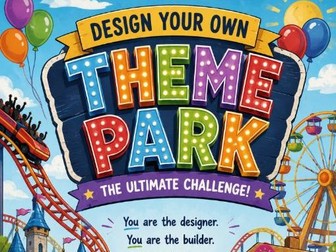
Year 6 Theme Park Enterprise Maths Project
Looking for an engaging, low-input project your Year 6 children can complete independently?
This cross-curricular Theme Park Project combines maths, problem solving, creativity and teamwork across ten structured lessons.
Perfect for:
independent learning,
split classes,
end-of-term projects,
transition activities,
enterprise weeks,
maths enrichment,
or keeping Year 6 meaningfully occupied while teaching another group.
Children work in teams to design, budget, expand and advertise their own theme park while completing maths-rich challenges and problem-solving tasks.
Included:
10 project lessons
Printable student booklet
MUST / SHOULD / COULD differentiation
Maths-focused problem solving challenges
Budgeting and enterprise activities
Scale drawing tasks
Data handling and statistics
Advertising and persuasive writing tasks
Early finisher extension ideas
Printable challenge cards
Colourful visuals and engaging layouts
Maths Skills Covered:
Budgeting
Percentages
Area and perimeter
Scale
Timetables
Data handling
Profit and loss
Problem solving
Money calculations
Cross-Curricular Links:
English
Art & DT
Computing
Geography
Enterprise
Teamwork and communication
Ideal for Year 6 pupils working independently in pairs or groups.
PDF and PowerPoint presentation format.
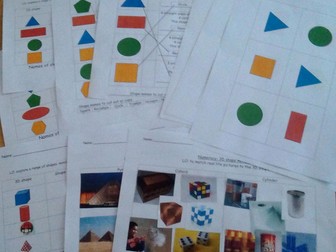
A large range of differentiated worksheets for lower, middle and higher abilities to explore and learn about 2D and 3D shapes, including naming the shapes, exploring the basic properties of shapes, matching 2D shapes by their descriptions and matching 3D shapes to real life pictures. 2D bingo- good for matching, social skills, speech and language. Suitable for all abilities as differentiation is included in the resources.
*2D and 3D basic shape properties:
4 sheets (includes a blank one that can be adapted for other shapes).
Lower abilities: Recognising the names of Triangle, Square, Circle and Rectangle, then counting the number of straight and curved sides.
Middle abilities: The same as above, but there is also a second worksheet for them with a Diamond, Hexagon, Oval and Pentagon.
Higher abilities: 1 sheet with 3D shapes- Cuboid, Cylinder, Sphere and Pyramid.
There is a blank sheet included so that you can add your own shapes or get the children to take photos around the classroom or look in magazines and cut and stick their own shapes, then write the number of straight and curved sides.
*2D shapes, their properties and matching descriptions:
This includes 2 worksheets and a matching activity (needs cutting out and laminating to be used over and over again- includes 6 shapes, descriptions and names that need to be matched together). Adapt for lower or higher abilities.
Lower abilities- the first worksheets just has 4 shapes: Triangle, Rectangle, Circle and Square. The children need to match the shape name with the description, then match to the correct shape image.
Middle and Higher abilities- the second worksheet contains 6 shapes: Pentagon, Rectangle, Triangle, Square, Circle and Hexagon.
*3D shape matching:
Includes 4 pages (2 worksheets and 2 pages of 3D images).
This is aimed at middle and higher abilities.
The children need to identify the shapes that are Pyramid or Sphere, then Cuboid or Cylinder, then cut them out and glue them in the correct area.
Extension: the children should be encouraged to look around the classroom and identify objects of these shapes, recording them on their sheets. They could also look through magazines or go online to find matching 3D images.
*2D shape bingo- shape pictures and names:
Good for recognising, matching, and naming the basic 2D shapes.
2D shape bingo- 4 bingo cards for lower abilities (square, rectangle, triangle and circle.
4 bingo cards for middle/higher abilities (square, rectangle, triangle, circle, pentagon and hexagon).
Shapes to cover the called shapes for lower and middle abilities.
Names of the shapes for higher abilities to cover the called shapes.
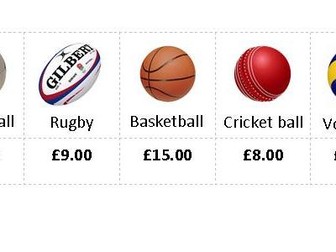
Addition, Subtraction and Multiplication practice using a fictional online shopping experience
+
Introduction to Sequences
Leave a comment, I would love your feedback
Build a Strong Foundation in Numbers with Fun and Learning!
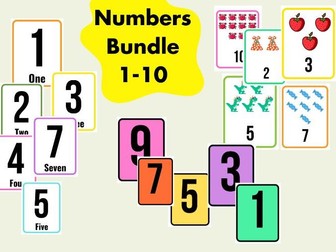
This Number Bundle is the perfect resource to introduce early years learners to numbers 1-10. Designed to support foundational maths skills, it combines hands-on activities with engaging visuals to make learning numbers exciting and memorable.
What’s Included:
Brightly Illustrated Number Flashcards: Visual aids with numbers 1-10 and corresponding quantities for easy recognition.
Interactive Worksheets: Fun activities to practice counting, tracing, and identifying numbers.
Games and Activities: Ideas for group play to reinforce learning through movement and interaction.
Key Benefits:
Builds Confidence in Maths: Supports early numeracy skills through a hands-on approach.
Encourages Recognition and Counting: Clear visuals help children connect numbers to quantities.
Durable and Reusable: High-quality materials for lasting use in classrooms or at home.
How to Use:
Flashcards for Recognition: Introduce numbers by showing the cards and discussing the images.
Worksheets for Practice: Use for tracing, coloring, and matching activities to reinforce learning.
Play-Based Learning: Incorporate games like number hunts, memory match, or counting songs to make maths fun!
Why Choose This Bundle?
Perfect for teachers, parents, and caregivers looking for a comprehensive early maths resource.
Easy to integrate into daily learning routines, playtime, or group activities.
Promotes confidence, curiosity, and enthusiasm for maths.
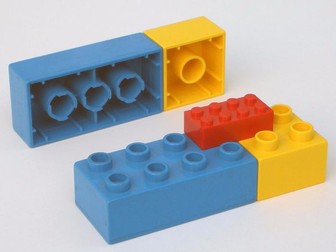
Introducing bar modelling through Duplo resource.
Christmas themed - measuring tinsel
Whole class instruction for one week for a Reception class using the method of teaching used in Shanghai (my interpretation of it anyway!)
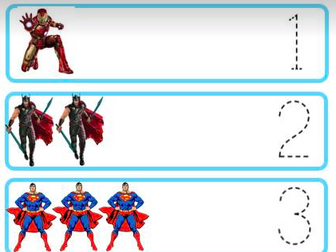
These are superhero Maths worksheets for Early Years or SEN featuring Spiderman, Batman and The Hulk. It includes 6 pages with writing numbers, counting up and simple addition, ideal for the little superheroes in your lives.
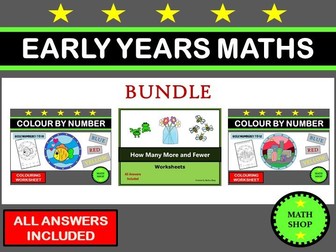
This is a bundle of Maths for Early Years interactive worksheets covering the following topics:
2D and 3D shapes
Angles
Comparing Fractions
Coordinates and Grids
Division
Odd, Even, Multiples, Divisors and Remainders
Estimating Numbers
Fact Families
Fractions
Mixed numbers, Proper and Improper Fractions
Frequency Tables and Bar Charts
Measure: Capacity
Measure: Distance and Weight
Measuring Volume
Regular and Irregular Polygons
Shapes: Area and Perimeter
Shapes: Rectangles, Squares and Triangles
Symmetry
Time: Minutes, Days, Weeks, Months, Years and the 24 Hr clock
Time: The date, Days, Months, Years and the Calendar
Suitable for online teaching, home schooling, and classwork.
Work well with Primary students, EAL students and English as a Foreign Language students.
Key language, phrases and concepts are introduced and practised in each worksheet through a variety of speaking, reading, writing and drawing activities.
This bundle is perfect for Early years. Fine motor skills help to build strength in their fingers. This will then help then with their writing whilst completing a range of Little Red Riding Hood activities. The doubling game is a fun way to practice their Maths skills.
This bundle for younger children offers a range of activities and supporting resources. A visual counting game, time telling fun, maths puzzles, visual inspiration through times table posters and photographs of numbers in the wider environment. Bright, fun, friendly maths.
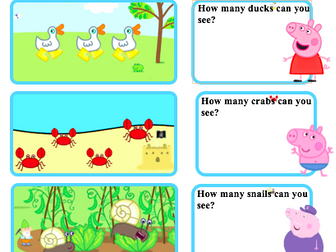
This visual resource for younger children offers a wide range of high quality photographs of a variety of objects. Children are challenged to count the objects. A great way to engage a whole group in counting and number recognition. Ideal as a visual introduction to counting, or as a fun end of day activity.
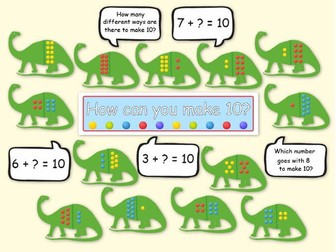
Dinosaur Number Bonds to 10
Help your children to learn all the way to make 10 using this gorgeous Dinosaur Maths Display. Simply download, print out and display for an instant teaching resource for your Maths Area.
Included in this Display Pack are:
* 90 cm title banner - How can you make 10?
* 12 cute Dinosaurs - A4 size showing a different number bond (including 1 blank)
* 10 A4 pages with 2 speech bubbles per page containing questions, number sentences and editable blanks so you can add your own questions, learning intentions and text


 Quick View