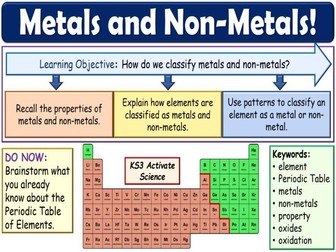
Perfect lesson resource for KS3 Chemistry! A fully differentiated and resourced lesson that assists students in learning about and investigating the properties of metals and non-metals. Students will recall the properties of metals and non-metals, explain how elements are classified as metals and non-metals, and use patterns to classify an element as a metal or non-metal.
The resource includes a detailed and engaging lesson PowerPoint with differentiated activities, quizzes and a class practical for students to complete. This resource is part of The Periodic Table topic and has been created for the delivery of the Activate KS3 Science course. Also great for GCSE Science.
27 slides in total for the lesson PPT
KS3 new for the AQA Activate 2 unit ‘Earth’ or the Oxford Activate 2 unit 'Metal and Acids’.
Full lesson ready to use straight ‘out of the box’.
Though designed for teachers to deliver (specialist and non-specialists), the lessons are structured in an intuitive way for students to navigate for independent/ remote learning/ homework covering missed content/recap
Similar structure to my other power points following the input - activity - review phasing
plenary sections for progress checking
Clear learning objectives and outcomes
Modern and engaging layout
Little adaptation needed
Covers an hour lesson of content matched to the specification
37 ppt slides
Please give constructive feedback :D
New for the AQA GCSE 1-9 Combined Trilogy Unit ‘C3 Structure and Bonding’.
Full lessons ready to use straight ‘out of the box’.
Lesson meets the full criteria for this unit
Similar structure to my other power points following the input - activity - review phasing
Plenary sections for progress checking
Clear learning objectives and outcomes
Modern and engaging layout
Little adaptation needed
Each lesson covers at least an hour of lesson time
24 ppt slides
Practice questions and Mark scheme
Please leave constructive feedback :D
KS3 Activate 2 module 'Metals and Acids’
or
KS3 Activate 2 modules ‘Reactions’
Lesson ready to use straight ‘out of the box’.
Similar structure to my other power points following the input - activity - review phasing
Plenary section for progress checking
Clear learning objectives and outcomes
Modern and engaging layout
Little adaptation needed
Please leave some constructive feedback :D
Comprehension and additional task exercises pages 92 and 93 from Next Page Science KS3 Complete. Accompanying PowerPoint and word searches available for free from the website.
This exercise covers:
• The position of metals and non-metals on the periodic table
• The properties of metals to include: conductors, strong, shiny, sonorous, dense, high melting points, magnetic metals (Fe, Ni, Co), ductile, malleable and ability to make alloys
• The properties of non-metals to include: insulators, not strong, often gases at room temp (minus boiling points), not dense, not magnetic, dull
• Two exercises on the properties of metals
• An exercise recognising where metals and non-metals are on the periodic table
• An exercise where students can write about the uses of metal they know about
• Amazing WHAT? facts
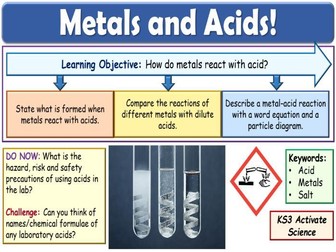
Perfect lesson resource for KS3 Chemistry! A fully differentiated and resourced lesson that assists students in learning about and investigating the reactions of various metals with dilute acids. Students will practice writing word equations to represent these chemical reactions and explain a metal-acid reaction using particle diagrams.
The resource includes a detailed and engaging lesson PowerPoint with differentiated activities, worksheet, quizzes and class practicals/demos for students to complete. This resource is part of the Metals and Acids topic and has been created for the delivery of the Activate KS3 Science course. Also great for GCSE Science.
Included:
17 slides in total for the lesson PPT, worksheet
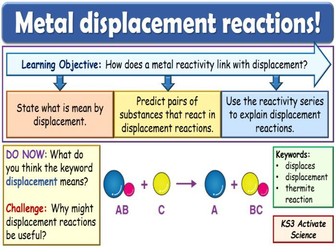
Perfect lesson resource for KS3 Chemistry! A fully differentiated and resourced lesson that assists students in learning about and investigating metal displacement reactions. Students will practice writing word equations to represent these chemical reactions and use the reactivity series to explain displacement reactions.
The resource includes a detailed and engaging lesson PowerPoint with differentiated activities, quizzes and a class practical for students to complete. This resource is part of the Metals and Acids topic and has been created for the delivery of the Activate KS3 Science course. Also great for GCSE Science.
16 slides in total for the lesson PPT
Lessons from the 8G unit in the new Exploring Science scheme of work all about metals and their uses.
Including lessons for:
8Ga Metal properties
8Gb Corrosion
8Gc Metals and water
8Gd Metals and acids
8Ge Pure metals and alloys
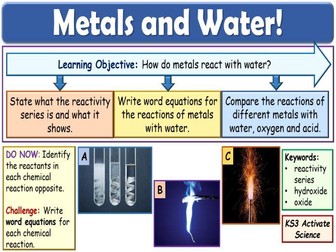
Perfect lesson resource for KS3 Chemistry! A fully differentiated and resourced lesson that assists students in learning about and investigating the reactions of various metals with water. Students will practice writing word equations to represent these chemical reactions and use the reactivity series to predict reactions.
The resource includes a detailed and engaging lesson PowerPoint with differentiated activities, worksheet, quizzes and a class practical for students to complete. This resource is part of the Metals and Acids topic and has been created for the delivery of the Activate KS3 Science course. Also great for GCSE Science.
*INCLUDED:
16 slides in total for the lesson PPT, Differentiated worksheet. *
New for the AQA GCSE 1-9 Combined Trilogy Unit ‘C12 The Earth’s Resources’.
Full lessons ready to use straight ‘out of the box’.
Lesson meets the full criteria for this unit
Similar structure to my other power points following the input - activity - review phasing
Plenary sections for progress checking
Clear learning objectives and outcomes
Modern and engaging layout
Little adaptation needed
Each lesson covers at least an hour of lesson time
48 ppt slides
Please leave constructive feedback :D
New for the AQA GCSE 1-9 Combined Trilogy Unit ‘C2 Periodic Table’.
Full lessons ready to use straight ‘out of the box’.
Lesson meets the full criteria for this unit
Similar structure to my other power points following the input - activity - review phasing
Plenary sections for progress checking
Clear learning objectives and outcomes
Modern and engaging layout
Little adaptation needed
Each lesson covers at least an hour of lesson time
34 ppt slides
Please leave constructive feedback :D
KS3 new for the AQA Approved Activate 1 unit ‘Reactions’.
Full lesson ready to use straight ‘out of the box’.
Though designed for teachers to deliver (specialist and non-specialists), the lessons are structured in an intuitive way for students to navigate for independent/ remote learning/ homework covering missed content/recap
Similar structure to my other power points following the input - activity - review phasing
plenary sections for progress checking
Clear learning objectives and outcomes
Modern and engaging layout
Little adaptation needed
Covers an hour lesson of content matched to the specification
29 ppt slides
Please give constructive feedback :D
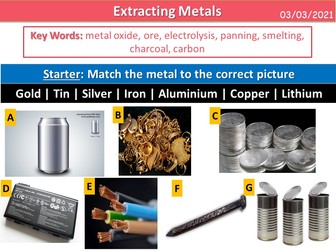
This GCSE Chemistry PowerPoint presentation covers the extraction of metals, focusing on different methods used based on the metal’s position in the reactivity series. It includes engaging explanations, practical applications, and exam-style questions to help students understand carbon reduction, electrolysis, and the extraction of iron in a blast furnace.
What’s Included?
Definition of a metal ore – Explanation of what ores are and why some metals need to be extracted while others exist in pure form.
Reactivity series – Understanding how metal reactivity determines the extraction method used.
Electrolysis for highly reactive metals – Explanation of why metals above carbon (e.g., aluminum, sodium, magnesium) are extracted using electrolysis.
Reduction with carbon – How metals below carbon (e.g., iron, zinc, lead) are extracted using carbon reduction.
Blast furnace process for iron extraction – Step-by-step reactions, role of coke, limestone, and hot air, and key chemical equations.
Oxidation and reduction concepts – Identifying what is oxidized and reduced in metal extraction reactions.
Word and symbol equations – Example equations for extracting different metals, with opportunities for student practice.
Review and exam-style questions – to check understanding.
Why Use This Resource?
Aligned with GCSE Chemistry (AQA) specification.
Fully editable PowerPoint (.pptx) – Customizable for different lesson styles and student needs.
Clear visuals and structured explanations – Ideal for classroom teaching or independent learning.
Develops key exam skills – Helps students practice writing equations and explaining extraction methods.
Last updated: February 2025.
Perfect for teachers, tutors, and students looking for a comprehensive and engaging resource on metal extraction. Download now to enhance your chemistry lessons!
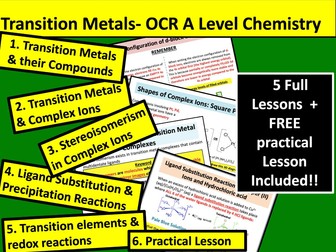
5 Full Lesson Bundle + FREE practical lesson covering Transition Elements from OCR A Level Chemistry. Please review the learning objectives below
Lesson 1: Transition Metals & Their Compounds
To know the electron configuration of atoms and ions of the d-block elements of Period 4 (Sc–Zn), given the atomic number and charge
To understand the elements Ti–Cu as transition elements
To illustrate, using at least two transition elements, of:
(i) the existence of more than one oxidation state for each element in its compounds
(ii) the formation of coloured ions
(iii) the catalytic behaviour of the elements and their compounds and their importance in the manufacture of chemicals by industry
Lesson 2: Transition Metals & Complex Ions
To explain and use the term ligand in terms of dative covalent bonding to a metal ion or metal, including bidentate ligands
To use the terms complex ion and coordination number
To construct examples of complexes with:
(i) six-fold coordination with an octahedral shape
(ii) four-fold coordination with either a planar or tetrahedral shape
Lesson 3: Stereoisomerism in Complex Ions
To understand the types of stereoisomerism shown by metal complexes, including those associated with bidentate and multidentate ligands including:
(i) cis–trans isomerism e.g. Pt(NH3)2Cl2
(ii) optical isomerism e.g. [Ni(NH2CH2CH2NH2)3] 2+
To understand the use of cis-platin as an anti-cancer drug and its action by binding to DNA preventing cell division
Lesson 4: Precipitation and Ligand Substitution Reactions
To recall the colour changes and observations of reactions of Cu2+, Fe2+, Fe3+, Mn2+ and Cr3+ with aqueous sodium hydroxide and ammonia (small amounts and in excess)
To construct ionic equations for the precipitation reactions that take place
To construct ionic equation of the ligand substitution reactions that take place in Cu2+ ions and Cr3+ ions
To explain the biochemical importance of iron in haemoglobin, including ligand substitution involving O2 and CO
Lesson 5: Transition Elements & Redox Reactions
To interpret the redox reactions and accompanying colour changes for:
(i) interconversions between Fe2+ and Fe3+
(ii) interconversions between Cr3+ and Cr2O72−
(iii) reduction of Cu2+ to Cu+
(iv) disproportionation of Cu+ to Cu2+ and Cu
To interpret and predict redox reactions and accompanying colour changes of unfamiliar reactions including ligand substitution, precipitation and redox reactions
Lesson 6: Practical on Precipitation and Ligand Substitution Reactions
To make observations of the reactions of Cu2+, Fe2+, Fe3+, Mn2+ and Cr3+ in aqueous sodium hydroxide and ammonia
To construct ionic equations for the redox reactions that take place
For 23 printable flashcards on this chapter please click here:
https://www.tes.com/teaching-resource/resource-12637622
For lessons on redox titrations involving transition metals please click here :
Part 1:
https://www.tes.com/teaching-resource/ocr-redox-titrations-part-1-12244792
Part 2:
https://www.tes.com/teaching-resource/ocr-redox-titrations-part-2-12244807
Declaimer: Please refrain from purchasing this popular resource for an interview lesson or a formal observation. This is because planning your own lessons including using your own lesson PowerPoints is a fundamental skill of a qualified/unqualified teacher that will be reviewed during these scenarios outlined above
KS3 Activate 2 module 'Metals and Acids’
Lesson ready to use straight ‘out of the box’.
Similar structure to my other power points following the input - activity - review phasing
Plenary section for progress checking
Clear learning objectives and outcomes
Modern and engaging layout
Little adaptation needed
Please leave some constructive feedback :D
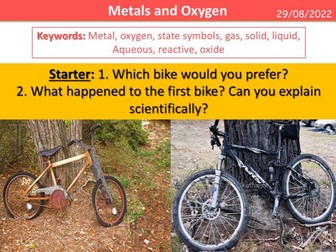
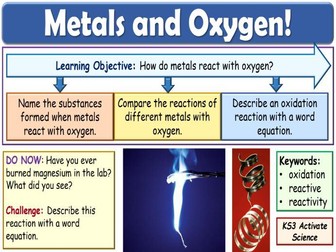
Perfect lesson resource for KS3 Chemistry! A fully differentiated and resourced lesson that assists students in learning about and investigating the reactions of various metals with oxygen. Students will write word equations, compare the reactions of different metals with oxygen, and explain what is meant by an oxidation reaction.
The resource includes a detailed and engaging lesson PowerPoint with differentiated activities, worksheet, quizzes and class practicals/demos for students to complete. This resource is part of the Metals and Acids topic and has been created for the delivery of the Activate KS3 Science course. Also great for GCSE Science.
Included:
21 slides in total for the lesson PPT, differentiated worksheet
**Metals and Non- Metals GCSE Chemistry AQA 9-1 **
By the end of the lesson your students will be able to:
Identify where metals and non-metals are found in the periodic table.
Describe the differences in metals and non-metals based on their properties.
Explain how the electronic structure of metals and non-metals links to how they react and where they are positioned in the periodic table.
This resource is a PowerPoint presentation to support teaching about metals and non-metals for the first time. By the end of the lesson, students should understand the differences between metals and non-metals, where they are situated in the periodic table and how their electronic structures correspond to how they react. Previous knowledge on what a group is will be required, as well as atomic structure (e.g. understanding what an electron is).
Included in the resource:
Opening slide with title, keywords, learning objectives and lead on topics
Starter slide with simple intro task
Information slides showing positioning of metals and non-metals in the periodic table and the ions they make
Printable worksheet slide to consolidate knowledge and organize learning
Activity slide with three tasks (one stretch)
Plenary question slide to summarize
All ANSWERS included and the resource is completely EDITABLE.


 Quick View