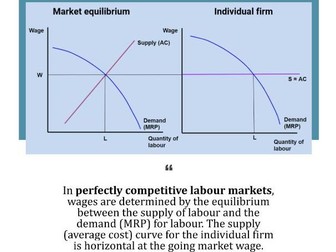
Wage and non-wage factors.
The influences of demand and supply, relative bargaining power and government policy, including minimum wage.
How changes in demand and supply, relative bargaining strengths, discrimination and government policy can all influence differences in earnings between workers whether they are: skilled/unskilled; primary/secondary/tertiary; male/female; private sector/public sector. Definition, drawing and interpretation of diagrams that illustrate the effects of changes in demand and supply in the labour market.
Advantages and disadvantages for workers, firms and the economy.
Questions with suggested solutions
NEW FOR 2022
This is my complete set of presentation resources and corresponding workbooks for teaching the AQA Microeconomics Year 1 content.
Slides have starters, activities and all of the core information needed for the AQA course. There are 69 lessons in total (I teach 50 minute lessons) with plenty to stretch and challenge, meaning many lessons could be stretched out over more than one lesson. Most lessons have 3 multiple choice starter questions to prompt discussion and memory retention as students have to revisit past concepts. Towards the end of the course, this changes to essay titles for discussion and revision.
Workbooks are also included, which I use digitally, so that pupils have the core information and useful images in their notes. There are links, review exercises and research tasks all in an attractive and easy to navigate format. My pupils have loved this new addition. My reasoning was to reduce note-taking time and increasing discussion and active thinking time. I use them with Google Classroom as an ongoing assignment, meaning that I can check in on their notes as the course progresses.
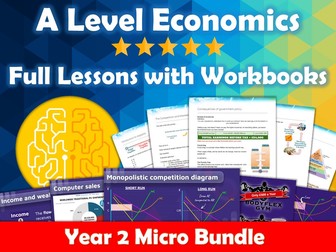
Outstanding bundle of Workbooklets / Worksheets for Year 2 Micro-economics, including:
Market Structures: Perfect Competition, Monopolistic Competition, Oligopoly and Monopoly Markets
The Law of Increasing and Diminishing Marginal Returns, Total Product Curves, Marginal Cost
Costs and Revenue diagrams: Objectives of firms
Costs and Revenue diagrams: The 4 efficiencies
Costs and Revenue Introduction
Economies of Scale, Diseconomies of Scale, and External Economies of Scale
These booklets are fantastic for building understanding, they often come with Model Answers on the following page, and will save you hours of preparation time!
(Suitable for both Edexcel and AQA)
Superbly structured, colourful and engaging series of Worksheets / Work Booklets, along with Revision Notes.
The booklets include:
Production Possibility Frontiers (PPFs) Work Booklet
Production Possibility Frontiers (PPFs) Revision Notes
Supply and Demand Work Booklet
Elasticities Work Booklet (PED, YED, XED and XED)
Elasticities Revision Notes
Public Goods Work Booklet
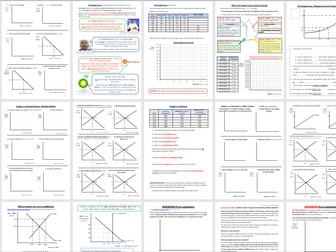
Labour Market Work Booklet
Externalities Revision Notes
Tradeable Pollution Permits Revision Notes.
Year 1 Micro Diagrams - Student Test doc, and Model Answer doc.
These AQA-specific booklets will save you hours and hours of time! The examples have been honed over a decade of teaching experience, and test students’ understanding in a multitude of ways.
Model Answers are provided to many of the questions.
This bundle is fantastic - and I will happily transfer the money back to you if you are unsatisfied (just contact me if so!).
Best wishes,
Llywelyn
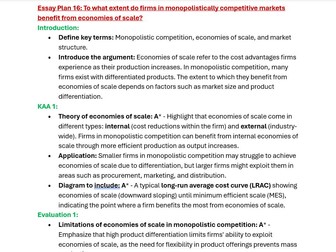
This resource contains 77 expertly crafted essay plans to help AQA A-Level Economics students achieve an A*. Each plan includes clear chains of reasoning, essential diagrams with explanations, in-depth evaluation, and critical analysis supported by real-world examples. Designed to enhance essay structure and maximise marks in exams.
I got A* A* A* in my A-levels and a high A* in Economics; these notes are concise, clear and has little pointers as to what examiners want - perfect for adding to your own notes/ offering a holistic A* view of the course.
A must buy if your are doing Edexcel Economics for A-levels.
A complete AQA A-Level Microeconomics predicted paper for 2026, featuring four full data response sections with mark schemes.
Each section uses real-world, up-to-date contexts likely to appear in the 2026 exam:
1. Weight-loss drugs & pharmaceutical markets – patents, monopoly power, market failure, positive externalities
2. Fast fashion & environmental externalities – negative externalities, government intervention (taxes, regulation, subsidies)
3. Dynamic pricing in concert tickets – price discrimination, market power, consumer surplus, government regulation
4. Supermarket competition & supplier pressures – economies of scale, buyer power, oligopoly, monopsony
Every section includes a two-extract stimulus, four questions (5, 10, 15 and 25 marks), and a detailed mark scheme with indicative content, level descriptors and example answers. Questions mirror AQA command words and mark allocations exactly.
Ideal for timed exam practice, mock exams, or independent revision. Covers key specification areas including market failure, market structures, government intervention and competition policy — all through engaging, current contexts students will find relevant.
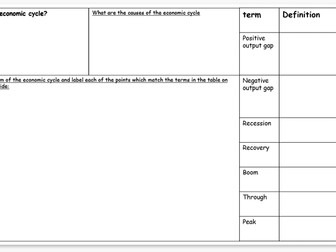
This covers the whole of the AQA economic year 13 A-level content. The sheets are designed to test knowledge of key concepts, definitions, diagrams, data and more. They are a great last minute revision resource to test areas of strength and weakness and to ensure all content is covered.
Superbly structured, colourful and engaging series of Worksheets / Work Booklets, along with Revision Notes.
The booklets include:
Year 1 Micro Key Terms List
Year 1 Micro Diagrams - Student Test doc, and Model Diagrams doc
Production Possibility Frontiers (PPFs) Work Booklet
Production Possibility Frontiers (PPFs) Revision Notes
Supply and Demand Work Booklet
Elasticities Work Booklet (PED, YED, XED and XED)
Elasticities Revision Notes
Public Goods Work Booklet
Labour Market Work Booklet
Externalities Revision Notes
Tradeable Pollution Permits Revision Notes.
These Edexcel-specific booklets will save you hours and hours of time! The examples have been honed over a decade of teaching experience, and test students’ understanding in a multitude of ways.
Model Answers are provided to many of the questions.
This bundle is fantastic - and I will happily transfer the money back to you if you are unsatisfied (just contact me if so!).
Best wishes,
Llywelyn
All of the lessons necessary to help get your students through IB Microeconomics. Most of the lessons include engagements as well as recap quizes that will ensure that your students are clearly following all of the necessary components of IB Microeconomics.
This is a powerpoint containing all of the economics AQA A-level content. useful as a revision resource for exam students or those in years 12 or 13. there are questions on each of the following topics: theory of the firm, market failure, elasticity, wages theory and income inequality.
"All materials not originally created by Michelle O Looney are used with permission or under fair use guidelines.¨
Action-packed lessons: Forget dry lectures, these engaging activities (think props, games, and even a space adventure!) will have students clamoring for more.
Catchy titles: Each lesson boasts a title that sparks curiosity and sets the tone for the learning journey.
Crystal-clear learning objectives: Students know exactly what they’ll achieve by the end of each session.
Engagement for all: This resource caters to different learning styles, ensuring no student gets left behind.
The best part? You don’t need to scour the internet for hours. This comprehensive scheme of work has it all, meticulously researched and ready to use.
Business Economics Playground
Micro 2026 Hot Topics Review is a sharp, exam-focused teaching booklet designed to help A Level Economics students prepare intelligently for the highest-value micro themes across Edexcel, AQA and OCR.
This is not a vague prediction sheet. It is a practical revision weapon: a cross-board guide to the topics most likely to reward strong analysis, precise diagrams, current application and developed evaluation. It covers essential micro areas including externalities, demerit and merit goods, digital monopoly, oligopoly, price controls, labour markets, inequality, contestability, regulation and government failure.
Each section gives students exactly what they need: board fit, likely essay angle, model KAA chains, evaluation pressure points, application hooks and exam-style practice. The booklet also trains students to write better paragraphs using the Point – For example – This means – Therefore – However structure, before finishing with a clear DJCLL judgement.
Perfect for teachers, tutors and ambitious students, this resource works as a revision pack, intervention tool, lesson starter, essay-planning guide or post-mock upgrade booklet.
Built for 2026 preparation, it helps students move beyond memorising content and towards the real exam skill: building precise, contextual, evaluative arguments that answer the question.
Micro revision made sharper, more current and more exam-ready.
Links to the microeconomics quizzes that I make on Quizizz.
Students play on their own laptops and compete against one another.
This is a live document: every time I create a new quiz, I will add it to the list.