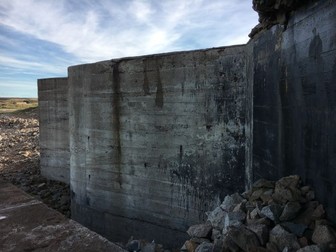
A collection of photos of World Water Two German bunkers on the British Channel Island of Alderney and other related photos. These bunkers are made from concrete and were built by the prisoners of war, using designs from an engineer's handbook. My students have used the photos in their projects and presentations about World War Two. I hope you will find them of use to your class too.
Please leave me a review and I will send you any other resource of your choice for free (contact me: office@oceansproject.com). Check out my other resources at my shop: https://www.tes.com/teaching-resources/shop/sarah277
Let me know if you have any resource requests and I will tailor make a resource for you.
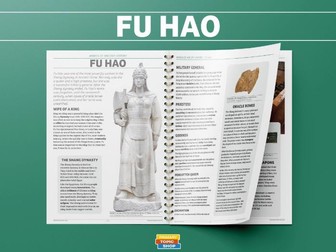
Fu Hao was one of the most powerful women in the Shang Dynasty in Ancient China. Not only was she a queen and a high priestess, but she was a successful military general. After the Shang dynasty ended, Fu Hao’s name was forgotten, until the nineteenth century, when caves of oracle bones were discovered, and her tomb was unearthed.
This printable pdf resource explores Fu Hao as queen, priestess, military commander and goddess, as well as the excavation of her tomb. The Shang Dynasty is covered briefly, as well as some detail about oracle bones.
Number of Pages: 13 (including 4 answer sheets)
Contents:
4 Information Pages (including key events summary and vocabulary)
Differentiated Comprehension (Reading Response and Multiple Choice Questions)
Synonym Activity
Oracle Bones Activity
Early Finisher Cryptic Crossword Activity
Answer Sheets
Germany GCSE History – Military Opposition
This is one of many lessons that I have uploaded on the history of Germany for GCSE pupils. All of the lessons can be taught together, but each covers a topic so can also be picked up separately. For ease of locating, the title stem is the same: 'Germany GCSE History -'. This is a full PowerPoint lesson, ready to teach, and any relevant resources are also uploaded with it. This lesson’s LO: To be able to describe the July Bomb Plot 1944 using accurate detail
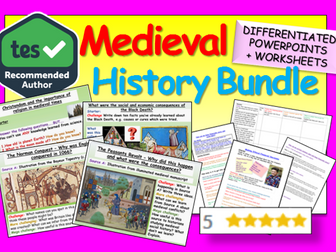
HUGE 18 HOUR BUNDLE. 18 x fully resourced medieval history lesson packs - all complete with detailed PowerPoints and worksheets, clip links, starters, plenaries, source packs, peer assessments, practice GCSE style exam questions and much more.
Includes:
1. Medieval Religion
2. Life as a monk or a nun
3. The Black Death
4. The consequences of the Black Death
5. Medieval Medicine
6. The Norman Conquest
7. William I as King
8. Norman consolidation of power
9. The Crusades
10. The Hundred Year's War (introduction)
11. The Hundred Year's War and Joan of Arc (conclusion)
12. Edward I and Scotland
13. Edward I and Wales
14. The Peasants Revolt
15. Medieval science - causes of disease
16. Magna Carta and King John
17. Medieval Jobs
18. Castles
Designed by an experienced Head of Humanities in a UK secondary school, tried and tested and so easy to just pick up and run with. Eveything is editable for you to tweak as you wish.
**Who are EC Resources?**
EC Resources are a group of teachers who work together to create easy to use, high quality and editable lessons and units of work. We have created lessons for The Bank of England, The Children's Commissioner, MACS Charity, The British Legion, Tes, LikeToBe Careers, the Criminal Cases Review Commission (UK Gov) and have also completed PSHE and Citizenship commissions for schools across the UK.
This is the third of fourteen lessons that are linked to the Edexcel IGCSE history ‘The origins and course of the First World War, 1905-18’ so do be aware that any page numbers that have been added in are linked to the specific Edexcel textbook (the cover picture indicates the correct textbook).
These PowerPoints, along with the textbook and any other materials I have provided, go into enough depth that they can be adapted for other age groups and exam boards.
This is a cloze activity that details the different military approaches taken by the Viet Minh and their allies the Viet Cong on one side versus the military strategies and tactics taken by the United States and allies on the other side during the Vietnam War. It is designed for students of the NSW Modern History Syllabus for the Australian Curriculum
Higher School Certificate course
Peace and Conflict
Option C: Conflict in Indochina 1945-1975.
All Greek city states had agoges. But the Spartans were renowned for their military prowess rather than their pursuit of the intellect. Does this mean that their agoges focused were more bootcamps than schools? This source-based homework task assists student understanding of the NSW Ancient History syllabus
Higher School Certificate course
Part II: Ancient Societies
Option I: Spartan Society to the Battle of Leuctra
The Spartans were really no different to other Greeks of the 6th and 5th centuries BCE - they valued a rounded education but they also understood the political necessity of a strong military.
Detailed Power Point looking at the reasons behind Alexander II���s decision to introduce reforms into Russia. Also includes a starter test (and answers) on related content.
The Crimean War (Inc Video link)
Source task linking defeat in Crimean War to introduction of Reforms
Source task giving an overview of what Alexander II wanted to achieve by introducing reforms.
Task - Information and task on identifying top success criteria for Alexander’s reforms.
Alexander II’s Views (Political Reality) as a reason for reforms - plus small task.
Political Motives as a reason for reforms
Support of the Nobility (Political 2) as a reason for reforms
Economic Motives for introducing reforms
Military Motives for introducing reforms
Moral / Intellectual Motives for introducing reforms
Hierarchy task for reasons for introducing reforms
Overview slide of the reforms that Alexander did introduce
Source task -reasons for introducing reforms
What was the real reason for the introduction of reforms?
Link to podcast
The power-point explores the effectiveness of the British military and leadership during the Crimean War. The resource links to Edexcel and the ‘British Experience of Warfare 1790-1815’ unit of study for A level. The resource is designed to be used by teachers in the classroom to support students. The power-point contains activities to help engage students in this topic.
History Escape Rooms End of Year - 10 different History Escape Rooms
Contents of the Super Escape Room Bundle
Black Death History Escape Room
Industrial Revolution History Escape Room
The Great War History Escape Room
Titanic History Escape Room
Tudors History Escape Room
WW2 World War 2 History Escape Room
The Stuarts
Slavery Civil War and Abolition
The Middle Ages Escape Room
Early Elizabethan England
We use practicing Heads of Departments to create our engaging resources. Our resources have been downloaded and used across thousands of classrooms.
✰✰✰✰✰✰✰✰✰✰✰✰✰✰✰✰✰✰✰✰✰✰✰✰✰✰✰✰✰✰✰✰✰✰✰✰
What will each of the escape rooms come with?
☞ Escape Room Interactive Tracker PowerPoint - Keeps the competitive nature on display
☞ Escape Room Puzzle Keys (Six Sets for Six Teams)
☞ Escape Room Team sheet - Record codes, answers clues as they progress through the 7 rooms
☞ Escape Room Puzzles (7 Rooms = 7 Different styles of Puzzles)
☞ Teacher Answer Sheet - Quickly confirm to teams they have solved the puzzle correctly
☞ Teacher instructions of how to set up the escape room and what to print and top tips and shortcuts.
☞ Successful Escape Certificates for those that complete the entire challenge (There is a difficult bonus escape too :) for any quick teams
☞ The 7 Rooms each have a specific Puzzle that has been adapted to suit the topic of this Escape Room and is suitable for secondary Students
☞ 10 Bonus subject based questions per escape room
☞ 5 Bonus snippets of ‘Did you know’ facts and revision knowledge
How else can you further enhance your escape room experiences?
Subscribe to the Cre8tive Resources Youtube Channel to access Bonus escape room Videos with professional voice overs and animations to help enhance the already great learning experience.
Why not check out some of our most popular secondary History Resources below:
Set of 10 History Escape Rooms
History Revision Bundle
History KS3 Revision Bundle
Nazi Germany
The Black Death
Weimar and Nazi Germany
Exploring Tudor England
GCSE History - Medicine Through Time
The Great War Escape room
Elizabethan England
Vikings Task Cards
World War Two - End of Unit Escape Room
American Civil War
Resources developed for New A-level OCR Unit 1; Lancastrians, Yorkists and Henry VII 1445-1509
Unit 2; Why did the Yorkists have so much success between 1455-1461?
Lesson 2; How successful was the Yorkist military campaign?
Learning Objectives
To describe and explain the military successes of the Earl of March
To examine the significance of Mortimer’s Cross and Towton, 1461.
To evaluate the extent of Yorkist success in the overthrow of Henry VI and the accession of Edward IV
From the dramatic events around the storming of the Gallipoli Peninsula on April 25, 1915 to the public commemorations of today, Anzac Day is the national celebration of a military defeat. Why is the day important to Australians? This source-based activity examines the history of Anzac Day, the construction of memorials across Australia and wider afield, the personality traits held to be the examples set by the Anzacs and the role of Anzac Day in the development of Australia as an independent nation. This activity is designed for students of the NSW History K-10 Syllabus for the Australian Curriculum.
Stage 5
Depth Study 3: Australians at War - World War I
Looking for a reading passage and activities on Joan of Arc? If, so, check out this resource which is part of my Let’s Meet Series. Done in the first person, students will learn about the life of Joan of Arc. Also included are Did You Know? Fun Facts, Comprehension Questions, a Map Activity and a Teacher Page with extension activities.
Could be helpful during Women’s History Month or if you are coving this period of history. The reading passage activity could also be a lesson for a substitute or for a Friday activity.
Check out my Let’s Meet Series:
I have a number of similar reading passages on famous people in this series, “Let’s Meet…” including: Phillis Wheatley(poet), Sojourner Truth(abolitionist, Women’s Rights Activist, Author), Mary Anning (paleonotologist) ,Caroline Herschel(Astronomer), Hildegard of Bingen(writer/composer), Artemisia(Female Naval Commander during the Battle of Salamis), Sophie Brahe(Astronomer), Enheduanna(first known Poet),Hanno(Sea Explorer of the Phoenicians), Agnodice(First Female Doctor of Ancient Greece), Hypatia(First female mathematician), Aglaonike(astronomer), Alexander the Great(famous general), Aesop(Fable Writer of Ancient Greece), Hannibal(famous general), Ramses(Great Pharaoh), Hatshepsut(Female Pharaoh) and Socrates(Philosopher of Ancient Greece).
The Achaemenid Persian army had a number of elite military units who performed a military role similar to the special military forces in any 21st century nation. They were highly trained, received special benefits and were employed in the most difficult campaigns. The written and archaeological evidence presents a rich picture of them and their role. This source-based homework task is designed to build student understanding of the NSW Ancient History syllabus
Higher School Certificate course
Part III: Historical Periods
Option F: The Near East: Persia from Cyrus II to Darius III
This worksheet is an educational resource designed to help KS3 students learn about specific themes and events related to The British Empire. It includes reading comprehension and writing exercises, as well as matching and fill-in-the-blank tasks, to provide students with a comprehensive understanding of the topic. The worksheet aims to improve students’ knowledge and understanding of The British Empire and to engage them in learning about the war through different learning modalities. The content of the worksheet may vary depending on the specific topic or theme, but the overall goal is to help students develop a deeper appreciation for the history and impact of The Empire.
 Quick View

 Quick View
 Quick View
 Quick View
 Quick View
 Quick View
 Quick View
 Quick View
 Quick View
 Quick View
 Quick View