Questions collated from old exam papers and revision guides so that topics are covered one by one.
Very good to guide revision and to makes sure that students are actually practicing exam style questions.
Will post answer booklet to go along with them soon.
enjoy!
Revision guides using questions from previous exam papers and various sources.
Useful for guided revision and to make sure the practice on questions is actually being done.
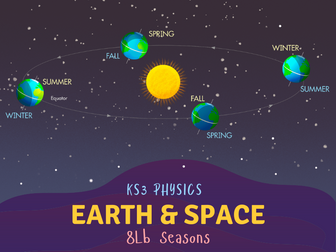
Earth and Space - The Science behind Seasons - 8Lb KS3 Physics
PLEASE READ BEFORE PURCHASING
My lessons follow the learning objectives of Exploring Science: Working Scientifically Student Book Year 8 by Pearson. This powerpoint is working towards Edexcel national curriculum but follows the overall English national curriculum suitable for schools that teach towards AQA & OCR curriculum also.
✰✰✰✰✰✰✰✰✰✰✰✰✰✰✰✰✰✰✰✰✰✰✰✰✰✰✰✰✰✰✰✰✰✰✰✰✰
My Lessons include:
Visually appealing graphics that encourage engagement throughout a lesson.
‘Do now/Starter’ activities with music to encourage fast and easy settling as the pupils arrive to lesson.
Progress steps: By having the student’s track their own progress, it creates ownership of goal achievement. The graphic representation of the students’ progress can be highly motivating. If improvements are not achieved, students can reflect on what changes need to be made to the intervention plan.
Peer and self-assessments (AfL) encouraging use of green pen self-assessment and purple pen peer assessment . This can be edited to meet the expectations of your school policy
Formative assessments to consolidate learning throughout (exam-style questioning, linking questions)
Plenary activities.
Extensions and challenge questions to reach higher ability students.
On screen timers to aid lesson plan and pupil focus.
Implementing subject specific key words throughout to encourage literacy
✰✰✰✰✰✰✰✰✰✰✰✰✰✰✰✰✰✰✰✰✰✰✰✰✰✰✰✰✰✰✰✰✰✰✰✰✰
I owe no rights to the music or images used in this PowerPoint
music credit to: Summer Adventure by DPmusic
Range of used icons credit to: Flaticon
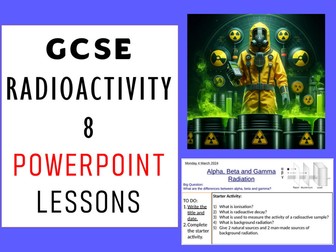
This GCSE physics resource bundle offers a complete introduction to the fascinating world of atomic structure and radioactivity. With eight detailed lessons, students will explore the fundamentals of atoms and isotopes, radioactive decay, and the practical applications of radiation. This bundle is designed to align with the GCSE physics curriculum, making it an essential tool for effective teaching and learning.
The bundle includes:
Atoms and Isotopes: Introduces the structure of atoms, isotopes, and their differences, with clear explanations and engaging examples.
Radioactive Decay: Explains the concept of unstable nuclei and how radioactive decay results in the emission of radiation.
Alpha, Beta, and Gamma Radiation: Examines the properties and differences of the three types of radiation, with visual aids and practical examples.
Nuclear Decay Equations: Teaches students how to write and balance nuclear equations for alpha and beta decay, linking theory to exam requirements.
Activity and Half-Life: Explores how to measure radioactive activity and understand half-life, with examples of real-world applications.
Working with Half-Life: Guides students through calculations involving half-life, providing plenty of practice opportunities.
Uses of Radiation: Discusses the practical and beneficial uses of radiation in medicine, industry, and power generation, as well as the associated risks.
Discovery of the nucleus: Guides students through the history of the atom, with lots of practice questions.
How to use:
Each lesson features engaging activities, clear explanations, and exam-style questions to reinforce learning. Teachers can use the materials for structured lessons, revision sessions, or interventions. With this bundle, students will develop a deep understanding of atomic physics and radiation, preparing them for exams and sparking their curiosity about the natural world.
Lesson 1 Atoms and Isotopes
Lesson 2 Radioactive Decay
Lesson 3 Alpha Beta and Gamma
Lesson 4 Nuclear Decay Equations
Lesson 5 Activity and Half Life
Lesson 6 Working with Half Life
Lesson 7 Uses of Radiation
Lesson 8 Discovery of the Nucleus
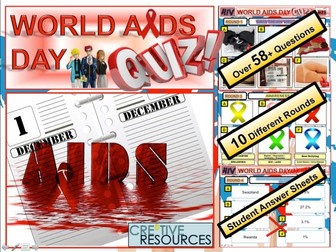
AIDS and HIV Quiz Lesson FUN/C8/QZ/66
Over 10 rounds and 58+ Questions. SRE PSHE Lesson about AIDS and HIV.
This resource contains:
1xPowerPoint
1x Student Answer Sheet double sided out of /58+ Marks (PDF and PPT Version) and all the answers!!
Contains 10 Rounds: Ways HIV can spread, Truth or Myth, What do all these ribbons represent?, HIV / AIDS Prevelence, Multiple choice, HIV by numbers, Countries and their statistics Design Challenge and more…
This quiz resource is perfect for lesson time, form time, extracurricular clubs, part of a drop-down day or as an educational treat for your class.
This will last a full hour by the time you get students into small teams and run through the Quiz and the interactive way the answers appear. A tie-breaker is included which involves drawing an image top 3 score points.
This informative, educational and engaging quiz will be a great way to teach about HIV and AIDS, How to protect against it and to understand more about the truths and myths surrounding it to combat prejudice, stigma and discrimination that surrounds this sensitive topic.
A variety of different rounds and different challenges within this quiz for all types of learners to access (something fun no matter what ability) FUN/C8/QZ/66
You may also like some of our other popular form tutor resource Packages …
Autumn Term Tutor Time Form Time Super Bundle
Spring Term Tutor Time Form Time Super Bundle
Summer Term Tutor Time Form Time Super Bundle
1-2 Years Worth of Tutor Time Form Time Super Bundle
Summer School Package - Team Building Challenges / Quizzes and Fun stuff!
News Quiz
Big film and TV Quiz
Healthy Eating Quiz
I created these forces arrows to cut out, laminate and stick onto whatever I am using in an introductory discussion of forces. Get pupils to come up and place the arrows in the correct places themselves. I placed a lab stool on the desk and asked pupils to choose an arrow to label a force acting in the situation. To show an imbalance of force, use a large arrow to represent the greater force and a smaller arrow to show the lesser force etc. A great way of bringing the topic to life and engaging pupils, ask them to come up with a situation then apply the arrows to what is happening.
This is a complete set of PowerPoints to aid you in teaching the Particle Physics topic for AQA A level (New specification from 2017)
I have included multiple choice quizzes in each lesson to ensure students are consolidating their understanding. As well as discussion activities and informative videos where relevant. I have also included 6 mark exam style questions where relevant to ensure students are practicing their long written answers.
I have included a revision mat for the particles topic which helps students organise their knowledge. I have also included a tarsia puzzle which my year 12’s enjoyed as part of their revision for the topic.
This bundle contains the revision mats for the required practicals that now involved in the new AQA specification for 2018.
They contain questions based around the methodology of the practicals, graph work and evaluation of the methods chosen. Exam question would be good to go along with these for added benefits.
This can also be used as home learning for students if they are requested to isolate for two weeks.
Answers are included for the trilogy revision mats. Answers for the Triple will be uploaded shortly.
This revision mats include:
Specific Heat Capacity
Resistance (1)
Resistance (2)
I-V Characteristics
Density
Force and Extension
Acceleration
Waves
Radiation and Absorption
Thermal Insulation (Triple):
Material Used
Thickness of Material
Light (Triple)
These are great tools for use as homework after the students have performed the required practical or for revision before any assessments and their exams.
Students have commented on these saying that they have found them useful tools for revision and helped them in lessons as aids.
Please rate these resources and follow me for upcoming revision mats for the other areas of the specification.
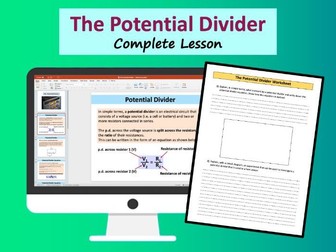
This resource is a complete lesson that covers The Potential Divider for the OCR A Level Physics A course. However, it is useful for other exam boards too.
This lesson teaches the following content:
-potential divider circuit
-potential divider equations; V1/V2 = R1/R2 and Vout = R2 / (R1 + R2) x Vin
-potential divider circuits with variable components e.g. LDR and thermistor
-Potentiometers
-techniques and procedures used to investigate potential divider circuits which may include a sensor such as a thermistor
This lesson includes:
-A full presentation including 2 example questions with worked solutions.
-A worksheet with model answers, perfect to set as homework.
-Clear visual aids and diagrams to simplify complex concepts.
-Editable PowerPoint and Word document for easy customisation.
Click on the links below to check out our FREE A Level Physics resources:
Mass, Weight & Force Basics Lesson
Net Forces & Equilibrium Lesson
Moments & Torques Lesson
Drag & Terminal Velocity Lesson
Density, Pressure & Upthrust Lesson
We appreciate your feedback! If you found this resource helpful, please leave a review — it helps us continue creating high-quality materials. For questions, contact resourcifyeducation@gmail.com
OCR B GCSE lesson looking at the physical and human causes of development being affected, Rostow’s stages of development and different types of aid
Link to Topic 6 (Development Dynamics) from the specification
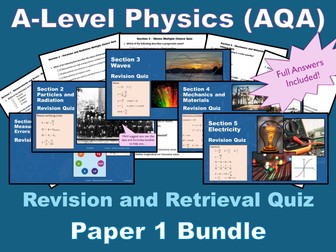
Unlock the potential of your KS5 students with this comprehensive bundle of AQA A-Level Physics Year 12 Revision and Retrieval Quizzes.
This bundle includes a multiple-choice quiz for the first 5 sections of the A-Level Physics specification, providing a multi-purpose resource for effective revision and assessment of the topics typically taught in year 1.
Key Features:
Dual Format: Delivered as PowerPoint slide decks for interactive class quizzes and as Word documents for easy printing and homework assignments.
Ready to Use: Designed for immediate implementation, saving you hours of valuable preparation time. Includes answers on PowerPoint slides and printed formats, with full solutions provided to aid understanding and support student progress.
Broad Coverage: Each quiz contains 25 questions, offering a mix of recall, application, and calculation problems aligned with the learning outcomes of the AQA A-Level Physics specification.
Versatile: Perfect for revision ahead of mocks, AS exams, or A-Level Physics Paper 1. Ideal for formative assessment, baseline testing for Year 13 transition, or independent study.
Sections included:
Measurements and Errors
Particles and Radiation
Waves
Mechanics and Materials
Electricity
6.1. Periodic Motion (Free sample)
Similar Resources:
AQA A-Level Physics Paper 2/Year 13 Quiz Bundle
Gravitational Fields - A Level Revision Quiz
Electric Fields - A Level Revision Quiz
Thermal Physics Retrieval and Revision Quiz
This lesson aims to provide them with an awareness so they are able to answer theory questions. I then arranged for St John Ambulance to come in to deliver a basic first aid course to students to gain their certificate.
This could be amended to be delivered in tutorial or detail added to make it applicable to higher level BTEC or A-Level courses.
This PowerPoint contains activities on how to call 999 and what to say, DR ABC protocol, risk assessment, basic treatment of unconsciousness, burns, bleeding, fractures, anaphylaxis and choking.
Their are practical activities throughout with instructions which include scenarios.
You would benefit from basic first aid supplies e.g. gloves, bandages etc.
CPR is not included in the lesson content due to health and safety implications and not having access to a resuscitation mannequin at the time of delivery.
Teacher will need some basic prior knowledge to deliver this lesson.
Print these off back to back and laminate. These work amazingly well at aiding students in recalling starting positions as well as having boundaries on the reverse.
Laminate and use whiteboard pens to get students to recall where each player must start!
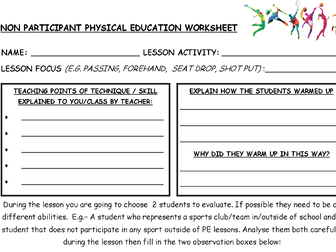
Designed to aid secondary school PE teachers in giving non participants a productive worksheet to complete if they are unable/it is not relevant for them to coach/umpire during the lesson. The worksheet is generic for any activity and will develop the analytical skills of the pupil. The worksheet will ask the pupil to explore the lesson objectives, the warm up, the coaching points of the skill being taught and to analyse two students of differing abilities. Furthermore, there is a differentiated additional task of designing a new drill/activity with options to increase/decrease the difficulty of the exercise.
** An Ofsted inspector was very impressed with the content of the sheet when questioning a non participant in my group and stated 'an excellent and challenging PE resource for all capabilities' . **
Furthermore, we all have students who like to make up excuses/convince their parents they are too ill for PE so hand you a note to be excused. When they realise there is writing involved in PE each time they manage to be excused from participating they may decide that taking part in the lesson is the a more sensible option! Which is what an outstanding PE teacher should want- all their students to be actively involved if possible.
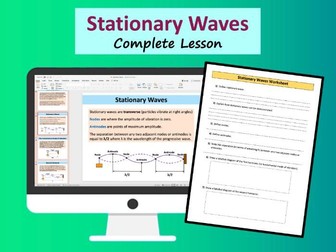
This resource is a complete lesson that covers Stationary Waves for the OCR A Level Physics A course. However, it is useful for other exam boards too.
This lesson teaches the following content:
-stationary (standing) waves using microwaves, stretched strings and air columns
-graphical representations of a stationary wave
-similarities and the differences between stationary and progressive waves
-nodes and antinodes
-stationary wave patterns for a stretched string and air columns in closed and open tubes
-techniques and procedures used to determine the speed of sound in air by formation of stationary waves in a resonance tube
-the idea that the separation between adjacent nodes (or antinodes) is equal to λ/2, where λ is the wavelength of the progressive wave
-fundamental mode of vibration (1st harmonic); harmonics.
This lesson includes:
-A full presentation including 3 example questions with worked solutions.
-A worksheet with model answers, perfect to set as homework.
-Clear visual aids and diagrams to simplify complex concepts.
-Editable PowerPoint and Word document for easy customisation.
Click on the links below to check out our FREE A Level Physics resources:
Mass, Weight & Force Basics Lesson
Net Forces & Equilibrium Lesson
Moments & Torques Lesson
Drag & Terminal Velocity Lesson
Density, Pressure & Upthrust Lesson
We appreciate your feedback! If you found this resource helpful, please leave a review — it helps us continue creating high-quality materials. For questions, contact resourcifyeducation@gmail.com
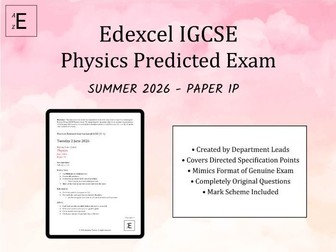
The original and still the best! For a fifth year running, our heads of department have been hard at work to create a series of predicted exams for Summer 2026!
This is for the following paper: 4PH1 - 1P
These questions are completely original and have been designed from scratch. There has been no reuse of previous exam questions.
Our mock paper follows the format of the true Edexcel IGCSE Physics 1P paper closely. It is also the exact duration and mark-count, with questions of increasing difficulty. A mark scheme is also attached.
The paper covers the following specification points:
• Topic 1b - Movement and position (1.3 - 1.6)
• Topic 1c - Forces, movement, shape and momentum (1.19 - 1.21)
• Topic 2b - Mains electricity (2.5 - 2.6)
• Topic 2c - Energy and voltage in circuits (2.9 - 2.17)
• Topic 3b - Properties of waves (3.2 - 3.9)
• Topic 3c - The electromagnetic spectrum (3.10 - 3.13)
• Topic 3d - Light and sound (3.18 - 3.22)
• Topic 4b - Energy resources and energy transfers (4.2 - 4.8)
• Topic 4c - Work and power (4.13 - 4.15)
• Topic 5b - Density and pressure (5.3 - 5.4)
• Topic 5d - Ideal gas molecules (5.15 - 5.22)
• Topic 6c - Electromagnetism (6.8, 6.15)
• Topic 7b - Radioactivity (7.2 - 7.8)
• Topic 7c - Fission and fusion (7.17 - 7.20)
• Topic 8b - Motion in the universe (8.3 - 8.6)
• Topic 8c - Stellar evolution (8.7 - 8.10)
Please note that the content is similar to the 2025 edition.
Disclaimer: This document was created by department heads with many years of experience teaching the Pearson Edexcel IGCSE Physics course. We cannot however guarantee that it is an accurate representation of the 2026 examinations and students should not treat it as such. Please use this as an aid, alongside other methods of revision.
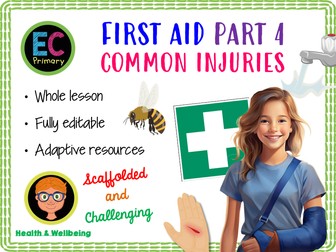
First Aid: Common Injuries - New for the 2024/25 Academic Year!
This brand-new lesson is the fourth instalment of our progressive First Aid curriculum, which begins in Year 3 and continues through to Year 6, culminating in lessons on life support and CPR.
Other lessons in this series:
First Aid Part 1 - Burns and Scalds
First Aid Part 2 - Allergies and Anaphylaxis
First Aid Part 3 - Asthma and Allergies
First Aid Part 4 - Common Injuries
First Aid Part 5 - Life Support
Developed as part of our enhancement to the primary PSHE scheme of work, this lesson seamlessly fits into our Year 5 module on health, including both physical and mental illness.
The lesson begins with a retrieval activity linked to burns and scalds, which was last taught in Year 3, before focusing on common minor injuries such as cuts, grazes, sprains, strains, bites, stings as well as minor head injuries. It then introduces key terms, includes a scavenger hunt activity with reflection questions, as well as an interactive plenary. As always, our resources are fully editable, detailed, engaging, and ready to use! Our materials support an adaptive teaching style, offer reflective assessment opportunities, and include scaffolded resources. They are ambitious and challenging, ensuring all students have the opportunity to excel.
Who are EC Resources?
EC Resources are the top TES PSHE providers and are a group of teachers who work together to create easy to use, high quality and editable lessons and units of work. We have created lessons for The bank of England, The Children’s Commissioner, The Bank of England, MACS Charity, Tes, LikeToBe Careers, the Criminal Cases Review Commission (UK Gov) and have also completed PSHE and Citizenship commissions for schools across the UK.
You can contact us at info@ecpublishing.co.uk
Teaching PSHE, RE or Citizenship GCSE next year? Why not join our Citizenship and PSHE teachers Facebook group, with 7000 other teachers, for guidance, advice and resource sharing.
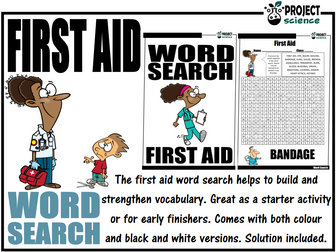
A word search on common vocabulary found in first aid. Great as a starter activity or for early finishers. Comes with colour and black and white versions. Complete with solution.
Includes the following vocabulary:
➸ first aid ➸ CPR ➸ injury ➸ wound ➸ bandage ➸ sling ➸ gauze ➸ broken ➸ ambulance ➸ paramedic ➸ burn ➸ blood ➸ bleeding ➸ sprain ➸ breathing ➸ choking ➸ airway ➸ heart attack ➸ asthma
Why choose word searches?
➸ They help develop word recognition and can enhance spelling.
➸ They introduce new vocabulary.
➸ They help consolidate vocabulary.
➸ They help develop pattern recognition.
➸ They help improve problem-solving skills.
➸ They support learning context clues.
➸ They are self-differentiating.
➸ They can assist in boosting working memory.
➸ They foster persistence.
Clipart by:
Ron Leishman
ToonClipart
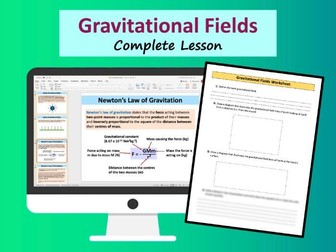
This resource is a complete lesson that covers Gravitational Fields for the OCR A Level Physics A course. However, it is useful for other exam boards too.
This lesson teaches the following content:
-gravitational fields are due to objects having mass
-modeling the mass of a spherical object as a point mass at its centre
-gravitational field lines to map gravitational fields (uniform and radial)
-the concept of gravitational fields as being one of a number of forms of field giving rise to a force
-Newton’s law of gravitation; F = -(GMm)/r² for the force between two point masses (inverse square law)
This lesson includes:
-A full presentation including 2 example questions with worked solutions.
-A worksheet with model answers, perfect to set as homework.
-Clear visual aids and diagrams to simplify complex concepts.
-Editable PowerPoint and Word document for easy customisation.
Click on the links below to check out our FREE A Level Physics resources:
Mass, Weight & Force Basics Lesson
Net Forces & Equilibrium Lesson
Moments & Torques Lesson
Drag & Terminal Velocity Lesson
Density, Pressure & Upthrust Lesson
We appreciate your feedback! If you found this resource helpful, please leave a review — it helps us continue creating high-quality materials. For questions, contact resourcifyeducation@gmail.com