A non-chronological text pack including model text, feature find worksheets, and planning and writing templates to write an information text about the yellow-spotted lizard from the novel Holes by Louis Sachar.
Resources provided:
• Non-chronologcial report WAGOLL text
• Non-chronologcial report Feature Find worksheet differentiated x3
• Non-chronologcial report Feature Find answers
• Planning sheets differentiated x2
• Writing templates differentiated x2
• Task explanation sheet
Structural, grammar, punctuation and language features included in the model information text:
• Heading
• Introduction
• Subheadings
• Bullet-pointed list
• Picture/diagram with caption
• Present tense
• Adverbs of degree
• Alliteration
• Brackets to add a definition
• Complex list with semi-colons
• Embedded relative clauses
• Expanded noun phrases
• Fronted adverbials
• Modal verbs
• Passive voice
• Relative clauses
• Subordinate clauses
• List introduced with a colon
• Singular possessive nouns
• Plural possessive nouns
Pupils read the model non-chronological report, identify the features, and then plan and write their own non-chronological report about the yellow-spotted lizard using the templates provided.
The resources are provided in both PDF and editable Word format.
More Holes themed resources:
✦ Holes Complete Unit of Work | Four Weeks | Year 5/6
✦ Holes: Example Text Pack BUNDLE
✦ Holes: Description Example Text Pack
✦ Holes: Character Profile Example Text Pack
✦ Holes: Newspaper Report Example Text Pack
Other popular resources:
✦ Percy Jackson BUNDLE
✦ Harry Potter BUNDLE
✦ Street Child BUNDLE
✦ Stormbreaker BUNDLE
✦ Oranges In No Man’s Land BUNDLE
✦ The Nowhere Emporium BUNDLE
✦ The Boy at the Back of the Class BUNDLE
✦ The Iron Man Unit of Work | Year 3/4
✦ Stig of the Dump Unit of Work | Year 3/4
Visit Helen-Teach’s Shop for more resources.
Example newspaper report pack based on the popular novel Holes by Louis Sachar.
This exemplar newspaper article is perfect to use as a WAGOLL when studying the mystery adventure bookHoles. The example text reports on Stanley Yelnat’s conviction for theft, from chapters 1 to 6 in the book.
The model newspaper report comes with a feature find worksheet for children to fill in, with answer sheet, to give students the opportunity to examine the text in detail. After identifying the features, pupils complete the quotation punctuation worksheets, filling in the missing punctuation marks.
Then pupils use the templates provided to plan and write their own newspaper report based on the example text or other events that take place in the novel.
This resource comes with the following documents:
• Example newspaper report WAGOLL
• Feature find worksheets, differentiated x 3
• Feature find answers
• Quotation punctuation activity with answers
• Newspaper report planning templates
• Newspaper report writing templates, differentiated x2
• Labelled writing templates
The genre-specific, language, grammar and punctuation features in the text include:
• Headline with alliteration
• Byline
• Date
• Lead: introductory paragraph containing 5 Ws
• Quotes, with inverted commas
• Photograph with caption
• Passive voice
• Past tense
• Third person
• Relative clauses
• Alliteration
• Fronted adverbials followed by comma
• Synonyms to avoid repetition
• Expanded noun phrases
• Subordinating conjunctions
• Modal verbs
• Present perfect tense
• Hyphens
• Apostrophes for contraction
• Apostrophes for singular possession
• Apostrophes for plural possession
All resources come as both easily editable Word documents and PDFs.
More Holes themed resources:
✦ Holes Complete Unit of Work | Four Weeks | Year 5/6
✦ Holes: Example Text Pack BUNDLE
✦ Holes: Description Pack
✦ Holes: Non-Chronological Report Pack
✦ Holes: Character Profile Pack
Other popular resources:
✦ Lightning Thief BUNDLE
✦ The Nowhere Emporium BUNDLE
✦ The Iron Man Unit of Work
✦ Stig of the Dump Unit of Work
Visit Helen-Teach’s Shop for more resources.
This document is a structured research planning template designed to help students organize their Cambridge IGCSE Global Perspectives Individual Report. It guides them step-by-step through the research process, from identifying a topic and research question to compiling sources, analyzing causes and consequences, and exploring different perspectives.
The template is divided into six main sections:
Introduction:
Students define the global issue, explain its importance, and record initial sources with notes on reliability.
Causes and Consequences:
They identify at least two causes and two effects of the issue, supported by research sources.
Global Perspective:
Focuses on what international organizations or global actors say about the issue, helping students understand the worldwide impact or response.
National (or Local) Perspective:
Encourages analysis of opinions, policies, or data from a specific country - often the student’s own - to contrast with global views.
Course of Action / Solutions:
*Students propose local and global solutions, specifying who should act and predicting possible impacts.
Conclusion:
Summarizes the student’s final stance on the research question, referencing key evidence and reflecting on what was learned.
Each section includes a clear table for sources - listing the link, title, author or organization, main ideas, and an evaluation of reliability - promoting critical thinking and proper referencing skills.
This resource helps students stay organized, meet Cambridge assessment objectives, and produce well-structured, evidence-based reports.
A clear and easy-to-use newspaper planning sheet designed to support pupils when writing a newspaper report. The template helps children plan their ideas and structure their writing before producing a full report.
Suitable for KS1 pupils and can be used across a range of topics, stories, or classroom events. Ideal for introducing newspaper writing and supporting early report writing skills.
Overview of the Unit:
Lesson 1: Engage Through Drama
Kick off the unit with playscripts and hot seating to spark interest and immerse pupils in the Viking topic.
Lessons 2–4: Master Relative and Embedded Clauses
Build technical skills by focusing on relative clauses and embedded clauses using dashes. Scaffolded tasks include identifying, practicing, and applying these skills to descriptive paragraphs about the Vikings.
Lesson 5: Expanded Noun Phrases and Prepositional Phrases
Teach pupils to add detail and precision to their writing by crafting vivid sentences about Viking roles and lifestyle.
Lesson 6: Ad Same Ad Sentence Structure
Introduce Allan Peat’s Ad Same Ad sentences to help students create impactful, descriptive sentences.
Lesson 7: Describing Viking Clothing
Apply learned skills to describe Viking clothing and settlements, blending expanded noun phrases, prepositional phrases, and Ad Same Ad sentences.
Lessons 8–10: Using Formal Language
Guide students to write formally, using generalizers and precise vocabulary, while practicing formal sentence construction.
Lesson 9: Plan the Report
Pupils organize their ideas under clear subheadings, ensuring all features—relative clauses, formal language, expanded phrases—are included.
Lessons 10–12: Writing the Non-Chronological Report
Over three lessons, pupils draft their reports, working to different ability levels with sentence starters, scaffolds, and modeled examples.
Lesson 13: Publish with Style
Pupils polish their work, adding illustrations and neat formatting to create a final report ready for display or assessment.
Key Features:
Fully differentiated tasks to support lower ability, age-related, and greater depth learners.
Focus on grammar skills: relative clauses, embedded clauses, expanded noun phrases, and formal language.
Engaging activities including hot seating, sentence crafting, and publishing with illustrations.
Scaffolds, WAGOLLs, and success criteria provided for every step.
Perfect for cross-curricular links with history or thematic units on the Vikings.
Why Teachers Love It:
Saves time with ready-to-teach lesson plans and resources.
Encourages creativity alongside rigorous grammar skills.
Supports writing progression with clear success criteria and scaffolded tasks.
Engages learners with a high-interest topic and varied teaching methods.
What’s Included:
13 detailed lesson plans with objectives, activities, and differentiation.
WAGOLL examples for each skill.
Printable planning templates, worksheets, and success criteria.
Editable resources for tailoring to your class.
Example newspaper report based on the children’s novel The Iron Man by Ted Hughes.
This exemplar newspaper article is perfect to use as a WAGOLL when studying The Iron Man. The example text reports on the events in Chapter 3 of the book when the Iron Man digs himself out of the hill.
The model newspaper report comes with two feature identification worksheets for children to fill in, one for layout features and one of language and grammar features, plus answer sheets.
Then pupils use the templates provided to plan and write their own newspaper report based on the example text. Pupils’ reports can be about the events in Chapter 3 or a different event from later on in the novel.
This resource comes with the following documents:
• Example newspaper report
• Feature find sheets, x2
• Feature find answers, x2
• Newspaper report planning template
• Newspaper report writing templates x2
The features in the text include:
• Headline in the present tense
• Byline
• Date
• Introductory paragraph containing the 4 Ws
• Quotes, with inverted commas
• Photograph with caption
• Alliteration
• Past tense
• Third person
• Relative clauses
• Fronted adverbials
• Possessive nouns
All resources come as both easily editable Word documents and PDFs.
You may also be interested in:
✦ The Iron Man Unit of Work | Four Weeks | Year 3/4
✦ The Iron Man Example Diary Text with Features
✦ The Iron Man Dialogue Writing - Example Text & Feature Identification Sheet
✦ The Iron Man - Example Apology Letter from Hogarth & Feature Identification
✦ Iron Man 6 Example Texts Plus Glossary BUNDLE
✦ Iron Man Example Texts BUNDLE: Diary, Dialogue & Non-Chronological Report with Features Sheet & Answers
Visit Helen-Teach’s Shop for more resources.
Designed for headteachers, school business managers and SLT, this ready-made template gives you a clear, structured starting point for reporting on school finances to your governing board without having to build a report from scratch.
You’ll get:
Finance Report to Governors Template – a comprehensive, editable 10-page Word document covering:
pupil numbers and funding impact
a summary of the current budget including income, expenditure and reserves
in-year budget monitoring with variance analysis
a three-year financial forecast
detailed income and expenditure breakdowns
pupil premium allocation, strategy and impact
spending aligned to school priorities and value for money
benchmarking against similar schools using the DfE Financial Benchmarking and Insights Tool
a procurement and contract register
a financial risk register
SFVS and compliance checks
a summary and evaluation section including recommendations for the governing board and governor questions and challenges
All sections are fully editable so you can adapt the template to your school’s context and reporting cycle.
For further reports to governors, visit our Honeyguide-SLS website.
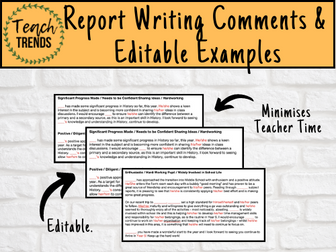
A template with citations for Outstanding, Good, Satisfactory and Unsatisfactory.
Particular words are highlighted to make it easier for you to adapt to your own subject, students, targets and words.
There are also sentence starters to help you compose your own report and a list of general targets that you can use.
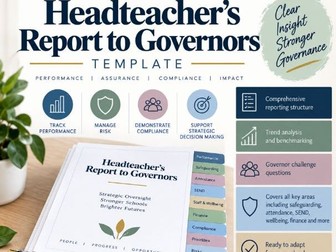
The headteacher’s report to governors is essential for providing the governing body with the necessary information about the school to make informed strategic decisions, ultimately enabling them to fulfil their responsibilities. Utilise our Headteacher’s Report to Governors to ensure you share the appropriate information each term to keep governors up to date. This fully editable word document template enables you to share information such as pupil numbers, staffing, attendance, SEND, safeguarding, behaviour, welfare, quality of education and more in an easy to read and digest format.
Our full 2025 Ofsted Inspection Preparation pack includes this and so much more. Visit our website for further information.
Disclaimer: This resource is intended solely for informational purposes and should not be interpreted as professional advice. The information provided herein is not tailored to your specific circumstances therefore we can not guarantee the completeness, accuracy or appropriateness of the information presented. Any reliance you place on the information provided is strictly at your own risk.
Save time and strengthen governance with this comprehensive, ready-to-use Headteacher’s Report to Governors template.
Designed to support strategic governance, accountability and statutory oversight, this resource provides a clear structure for reporting the information governors really need – without becoming overwhelmed by operational detail.
Ideal for headteachers, senior leaders, Chairs of Governors, trustees and governance professionals.
The template supports leaders to report clearly on:
• School performance and key priorities
• Safeguarding assurance
• Attendance
• SEND and vulnerable groups
• Staffing, wellbeing and workload
• Finance and resources
• Statutory compliance
• School improvement priorities
• Strategic risks and mitigating actions
• Achievements, successes and emerging concerns
Built-in prompts and governor challenge questions encourage leaders and boards to consider evidence, impact, trends and next steps rather than simply reporting activity.
The framework also encourages three-year trend analysis, national comparisons and appropriate benchmarking, helping governors understand the bigger picture and identify emerging patterns.
Using this template can help schools:
• Save valuable leadership time
• Improve the consistency and quality of governor reporting
• Strengthen strategic oversight and challenge
• Demonstrate statutory assurance
• Track trends and priorities over time
• Ensure key areas are not overlooked
• Create a clear evidence trail of leadership evaluation and governor scrutiny
A practical termly reporting framework bringing performance, assurance, compliance, risk and strategic oversight together in one structured document.
Ready to adapt to your own school, academy, trust, special school or alternative provision setting.
A selection of different report writing examples and templates to assist you with writing a generalised report for students in your form or tutor groups as well as for the subject of Geography. These resources are best used when writing reports which are to include an overview of students’ subject reports as well as their other commitments in school, for example, art, sport or music activities. Several other documents can also be used for writing subject-specific reports
The report examples in this download range from capable/high achieving students to students with poor focus and concentration as well as those involved within the wider school community.
11 Different Form/Tutor Group Reports Included
4 Different Year 5 End-of-Term reports Included
Each report includes highlighted possessive pronouns (he/she/him/her) and well as blank lines to easily identify relevant changes to be made.
Reports range from approx. 200 - 400 words in length
Available for download on Pages and as a Word document.
Templates & Examples for form tutor reports and also for Design Technology subject reports. They are very detailed and can be used for a range of year groups. The offer a different range of abilities.
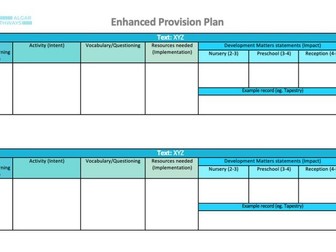
Plan purposeful enhancements to your EYFS provision with this simple, fully editable Enhanced Provision Planning Template.
Designed to help practitioners clearly demonstrate the intent, implementation and impact behind enhanced provision, this reusable template provides space to plan activities while considering vocabulary, questioning, resources, Development Matters and individual children.
Each planning section includes space for:
Area of Learning / Learning Objective
Activity and Intent
Vocabulary and Questioning
Resources / Implementation
Development Matters statements / Impact
Nursery (2–3)
Preschool (3–4)
Reception (4–5)
Targeted key children
Example observation/evidence records
The editable Word format means the template can be duplicated, adapted and reused throughout the year for different topics, texts, themes and children’s interests.
Format: Editable Microsoft Word document
Suitable for: Nursery, Preschool and Reception / EYFS
A useful planning tool for teachers, Early Years practitioners and EYFS leads wanting to make the purpose behind enhanced provision clear without overcomplicating planning.
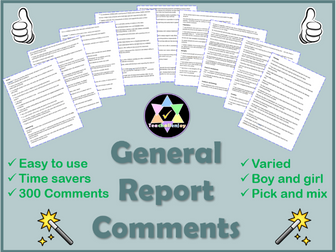
300 general report comment statements covering all aspects of school life. Easily make 30 different personalised paragraphs for your class. Use the boy or girl versions to save even more time. Suitable for KS1 and KS2.
Choose from the 300 comments, enough to create a whole class of different reports, 10 different statements to choose from for every child. Quickly create your general report comment paragraphs by selecting the right comment to suit each child, one from each of the 10 sections. Describe your pupils in a precise, eloquent and efficient way.
Written for all primary year groups, relevant for years 1, 2, 3, 4, 5 and 6
High Quality
Use these high quality comments, 18 pages covering:
Overall Introduction
Working and Learning Style
Attitude
Working & Playing With Others
Behaviour
Learning Outcomes & Presentation
Strengths
Next Steps
Responsibilities, Homework & Spellings
Summary and Looking Forward
Easy to Use
All the comments come in a girl and a boy version saving you having to change any pronouns. All names are replaced with 3 stars so you just have to find and replace to insert names.
Save Time
Teaching is busy enough without report writing as well, save time whilst doing a good job. Easily copy and paste these thoughtful comments to create personalised and admired reports.
Also…
Check out these other handy end of year resources:
English Report Comments
Maths Report Comments
Geography Report Comments
A planning template has sections for headlines, what, why, who, where, when and quotes. The writing templates follow a traditional newspaper format with sections for the date, headline and an illustration.
Inkwell Plans creates high quality lesson sequences. This resource is from a unit of work on the theme of Lost in Books.


 Quick View
 Quick View
 Quick View
 Quick View
 Quick View
 Quick View
 Quick View
 Quick View
 Quick View
 Quick View
 Quick View
 Quick View
 Quick View