GCSE Single Award Chemistry Mind Map on Metals, Reactivity Series, Flame Tests, Metal-Water, Metal-Acid, Investigating Reactivity, Exothermic, Endothermic Reactions, Investigating Exothermic Reactions, Electrolysis, Aluminium Extraction, Rates of Reaction, Measurement, Interpreting Graphs, Factors affecting Rate of Reaction and Collision Theory in a bright, clear and accessible format (CCEA Specification)
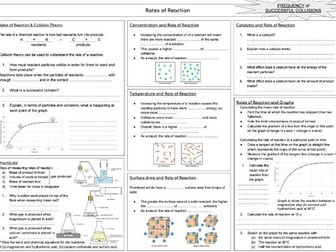
KS4 Science Edexcel iGCSE Revision Spread and Answer Sheet - Chemistry: Rates of Reaction.
This A3 revision spread can be printed off and filled in to aid revision and help summarise the topic.
A full answer sheet is provided which can be used to mark the filled in revision spread and can also be used as a revision poster.
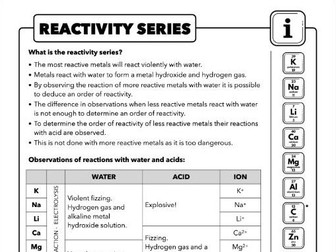
This resource is what I use as the first lesson of the AQA GCSE Chemistry ‘Chemical changes’ topic in paper 1. The resource introduces students to using reactions of metals with water and acids in order to determine an order of reactivity. The metal reactivity series resource works well alongside a teacher demo and student practical. The resource includes:
Information sheet (Reactivity series)
Worksheet (Reactivity series)
Answer sheet (Reactivity series)
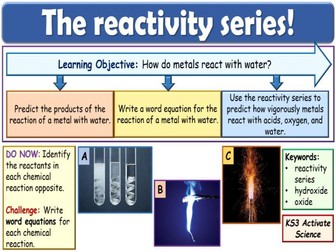
Perfect lesson resource for KS3 Chemistry! A fully differentiated and resourced lesson that assists students in learning about how metals react with water. Students will predict the products of the reaction of a metal with water, write a word equation for the reaction of a metal with water, and use the reactivity series to predict how vigorously metals react with acids, oxygen, and water.
The resource includes a detailed and engaging lesson PowerPoint with differentiated activities, worksheet, quizzes, and a class practical activity for students to complete. This resource is part of the Metals and other materials topic and has been created for the delivery of the Activate KS3 Science course. Also great for GCSE Science.
*Included:
16 slides in total for the lesson PPT
Differentiated worksheet *
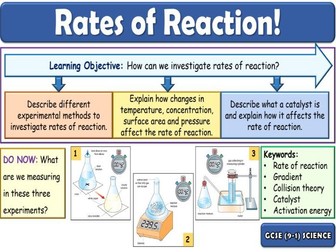
Perfect if you teach GCSE Chemistry Single Science, this fully differentiated and resourced lesson supports your students in learning about rates of reaction. Covering the full GCSE Chemistry specification, this resource is adapted to cover all exam boards. Students will:
State what is meant by rate of reaction.
Calculate the rate of a reaction.
Describe the different experimental methods used to investigate the rate of a reaction - disappearing cross experiment, change in mass experiment, volume of gas given off experiment.
Explain what is meant by collision theory and state what factors the rate of a reaction depends on.
Explain how changes in temperature, concentration, pressure and surface area affect the rate of reaction.
Complete rate experiments involving gases and precipitates.
Describe what a catalyst is and explain how it affects the rate of a reaction.
This lesson includes a detailed and engaging lesson PowerPoint with differentiated activities, class practical/demo activities, exam style questions and progress quizzes for students to complete. Enjoy and feel free to leave a review.
*INCLUDED IN BUNDLE:
24 slide PowerPoint Presentation with key points, progress check questions, checkpoints, practice exam questions, quizzes, class practical activities. *
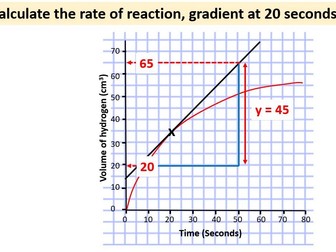
A step-by-step lesson to teach students how to fit a tangent to a curve and calculate a gradient. Fully animated steps
Embedded video
Graph drawn on squared paper for teacher to model with class
Exam questions and work sheets
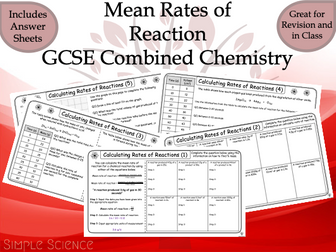
This resource contains 5 worksheets for mean rates of reaction in rate of reactions that can be used in class or as homework to enable your students to practice what they have learnt in the classroom. The diagrams are simple to aid students to visually see what may come up in their upcoming GCSE exams.
These resources could used to check prior learning for your students so you can plan accordingly for future lessons. I hope your students find these useful either in the classroom or as revision.
Students will be:
Calculating the mean rates of reaction
Interpreting table data
Interpreting graphs
Drawing tangents of a curve.
We currently have worksheets for the following topics in Chemistry Paper 2:
Rate and Extent of Chemical Change
Calculating Mean Rates of Reaction
Le Chatelier’s Principle – Equilibrium
Organic Chemistry
Alkenes – Triple
Reactions of Alkenes – Triple
Alcohols - Triple
Carboxylic Acids - Triple
Chemical Analysis
Identification of Common Gases
Identification of Ions - Triple
Flame Emission Spectroscopy – Triple
Please take a small amount of time to review this resource to let other buyers know your thought about these worksheets.
Thank you!
AQA C6 topic ‘The Rate and Extent of Chemical Change’.
Suitable for combined science F/H and triple.
Lesson:
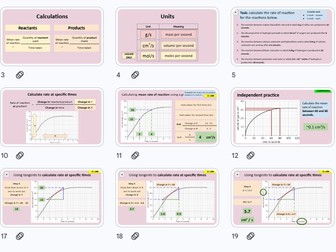
Calculating rate of reactions using volume/mass of reactants or products, units, calculation practice, drawing tangents on graphs, using tangents to calculate rates of reaction.
Includes:
teacher slide (recall starter, information, activities and independent practice - answers to every task) - one for higher/triple, another for foundation (F).
graphs to print for students to practice drawing tangents/calculate rate.
Fully planned and resourced lesson with self assessment, AFL, scaffolding and challenge tasks.
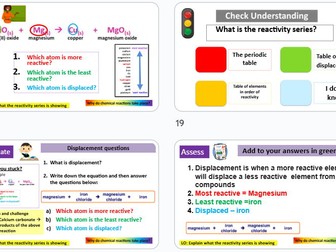
LO: Explain what the reactivity series is showing
Write the correct order of the reactivity series
Describe what the reactivity series is showing
Describe the term displacement
The new AQA Combined Science Trilogy Unit 6 - The rate and extent of chemical change.
Includes powerpoints, worksheets and practical worksheets.
Divided into the following lessons:
4.6.1.1 Calculating Rates of Reaction/Rates graphs and tangents.
4.6.1.2/3 Factors which affect rates of reaction and collision theory.
4.6.1.4 Catalysts
4.6.2.1/2 Reversible reactions and energy changes
4.6.3 Equilibria (all)
Required Practical 5 - part a disappearing cross
Please see my other reviews for an insight as to the time and effort I put into making these of a high quality.
As always I really appreciate your feedback so please do comment below!
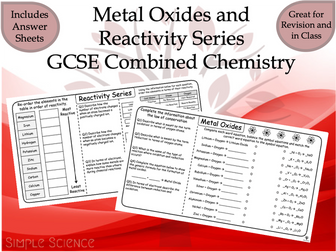
This resource contains 2 worksheets for metal oxides and the reactivity series that can be used in class or as homework to enable your students to practice what they have learnt in the classroom.
This resource contains:
Metal Oxides
Reactivity Series
We have worksheets for the following topics in Chemistry Paper 1:
Atomic Structure and The Periodic Table
Atoms, Elements and Compounds
Mixtures and Separation Techniques
Relative Atomic Mass and Electronic Structure
The Periodic Table and Metals
Groups 0 & 1
Group 7
Bonding, Structure, and The Properties of Matter
Ionic Bonding
Covalent and Metallic Bonding
Structure and Bonding of Carbon
Quantitative Chemistry
Balancing Equations
% Mass
Relative Atomic and Formula Mass
Amount of Substances in Equations
The Mole
Using Moles to Balance Equations
Limiting Reactants
Concentration of Solutions
Chemical Changes
Metal Oxides and Reactivity Series
Displacement Reactions
Extraction of Metals and Reduction
Ionic Equations
Reactions of Metals with Acids
Neutralisation of Acids
pH Scale, Neuralisation, and Strong & Weak Acids
Electrolysis
Energy Changes
Energy Transfers and Reaction Profiles
Energy Changes of Reactions
More worksheets will be added in the future.
Please rate and review this resource. Thank you!
This PowerPoint resource, Lesson 1 - Rates of Reaction, introduces students to the concept of reaction rates in chemistry. Designed for secondary-level science classes, this resource helps students define key terms such as reactants, products, and rate of reaction, while also exploring methods for measuring reaction rates using real-world examples.
The lesson includes engaging activities like graph plotting, calculating gradients, and analyzing reaction data to determine the mean and instantaneous rates of reaction. Students will develop critical analytical skills by interpreting graphs and calculating the gradient of tangents to measure reaction rates at specific points. Key methods for measuring reaction rates, including gas collection, mass loss, and time-to-precipitate formation, are thoroughly explained and accompanied by visual examples.
This resource also features interactive starter activities, extension challenges, and plenary tasks, ensuring comprehensive coverage of the topic while catering to varying student abilities. It is compatible with most devices, provided in a .pptx format, and can be used with software like Microsoft PowerPoint or Google Slides.
Last updated on 12/12/24, this resource includes updates to video links and questions for better user experience. Perfect for teachers aiming to simplify complex chemistry concepts, this resource is aligned with standard curricula and designed to enhance both classroom and independent learning.
This engaging PowerPoint presentation, titled Surface Area, provides an in-depth exploration of how surface area affects the rate of chemical reactions. It is specifically designed for science educators aiming to deepen students’ understanding of collision theory and reaction dynamics.
The resource begins with clear learning objectives: identifying factors influencing reaction rates and explaining how surface area impacts these rates. A starter activity involving word unscrambling and foundational questions primes students for the main content. The lesson introduces collision theory, activation energy, and the role of particle interactions in reaction rates.
Students explore the effects of surface area through practical examples, including calculations comparing the surface area of whole cubes and smaller subdivisions. Visual aids and structured activities, such as filling in the gaps and analyzing reaction scenarios, enhance comprehension. A detailed explanation of how increased surface area leads to more frequent and energetic collisions solidifies theoretical understanding.
This resource also includes a practical alternative using a video demonstration of calcium carbonate reacting with hydrochloric acid. Students learn to graph reaction rates and interpret data, distinguishing between scenarios involving whole and crushed marble chips. The steeper slope for crushed chips vividly illustrates the concept of reaction rate acceleration.
Practice questions and challenge questions extend learning opportunities for diverse student abilities. The included file is a PowerPoint presentation (.pptx), ensuring compatibility with standard devices. Updated with the latest interactive features and alternative formats, this resource is a valuable tool for both classroom and virtual teaching environments.
Keywords: Collision Theory, Surface Area, Reaction Rate and Activation Energy.
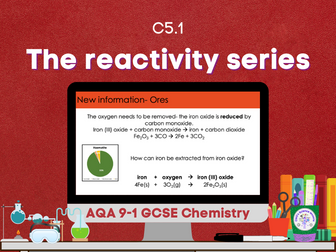
During this lesson (C5.1 The reactivity series) GCSE students work through a variety of tasks to develop their understanding of the order of reactivity of metals based on experimental results. Based on the 1st from the AQA 9-1 GCSE Chemistry (OUP scheme) C5: Chemical changes chapter.
Also available as a digital worksheet, which is ideal for distance learning, independent study or catch-up of missed work through absence.
Presentation contains (22 slides)-
Bell work activity
Lesson objective and success criteria
Information slides
Challenge activities (group work)
Practical activity (where appropriate)
Demonstrate understanding tasks (with answers)
Lesson resources (additional to scheme)
Aimed at a mixed ability class covering content 1-8.
Please note: Kerboodle worksheets from scheme are not included due to license.
If you require more assistance, please contact me at-
cmgeducationresources@gmail.com
Revision booklet aimed at y8 for the following topics:
Metal reactions
Reactivity series
Displacement
Rates of reaction
Includes exam questions
Can be done as a class or independently
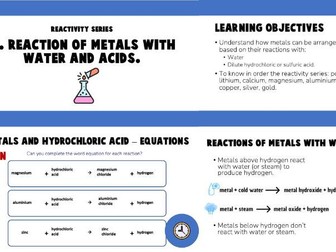
This resource is Lesson 1 of the Reactivity Series unit for IGCSE/GCSE Chemistry (Edexcel-aligned but adaptable to other boards), introducing students to how metals are arranged in order of reactivity based on their reactions with water and dilute hydrochloric or sulfuric acid. Students learn the full reactivity series — potassium, sodium, lithium, calcium, magnesium, aluminium, zinc, iron, (hydrogen), copper, silver, gold — and explore the investigation used to determine this order through observation and temperature changes.
It consists of a fully editable PowerPoint presentation (with embedded teacher notes, structured activities and on-screen timers), a print-ready PDF version of the presentation, plus a ready-to-use worksheet to consolidate understanding and support equation writing and analysis. Everything is laid out for immediate classroom use and requires no additional preparation.
Presentation PPTX – includes learning objectives, activities and built-in timers
Presentation saved as PDF
Worksheet included
What you see is just a preview and selection of a few slides.
While some of the images used weren’t created by me, what you’re purchasing is the carefully structured lesson plan along with the custom-designed presentation and worksheet.
A fully-resourced lesson which looks at the meaning of the rate of reaction and guides students through calculating both the mean and instantaneous rate of reaction. The lesson includes a concise lesson presentation (19 slides) and a question worksheet which is differentiated two ways.
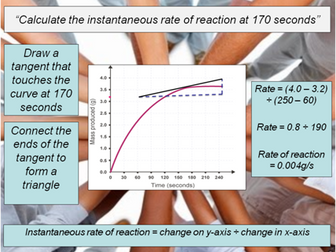
The lesson begins by challenging the students to suggest the missing factor in the rate of reaction equation so they can learn that either the mass of a reactant or a mass of a product could be used. Links are made to practical skills as students will understand that if a product is in the gaseous form, the volume produced within a set time will enable the rate to be calculated. Worked examples are used to show the students how to calculate the mean rate of reaction and then the instantaneous using a tangent. The rest of the lesson involves collecting data from an experiment to calculate the rate of reaction. The questions associated with the practical have been differentiated so students who need assistance can still access the learning.
This lesson has been written for GCSE students
Quiz based on hyperlinked slides. One mistake and it is 'Game over'. Also includes explanation slides, so could be good for independent learning and revision