Phase 3 and 4 read and draw slides, perfect for morning work!
17 slides (one for each phase 3 sound) with sentences using phase 3 and 4 words. Read the sentences and draw the
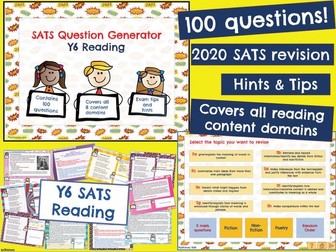
SATS - 100 reading questions organised by content domain, created for SATS revision. This is a popular revision tool for the Y6 Reading SATS test! The resource can be used all year round to help prepare pupils for the requirements of the KS2 test or as a last minute revision tool.
Get ready for the KS2 reading assessments with this SATS Question Generator! Covering all of the reading content domains, you can use this SATS revision resource to practise the different types of questions that might come up in the KS2 SATS paper.
Select one of the following modes:
- Choose a particular reading content domain to revise
- Practise those tricky 3-mark questions where pupils often lose marks
- Revise fiction/non-fiction/poetry questions
- Random mode, giving you a mixture of all types of questions
The SATs revision resource also includes handy hints and tips to help pupils in the test. Perfect for teachers to use as morning work, lesson starters or revision sessions or alternatively for pupils to practise independently at school or at home. Each slide contains a short passage in the style of the reading SATS papers and then a question to answer.
This is a must-have resource for Y6 pupils working towards their reading SATS tests!
You might also like our similar resource: Y6 SATS Question Generator: SPAG
#helpwithsats
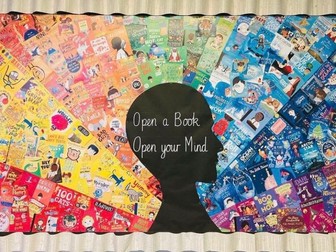
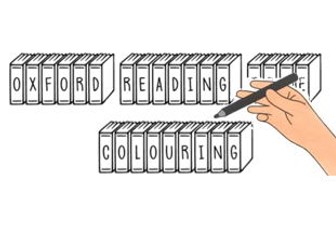
Are you looking for a display to showcase a love of reading in your school?
This display pack contains everything you need to recreate this display in your setting.
Featuring over 200 book covers, organised by colour.
All you need to do is print and trim and then you can create a stunning display that will be the talk of your school!
Documents included
Head Silhoutete
Title
Red Book Covers x2
Orange Book Covers x2
Yellow Book Covers x2
Green Book Covers x2
Blue Book Covers x2
Dark Blue Book Covers x2
Purple Book Covers x2
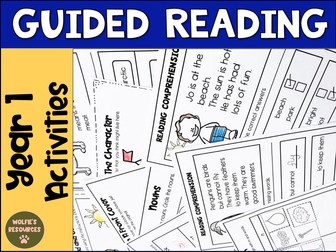
Independent reading activities. Over 120 pages of guided reading activities to save you time and stress! Suitable for children aged 5-6 years old. Year 1 UK.
These updated reading activities are designed for children to be able to complete independently, as part of a guided reading carousel or even as homework.
I have put together over 120 pages of activities that children can do independently whilst still improving their reading skills and their understanding of books and stories.
There is a variety of activities starting with very simple phonics activities for lower abilities. The activities get more advanced for use throughout the school year.
Some of the activities are also linked to the year 1 curriculum eg the lifecycle of a sunflower, seasons and keeping healthy.
All aspects of the year 1 reading National Curriculum covered.Also perfect for lower ability children in year 2 and up.
Included in this product:
reading journal book cover
year 1 national curriculum statements for assessment
guided reading timetable
35 reading comprehensions
initial sounds cut and stick
b or d cut and stick
m or n cut and stick
c or k cut and stick
missing letters
draw the word x 3
2 syllable words
draw the caption x 3
mixed up sentences x 6
draw the book cover x 2
draw the characters x 2
draw your favourite part x 2
draw the ending x 2
write the tricky words x 2
find the digraph x 2
write the noun x 2
design a new front cover
find the nouns/weather words/plant words
reading questions
all about the book
book review x 2
read and colour x 3
read and draw x 3
describe the setting x 2
draw and describe the character x 2
draw the character x 4
draw the setting x 4
where is cat?
inference questions x 4
sunflower life cycle
make a foldable book
label a snail
make a wanted poster
decode words x 4
word endings x 2
missing words
syllables x 2
sequence story x 2
contractions
what happens next?
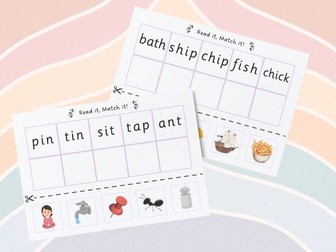
8 CVC read it, match it sheets.
Match the CVC pictures to the words.
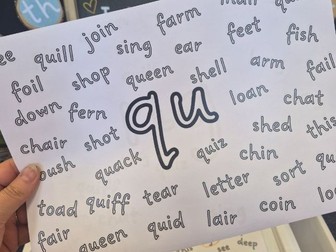
5 words per sheet, covering phase 2 plus digraphs qu, sh, th & ch
Can be used as a cut & stick activity or chop and laminate to make a reusable activity.
This is an activity that you can do after you introduced the different characters to your learners. Let your learners colour in the pictures for each character. I use this for Year 1 and 2 and they really enjoy it. You can let them colour in the characters exactly how they are presented in the stories for example the exact colours of their clothes etc.
Activity Description:
After introducing the different characters to your learners, you can engage them in a fun and creative activity.
Steps:
Introduction: Begin by introducing each character to the class, sharing their names, traits, and roles in the story. Make sure the students are familiar with the characters before starting the activity.
Distribution: Hand out the colouring sheets featuring the characters. Ensure each student has a complete set of characters to colour.
Guidance: Encourage the students to colour the characters exactly as they are depicted in the stories. For instance, if a character wears a red shirt and blue pants in the story, guide the students to use the same colours. This helps reinforce their memory and attention to detail.
Creativity: While it’s important to follow the story’s depiction, also allow room for creativity. If a student wants to add a personal touch, such as a different background or additional elements, encourage them to do so.
Sharing: Once the colouring is complete, have a sharing session where students can show their work to the class. This not only boosts their confidence but also fosters a sense of community and appreciation for each other’s efforts.
Benefits:
Engagement: Colouring activities are highly engaging for young learners and help maintain their interest in the lesson.
Fine Motor Skills: This activity aids in the development of fine motor skills as students practice colouring within the lines.
Memory Reinforcement: By colouring the characters as they appear in the story, students reinforce their memory of the characters and their attributes.
Creativity: It provides an outlet for creativity and self-expression, allowing students to personalize their work.
Feel free to adapt this activity to suit your classroom’s needs and the specific characters in your stories!
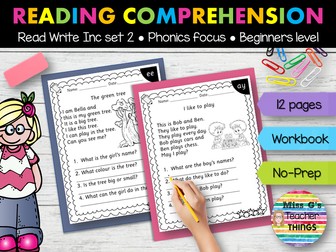
Improve your student’s reading comprehension and phonics skills with RWI Book 1: a comprehensive and engaging resource that covers RWI set 1 sounds and introduces set 2. This book includes 12 reading comprehensions, each one carefully crafted to provide a fun and interactive learning experience.
The book begins by focusing on cvc words, introducing new sounds and words with each comprehension. As your student works their way through the book, they’ll be exposed to more complex sounds and words, making the transition from set 1 to set 2 seamless.
The book comes with easy-to-follow instructions, guiding students through each comprehension and helping them develop their reading skills. With activities that encourage reading and re-reading, circling words with specific sounds, highlighting answers, and writing responses, your student will be fully engaged and on their way to reading success.
Order RWI Book 1 today and watch as your student’s reading comprehension and phonics skills improve with each passing day!
Take a peek at the preview for a better picture of what is included!
ay: may I play
ee: what can you see
igh: fly high
ow: blow the snow
oo: poo at the zoo
oo: look at a book
ar: start the car
or: shut the door
air: that’s not fair
ir: whirl and twirl
ou: shout it out
oy: toy for a boy
Instructions:
Children should read the short story 3 times. Each time they colour one star at the bottom.
Children should look at the sound in the top right corner and circle words with that sound in the story.
Children read (with support from an adult) the questions and highlight the answers in the story.
Then they write the correct answer on the lines provided.
Take a peek at the preview for a better picture of what is included!
HOW TO GET IN TOUCH WITH ME
Feel free to ask any questions or let me know of any problems regarding my resources by emailing me directly, especially if you have any requests or ideas I can create: MissGsteacherthings@gmail.com
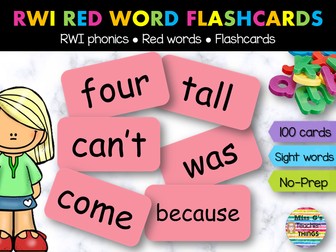
This RWI Read Write Inc Red Word Flashcards Set includes four sets of flashcards with high-frequency words designed to aid children’s reading and writing skills. Each set features specific words that are commonly used in the English language, gradually increasing in difficulty as the sets progress. The words range from simple words such as “I,” “my,” and “you,” to more complex words like “thought,” “brother,” and “mother.” These flashcards can be used to reinforce and consolidate learning in the classroom or at home, as well as for interventions and support. The sets can be used in various ways, such as covering the words once they have been read, writing them down, or using them in sentences. They are versatile and can be printed and laminated for physical use or used digitally for online learning. Take a look at the preview to get a better idea of what is included.
Set 1 - I the my you said your are be of no
Set 2 - what all was we so tome call her there want go old some he
Set 3 - does tall come watch who were brother any their where two small love many here once buy worse thought talk caught bought walk could anyone would great son water should
Set 4 - they half Monday eight eighteen going over fourteen orange Wednesday by laugh April don’t July do these four because can’t one people February grey another ball Mr Mrs bear other through baby only told why even key mother eye friend
These red word cards also come in a black and white version if you want to print onto coloured card!
HOW TO GET IN TOUCH WITH ME
Feel free to ask any questions or let me know of any problems regarding my resources by emailing me directly, especially if you have any requests or ideas I can create: MissGsteacherthings@gmail.com
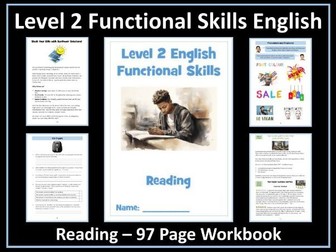
This resource has been designed for students working towards Functional Skills English qualifications at Level 2 (Edexcel-Pearson, NCFE, City and Guilds, AQA, Highfield Qualifications, NOCN, Open Awards). It contains an 97-page workbook on reading.
This resource will help students to achieve these outcomes:
identify the main points and specific details in texts
compare information, ideas and opinions in texts
identify implicit and inferred meaning
understand the relationship between textual features/devices and how they are used for different audiences/purposes
use a range of reference materials
understand organisational features/use them to locate information
analyse texts and vocabulary
identify levels of formality/bias
follow an argument, identify different points of view
distinguish between fact and opinion
identify different styles of writing/the writer’s voice
The 97-page workbook includes 54 information pages, 24 reading tasks and 3 progress checks. The workbook is provided in PDF and an editable PowerPoint version. It can be used for classwork, homework, revision or as an independent learning pack.
Please note, the watermark on the preview images is not present on the resource itself.
You may also be interested in:
Level 2 Reading - 200 Slide PowerPoint Lesson
The editable PowerPoint outlines the reading skills needed at Level 2 and provides many examples. It contains links to several videos on reading and example exam questions. It is ideal for introducing the reading component of the specification and for revision purposes.
Save money and buy both resources at a discounted rate:
Level 2 - Reading - PowerPoint Lesson and Workbook
The bundles below contain resources for all the learning outcomes for English Functional Skills at each level:
Entry Level 1 English Bundle
Entry Level 2 English Bundle
Entry Level 3 English Bundle
Level 1 English Bundle
Entry Level Maths Resources
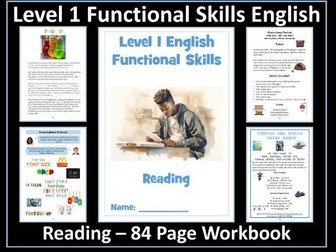
This resource has been designed for Entry Level 3 students working towards Functional Skills English qualifications at Level 1 (Edexcel-Pearson, NCFE, City and Guilds, AQA, Highfield Qualifications, NOCN, Open Awards). It contains an 84-page workbook on reading.
This resource will help pupils to achieve these outcomes:
identify and understand the main points, ideas and details in texts
compare information, ideas and opinions in texts
identify meanings in texts and distinguish between fact and opinion
recognise that language and other textual features can be varied to suit different audiences and purposes
use reference materials and appropriate strategies for a range of purposes, including to find the meaning of words
understand organisational and structural features and use them to locate relevant information in a range of texts
infer from images meanings not explicit in the text
recognise vocabulary associated with specific types and purposes of texts - formal, informal, instructional, descriptive, explanatory and persuasive
read
understand a range of specialist words in context
The workbook includes 37 information pages, 31 reading tasks (44 worksheets) and two progress checks. The workbook is provided in PDF and an editable PowerPoint version. It can be used for classwork, homework, revision or as an independent learning pack.
Please note, the watermark on the preview images is not present on the resource itself.
You may also be interested in:
Level 1 Reading - 175 Slide PowerPoint Lesson
Save money and buy both resources at a discounted rate:
Level 1 Reading -PowerPoint Lesson and Workbook
Entry Level 1 English Resources
Entry 2 English Resources
Entry 3 English Resources
Level 1 Functional Skills English Resources
Entry Level Maths Resources
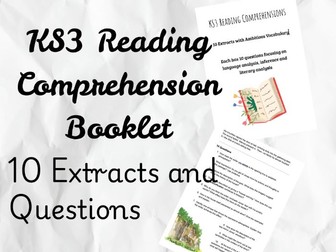
This resource is perfect for Years 7–9 and provides ten original fiction extracts (approximately 500 words each) across a variety of genres and settings, including gothic, sci-fi, magical realism, historical, and adventure. Each extract is accompanied by ten carefully designed questions focusing on key KS3 literacy skills:
Language analysis (e.g., similes, metaphors, personification, imagery)
Inference (reading between the lines to understand character, mood, or theme)
Analysis of structure, setting, and characterisation
Evaluation of effect on the reader
A full-sentence mark scheme is included for all extracts and questions, providing model answers to support teaching, marking, or self-assessment. This makes the resource particularly suitable for cover lessons, independent study, or guided reading sessions.
Key Features:
Ten engaging, original extracts covering a wide range of genres
100 questions total, designed to develop comprehension, analytical writing, and critical thinking
Full-sentence mark scheme included for easy assessment
Explicit focus on KS3 literacy and reading skills, including ambitious vocabulary
Ready-to-use for cover work, extension tasks, or literacy lessons
This resource saves teachers time while providing stimulating material to challenge students, improve their reading for meaning, and develop their ability to analyse and evaluate fiction at KS3.
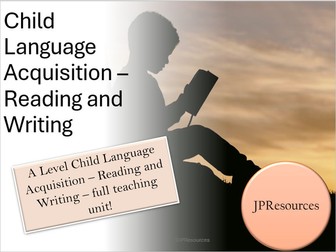
A 10 lesson unit comprising a 70 slide PowerPoint and 10 different worksheets exploring the topic of child language acquisition (reading and writing) and a summary terminology and theory sheet. The first 2 lessons are about reading and the final 8 are about writing. This unit can be used for any exam board.
Each lesson includes a starting discussion prompt which acts as a learning objective, detailed notes on the theories and terminology listed below, a worksheet containing examples of writing or a transcript (or revision cards for lesson 10), and a homework task. The following theories and terminology are covered:
Early literacy – Shirley Brice Heath (1983)
Stages of Reading Development – Jeanne Chall (1983)
Features of reading schemes
Language Acquisition Support System – Jerome Bruner (1983)
Synthetic phonics
Stages of writing development – Barry Kroll (1981)
Emergent writing
Stages of writing development – Kathy Barclay (1996)
Emergent literacy – Marie Clay (1975)
Initial literacy – Yetta Goodman (1985)
Ascender/descender graphemes, cursive handwriting and different types of join
The impact of touchscreen technology on children’s writing – Dunn and Sweeney (2018)
Homophones, graphemes and digraphs
Stages of spelling - Bear, Invernizzi, Templeton & Johnston (2004); Bear & Templeton (1998); Gentry (1977; 1982)
Categories of spelling errors
Functions of punctuation – David Crystal (1995)
Learning About Punctuation – Nick Hall and Susan Robinson (1996)
Playful punctuation – Andrew Burrell and Roger Beard (2022)
Genre theory in children’s writing – J.R. Martin and Jean Rothery (1981)
How genre is linked to schoolwork – Frances Christie (1987)
Modes of children’s writing – James Britton (1982)
Chronology in texts – Katherine Perera (1984)
The final lesson is a consolidation activity complete with guided revision cards. Alternatively, you could use an app such as Quizlet so that the students could produce digital revision resources.
Check out my other English Language resources:
Language and Gender
Language and Region
Language and Power and Occupation
Language and Global and World Englishes
Language Change
Language and Technology
Language and Ethnicity
Language and Social Groups
Language Discourses
Analysing Spoken Language
Child Language Acquisition - Speech
Prince William recently spoke out about the plight of elephants in China.
This reading comprehension resource supports a BBC News article which investigates the real threat to China's elephants - habitat destruction.
3 differentiated worksheets of questions are included.
Reading comprehension sheets using the** VIPERS** style
Vocabulary
Inference
Predict
Explain
Retrieve
Summarise/ Sequence
APE = Answer, Prove Explain
Reading comprehension that I use for weekly homework in Year 5. I have included the extracts of the texts and questions. Texts have been taken from “lovereading4kids”
This engaging Reading Reflection worksheet encourages students to think more deeply about what they read while building strong comprehension and reflection skills.
The structured layout guides students to record their reading progress and respond to key elements of the text, including plot, characters, important events, predictions, and personal responses. The worksheet also includes drawing spaces to support visual learners and encourage creativity.
Students are prompted to:
Record the book title, author, and pages read
Summarise what they have read
Identify characters and key events
Make predictions about what might happen next
Reflect on their favourite scene
Build vocabulary by noting new words
Share their personal response to the text
This worksheet works well as:
A weekly reading log
A book-in-a-bag activity
A guided reading response
Homework or independent reading reflection
Suitable for Junior Cycle / KS3 students and adaptable for a range of reading levels.
Includes one printable worksheet that can be used repeatedly with any novel or text.
Gave to my Y9 GCSE French.
Differentiated worksheets - I let them choose which one they wanted to do. There isn't much difference between the two - just an extra gap fill on the higher.
Plus a writing frame for the last activity


 Quick View
 Quick View
 Quick View
 Quick View
 Quick View
 Quick View
 Quick View
 Quick View
 Quick View
 Quick View
 Quick View
 Quick View
 Quick View
 Quick View
 Quick View
 Quick View