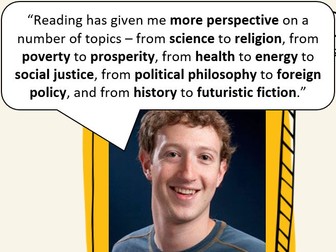
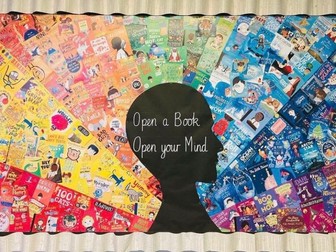
Are you looking for a display to showcase a love of reading in your school?
This display pack contains everything you need to recreate this display in your setting.
Featuring over 200 book covers, organised by colour.
All you need to do is print and trim and then you can create a stunning display that will be the talk of your school!
Documents included
Head Silhoutete
Title
Red Book Covers x2
Orange Book Covers x2
Yellow Book Covers x2
Green Book Covers x2
Blue Book Covers x2
Dark Blue Book Covers x2
Purple Book Covers x2
An assembly for KS3 and KS4 on promoting reading for pleasure. It includes facts on the benefits of reading for pleasure, quotes from famous people who credit their success to reading, a range of books recommendations and even a short video from Stormzy on why reading is so important!
Read Harry Potter and don’t know what to read next? Mad about David Walliams but need to branch out? Look no further, perfect for KS3-KS4.
Includes:
A Popular Author Map (Michael Morpurgo, Jaqueline Wilson etc.)
A Popular Genres Map (Dystopian, Detective, Romance etc.)
A Popular Series (How to Train Your Dragon, Percy Jackson etc.)
All books listed are popular and well-known children’s and Young Adult novels that can be found in most libraries and book shops. Designed for pupils 11-15 Years. Perfect for encouraging Reading for Pleasure, classroom displays, reading challenges and more!
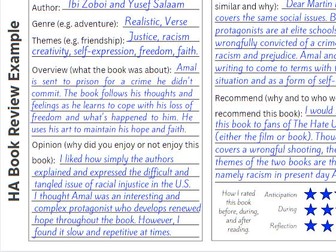
Two book reviewing templates WITH EXAMPLES; one simpler and shorter one for LA pupils and one longer and more challenging. Both include example reviews of Punching the Air by Ibi Zoboi and Yusef Salaam.
LA 1x templates per A4 paper - portrait
HA 1x template per A4 paper - landscape
A booklet filled with first chapters on amazing teen books. Aimed at KS3 to promote reading for pleasure, could be used in tutor time, English classes or for home learning.
I designed this for a whole school assembly. It is a quiz for Children versus the adults and is differentiated accordingly. It contains fun picture rounds, such as which character enjoys this food? Guess the book, what’s the film ( based on a book), multiple choice rounds and a tie breaker about the seven dwarfs.
The assembly also begins with interesting facts about well known books and facts about how reading can be good for you! It ends with a beautiful poem about reading by Julia Donaldson.
We had a panel of children and a panel of adults at the front and asked for help from the audience. We even invited parents and governors and it was very successful.
This was used for World Book Day but could used for a range of contexts and is suitable for KS2 and 3. Answers are included.
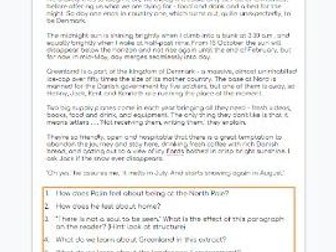
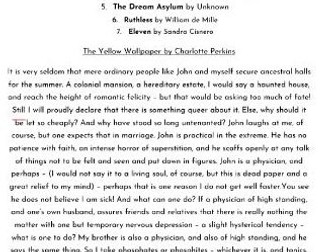
A comprehensive booklet containing six different extracts from both fiction and non fiction texts. All have questions for students to answer alongside them. Can be used as a reading comprehension activity, homework booklet or as a reading strategy within lessons.
Extracts included are below:
Pole to Pole by Michael Palin
The Pet
The Storm
Chocolate
The Pickwick Papers by Charles Dickens
Frankenstein by Mary Shelley
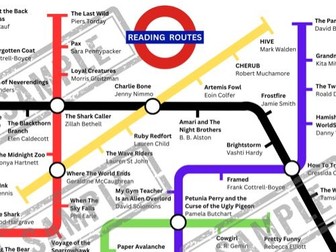
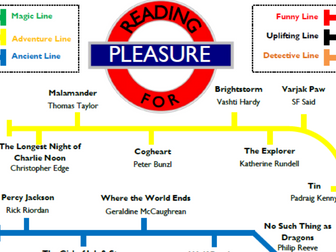
I have created an Underground Map linking similar fiction books together to help with reading for pleasure in Key Stage 2. For example, if a child likes reading David Walliams, they can follow the “Funny” line to find other similar books. The lines cross at certain points as well to encourage children to read other genres!
I have also included the original Word document, so you can edit and change it!
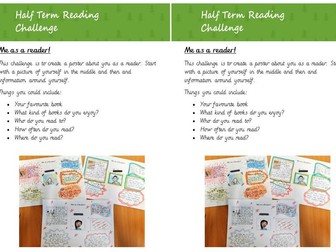
There are 5 holiday challenges based on ideas from the Open University Reading for Pleasure training.
Included:
3 x Half term challenges (Me as a reader, reading river and 24 h as a reader)
1 x Christmas challenge (Library genre challenge)
1 x Easter challenge (Reader Treasure Hunt)
Price is for all 5 challenges that can be printed out (2 per A4 page)
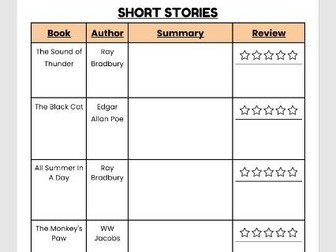
A booklet full of short stories for your students to enjoy. The table at the front of the booklet allows students to review and rate the stories that they have read.
Celebrate the joy of reading with this colourful and engaging Children’s Book Week Assembly PowerPoint. Designed for primary pupils, this resource highlights the importance of reading for pleasure, different types of books, famous authors, and tips to encourage a love of books in every child.
Perfect for a whole-school or class assembly, this PowerPoint includes:
• What is Children’s Book Week?
• Literacy facts and reading statistics
• The power of reading: imagination & knowledge
• Picture books vs. chapter books
• Famous children’s authors timeline
• How to choose the right book
• Book clubs and sharing stories
• Top tips to inspire young readers
• Ideas for creating a fun, cosy reading space
Ideal for EYFS, KS1 and lower KS2, this assembly promotes reading enjoyment and builds a strong reading culture in school.
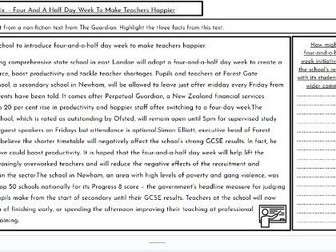
Booklets that contain seven weeks worth of extracts from both fiction and non fiction text. All have comprehension questions attached to them to check understanding. These booklets are aimed at KS3 students.
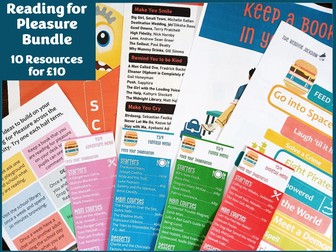
A comprehensive collection of display material, activities and ideas for building the foundations of Reading for Pleasure in your school. All the resources have been updated in 2024. The pack includes:
An 8 page step by step guide to starting on the journey towards being a Reading School
A Power Point to help build the foundations of an R4P school
Posters
Bookmarks with fiction recommendations for different year groups
A R4P Game
Year 6/7 transition Fiction Menu
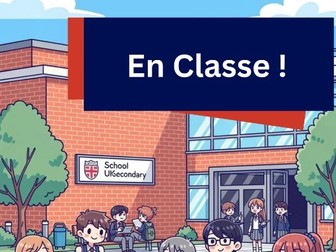
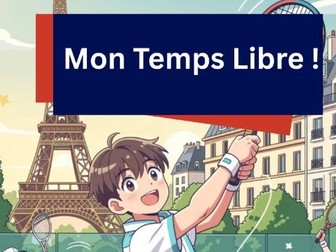
This engaging French Reading for Pleasure booklet series has been designed to support Year 7 learners following Dynamo 1 or any KS3 introductory French curriculum. The short illustrated reading books build confidence, fluency, and enjoyment of reading in French while reinforcing key vocabulary and structures from early units.
Book 1 – All About Me
Students read short texts about names, age, personality, hobbies, and basic opinions. Ideal for Unit 1.
Book 2 – Where Are You From?
Short cultural and personal introduction texts focusing on countries, nationalities, and where people live.
Book 3 – En Classe (School Life)
Reading texts covering school subjects, opinions, timetable, and school uniform vocabulary.
A booklet full to the brim with dytopian short stories for students to enjoy! This can be used during tutor/ form time reading, literacy intervention and dystopian stories studies.
This beginner-friendly French reading book is designed for Year 7 students who are starting their language-learning journey. Through short, simple texts, students discover young characters from different French-speaking countries such as France, Belgium, Switzerland, Senegal, Québec, Morocco, and Côte d’Ivoire.
Each character introduces themselves by talking about:
where they are from and the capital city where they live
their age and daily life
the weather and seasons in their country
their favourite sports and hobbies
activities they like doing using aimer
A rolling powerpoint of 6 weekly reading lessons that introduce students to new vocabulary each week. Each lesson contains one piece of useful analytical vocabulary, e.g. juxtaposition and one piece of vocabulary they may come across in their GCSE texts; alongside silent reading activities.
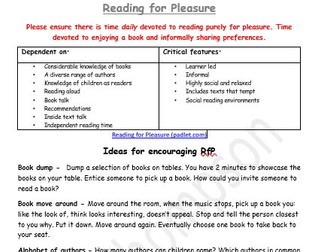
I collected ideas whilst developing Reading for Pleasure within my school. Here is a document I handed out to staff to remind them of simple ways to encourage reading for pleasure within classrooms.
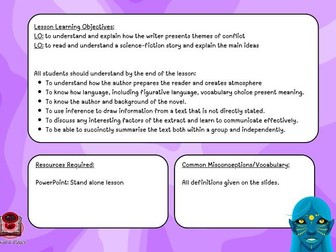
This engaging reading-for-pleasure lesson uses an extract from Avatar to introduce students to key science-fiction themes, with a particular focus on conflict, atmosphere, and writer’s craft. Through guided reading and discussion, students explore how the author prepares the reader for events in the story and uses language to create a vivid and immersive world.
Students are encouraged to enjoy the text while also developing analytical reading skills. The lesson supports students in identifying explicit and implicit meaning, using inference to understand ideas that are not directly stated, and recognising how vocabulary choices and figurative language shape the reader’s response.
The lesson also provides contextual knowledge about the author and background of Avatar, helping students to understand how genre and context influence writing. Structured talk activities allow students to share ideas, discuss interesting aspects of the extract, and practise clear and effective communication.
By the end of the lesson, students will have collaboratively and independently summarised the text, demonstrating their understanding of the main ideas and themes. This lesson is ideal for building confidence in reading longer texts while fostering enjoyment of science fiction.
Learning Objectives:
To understand and explain how the writer presents themes of conflict
To read and understand a science-fiction story and explain its main ideas
Outcomes:
Understanding how the author prepares the reader and creates atmosphere
Identifying how language choices, including figurative language, present meaning
Using inference skills to interpret unstated information
Discussing and responding thoughtfully to a literary extract
Producing clear, succinct summaries independently and in groups


 Quick View