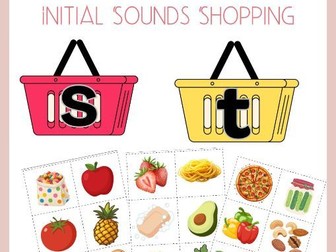
Label your own baskets/bags with s,a,t,p,i,n or print the baskets within the resource. Ask the children to sort the items into the bag that matches the initial sound.
Each child could be a different sound to complete as a group or have this out at a table for children to have a go at independently.
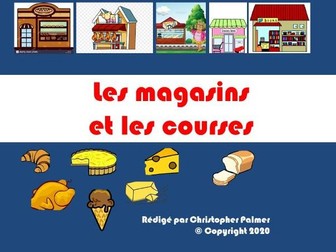
This resource exclusively explores which items can be found in which shops, as well as the preposition ‘de’.
There are lots of follow-up differentiated activities and attached, is a vocabulary sheet.
This resource is geared towards Key Stage 3 and it is compatible with Tricolore 2.
Happy teaching and learning!
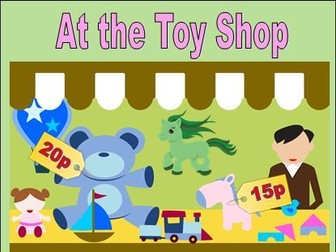
The toy shop is a money activity pack to encourage recognising amounts, adding amounts, working out change, solving problems and game playing. You can also use the resources for role-playing.
Your pack includes
A toy shop with pre-written amounts (up to 20p) in colour and black and white
A toy shop with blank tags for you to write your own amounts
Addition problem sheets
Money problem cards
I have/I buy/my change sheets
Large coloured toy cards with blank tags for using in games and for display
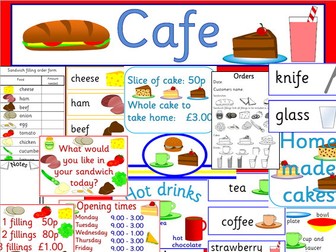
A bumper pack with lots of posters, banners and pictures to set up a role play area of a Cafe
The pack is great for use in the EYFS and also within KS1 and KS2
The pack includes:
A large banner with ‘Cafe’, decorated with food pictures
A large banner with ‘Restaurant’, decorated with food pictures
Large coloured pictures of different food to buy and the crockery to use
A colourful drinks poster
A large colourful food poster
Hats to make for the staff to wear
Name badges to make for the staff to wear
A colourful poster with space for you to add the price of the food- this enables you to price it according to the ability of the children
Sandwich filling labels, drinks labels and food labels
A large colourful sandwich filling poster
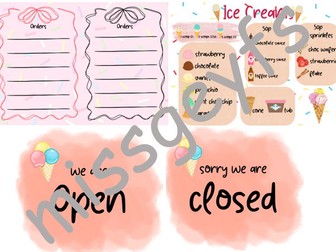
An open and closed sign for you cafe with pictures of food on
Opening times posters for you cafe
A sandwich filling order form with pictures of the different sandwich types and fillings available
A colour and black and white menu for your cafe
Order forms in colour and black and white for the cafe
Decorated notes and messages paper to encourage writing in the role play area
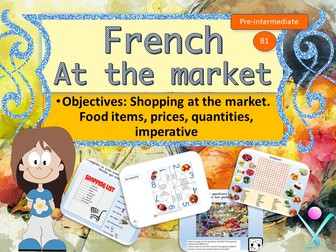
Shopping in a market is a great topic to teach students about different topics: food items, prices, quantities, engaging in conversations are just some examples of what you will find in this resource.
Your students will love this resource full of fun games, videos and interactivity. It is aimed at teaching a B1 level groups (pre-intermediate) but it can be adapted to a wider audience. Note that some activities are more challenging to allow more differentiation in class. All the activities are corrected to save you time AND you get clear explanations at the bottom of each slide to guide your teaching progression!
⭐ Here’s what you’ll get in this 28-slide PPT: ⭐
A self-target setting slide with the objectives of the lesson then…
Some questions as a starter to break the ice about summer
A video about a market in the south of France with elements to identify and questions
A matching up between pictures and words related to shopping in markets
a shopping list to complete with food items and then quantities
An activity to put food items under categories
A reading activity with a conversation at the market to re-organize
A grammar point about the imperative with exercises
A writing-speaking activity in pairs
A battleships activity in pairs
A fortune teller game as a plenary
Have fun! Have a wonderful teaching day!
A script for 2 performers in which old acquaintences meet and endure an uncomfortable conversation - BUT, the audience hear their thoughts, rather than their words.
An excellent exercise in vocal tone for Drama or English students and a humorous performance for a school gala or concert. Two versions included: one 'Christmas Shopping" for seasonal concert/show, and the original version which is not season specific.
Clean language an humour appropriate to school setting.
If you enjoy, please leave a review!
Help learners develop essential Functional Skills reading skills with this fun and accessible Entry Level 1 assessment based around a visit to a pet shop. Students read a colourful source document before answering a range of carefully scaffolded comprehension questions designed to assess understanding of everyday information.
The assessment covers information retrieval, simple inference, vocabulary, alphabetical order and following instructions using an engaging real-world context that learners can easily relate to.
All illustrations have been created using AI-generated images, ensuring the resource is visually appealing while remaining entirely original and copyright-safe.
Suitable for:
Functional Skills English Entry Level 1
Initial assessments
Diagnostic assessments
SEND learners
Adult education
Alternative provision
Independent practice and revision
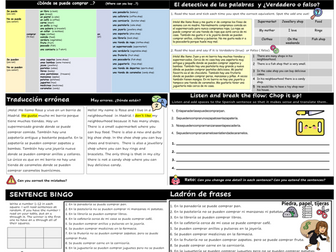
This resource is to describe what you can buy in different shops using Se puede and Se pueden. It has different Conti approach activities. IT IS EDITABLE:
Vocabulary
What is missing? Game
match the word with the picture
Sentence builder
Tick me quick!
Read my mind
Sentence stealer
Sentence bingo
Faulty echo
Listen and tick the word I say
Listen and break the flow.
Words detective and true or false? Reading activities
Wrong translation
One pen one dice
Trapdoor
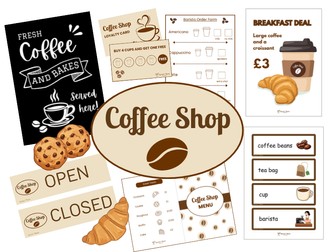
Create an engaging coffee shop role play area with this printable café set for EYFS and KS1 . Perfect for developing communication, mark-making, early maths and imaginative play skills through a familiar real-world theme.
This resource encourages children to explore everyday experiences while building confidence in speaking, listening, reading, writing and social interaction. Ideal for continuous provision, classroom role play areas, or home learning environments.
What’s Included
Shop signs
Opening hours signs in both 12-hour and 24-hour time
Double-sided table menus
Promotional posters for display
Loyalty cards
Two blackboard-style signs to create your own A-frame boards
Play food to cut out and display
Credit card and 3D card scanner
Barista order forms
20 key vocabulary words to cut out and laminate
Learning Opportunities
Children can develop:
Early writing and mark-making skills
Communication and language
Reading environmental print
Counting and money skills
Understanding of time and opening hours
Turn-taking and collaborative play
Perfect For
EYFS classrooms
KS1 role play areas
Continuous provision
Home education
Literacy and maths enhancements
Why Teachers Love It
Easy to print and set up
Supports multiple areas of learning
Encourages child-led imaginative play
Real-life learning opportunities
Flexible for a range of ages and abilities
A fun, stylish, and engaging way to bring your classroom role play area to life
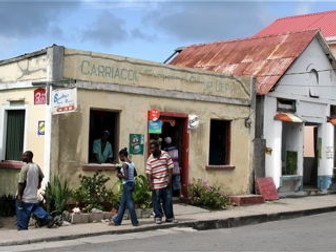
A collection of photos on the topic of shops and shopping around the world. This collection will be added to in time.
Please leave me a review and I will send you any other resource of your choice for free (contact me: office@oceansproject.com). Check out my other resources at my shop: https://www.tes.com/teaching-resources/shop/sarah277
Let me know if you have any resource requests and I will tailor make a resource for you.
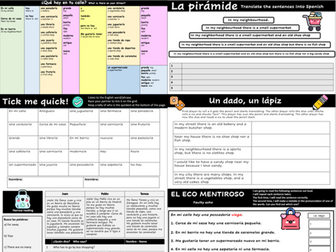
This resource is to describe shops in the neighborhood using Hay, No hay, me gustaría tener plus adjectives to describe the shops. It has different Conti approach activities. IT IS EDITABLE:
Vocabulary
What is missing? Game
match the word with the picture
Sentence builder
Tick me quick!
Read my mind
Sentence stealer
Sentence bingo
Faulty echo
Listen and tick the word I say
Sentence chaos
Break the flow
Narrow reading activity
One pen one dice
Pyramid translation
Trapdoor
This pack contains:
SPaG PowerPoint lesson to teach using commas to separate items in a list
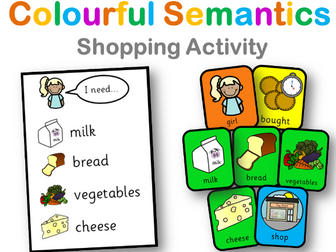
36 colourful semantics cards related to shopping at the supermarket
12 shopping list game cards
4 speech/writing frames to use with the cards
This activity can be used in at least 4 different ways! I have used it for the following:
teaching food vocabulary: This can be done either in the context of shopping or as expressing likes, dislikes. Both options are included in this resource.
using commas to separate items in a list: Use the game cards for children to use as a writing prompt. They can record what each person bought at the supermarket to practise using commas.
Shopping list memory game: Give each child a shopping list and lay out the green cards on the table. Give them a moment to look at their list then turn it over. They must try and remember which items they need to buy in the correct order!
speaking and listening to describe someone’s shopping list: Children could use real life experiences to recall a visit to the shops with family. What did each member buy?
If you find another use for the cards, please leave a review or tag me on Instagram @simply_semantics - I’d love to see how you’re using them! *
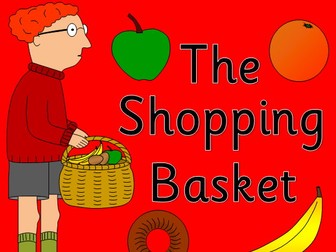
A bumper resource pack for the popular story ‘The Shopping Basket’ by John Burningham
The pack includes:
DISPLAY
Display banner- a long colourful banner for your display
Display border- a colourful display border to print out as many times as you need for a display board of any size
Word cards- words on shopping baskets relating to the story
Word and picture flashcards- coloured pictures of each of the animals and foods in the story and the words
Shopping and animal posters- A4 posters with each animal and food on with the name
LITERACY
A4 word card- an A4 word card with words and pictures for the children to use when writing about the story
Shopping alphabet- a lovely alphabet line on the different foods in the shopping basket
Writing sheets- a set of writing sheets with borders for the children to write on and use in the writing area
Speech bubble worksheets- fill in the speech bubbles to show what the characters are saying
Writing worksheet- write about the different animals in the story
Shopping list worksheet- label the different items in the shopping basket
Favourite part of the story- draw and write about your favourite part of the story
MATHS
Basket number line- a number line to 50 on shopping baskets
Counting cards- count the objects from 1-10
Size ordering worksheets- order the character props by size- in colour and also black and white
Counting worksheets- count the number of items in each shopping basket
Number worksheet- draw the correct number of foods
GAMES
Picture bingo- collect the characters and foods for your bingo board
Matching pairs- find the picture matching pairs
Number dominoes- a colourful domino game to make and play
Shopping game- collect the different foods needed for your shopping basket by spinning the spinner
ART & CRAFT
Picture jigsaws- cut out and reassemble the jigsaws of the different characters
Tracing sheets
Stick puppets
Face masks
Play dough mats- make the correct number of items in each shopping basket
Matching worksheet- match each character to the correct food
Colouring
Make a 3D basket- cut out and make a shopping basket
Drawing worksheet
STORY TELLING
Sequence pictures
Face masks
Stick puppets- coloured stick puppets to use when retelling the story
Large character and food pictures to match
Please note: The art work used in these resources has been produced by ourselves. It is not associated with, or endorsed by the authors or publishers of the story, or any related stories or product
Here is a ppt I used with my students to revisit types of shops in French and to link what you can buy in the different shops. Linked to Metro 3 vert, module 3, section 5.
A cross-curricular resource with a toy theme.
Children label the 12 toys for sale in the toy shop.
Children say how much each toy is as written on the price tags and count out the appropriate amount of coins for each one.
Children draw a picture of the toys matching the price tags.
Differentiate here by adding in your own prices or children use this sheet to write the cost of the toys.
Add up the cost of two toys and write the answer.
Tie in with some practical work with your own toy shop, tags and coins for role play fun and application of counting and money skills.


 Quick View