In this lesson, Students will understand that modern technology has benefited human beings by increasing production of goods and services, reducing the amount of labour needed to produce these goods and services, and …
This pack includes a starter, a powerpoint and lesson plan.
This Bundle includes resources aimed at raising students awareness of the environmental impact of design and energy uses.
The sustainability lesson focusses on the 6R's, Carbon Footprints and Product Life Cycles.
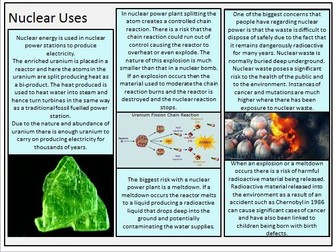
The energy lessons focus on the pros and cons of various energy sources.
The lessons are interactive and require full student participation.
I hope you enjoy this resource.
In this lesson, students work in groups to investigate different items of Aboriginal technology. They then share their findings through a marketplace activity before designing a leaflet detailing the nature of Aboriginal technology.
This paper examines ways in which the idea of cognitive conflict is used to facilitate learning, looking at the design and use of learning environments for this purpose. Drawing on previous work in science education and educational computing, three approaches to the design of learning environments utilizing cognitive conflict are introduced. These approaches are described as confrontational, guiding and explanatory, based on the level of the designer's concern with learners&' pre-existing understanding.
This set of resources includes 2x PPTs which can be delivered over 3 lessons (over 65 slides of engaging and interactive learning throughout the bundle).
We start by discussing the different types of social changes that exist before looking at some informative graphs and charts to contextualise understanding. A short exam style question before going on technological changes, again discussion of real life examples for context and a short question. Some true or false questions as a mini plenary and debate.
In the second powerpoint, we focus on corporate social responsibility, lots of real life examples. case studies, videos to help students understand the extent to which businesses are socially responsible (or not) i.e Apple and Primark’s suppliers and tax avoidance by many firms.
We also have a case study on shareholders vs stakeholders, students prepare arguments to present back to the class on whether the firm should aim to satisfy shareholders or stakeholders, this can be answered as a 24 mark exam style question with a peer assessment grid to follow.
Colourful, concise and engaging slides!
Thank you
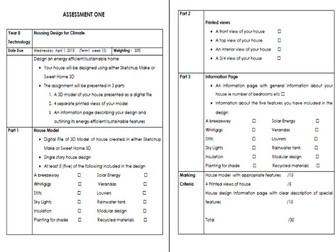
This bundle includes worksheets and assessment tasks for studying Built Environments (Mandatory Technology - Australian Curriculum) and instructions for using Sweet Home 3D freeware for interior design.
All the resources necessary for teaching this particular unit of work.
Revision knowledge organiser for Engineering and the environment, including renewable energy sources, recycling and product life cycle
Written for WJEC Level 1/2 Engineering, Unit 3
12 colourful Technology Posters and expectations for secondary students!
So, you either are or are looking to go digital in your classroom but are anxious about your students potentially misusing or being irresponsible with the technology? That is a valid concern! There are a world of distractions online, plus technology is expensive and it is paramount our students treat resources available to them with respect.
These posters contain 12 top technology rules to help create a responsible and safe environment. You can display them in your classroom / computer lab / device station as well as use them to prompt class discussions about these rules and why they are so important, after all rules are more likely to be followed if students understand why they are there in the first place!
They have a colourful watercolour theme and have been designed in a way that makes them suitable for all age groups and environments. I hope you enjoy using these in your classroom!
A full set of revision cards for the Educas Construction & the Built Environment specification (2025).
Includes 97 slides of questions and answers for pupils to use as a revision tool.
I have included both a PDF and a PP version (please open in slides to match fonts).
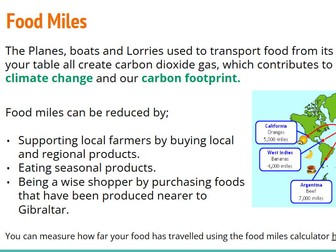
This resource is an editable power point, exploring the key points of food and the environment. This covers ares such as seasonality, food miles, landfill/composting and tackling sustainability.
This resource is aimed for Year 10 and Year 11 GCSE Food & Nutrition for AQA, but it can easily be used for other exam boards too.
Design and technology sustainability and the environment lesson resource - colourful, informative, visually engaging resource for a lesson covering environmental, social and ethical factors and questions to finish. Suitable for ks3 and ks4
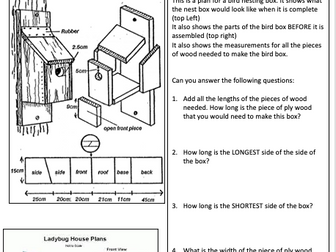
A KS3 resource for Design and Technology. This is a workbook that supports the making of a habitat environment, whether that be a bird box, bug hotel or any other suitable habitat.
The resource is essentially a workbook that includes assessment materials, Tier 2 and 3 vocabulary, a learning journey. A ‘Big Question’ has also been identified to justify why this should be an appropriate project to cover as part of the DT KS3 curriculum.
The resource is designed to take students through the process of design thereby equipping students with appropriate skills that will be required for studying the subject at KS4 and beyond.
Perhaps, more importantly, the project raises awareness of habitat loss and what designers can achieve to provide alternative habitats.
A KS3 project (year 8 or 9).
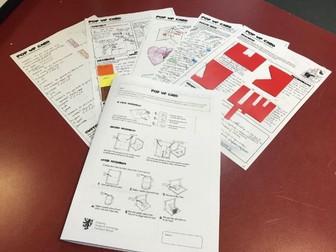
A project written for an environment without powerpoints and interactive boards. It hangs on the initial two lessons researching into pop up mechanisms and then pop out mechanisms. Students practically manufacture a range of them, but also record and analyse the mechanisms in a work booklet.
The remaining weeks focus on concept designs, then developments and a final working card.
Included are all the resources (templates & handouts) along with lots of exemplars from previous students.
This Bundle include a multiple lesson powerpoint and a student work booklet for WJEC Unit 1 Safety and Security in Construction. It is modelled on the specification and covers all the learning objectives and assessment criteria.
Topics Covered:
Signs (RED, BLUE, YELLOW, GREEN, ORANGE)
Risk Assessments
Sub and Super Structure
Fire extinguishers
Permits to Work
Hazard/ Risk/ Control Measure
Security of Construction Site
Health and Safety Legislation
Responsibility of Employer and Employee
It can also be used with other Construction course to as it would provide students with a very solid understanding of Health and Safety in the construction industry.
THE IMAGES USED IN THIS RESOURCE ARE SOURCED FROM THE INTERNET, I DO NOT CLAIM OWNERSHIP OF THEM. ALL OTHER CONTENT IS MINE.
A highly effective worksheet that allows Key Stage 3 pupils to fully investigate key elements of Design & Technology.
This resource focuses on the core content specified in the AQA GCSE specification for New & Emerging Technologies, with a focus on sustainability and the environment, designing for maintenance, planned obsolescence, end of life disposal and linked ethics
This resource can be used at the heart of a full lesson, or used as standalone cover work.
Please take a moment to look at other resources that i am selling through TES, I can help you to enhance your teaching of DT with my high quality materials.
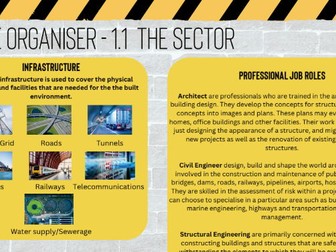
This is a bundle for EDUQAS Construction and the Built Environment Unit 1. The new specification that was introduced in 2022.
In this bundle is a teaching powerpoint and student tasks for each of the Assessment Criteria.
AC1.1 The Sector
AC1.2 The Built Environment Life Cycle
AC1.3 Type of Building and Structure
AC1.4 Technologies and Materials
AC1.5 Building Structures and Forms
AC1.6 Sustainable Construction Methods
AC1.7 Trades, Employments and Careers
AC1.8 Health and Safety
Each powerpoint is a breakdown of the AC and is lesson by lesson. Each lesson is interactive with tasks that can be printed directly from the powerpoint. Each lesson has a starter and plenary.
This will save you hours of planning.
Also included is a Unit 1 knowledge tracker.
Please check out other resources in my shop for this course.
Bundle total is £34
Sold at £25 saving you 26%
A comprehensive series of multimedia materials to support the teaching of the GCSE Design and Technology Food Technology course. The materials can be downloaded as a complete Moodle course or as individual elements. The bilingual resources include video clips, animations, text and quizzes within Moodle and can be used on an interactive whiteboard for whole class teaching or by students on individual computers. The images included in this work, to the best of our knowledge, are from sources that their use do not breach any copyright rules. Please visit the NGfL site, linked below.
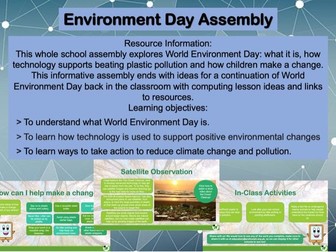
This whole school assembly explores World Environment Day: what it is, how technology supports beating plastic pollution and how children make a change. This informative assembly, covering geography curriculum links ends with ideas for a continuation of World Environment Day back in the classroom with computing curriculum inspired lesson ideas and links to resources.
Learning objectives:
To understand what World Environment Day is.
To learn how technology is used to support positive environmental changes
To learn ways to take action to reduce climate change and pollution.
 Quick View

 Quick View
 Quick View
 Quick View
 Quick View
 Quick View
 Quick View
 Quick View
 Quick View
 Quick View
 Quick View
 Quick View
 Quick View
 Quick View
 Quick View