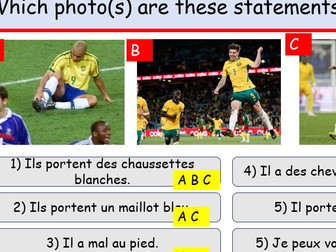
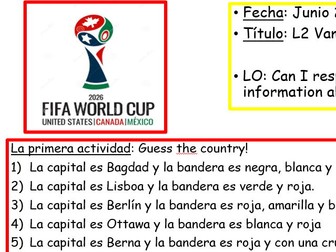
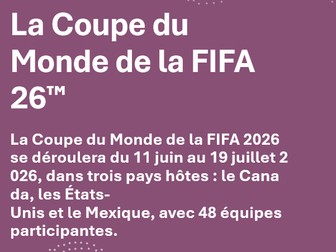
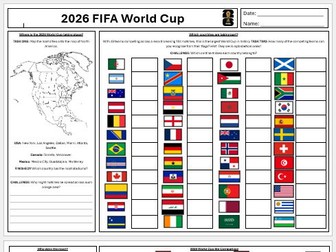
A PPT and A3 double sided word document for students to complete on the 2026 World Cup with a variety of tasks:
Marking on stadium locations.
Identifying flags.
Looking at the advantages and disadvantages of hosting a World Cup.
Comparing country data to decide who should host the 2038 World Cup.
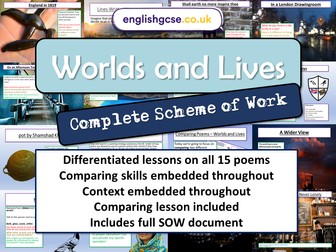
Fifteen practice questions for the Worlds & Lives anthology poems.
There are 15 fully formatted questions, one for each of the poems. Printable as singular sheets for in-class practise or as a booklet for student revision.
** Get these as part of a bundle with full scheme of work and 15 lessons**
2026 FIFA World Cup French Project Booklet | KS3 French | World Cup Activities | Cultural Capital
Bring the excitement of the 2026 FIFA World Cup into your French classroom with this engaging and visually appealing 20-page French project booklet, designed to develop vocabulary, reading, writing and intercultural understanding through the theme of football.
Perfect for Years 7–9, transition activities, enrichment days, end-of-term projects or cover lessons, this booklet combines language learning with one of the world’s biggest sporting events. Updated specifically for the 2026 FIFA World Cup hosted by Canada, Mexico and the United States, it provides a motivating context for practising key French skills.
What’s included?
• Introduction to the 2026 FIFA World Cup and participating teams
• Activities based on the 2026 World Cup groups
• French countries and flags matching task
• Reading activity on international football players and national teams
• True or false comprehension tasks
• World Cup history timeline activity (1930–2026)
• Football-themed French vocabulary exercises
• Translation activities using opinion phrases
• French-to-English and English-to-French sentence-building tasks
• Football-themed word search
• Labelling activity on football equipment vocabulary
• Creative football kit design task
• Reading comprehension activities based on famous footballers including Kylian Mbappé, Jude Bellingham, Erling Haaland, Sadio Mané and Harry Kane
• Independent research and writing tasks on students’ favourite football players
• Reflection and celebration pages to conclude the project
Why use this resource?
✓ High levels of student engagement through a real-world sporting event
✓ Supports vocabulary acquisition and cultural awareness
✓ Encourages creativity alongside language development
✓ Suitable for mixed-ability groups with a variety of task types
✓ Ideal for collapsed curriculum days, enrichment weeks, sports-themed learning or independent projects
Curriculum links
This resource supports the development of key skills within the KS3 National Curriculum for Languages, including:
• Reading comprehension
• Translation skills
• Vocabulary development
• Sentence construction and writing
• Cultural understanding and international awareness
Although not written for a specific GCSE specification, the resource also provides useful reinforcement of high-frequency language and thematic vocabulary that can support progression towards AQA GCSE French.
File types included
• PDF (.pdf) – ready to print as an A4 booklet or use digitally via a virtual learning environment.
Whether you’re looking for a French World Cup project, football-themed French activities, a KS3 French booklet, or engaging end-of-term language resources, this booklet offers an exciting way to celebrate the FIFA World Cup 2026 while developing students’ confidence in French.
Resource preview available here:
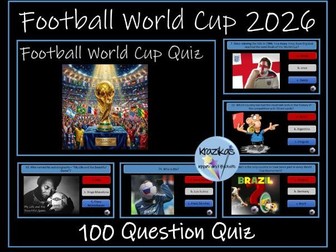
This resource contains a 100-question PowerPoint quiz on the 2026 FIFA Football World Cup tournament. Each question has three possible answers. The answers can be found by clicking on the ball image at the bottom right-hand corner of each slide. An answer sheet is provided to allow individuals/teams to record their answers. The quiz is divided into 6 categories:
Past World Cups
World Cup Records
Miscellaneous
Picture Round
World Cup 2022
World Cup 2026
Sample questions:
How many times have England won the World Cup?
Who has played the most games for England at a World Cup?
Who scored the infamous ‘hand of God’ goal in 1986?
Which is the only country to have taken part in every World Cup tournament?
Which country has won the World Cup the most times?
The PowerPoint contains links to Pele’s 5 top World Cup goals, news report on the stolen world cup in 1966 and Pickles the dog, the World Cup Willie song, the highlights of the 1966 World Cup final, Maradona’s controversial ‘hand of God’ goal against England, highlights of the 2022 World Cup and the 2026 World Cup mascots.
Please note, the watermark on the preview images is not present on the resource itself.
You may also be interested in:
Football World Cup 2026 -115 Slide Presentation
Save money and buy both resources at a discounted rate:
Football World Cup Quiz 2026 - 100 QuestionPowerPoint Quiz and 115 Slide Presentation
Football World Cup 2026 - Fixtures and Results Templates
Thinking of publishing your own resources or already an author and want to improve your resources and sales? Check out this step-by-step guide:
How to Become a Successful TES Author: Step-by-Step Guide
A comprehensive 17-slide German language workbook built around the theme of the World Cup, countries, capital cities, flags, and colours. Ideal for KS3 and lower KS4 learners, this resource blends vocabulary practice, grammar work, reading comprehension, and creative puzzle tasks to keep students engaged from start to finish.
What’s included:
Matching activity: German and English country names (colour-coded pairs)
Unscramble the German country names
Secret code decoding task plus a “create your own code” extension
German country names crossword
Translation task with article (der/die/das) grammar practice
“Which country is it?” clue-matching activity
Capital cities matching task
True or false comprehension exercise
Colours matching task and flag colouring activity using a colour code
“Was sagen die Kinder?” World Cup reading and name-matching
“Find the word!” vocabulary hunt from the reading text
Story-time reading task featuring Alexandra Popp with follow-up tasks
Word search (including ß / ss guidance)
Format: Delivered as a ready-to-print PDF, including a full vocabulary list and the complete answer key so it’s plug-and-play for cover lessons, homework, end-of-term activities, or themed World Cup weeks.
Perfect for independent work, paired tasks, or homework, with minimal teacher prep required.
I’ve updated my World Cup resources for 2026 (Spanish and German to follow).
Here are a series of lessons on this theme.
L1 – countries participating, past winner, flags
L2 – Reading about country + players
L3 – describing or designing your own kit
L4 – body parts / sports injuries
L5 – describing outcomes of games / who will win / visit to a game. Sentence building
L6 – Speaking GCSE Style activities - based around Edexcel exam board requirements but can be adapted (photo description / read aloud / role play)
Plus a glossary/knowledge organiser of key vocab, which could be printed off to support if you are using all/nearly all of these lessons.
I’ve updated my World Cup resources for 2026 (French and German also available).
Here are a series of lessons on this theme.
L1 – countries participating, past winner, flags
L2 – Reading about country + players
L3 – describing or designing your own kit
L4 – body parts / sports injuries
L5 – describing outcomes of games / who will win / visit to a game. Sentence building
L6 – Speaking GCSE Style activities - based around Edexcel exam board requirements but can be adapted (photo description / read aloud / role play)
Plus a glossary/knowledge organiser of key vocab, which could be printed off to support if you are using all/nearly all of these lessons.
Make the most of this year’s World Cup with these fun and engaging football focused creative writing resources, based around and inspired by the World Cup in the US, Mexico and Canada!
25 slides jam packed with content, this lesson is sure to get your students excited about this major sporting event, whilst helping them improve their creative writing skills. Complete with a printable worksheet, this lesson has the following structure:
Starter - Quiz (general knowledge/picture round/English based World Cup Questions) with peer-assessed answer slides
Differentiated lesson aims with a big question
Background and context to the World Cup
Using sensory description to envisage a stadium
Video stimulus of England’s trip to the Euro 2024 final to generate ideas about thoughts and feelings of being in that moment
Image based stimulus for independent creative writing task
Exemplars of good and bad responses for students to evaluate
Self-assessment activity in which students edit and improve their own work based on the exemplars
The lesson has lots of differentiation opportunities with scaffolding and stretch and challenge opportunities throughout; full teacher notes are provided underneath the slides to ensure that the lesson is ‘ready to roll’ with no adaptation required.
This lesson is recommended for students from year 6 up to year 10 - so top of Key Stage 2, Key Stage 3 and the bottom of Key Stage 4.
Feedback and reviews very much welcomed and appreciated.
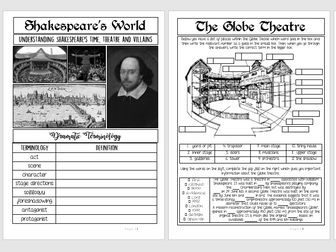
This is an extremely dense 12 page booklet with easily an entire scheme of work. This has been created to give year 7 an introduction to Shakespeare: to understand his life, works, times, theatre and to grasp how a script works. There are two pages which focus on Shakespeare’s villains (Don John and Iago) but in reality this is to simply expose students to Shakespeare’s life and characters rather than to complete in depth analysis of a plot and character. Although this was created with year 7 in mind it would fill a gap at any level of Key Stage 3 if students’ knowledge of Elizabethan England is lacking.
Both the editable Word document and .pdf are provided - please note the word document may not appear like the booklet pdf because of font use and formatting.
This booklet is also available as part of a Shakespeare bundle with two other KS3 booklets covering Shakespeare heroes and the idea of tragic heroes and Shakespeare’s relationships.
The booklet is as follows:
1 - front cover and basic dramatic terminology glossary
2 - William Shakespeare information with space to create a fact file
3 - Shakespeare’s works - basic information, followed by a task to understand the difference between comedies, tragedies and histories then sorting key plays into each type
4+5 - a double page spread with a timeline across Elizabethan and Jacobean England. At the top students can create a timeline of historical events and then plot Shakespeare’s life underneath (perhaps using page 2)
6 - Elizabethan entertainment - 4 boxes for students to complete information about bear baiting, bull baiting, cock fighting and the theatre - I have attached the factfile made to accompany this lesson.
7- The Globe Theatre - A label the Globe picture followed by a gap fill about its history (in image)
8- Understanding a script - the first scene of Macbeth is used to explain the layout of a script, followed by a gap underneath for students to make their own mini script using a similar layout and features.
9- Stage directions- a list of common Shakespeare stage directions with definitions for students to match followed by some complex stage directions to "translate"
10 - An explanation of the character and his motives, an extract from the play (1.3) and a series of questions which track students through the extract.
11 - An explanation of the character and his motives,an extract from 1.1 alongside a modern translation followed by a series of questions.
12- a common words glossary where students should independently record new words learnt.
A simple coloured world map with coordinates. Children can use the map to become familiar with countries, continents, oceans and seas! Also using their coordinates skills. Can be printed A4/A3 depending on use.
Worlds and Lives pack for the new AQA poetry anthology. Currently includes:
Lines Written in Early Spring - William Wordsworth
England in 1819 - Percy Bysshe Shelley
Shall earth no more inspire thee - Emily Bronte
In a London Drawingroom - George Eliot
On an Afternoon Train from Purley to Victoria, 1955 - James Berry
Name Journeys by Raman Mundair
pot by Shamshad Khan
A Wider View - Seni Seneviratne
Homing - Liz Berry
A Century Later - Imtiaz Dharker
The Jewellery Maker Louisa Adjoa Parker
With Birds You’re Never Lonely - Raymond Antrobus
A Portable Paradise - Roger Robinson
Like an Heiress - Grace Nichols
Thirteen - Caleb Femi
Comparing poems lesson
Scheme of Work document
A knowledge organiser containing a brief overview of the main ideas, key quotations, structure and context for the 15 poems from the AQA Worlds and Lives new poetry anthology. Useful for anyone, like me, who is trying to prepare to teach these largely unfamiliar poems for the first time.
AQA Combined Science Trilogy unit ‘B1 Cell Structure and Transport’.
Full lesson ready to use straight ‘out of the box’.
Similar structure to my other power points following the input - activity - review phasing
Plenary section for progress checking
Differentiated worksheet (Get the original undifferentiated WS free from MeeraPatel2)
Clear learning objectives and outcomes
Modern and engaging layout
Little adaptation needed
Each lesson covers at least an hour of lesson time
42 ppt slides
Feedback welcome :D
Revision flashcards for the 15 poems in the Worlds and Lives Poetry Anthology.
Each card has brief notes on main ideas, 3 key quotations, structure and context.
Ideal for anyone in the same position as me and teaching these poems for the first time.
Suitable for all age groups.
Suggested script in the notes section of each slide, but feel free to adjust as appropriate.
Suggested follow up activities for tutor/form time in the notes section of the last slide.
All images used in this resource are in the public domain and are therefore copyright free. Images which require attribution have been attributed in the notes section of each slide where the image appears.
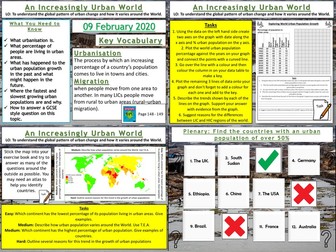
AQA GCSE Geography lesson for the new specification Unit 2A: In this lesson we look at the increasing number of the global population living in urban areas.
We start with a quick quiz on global populations and a video to put global population increase into context for the pupils. We then look at how urbanisation varies around the world by plotting data on a graph. The pupils then describe the trends they have found.
We then look at a map of the urban populations around the world and the pupils can tackle several different questions depending on ability. We then discuss how these patterns might be explained. We then answer a GCSE-style question looking at the percentage of people living in urban areas on different continents using a bar chart. The pupils have guidance on how to answer the question if needed. We finish with a plenary quiz where the pupils have to find the countries with an urban population of over 50%.
In a nutshell lesson includes:
Quiz starter
Video clip
Graph plotting exercise with questions
Map interpretation task
GCSE-style question using graph with guidance
Plenary quiz.
Hope this saves you some valuable planning time.
https://www.tes.com/teaching-resources/shop/markthegeographer
This resource includes a PPt, workbook and worksheet built around the upcoming 2026 World Cup. It introduces the host countries, with a focus on Canada as a francophone country and includes a link to watch and hear more about the range of stadia. A straightforward colour by numbers of the flags is included. It also looks at the mascots and language work around qualities associated with them, so useful vocabulary for role models, backed up by links to Wordwalls. There are several reading texts and tasks arranged to reinforce reciprocal reading skills: what are the issues around tickets (a chance to revise numbers in a different context), the technology of the 2026 football and the history of the competition. There is also a chance to find out more about the countries participating and work on the grammar around being ‘in’ or going ‘to’ a country.
This Power Point Quiz shows the flags of all 32 competing nations in the 2010 World Cup. Answers are after all flags have appeared.
*UPDATED AND CORRECTED*
This booklet looks at several areas of population including: key Words, Population Change, World’s Population Distribution, Why Are Some Families Larger Than Others?, Changes In Population, Sustainable Population, One-Child Policy, Ageing Population, France’s Solution, International Migration
Two texts in which Wallace & Gromit and Bruce Wayne é Selina Kyle describe their plans for a trip around the world. The texts are followed by a true/false exercise in German and a writing task.


 Quick View