Full unit of work for tourism. All lesson are suitable for 50 minutes to 1 hour of teaching time. Includes supporting worksheets for lessons - no additional resources are required. Homework’s integrated into lessons where appropriate.
Most suitable for KS3 geography.
All lessons have a starter and lesson objectives. All PowerPoints in the same style.
Lesson sequence:
1 - What is tourism?
2 - The growth of tourism
3 - What attracts tourists to different destination?
4 - British tourism
5 - What are the impacts of tourism in National Parks?
6 - Declining tourism in Britain
7 - History and tourism
8 - The impact of tourism
9 - Jobs in the tourist industry
10 - Ski resorts
11 - Tourism in Kenya
12 - Sustainable tourism
13 - Sustainable tourism in Peru
14 - Does tourism cause conflict?
A revision sheet for the BTEC (tech award) in Travel and Tourism by Pearson. It contains x90 short questions that students can test their knowledge on. Best printed enlarged to A3 when printed.
Can be used a standalone worksheet and does not require a textbook.
The Language of Tourism Advertising
Created for Year 12 English Studies
A 7-page document that goes through the specific language used in Tourism Advertising for students.
Includes; Content in Tourism Advertising - Features - Language - Descriptions - Language of Desire - Advice-Action. ( Visuals included assist to clarify the advertising techniques employed)
Also includes a Task for students to advertise 3 Tourist sites using the appropriate language and stylistic features of a tourism poster. Students to choose both visual and written text to advertise the site.
Would be suitable for years 10, 11, 12
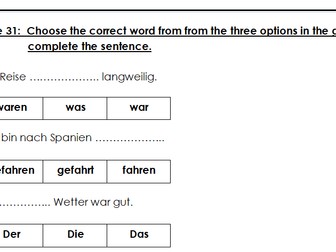
25 pages of reading, writing and grammar exercises designed to practise key skills and vocabulary for the AQA GCSE German specification (for 2026). The comprehensive vocabulary list and answer sheet make this resource ideal for independent revision, homework or cover lessons.
This bundle includes notes on all four learning aims. It also includes a student friendly checklist which is great for students tracking their revision.
Powerpoints can be used as a teaching resource, revision resource or printed as a revision booklet for students.
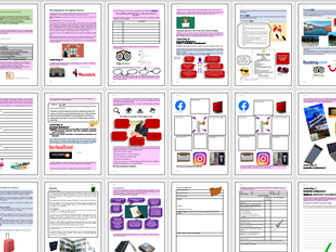
Best selling work booklet containing tasks and activities covering all the outcomes for Travel and Tourism Customer Service Unit at National 5 level (can also be used for National 4). May also have relevance for Customer Needs BTEC Level 1/2.
Engaging activities and role plays including dealing with difficult customers, being a travel agent, setting up and marketing your own Air B and B and travel agency - all covered in an engaging, colourful 28 page booklet. Files are provided in PDF format which could easily be uploaded onto OneNote etc for remote learning should it be required for poor attenders or absentees. The resource includes a free Sway directing learners to the pros and cons of different methods of promotion.
Why give yourself extra work and stress when you can just download this resource! :) Tried and tested in the classroom and very successful.
Some of the activities could have relevance for geography lessons, vocational studies and other Edexcel Travel and Tourism courses.
Find out more with this film clip -
https://youtu.be/xOV9A9KaKa0?si=Dl5_FpvSfddB0Rzi
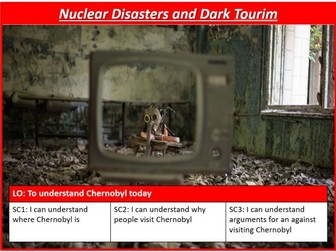
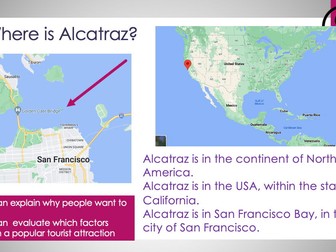
Lesson on the Chernobyl nuclear disaster and the increasing rise of extreme or dark tourism to sites of past disastrous events. All supporting worksheets provided - no additional resources needed.
**If you have previously purchased my GCSE 2016 unit 8 resources, please get in touch if you would like to upgrade to this new version. **
In this digital product:
You will find everything you need to teach Topic 7: Travel and Tourism, including Places of interest (first topic of Theme 3 of the new GCSE course (with AQA): Communication and the World around us.
The Presentation (approx. 150 slides including answer slides) covers the whole topic and is composed of 4 parts:
A: Going on a trip
B: On holiday
C: Tourism
D: Places of interest
There are 4 folders (A, B, C and D) containing the relevant files for that part.
It includes:
• a range of Listening, Speaking, Reading, Writing and Translation activities
• grammar points including: Revision of present, perfect and imperfect tenses. Perfect Vs Imperfect. Introduction of conditional (Higher only)
• elements of phonics: oi/oy, j and soft g, the letter h, the sounds -ou Vs -au
• retrieval activities, cultural aspects and homework tasks
• QR codes/ links for independent study
• vocab lists (full topic list or 4 lists for the 4 parts) + link to online course
• comments under the slides for notes and worksheet location
• answers
• audio files and transcripts
• .pdf and editable versions of the worksheets (except the writing support mat, which is only available as a .pdf)
Activities are differentiated and exam style.
The first 15 files are a preview of what is included in the .zip folder: Topic7.zip.
After downloading, save the .zip file in your computer (in “documents” for example), then right-click and select “extract all” to access all the resources.
For the full overview, you can check the free SOW available for download here.
If you have any questions or if you are interested in more resources like this one, you can check this Facebook page: @Frenchresources, where links to resources and freebies are posted regularly.
This booklet is for Tech Award from 2022 (New specification) Component 3 Exam : Influences on Global Travel and Tourism.
This Component 3 Learning Aim A booklet could be used as a revision book, a homework booklet or a knowledge organiser.
Each topic in Learning Aim A has 1 or 2 pages of notes, followed by retrieval practice.
A pdf and word version are included.
Would you pay thousands of pounds to risk your life?
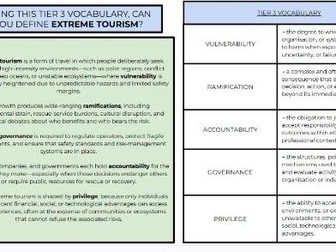
Take students beyond the classroom with this high-interest, debate-driven non-fiction lesson exploring the controversial world of extreme tourism.
From climbing Mount Everest to visiting active volcanoes and exploring some of the world’s most dangerous environments, students are challenged to consider a difficult question:
Should people be allowed to pay for extreme tourism in dangerous environments?
This lesson provides an engaging springboard into rhetoric, argument and non-fiction writing, giving students a real issue to debate before transforming their ideas into persuasive writing.
Students will:
Explore the appeal and dangers of extreme tourism
Consider arguments for and against allowing people to pay for dangerous experiences
Develop and challenge their own opinions
Consider audience, purpose and viewpoint
Select convincing evidence and reasoning
Use rhetorical devices to influence their audience
Build towards a piece of persuasive non-fiction writing
Perfect for:
KS3 English | Year 7–9 | Rhetoric | Persuasive Writing | Non-Fiction | Speaking & Listening | Debate
The lesson is designed to get students thinking, talking and arguing before they write making the transition from discussion to purposeful non-fiction writing much more natural.
Why students will love it
It’s a question with no easy answer.
Is extreme tourism a personal choice?
Should people be free to take risks if they can afford it?
Who is responsible when things go wrong?
Does extreme tourism damage the environments people travel to see?
Students become writers with something to say, rather than simply completing another persuasive writing task.
An ideal early KS3 lesson for introducing argument, rhetoric and purposeful non-fiction writing through a genuinely fascinating real-world issue.
Worksheets for the BTEC (tech) award in Travel and Tourism by Pearson (2022 onwards).
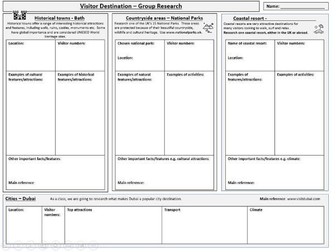
Worksheet 1: visitor destinations
This worksheet supports students research on Dubai, as a popular World city, Bath, as an historical town/city, and then gives them an open option to research 1 National Park/landscape in the UK and one coastal resort of their choice. Students would need to have access to ipads, computers or laptops to conduct the research.
Worksheet 2: tourism types and activities
This worksheet gives students scenarios of domestic, outbound and inbound tourists and they have to research different a suggested itinerary. It also gives them an opportunity to categorise each scenario into leisure or business. Students would need to have access to ipads, computers or laptops to conduct the research.
Worksheet would need to be enlarged onto A3 when printing as it is currently set to A4 size.
A set of four worksheets based on vocabulary for describing travel and tourism from the new AQA Spanish syllabus (2024).
Answers provided.
These are intended for vocabulary practice, so would be ideal for when teaching a topic, a cover lesson, or as part of a revision pack.
Uses present / past / future tenses but not overly complex grammar so would suit mixed ability. Can be easily adapted for stretch or support groups.
Activities include:
Match the Spanish to English
Write the Spanish for
Gap-fills
Unscramble the phrases
Choose the correct translations
Reading comp
Present / Past / Future multichoice
Other GCSE topics available on my shop or as a bundle through this link:
https://www.tes.com/teaching-resource/resource-13210366
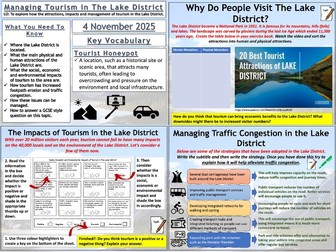
AQA GCSE Geography lesson for the latest specification Unit 1C: In this lesson we look at tourism in the Lake District. The attractions, impacts of tourism and management.
There is a multiple choice retrieval practice starter based upon prior learning in the section.
We start by looking at the location of the Lake District. The students complete a cloze exercise to create a paragraph detailing the location using information from the board. We then look at the human and physical attractions of the Lake District. The students watch a short video and sort the attractions into a table. Students then consider the impacts of tourism to the area. They are provided a worksheet and asked to sort the statements into, firstly advantages and disadvantages, then social, economic or environmental impacts. We then look at traffic congestion and how it is managed. The students are presented with some possible solutions, but they must explain how these help to reduce congestion. We then watch two videos on footpath erosion and the students create a diagram on the causes and problems of footpath erosion and the solutions, with a focus on the organisation ‘Fix the Fells’ and their work on the fells. We finish with a 6 mark GCSE-style exam question with guidance on how to answer it.
Hope this saves you some valuable planning time.
https://www.tes.com/teaching-resources/shop/markthegeographer


 Quick View