toys-past-and-presentQuick View
teachnchatter

toys-past-and-present

(0)
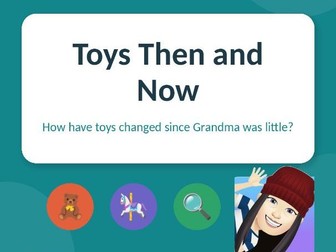
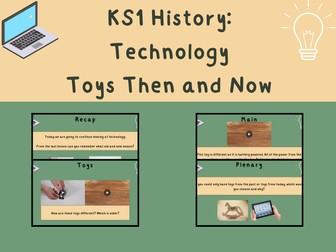
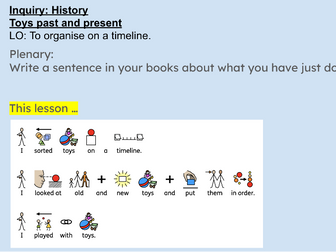
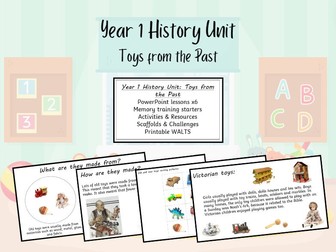
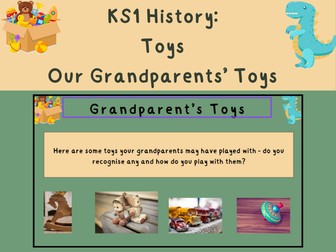
toys-past-and-present A history PowerPoint on toys now and then. 90 slides and includes photographs. toys-past-and-present includes; photographs of toys learning outcomes of lesson toys from the past toys now comparison of toys (difference) 3 Vocabulary slides (brief sentence to discuss example) discussion topics checking for understanding links to History (HASS) - life changes This lesson has been trialled in my Year One class with success. Please provide a review to let me know how you found it. I hope you enjoy it. Kind regards, Jennifer
Year 1 English Plan - Toys in SpaceQuick View
teresamcnally

Year 1 English Plan - Toys in Space

(0)
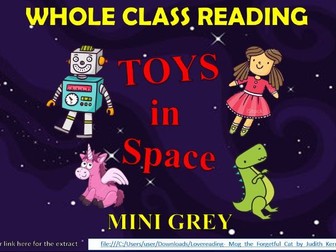
A 2 week English plan and resources based around the book Toys in Space by Mini Grey. Ideal for the Spring term for Year 1 but could be adapted for other terms/year groups.
Lost in the Toy MuseumQuick View
laura_hope11

Lost in the Toy Museum

(1)
Aimed for Year 1, simple sentences and sequencing events by using time conjunctions. Week 1 - Shared Write - retelling the story. Week 2 - Independent write - changing the setting and character. Week 3 - Non-Fiction Resources only
KS1 Writing Unit - Narrative - Lost in the Toy MuseumQuick View
AdamW2020

KS1 Writing Unit - Narrative - Lost in the Toy Museum

(0)
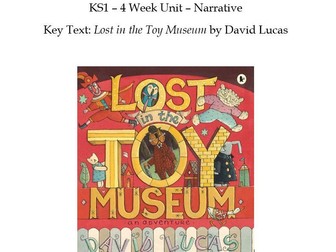
A full four week unit on narrative, inspired by the Lost in the Toy Museum by David Lucas. Suitable for KS1. This is a lovely picture book that gives wonderful opportunities for writing for KS1 pupils, and a copy of the book can be viewed on Youtube if you haven’t heard of this text before. Purchase includes: 4 x editable weekly (five-day) short-term plans 3 x editable PowerPoints for teaching 12 x Day’s worth of worksheets - including editable adapted worksheets for GD, EXP and WTS/SEND pupils (20 worksheets+). 1 x editable suggested example text (sentences) to support teaching Absolutely no amendments necessary to teach a full four week unit on narrative, featuring grammar foci and opportunities for creative writing. Planned with a newfound focus on oracy and developing pupils’ ability to orally story-tell, including clear differentiation to support pupils of all ability levels in your KS1 class. Created by a lover of English with almost a decade of experience working in KS1. If you do purchase this excellent unit of work, please consider returning to leave a review. Thank you!
Toys: Teddy Bears (Old and New)Quick View
ragilmore

Toys: Teddy Bears (Old and New)

(0)
A small collection of four worksheet activities comparing old and new teddy bears, which could be used within a scheme of work on Old Toys.
Kipper's Toy box story resource pack- story sack, toysQuick View
robbyn

Kipper's Toy box story resource pack- story sack, toys

(0)
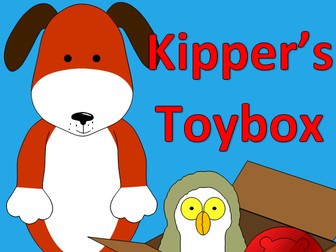
Kipper’s Toybox DISPLAY Display banner Display border- a display border with lots of mice to print out as many times as you need for a display board of any size Word cards Large coloured pictures- large character pictures to print out and use on a display Question cards- questions on decorated cards about the story to use as prompts or to add to a display LITERACY A4 word card Alphabet- a lovely alphabet line on mice Writing sheets- a set of writing sheets with borders for the children to write on and use in the writing area Speech bubble worksheets- fill in the speech bubbles to show what the characters are saying Favourite part if the story- draw and write about your favourite part of the story Writing worksheet- write some sentences about the different pictures on the worksheets My favourite toy ‘K’ for Kipper and ‘t’ for toys worksheets- two worksheets about the letters k and t Initial sound worksheets- match the labels to the correct toy pictures, write the initial sounds of the toys, cut and stick the toy pictures onto the initial sounds on the toybox NUMERACY Number line- a number line to 50 on Kipper’s toys Counting worksheets- count the number of toys- 3 differentiated worksheets Number worksheets- a set of 10 worksheets, one for each number from 1-10 Counting cards Number jigsaws- count the mice and match to the correct number to complete the jigsaw GAMES Matching pairs- find the most pairs to win the game Picture bingo- cover the different pictures from the story Picture dominoes- a colourful dominoes game to make and play Collect the toys- spin the spinner to collect all the toys in your toybox ACTIVITIES Stick puppets- colour and make your own Kipper stick puppet Face masks- colour and decorate the face mask of Kipper Colouring- a collection of colouring worksheets Finger mouse puppet- make your own mouse finger puppet Cut and assemble the owl- cut out the parts of the owl toy and reassemble Decorate the snake- make a pattern of the snake toy Draw the toys- draw all of Kipper’s toys in his toybox Make the pictures the same- make each pair of pictures on the worksheets the same- 3 different worksheets STORY TELLING Face mask Stick puppet Story sack tag Story props Number cards Please note: The art work used in these resources has been produced by ourselves. It is not associated with, or endorsed by the authors or publishers of the story, or any related stories or products.
Scratch - We Are Toy DesignersQuick View
esquiffy

Scratch - We Are Toy Designers

(10)
This PowerPoint takes you through the We Are Toy Designers Scratch project with Year 4. There are a couple of hyperlinks to online examples -thanks to Thackley primary school. Hope it helps guide you through the project.
TOYS TOYS TOYSQuick View
ACOYEAR8

TOYS TOYS TOYS

(2)
Lesson examines the purpose of toys and offers a number of different tasks designed to get students to reflect on why we have toys. Adaptable and certainly relevant for the coming festival on Dec. 25 (UK). worksheet could be added.
KS1 To compare Victorian toys and modern day toysQuick View
TeachersLoveSundaes

KS1 To compare Victorian toys and modern day toys

(0)
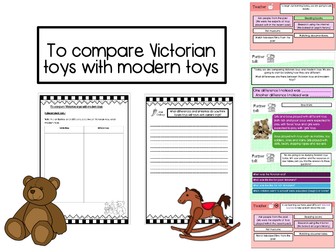
Thank you for looking at my resource. This resource includes a fully comprehensive PowerPoint ,worksheets/resources catering to a wide range of abilities and a preparation list. This is the third lesson in a sequence. The lesson can be taught independently without the need for the past or future lessons. This lesson can be picked up and taught straight from however is fully editable. Children will continue to look at historical sources of evidence. In the first part they will use books to answer questions to help them develop a basic understanding of the Victorian era. The teacher will then substantiate this by providing clear answers to the research answers. Children will have links made with their background research and the focus on toys. For instance, how there were differences between rich and poor. Children will then learn about Victorian toys through an exploration of actual toys (pictures/videos may be needed if you can’t access Victorian toys),After an exploration of the toys and reflection questions children will be taught about Victorian toys. Finally, children will complete small steps which will support them to independently make simple comparisons with Victorian and modern toys. Children will complete either an independent task or an adapted helping hands task drawing comparisons with Victorian and modern toys. A chilli challenge is provided to broaden children’s learning. Challenges should be given to all. Not just your most able. They are purposely open ended. The ‘differentiation’ comes from how your most able access the task.
At the Toy ShopQuick View
lbrowne

At the Toy Shop

(1)
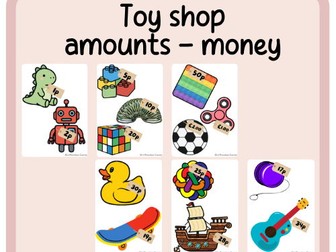
A cross-curricular resource with a toy theme. Children label the 12 toys for sale in the toy shop. Children say how much each toy is as written on the price tags and count out the appropriate amount of coins for each one. Children draw a picture of the toys matching the price tags. Differentiate here by adding in your own prices or children use this sheet to write the cost of the toys. Add up the cost of two toys and write the answer. Tie in with some practical work with your own toy shop, tags and coins for role play fun and application of counting and money skills.
'Toys and Games' Year 1 English Planning and ResourcesQuick View
lchrissy

'Toys and Games' Year 1 English Planning and Resources

(0)
Based around the non-fictions book ‘Toys and Games’ by Sally Hewitt, this 7 lesson English Unit of Work covers Year 1 National Curriculum Objectives for S & L, Reading, Grammar and Spelling and Writing Composition. The unit includes editable planning documents, worksheets, writing frames and much more.  End of unit Writing: Factual Report about a toy from the past. Zip file includes: Lesson Planning (7 editable lessons) (Microsoft Word Document) Comparing Activity (PDF) er and est suffix display (PDF) er and est writing frame (PDF) Factual Report Writing Frame (PDF) Glossary Vocabulary Activity (PDF) Guess the Antique Toy Presentation (PPTX) My favourite toy worksheet (PDF) Sorting old and new toys game (PDF) Toy Facts Planning sheets (PDF) Toy images for comparing er and est (PDF) Toys and Games Classroom display banner (PDF) Toys from the past riddles matching game (PDF) Toys Display Timeline (PDF) Toys Word Mat (PDF) Using Verbs in sentences Worksheets (PDF) Verbs Presentation (PDF) Unit overview: In this unit, children will explore the features of the non-fiction text ‘Toys and Games’ by Sally Hewitt. They will be ‘hooked’ into the unit by describing a set of hidden mystery toys from the past. They will then try to solve a selection of riddles that describe toys from the past. Children will be taught how to retrieve simple factual information from the text. They will then use the text to support their knowledge on grammatical features, such as the use of verbs and using the word endings er and est to compare toys from the past. The children will then be taught about why the glossary is important in non-fiction books. They will read simple definitions from key words within the text. Building upon this, they will begin to write their own simple definitions of topic words relating to toys. Using the knowledge learnt from this unit, children will plan out simple ideas to write their own factual text about a toy from the past. They will describe the toy’s appearance, write about how it is made and how it moves. The children’s writing can then be displayed to build up a class timeline of toys from the past, displaying factual information about each toy. Reading Objectives: Drawing on what they already know or on background information and vocabulary provided by the teacher. Discussing word meanings, linking new meanings to those already known. To understand how non-fiction books are structured. Speaking and Listening Objectives: Use relevant strategies to build their vocabulary. Give well-structured descriptions. Grammar Objectives: How words can combine to make sentences. Using verbs in simple sentences. Using–er and –est where no change is needed in the spelling of root words [for old, older, oldest}. Writing Objectives: Saying out loud what they are going to write about. Composing a sentence orally before writing it. Sequencing sentences to form short narratives.
Toys KS1 topic resources - powerpoints, activity and display packQuick View
highwaystar

Toys KS1 topic resources - powerpoints, activity and display pack

(2)
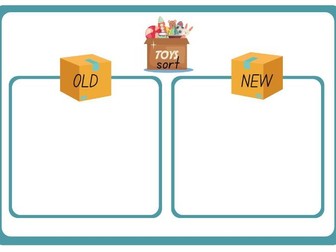
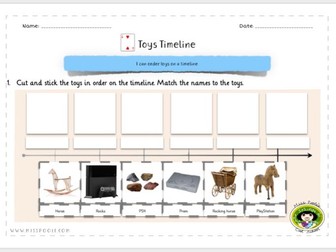
A set of powerpoints showing photographs of the most popular toys of the pre-50s, 50s, 60s, 70s, 80s, 90s and modern toys; an introduction to the history of toys - going back to dolls in Ancient Greece to computers today; a look at portraits of children from the past playing with toys; a sorting toy activity into old and new, and an old poem about the wonders of a toy shop. There are also 4 maths powerpoints looking at addition and subtraction in the toy shop, with cards to print for games. The activities include: An acrostic poem template Animal cut-out templates to join together to make a moving toy Colouring sheets Pictures of new/old teddy Puppets for role play Russian doll set to print and laminate for size ordering 6 x Santa lists to use around Christmas A thaumatrope template with instructions 3 x cover templates for a topic book Toy sorting cards - to sort into different materials/ properties. Toys from the past questionnaire to take home to fill in with parents. A copy of an old book 'What shall we do next' from 1907 full of games and activities that children played The Wonderful Toymaker fairy tale to read An outline planning document with cross curricular links that can be adapted. DISPLAY Old toys display - photographs Children's portraits playing with toys Toys banner Toys heading Toys in the past heading Toys timeline
KS1 Dance – Toys SOLQuick View
samjball

KS1 Dance – Toys SOL

(1)
UPDATED AND IMPROVED ON 21/02/2022 This resource is for KS1 teachers teaching dance through the Physical Education part of the national curriculum during the topic of toys (or any topic connected to toys, gifts, celebration etc). This ‘Toys’ scheme of work is great to teach after the holiday season. It allows pupils to share their holiday experience through emotion and movement games along with developing their creativity through choreography tasks. This SOL comes with: 6 lesson plans, detailing the activities in each lesson along with coaching points to aid teaching. A 6 lesson PowerPoint including notes under each slide to help with the delivery of the lesson. A CPD document that should help with aspects of teaching dance that a none dance specialist might find helpful. Notes: The timings of the lesson and the activities within the lesson plans can of course be adapted. Activities can be changed, lengthened, shortened, taken out, differentiated etc. Feel free to adapt this resource to suit your own needs as well as the needs of the children. Feel free to use your own music. I used ‘Epic Music – Toys Come Alive’ on YouTube I loved teaching this SOL and I hope you do too. If you find it helpful, I would massively appreciate it if you could leave me a review 
DT / Wind –Up ToysQuick View
mariesteachingresources

DT / Wind –Up Toys

(0)
I have created fact sheets and worksheets based and adapted from DT unit 2C Winding. It also links History Unit 1‘‘How are our toys different from those in the past?’ Some activities can be linked to Literacy (Reading and Writing, Non-Fiction, Story Telling). The unit can be adapted for a particular class topic. Planning included! . Through this unit, children learn about the concept of winding mechanisms, building on previous knowledge of wheels and axles. They learn about different mechanical toys and how they have changed over time. They explore how to make winding mechanisms using construction kits, then, after discussion, make their own toy using a winding mechanism out of reclaimed materials. Resources • Fact Sheet: Wind-Up Toys – What is a wind-up toy? • Fact Sheet: Wind-Up Toys – A History of Wind-Up Toys • Diagram: How to make a wind-up mechanism • Making a glossary of new vocabulary • Story writing: Write a short paragraph that links to the story History worksheets: • Draw a picture of each toy (from the past and modern) and label (similarities and differences) • Put pictures in the correct order (cut and paste) to show how wind-up toys have changed over time DT worksheets: • Draw a win-up toy and label the different parts of the mechanism • Designing (part 1): illustrate idea and label different parts to show how it will work • Designing (part 2): list materials, equipment and plan stages of making • Description: Using stages of making as a reference, write a description (word list) • Evaluation: evaluate own wind-up toy and make suggestions for improvement Useful Tip! Use the PDF doc with your IWB to work through the pages with your children :) Hope that you like and find them useful. If you have any comments or recommendations to make, please do not hesitate to do so. mariesteachingresources@gmail.com For updates go to my Facebook page – Marie’s Teaching Resources Thanks for looking :)
Toys and Objects Makaton SignsQuick View
SEN_teacher1707

Toys and Objects Makaton Signs

(0)
This resource is a handy A4 sheet with 36 Makaton signs for toys and/or objects. This resource includes the signs for: Ball Doll Tablet / Ipad Sand Sand Castle Teddy Bricks Music Slide Swing Sing Toys Messy Play Paint Draw Pram Spade Bucket Nappy Potty Dressing Up Telephone Playdough Bubbles Jigsaw Football Fire Car Bus Train Aeroplane Tractor Boat Bike Book Story Please check out my other Makaton resources to learn more Makaton signs, all with 12 signs to a page of A4 for easy reading. Please leave me a review, if you like my resources. If there is a resource you would find particular helpful please let me know and I can make it.
Knowledge Organiser - History of ToysQuick View
mrjedsmith

Knowledge Organiser - History of Toys

(0)
This History of Toys knowledge organiser is designed for an EYFS/KS1 Class (year R-2). This knowledge organiser is designed to introduce the children to the topic, encourage independence in learning and provide children with the key information they will learn more about during the topic. The sections included are a toy invention time line, key facts, key vocabulary and lots of useful images and questions.
Toy safety / What is a toy?Quick View
erica_c_hanson

Toy safety / What is a toy?

(13)
Useful for an intro to any toy project design, or as a task for childcare. What is a toy sheet? Toy safety? Choke tester (print on A4 to scale) anything that fits inside the center area of the tester would not be suitable for a child under 3 years as this can cause a child to choke. Question sheet? Matching cards? A5 info adapted from Lion mark website. In order to effectively use this resource you would need to use in conjunction with toy briefs or other resources. I have used the choke task with health and social care students when discussing child development, and health and safety in the home
Moving ToyQuick View
lisaledwick

Moving Toy

(0)
This resource is a complete 6-9 week KS3 unit on the planning and making of a moving toy, for year 7 students. It outlines and explains how students are to follow the design process in order to make a unique and individual moving toy using readily available classroom materials. Perfect for schools that don't have wood or specialised machinery. The PowerPoint outlines the steps to make this toy, while introducing the design process to year 7 students. This resource contains quality teacher and student examples. This resource is EAL friendly as language is clear and is used in conjunction with visual imagery.