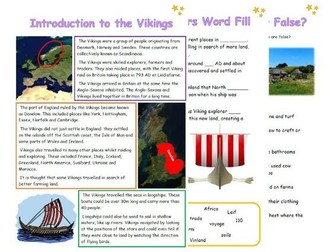
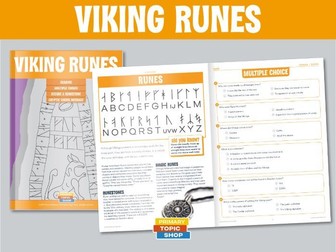
The Viking Runes lesson covers the runic alphabet, uses of runes, runestones and rune casting. It includes a multiple choice worksheet, a de-code the runestone activity and a cryptic Viking message activity. Aimed at KS2 Y4-6
Pages: 7 (including 2 answer sheets)
Contents:
Information Page
De-code the Runestone Activity
Cryptic Viking Message Activity
Rune Master Art Activity
Multiple Choice Worksheets
Answer sheets
All photos, illustrations and text are original by the author. This is part of a complete unit on Vikings.
Collection of fun factsheets and worksheets to complement teaching Vikings for KS1 and KS2 History. Various aspects of Viking life are covered in the resources and the collection is aimed to cater for all abilities.
Explore the fascinating world of Norse mythology with this engaging PowerPoint lesson and accompanying activities about the Viking gods and goddesses.
This resource helps pupils understand the importance of religion and mythology in Viking society. Learners will discover the roles, symbols and stories of the most famous Norse gods and goddesses, exploring how these beliefs influenced Viking culture, traditions and everyday life.
Pupils will learn about deities including Odin, Thor, Loki, Freyja, Frigg, Tyr, Heimdall and Baldr, discovering their powers, responsibilities and significance within Norse mythology.
This resource includes:
A fully editable PowerPoint presentation exploring Viking gods and goddesses.
Information about Norse mythology and Viking beliefs.
Details about famous Viking gods and goddesses, including their roles, symbols and stories.
Fact cards for each god and goddess to support research and independent learning.
Classroom posters for each deity, perfect for displays.
A “Create Your Own God or Goddess” worksheet encouraging creativity and application of knowledge.
Editable Canva version included:
A link to editable Canva versions of the PowerPoint, posters and activities is included with your purchase. This allows teachers to customise the resources, adapt the content, add their own activities, or tailor the materials to suit the needs of their learners.
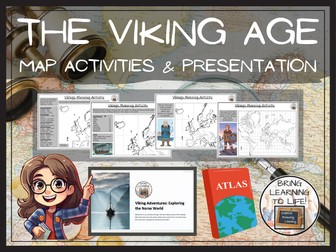
Explore the Middle Ages with our Vikings Mapping Activities!
Step into the incredible period in time with this engaging Vikings Map Activity and Teacher Presentation! Designed for Year 4 through to Year 7, this hands-on resource brings history and geography to life. Students will explore the homelands of the Vikings and beyond.
This comprehensive resource includes:
Modern and older maps to connect past and present.
Interactive Mapping Tasks that encourage research and critical thinking.
A focus on key geographic features like countires, and cities.
A wordsearch puzzle to reinforce vocabulary and historical knowledge.
A detailed Teacher Presentation to guide learning.
Aligned with National Curriculum Standards and perfect for topic, geography, and history lessons, this activity fosters skills like map reading, research, and spatial awareness. It’s ideal for homeschooling, classrooms, and history enrichment programs.
Engage your students with this exciting and educational journey into one of the world’s most influential periods of time! Download now and inspire a lifelong love of history and geography!
⎻⎻⎻⎻⎻⎻⎻⎻⎻⎻⎻⎻⎻⎻⎻⎻⎻⎻⎻⎻⎻⎻⎻⎻⎻⎻⎻⎻⎻⎻⎻⎻⎻⎻⎻⎻⎻⎻⎻⎻⎻⎻⎻⎻⎻⎻⎻⎻⎻⎻⎻⎻⎻⎻⎻⎻⎻⎻
This resource is great for:
In class learning
Independent work
Homework
Guided reading sessions
Assessment practice
Reading interventions
Emergency sub plans
⏚⏚⏚⏚⏚⏚⏚⏚⏚⏚⏚⏚⏚⏚⏚⏚⏚⏚⏚⏚⏚⏚⏚⏚⏚⏚⏚⏚⏚⏚⏚⏚⏚⏚⏚
For more great resources follow my store ⇉⇉ CLICK HERE
Across the areas of Viking settlement in the UK we see part of their legacy in the names of our places. In this activity the children will:
1.consider how places get their names
2.learn about elements of Viking place names
3.create place names for their own Viking settlement
4.explore your locality for evidence of Viking settlements
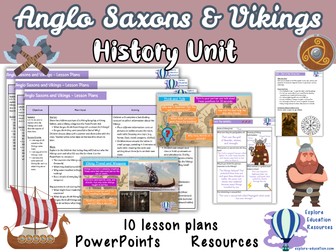
This KS2 history resource contains a full 10-lesson unit covering Viking and Anglo-Saxon life, raids, beliefs, and settlement in Britain. Suitable for Year 3 to Year 6, the unit includes lesson plans, activities, and PowerPoints designed to support pupils in understanding key historical events and daily life during this period.
Pupils will learn about Viking longships, Norse gods, the raid on Lindisfarne, Anglo-Saxon villages, and the reasons behind Viking migration and settlement. Lessons include opportunities for role play, poetry, drawing, and group discussion.
What’s included:
✔ 10 detailed lesson plans
✔ PowerPoint presentations for each lesson
✔ Differentiated worksheets and activity templates
✔ Vocabulary word banks and sentence starters
✔ Printable resources for games, quizzes, and poetry
✔ Links to child-friendly videos and websites
Lesson overview / structure:
★ Lesson 1 – Who Were the Vikings?
Fact-finding carousel on Viking origins, homes, food, and clothing. Includes a starter discussion and plenary quiz.
★ Lesson 2 – Viking Longships
Children label and design longships, learning about keels, sails, and shields. Includes video links and drawing activity.
★ Lesson 3 – Viking Traders and Settlers
Interactive trading game to understand Viking motivations for settling in England. Includes role cards and score sheets.
★ Lessons 4–5 – Lindisfarne Raid Poetry
Children write poems from both Viking and monk perspectives. Includes planning templates and vocabulary support.
★ Lessons 6–7 – Anglo-Saxon Daily Life
Research-based lessons with presentations or posters on Anglo-Saxon homes, jobs, food, and beliefs.
★ Lesson 8 – Viking Daily Life Research
Online research task with structured fact sheets and a carousel fact swap activity.
★ Lesson 9 – Viking Gods
Art and writing task focused on Odin, Thor, Freyja, and Loki. Includes fact files and drawing templates.
★ Lesson 10 – Viking Values Discussion
Open-ended discussion lesson using historical thinking questions. Includes group work and whole-class debate.
Why it’s useful:
✔ Fully differentiated activities for all abilities
✔ Includes creative tasks (poetry, drawing, role play)
✔ Supports historical enquiry and critical thinking
✔ Covers both Vikings and Anglo-Saxons in one unit
✔ Includes links to videos and safe research websites
Suggested use cases:
✔ KS2 history topic on Vikings and Anglo-Saxons
✔ Year 3–6 classroom teaching
✔ Whole-class discussion and group work
✔ Creative writing and cross-curricular literacy
✔ End-of-topic assessment or display work
Search tags:
KS2 history | Vikings and Anglo-Saxons | Viking longships | Lindisfarne raid | Norse gods KS2 | Anglo-Saxon village life | Year 5 history unit | Viking poetry | outstanding Viking lesson | KS2 trading game | Viking settlement lesson | Anglo-Saxon research task | Viking gods drawing activity | KS2 history planning
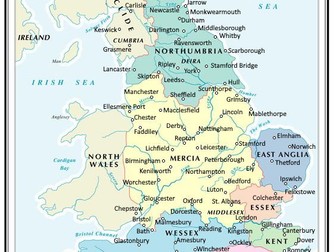
A ready-to-use KS2 history resource built around a bespoke UK map of Anglo-Saxon, Viking, and Roman place names—created and refined for real classroom use, as it was difficult to find a map with the right level of detail and clarity.
This resource helps pupils identify patterns in place names and understand their meanings, supporting topics on settlement, invasion, and legacy.
Includes:
Bespoke UK map showing place name origins (Anglo-Saxon, Viking, Roman), carefully edited for clarity and classroom use
Activity sheet for identifying and analysing place names
SEND-friendly version included
Example place names and meanings (e.g. -wich = farm, -mere = lake)
Useful video links to support teaching
The map has been adapted to include meaningful examples while avoiding unnecessary clutter, making it easier for pupils to spot patterns and engage in discussion.
Ideal for whole-class teaching, group work, or independent learning.
Designed to save planning time while supporting confident, effective teaching.
Note: No PowerPoint included, but this pairs well with existing introductions to Anglo-Saxon place name suffixes.
This complete, ready-to-teach KS3 History lesson explores how Iron Age Britons, Romans, Anglo-Saxons and Vikings shaped Britain before 1066. It is ideal for Year 7 pupils studying migration, invasion and early medieval Britain.
The lesson is guided by the enquiry question “Did Britain Change Through Conflict or Connection?” Pupils investigate how different groups arrived, settled, fought, traded and lived together. This develops an accurate understanding that change was gradual and that newcomers did not simply replace the people already living in Britain.
An engaging historical narrative about Boudica’s rebellion introduces conflict between Roman rulers and local communities. Pupils identify causes and consequences while considering the strengths and limitations of historical evidence.
The main activity uses a custom, illustrated information sheet and comparison table. Pupils compare each group’s:
Arrival and settlement
Everyday life and work
Power, beliefs and relationships
Legacy and surviving evidence
Information is deliberately presented in different orders, encouraging pupils to read carefully, select relevant evidence and organise knowledge independently. Through comparison and extended writing, pupils practise chronology, historical judgement and the second-order concepts of cause and consequence, change and continuity, similarity and difference, and significance.
The lesson supports mixed-ability classes through accessible language, defined keywords, bold key information, structured prompts and sentence starters. Challenge questions provide opportunities for deeper thinking, while completed answers and a model paragraph offer instant feedback, self-assessment and clear success criteria.
Resources include:
Fully editable lesson PowerPoint
Custom illustrated information sheets
Printable comparison table
Boudica historical narrative
Structured extended-writing task
Model answers and instant feedback
Challenge and plenary activities
Homework task
A complete and visually engaging lesson that builds secure knowledge of Britain before 1066 while developing essential KS3 historical skills.
This is a source-based set of activities around the topic of Viking trade. Students analyse a variety of documentary and archaeological primary sources to make decisions on where the Vikings traded and the goods they traded. It is designed for students of the NSW History K-10 Syllabus for the Australian Curriculum.
Stage 4
Depth Study 4: The Western and Islamic World
The Vikings
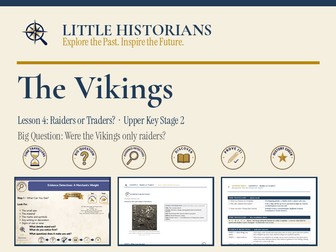
One complete lesson from the Little Historians Vikings unit.
Big Question: Were the Vikings only raiders?
A small lead weight with Arabic letters copied onto it by someone who could not read them. Pupils follow the silver from Baghdad to Lancashire and decide whether raiding is the whole story.
Pupils work two sources. The class investigates a trader’s weight stamped with copied Arabic writing together on the slides, in three steps: what can you see, what does it tell us, what can it not tell us. Pupils then take the same three steps on their own in the journal, on silver from the Cuerdale Hoard.
The lesson follows the Little Historians six-stage framework: Time Travellers,
Big Question, Evidence Detectives, Discover, Prove It! and History Check.
Learning intention: To investigate Viking trade and decide whether raiding is the whole story.
WHAT IS INCLUDED
Lesson plan: the unit overview plus the one-page plan for this lesson
PowerPoint lesson, with a PDF copy for phones and tablets
Journal pages, including the unit Knowledge Organiser
Teacher answer sheet
Start Here guide
The Little Historians Framework, explained in full.
Lesson 1 of this unit is free. Search for Little Historians Vikings free lesson.
The complete eight-lesson unit is in the Little Historians shop.
If this is useful in your classroom, a review would be a big help. It is how
other teachers find these resources.
Explore the Past. Inspire the Future.
Entire unit of work. Lessons with worksheets, printables and power points. Each lesson is planned with video links to each lesson. Planning is based around KS2 / KS3. Can be used to extend KS2 and for SEND and lower ability KS3. Can be extended to suit KS3 (Years 7,8,9)
Who were the Vikings
LongBoats
Lindisfarne
Alfred The Great
Viking Runes
Find a whole unit of lessons about the Vikings for KS1/KS2.
Bundle includes:
Who were the Vikings?
Viking Society
Vikings in Scandinavia
Viking Myths and Legends
Viking Clothes and Jewellery
The Battle or Largs
Old Norse Language and the Futhark Alphabet
Mastery of the Sea: The Longship
Leisure, Games and Hobbies
Labour, Society and Economy
Gods and Goddesses - Norse Mythology
Diet, Farming and Feasting.
Total price before bundle: £20.40
Bundle Price: £10
**Save 51% on bundle!! **
Lesson 1: Who Were the Vikings? Key stage 3 or 4 History
A fully resourced and engaging introductory lesson to the Vikings, designed for Key stage 3 or 4 History. This lesson encourages students to go beyond stereotypes and explore the real lives of the Vikings as raiders, traders, and settlers.
Lesson Focus:
Question: Who were the Vikings?
Challenge common Viking stereotypes.
Explore where the Vikings came from and how they lived.
Investigate their reputation as both fearsome raiders and skilled farmers, traders, and craftsmen.
Activities & Resources:
Time line task to place the Vikings in context.
Source analysis of maps, pictures, and accounts.
Class discussion and group work with differentiated worksheets.
Fully resourced Power Point(ready to teach)
Differentiated worksheets & source pack
Clear learning objectives and success criteria
A mix of activities to engage, challenge and support all learners
This lesson makes an ideal first lesson in a Vikings scheme of work, but also works well as a stand-alone lesson into Viking life and identity.
This is the fourth in a series of lessons on Vikings.
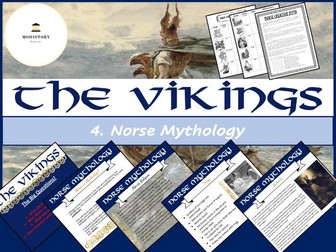
This fourth lesson explores the main features of Norse Mythology, answering questions like: Who are the main norse gods and goddesses? What did the Vikings believe in? How did they worship? What role did religion play in everyday Viking life? Included are starter activities and revision activities as well as two worksheet activities. The culminating task is a paragraph response.
A very visual presentation that can be used alongside other resources easily. Includes worksheets for activities inside the PowerPoint.
Included:
1 PowerPoint presentation with over 30 slides
2 PDF worksheets to match activities
.
Australian Curriculum - Stage 4 - Depth Study 4: The Western and Islamic World - Topic 4a: The Vikings (c. AD 790 – c. 1066)
Syllabus dot points covered
The way of life in Viking society (social, cultural, economic and political features) and the roles and relationships of different groups in society (ACDSEH007)
-using a range of sources, eg the Viking sagas, outline key social, cultural, economic and political features of Viking society
.
Historical skills covered
HT4-3 --> describes and assesses the motives and actions of past individuals and groups in the context of past societies
HT4-8 --> locates, selects and organises information from sources to develop an historical inquiry
HT4-9 --> uses a range of historical terms and concepts when communicating an understanding of the past
.
If you have any questions about this product or using this product, we are continuously seeking to improve the quality of our materials. Every effort has been made to make this unit error-free. Should you find any errors, please contact us via email at mrmsmohistory@gmail.com and we will ensure that you receive a corrected copy. Your feedback is greatly appreciated.
.
Keywords: Vikings, history, Stage 4, Australian Curriculum, Middle Ages, Scandinavia, Year 7, Year 8, PowerPoint, Yggdrasil, Valhalla, Hel, realms, sacrifice, gods, goddesses, deities, religion, Norse, mythology, Christainity, Thor, Odin, Freyja, Freyr, Frigg, Heimdall, Tyr, Loki, Valkyries, Muspelheim, Niflheim, Asgard, Vanaheim, Ragnarok, creation story.
Overview of the Unit:
Lesson 1: Engage Through Drama
Kick off the unit with playscripts and hot seating to spark interest and immerse pupils in the Viking topic.
Lessons 2–4: Master Relative and Embedded Clauses
Build technical skills by focusing on relative clauses and embedded clauses using dashes. Scaffolded tasks include identifying, practicing, and applying these skills to descriptive paragraphs about the Vikings.
Lesson 5: Expanded Noun Phrases and Prepositional Phrases
Teach pupils to add detail and precision to their writing by crafting vivid sentences about Viking roles and lifestyle.
Lesson 6: Ad Same Ad Sentence Structure
Introduce Allan Peat’s Ad Same Ad sentences to help students create impactful, descriptive sentences.
Lesson 7: Describing Viking Clothing
Apply learned skills to describe Viking clothing and settlements, blending expanded noun phrases, prepositional phrases, and Ad Same Ad sentences.
Lessons 8–10: Using Formal Language
Guide students to write formally, using generalizers and precise vocabulary, while practicing formal sentence construction.
Lesson 9: Plan the Report
Pupils organize their ideas under clear subheadings, ensuring all features—relative clauses, formal language, expanded phrases—are included.
Lessons 10–12: Writing the Non-Chronological Report
Over three lessons, pupils draft their reports, working to different ability levels with sentence starters, scaffolds, and modeled examples.
Lesson 13: Publish with Style
Pupils polish their work, adding illustrations and neat formatting to create a final report ready for display or assessment.
Key Features:
Fully differentiated tasks to support lower ability, age-related, and greater depth learners.
Focus on grammar skills: relative clauses, embedded clauses, expanded noun phrases, and formal language.
Engaging activities including hot seating, sentence crafting, and publishing with illustrations.
Scaffolds, WAGOLLs, and success criteria provided for every step.
Perfect for cross-curricular links with history or thematic units on the Vikings.
Why Teachers Love It:
Saves time with ready-to-teach lesson plans and resources.
Encourages creativity alongside rigorous grammar skills.
Supports writing progression with clear success criteria and scaffolded tasks.
Engages learners with a high-interest topic and varied teaching methods.
What’s Included:
13 detailed lesson plans with objectives, activities, and differentiation.
WAGOLL examples for each skill.
Printable planning templates, worksheets, and success criteria.
Editable resources for tailoring to your class.
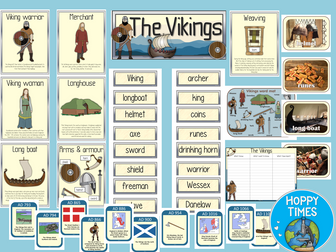
The Vikings Display board pack. Contains everything you need to decorate your display board for this popular topic. 44 pages in .pdf format (the display posters are NOT editable but do contact me if you want something adding or changing).
Included in the resource:
The Vikings header. A4, but can be printed as A3 to make it bigger, just adjust the settings on the printing page.
7 Vikings posters with short descriptions (Viking warrior, merchant, Viking woman, longhouse, long boat, arms and armour, weaving). A4
Vikings photos - a collection of 11 A4 real life photos to add to the display.
Vikings timeline - 10 A4 posters featuring the main events of the Viking era. Can be printed in a smaller format by choosing the "Multiple" option on the printing page.
Vikings KWL chart - A4 (for display or as an individual activity)
Vikings keywords - 2 keywords with borders per page of A4. An extra border provided if you want to write your own.
Vikings word mat with main keywords for the topic.
Save yourself hours of work by purchasing the ready made display, just print, laminate for durability and enjoy teaching the topic!
The Vikings - KS3 - (11 Lessons)
Leave a review for a FREE single resource.
Bundle SoW: https://www.tes.com/teaching-resource/the-vikings-13422232
This SoW is designed in detail and is both differentiated and engaging, and allows you to move pupils through content efficiently.
Made to the highest standard and constructed using current research, both dual coding and retrieval practices are at the heart of this unit. A colour scheme also runs throughout to ease both your delivery and students comprehension.
The Vikings - KS3 - (11 Lessons)
L1: Where were the homelands like in the Viking Age?
L2: How did the Geography of Scandinavia Shape Viking Society?
L3: How was Viking society structured?
L4: What was everyday life like for women and children in Viking society?
L5: How did Religion Influence Vikings Lives?
L6: What do different sources reveal about Viking society?
L7: How did Viking shipbuilding and weapon technology make expansion possible?
L8: How far did the Vikings explore, trade and settle?
L9: How Did Viking Occupation Occur in England?
L10: How have the Vikings influenced the modern world?
Cover Lesson: What were the key elements of Viking Society?
If you leave a review of any of our resources, you can claim any FREE single resource from our ever growing library. Simply message the above email, which is monitored daily.
teachercentralltd@gmail.com
Best FREE Resources (Teacher Central)
https://www.tes.com/teaching-resource/britain-losing-and-gaining-an-empire-12973075
https://www.tes.com/teaching-resource/financial-literacy-12898983
https://www.tes.com/teaching-resource/romeo-and-juliet-12908635
https://www.tes.com/teaching-resource/shakespeare-12908634
https://www.tes.com/teaching-resource/macbeth-gcse-12863697
https://www.tes.com/teaching-resource/animal-farm-free-sow-12942163 (FREE SoW)
https://www.tes.com/teaching-resource/slavery-sow-12843084 (FREE SoW)
https://www.tes.com/teaching-resource/-12727408 (FREE SoW)
https://www.tes.com/teaching-resource/russia-1917-91-from-lenin-to-yeltsin-12834552
https://www.tes.com/teaching-resources/shop/TeacherCentral?sortBy=lowestPrice&p=5
I hope you find this SoW useful. If you have, I have created a series of resources.
You can check them out here.
https://www.tes.com/teaching-resources/shop/TeacherCentral
Explore the famous Viking raids that shaped early medieval history with this engaging PowerPoint lesson and supporting differentiated activity.
This resource helps pupils understand why the Vikings carried out raids, where they travelled and how these attacks affected the people and places they encountered.
Pupils will explore famous Viking raids, including their attacks on monasteries and settlements, while developing an understanding of the impact these events had on Britain and beyond.
This resource includes:
A fully editable PowerPoint presentation exploring Viking raids and raiding.
Information about why Vikings carried out raids.
Details about Viking ships, weapons and tactics.
Exploration of Viking attacks on monasteries and settlements.
Information about the impact of Viking raids on local communities.
A differentiated complete the text worksheet to support understanding and recall.
Editable Canva version included:
A link to editable Canva versions of the PowerPoint and differentiated worksheet is included with your purchase. This allows teachers to customise the resources, adapt the content, add their own activities, or tailor the materials to suit the needs of their learners.
This free PDF unit overview outlines a 6-lesson cross-curricular humanities scheme exploring Norse mythology, Viking beliefs, and creative storytelling. Ideal for teachers planning KS2 or lower KS3 lessons (ages 9–13), it includes clear weekly learning objectives, creative outcomes, curriculum links, and differentiation suggestions.
What’s Included:
1-page unit plan with lesson titles and outcomes
Overview of skills covered across History, RE, English, Geography, and PSHE
Suggestions for differentiation and inclusive task formats
Ideas for creative assessment and student choice
Lesson Titles:
What Is Norse Mythology? – Map and storytelling traditions
From Ice & Fire – Norse creation myth and sacrifice
Yggdrasil & The Nine Worlds – Symbolism and human values
Meet the Gods, Goddesses & Giants – Viking characters and virtues
Valhalla – Bravery, grief, and belief in the afterlife
Ragnarök – Endings, rebirth, and myth writing
Main Subject:
Humanities – cross-curricular with English, RE, PSHE, and Geography
Use this overview to structure a full unit, build a cross-curricular project, or guide your planning before purchasing the complete lesson pack.
If this overview supports your planning, please leave a review!
Your feedback helps other teachers discover creative and thoughtful resources.


 Quick View