Whole School Literacy QuizQuick View
Cre8tive_Resources

Whole School Literacy Quiz

(0)
School Literacy Quiz Over 10 rounds and 70+ Questions. Literacy Quiz. A fun whole school english literacy quiz that tests a range of different skills with students working in teams to compete against each other. Let the best literacy team win! This resource contains: ☞ 1x PowerPoint with questions and answers laid out in a professional format (Literacy and essential English skills) ☞ 1x Student Answer Sheet double sided out of /70+ Marks (PDF and PPT Version) and all the answers!! ☞ Contains 10 Rounds: S.P.A.G, True or False, There Their or They’re, Link in Punctuation, Shakespeare Round, Design Challenge and more… ☞ 3 sets of certificates This quiz resource is perfect for lesson time, form time, extra curricular clubs, part of a drop down day or as a fun and educational treat for your class. ✿ A variety of different rounds and different challenges within this quiz for all types of learners to access (something fun no matter what ability) Product code: FUN/C8/QZ/24 ✿ This will last a full hour by the time you get students into small teams and run through the Quiz and the interactive way the answers appear. A tie-breaker is included . Why not check out some of our latest super bundles below: Personal Finance as a young Adult Online Safety + Staying Safe Y12 Survival Kit - Personal Safety Y11 Survival Kit - Revision + Exam Stress British Values Explored Bundle Society, Body Image + Peer Pressure Finance Risk + Online Safety
Whole School Cursive writing bundleQuick View
sjames15

Whole School Cursive writing bundle

6 Resources
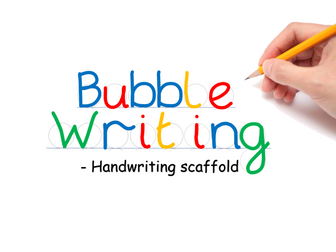
This bundle contains all cursive resources for KS1, LKS2 and UKS2 including yellow bubble scaffold sheets and word banks. Giving you the opportunity to save 33%!!
Whole School Assembly: Digital Citizenship & Online ResponsibilityQuick View
edward_lynn

Whole School Assembly: Digital Citizenship & Online Responsibility

(0)
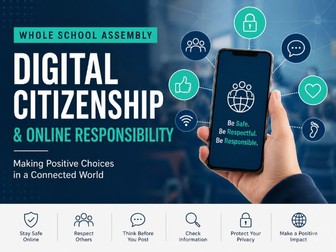
Whole School Assembly: Digital Citizenship & Online Responsibility A fully editable, ready-to-deliver assembly designed to help students understand the importance of responsible online behaviour, digital footprints, social media use, online safety, and respectful communication in the digital world. Perfect for secondary schools (KS3–KS5), this engaging assembly encourages students to reflect on their online actions and develop the skills needed to become positive, responsible digital citizens. Included: 10-slide PowerPoint assembly Discussion questions and student reflection opportunities Content on digital footprints and online reputation Guidance on social media responsibility Cyberbullying and respectful online communication Misinformation and critical thinking online Privacy, passwords, and online safety Ethical use of AI and technology Suitable for whole-school delivery (KS3, KS4 & KS5) Ideal for: Whole-school assemblies Tutor time and form periods PSHE lessons Online safety and safeguarding programmes Digital literacy education Learning Outcomes: Students will: Understand what it means to be a responsible digital citizen. Recognise the long-term impact of their digital footprint. Develop strategies for staying safe online. Learn how to communicate respectfully in digital spaces. Understand the importance of evaluating information critically. Reflect on how their online actions affect themselves and others. This assembly requires no preparation and is ready to deliver immediately, making it ideal for busy teachers, Heads of Year, pastoral teams, and safeguarding leads. Format: PowerPoint (.pptx) Age Range: 11–18 (KS3–KS5) Duration:10–15 minutes
Whole School Literacy BookQuick View
captain_picard

Whole School Literacy Book

(38)
A book I've written to be given to all staff and students. Topics include: What is literacy? How to improve your work: responding to feedback Making your writing more interesting: Sentence Variety Three tips for improving your writing style Making your writing accurate: Punctuation Commas Speech Marks Colons and Semi-colons Apostrophes Making your writing flow: Paragraphs Making your work flow: connectives How to develop your answers Making your writing accurate: Spellings Spelling strategies Nine spelling rules to learn Homophones Homonyms 25 commonly misspelt words How to improve your work: Redrafting How to improve your word power Worn out words 70 words to sharpen your expression Common literacy errors
Whole School Literacy PunctuationQuick View
mgroverresources

Whole School Literacy Punctuation

(0)
A slide-show with printable posters for classrooms; I usually use these at the start each year to remind students of important punctuation. I have used the slide-show as part of a whole-school assembly and then the challenge at the end is used as a reward scheme.
Whole school literacyQuick View
chinaroses

Whole school literacy

2 Resources
Several resources for whole school literacy and revision of key terminology across the school curriculum.
Whole School Literacy TrackerQuick View
katiewindridge

Whole School Literacy Tracker

(0)
The PLT document refers to a 'Personalised Literacy Tracker' which can be used with all students across the school. This can be glued into planners and referenced across ALL subjects. There is a step-by-step guide attached which tells you exactly how you could use this document in your school and also provides you with the resources needed to teach the explicit literacy foci across your subject areas. This is a great resource for any new Literacy Coordinators and also anyone who wants to introduce a way to promote and track literacy across the whole school.
Whole school Literacy keysQuick View
vshell

Whole school Literacy keys

(0)
This resource has been used to embed literacy in all lessons. A simple way to ensure that pupils can identify that an element of literacy is evident in any subject. After 3 years of using this resource, our pupils' literacy skills improved remarkably.
Whole School Literacy StrategyQuick View
ElaineB66

Whole School Literacy Strategy

(0)
This is a two year strategy designed to promote Literacy across the curriculum in a special school. Staff, students and parents are all included in the strategy. I have endeavoured to raise the profile of literacy and embed the concept that every teacher, regardless of subject specialism, is a teacher of literacy.
Whole school literacyQuick View
sumz123

Whole school literacy

(0)
This is a whole school literacy policy which is centred around the use of disciplinary literacy. It includes a policy and whole school strategies for staff and students to use. The policy covers; reading, writing and oracy strategies.
Whole school literacyQuick View
Christianne

Whole school literacy

(5)
These presentations and resources were made for whole staff training and termly targets that were implemented across the curriculum in our middle school. They focus on sentence structure, punctuation and reading skills, and the poster slides were on display in every classroom. I hope others might find them useful. Christianne:)
Whole-School Literacy and Spelling UnitQuick View
sallyedannock

Whole-School Literacy and Spelling Unit

6 Resources
Whole-school spelling activities designed to cover the entire school year. Aimed at KS3 and KS4. All instructions are included. Comes with a mini literacy task every week with a half-termly focus including: sentence types synonyms punctuation homohones verb tense word class.
Whole School Literacy NewslettersQuick View
johnleehough

Whole School Literacy Newsletters

4 Resources
This bundle includes four teaching and learning newsletters that contain practical strategies and recent research to improve the standards of literacy and written accuracy.
Whole school Literacy targetsQuick View
moonadaly

Whole school Literacy targets

(0)
Literacy objectives for the whole school separated into Key Stage targets. Ideal for tracking progression and ensuring curriculum coverage Reading, Writing, SPAG and handwriting all included
International Literacy Day 2026 | Whole-School Assembly Pack | KS1–KS3Quick View
LeRouxSEND

International Literacy Day 2026 | Whole-School Assembly Pack | KS1–KS3

(0)
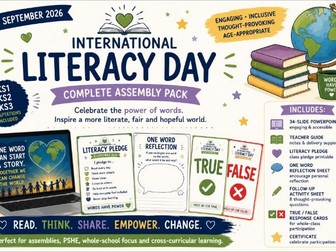
Celebrate International Literacy Day on 8 September 2026 with this complete, ready-to-deliver whole-school assembly pack for KS1, KS2 and KS3. Designed around the 2026 theme “Literacy for People, the Planet and Prosperity,” this engaging assembly helps pupils understand that literacy is much more than simply reading books. Pupils explore how reading, writing, communication and understanding information affect everyday life, safety, opportunity, the environment and the choices available to us. The assembly begins by asking pupils to consider how much they have already read in an ordinary day before exploring literacy around the world, global progress and why access to literacy opportunities is still unequal.
WHOLE SCHOOL LITERACY POLICYQuick View
rlyons81

WHOLE SCHOOL LITERACY POLICY

(0)
A draft policy proposal document. School specific but enough ideas, guidance and resources to be used by most secondary schools.
Writing Assessment Checklist for Whole SchoolQuick View
Teach_wise

Writing Assessment Checklist for Whole School

6 Resources
All of the writing objectives on one handy sheet for every year group! Each year group is spit into Below, Expected and Greater Depth statements with easy colour coding to seperate transcription, grammar and composition statements. Useful as a planning tool: to see what needs revisiting or even planning altogether, as well as assessing and planning for progress. I would use one sheet per child but this is not necessary. All reviews are welcome. You may also find my free editing guidance resource useful: https://www.tes.com/teaching-resource/editing-guidance-resource-and-marking-for-writing-lessons-13012677
Literacy WorkbooksQuick View
JodieMills

Literacy Workbooks

(15)
2 literacy booklets with a range of tasks focusing on grammar, punctuation, reading skills and vocabulary. These booklets are aimed at KS3and KS4 low ability pupils but I have found it useful to use certain pages as lesson starters to recap with higher ability pupils too. Topics include: nouns verbs adjectives adverbs noun phrases verb phrases subject verb object simple and compound sentences avoiding splicing skimming and scanning coordinating conjunctions commas apostrophes subordinating conjunctions improving vocabulary complex sentences tenses summarising making inferences bias in writing comprehensions speech marks capital letters and full stops dictionary skills clauses subject-verb agreement