A Level - Language Diversity (World Englishes)Quick View
LDOYLE94

A Level - Language Diversity (World Englishes)

(0)
This PowerPoint is a ready-to-use, exam-focused guide for Language Change and Diversity (Paper 2). It includes 102 slides, covering 14 lessons (6 weeks). It explores: Origins & Spread of English – From Anglo-Saxon roots to global dominance. Global Englishes – Case studies like Singlish, Denglisch, and Franglais. Key Theories & Models – Kachru’s Three Circles, McArthur’s Circle, Strevens’ Map. Language Attitudes – Prescriptivism vs Descriptivism, Aitchison’s metaphors. English as a Lingua Franca – Features, code-switching, and global communication. Debates & Future Trends – Linguistic imperialism, Globish, Multicultural London English. Includes interactive tasks, videos, essay scaffolds, and a knowledge organiser—perfect for engaging students and hitting AO2.
Language and Global and World Englishes A Level UnitQuick View
JPResources

Language and Global and World Englishes A Level Unit

(0)
A 10 lesson unit comprising a 67 slide PowerPoint, 9 different worksheets (including transcripts) exploring the topic of Language and Global and World Englishes and a summary terminology and theory sheet. Each lesson includes a starting discussion prompt which acts as a learning objective, detailed notes on the theories and concepts listed below, a worksheet (with the exception of lesson nine) and activities, and a homework task. The following theories and concepts are covered: David Crystal – World English: Past, Present, Future (1999) Jennifer Jenkins – Lingua Franca Core (2000) Nicholas Ostler – The Last Lingua Franca (2010) David Graddol – The Future of English? (1997) Bagele Chilasa – Hierarchy of Language (2011) Braj Kachru – Three Circle Model of World Englishes (1985) Jean Paul Nerrière – Globish (2004) Pidgins and creoles William Stewart (1965) and Derek Bickerton (1973) – Post-Creole Continuum Bettina Migge and Isabelle Léglise – Attitudes towards creoles in the Caribbean (2006) Einar Haugen - Code Switching (1954) David Crystal – Tri-English (2000) Tom McArthur – Circle Model of World English (1987) Peter Strevens – World Map of English (1980) Barbara Seidlhofer – Teaching English as a Lingua Franca (2004) Stress-Timed and Syllable-Timed Languages Rhotic and Non-Rhotic Accents Lisa Lim – Language Ecology Mark Pagel – The Future of English (2011) David Deterding and Andy Kirkpatrick – Influence of Technology on World Englishes (2011) British Council – The Future of English: Global Perspectives (2023) Lynne Murphy – British and American Politeness Features (2013) Yohai Hakak, Sophia Bosah, Kwaku Amponsah and Kei Long Cheung – Australian Politeness (2022) McMaster University – Canadian v. American Politeness in Tweets (2018) There are some references to AQA-style A Level specification questions, but you can adapt these if needs be. These can be found on slides 56-64. Lesson 9 is based on an AQA A Level question. The final lesson is a consolidation activity complete with guided revision cards. Alternatively, you could use an app such as Quizlet so that the students could produce digital revision resources. Check out my other English Language A Level resources! Language and Gender Language and Region Language and Power and Occupation Language Change Language and Technology Language and Social Groups Language Discourses Child Language Acquisition - Speech Language Investigation
world culture day languages quiz!Quick View
richardslanguages

world culture day languages quiz!

(0)
This is a quiz that contains around 37 slides of the best language quiz for world culture day to play with students where they will need to guess the language - it also comes with a hint. All in all it contains around 14 different languages from around the world that then offers a little bit of information about the country to help promote the countries location and culture! Enjoy!
The World's Wife - Duffy (IB Language and Literature 2021)Quick View
cdgray

The World's Wife - Duffy (IB Language and Literature 2021)

(1)
A series of lessons on Carol Ann Duffy’s ‘The World’s Wife’, planned for the IBDP Language and Literature course (for first examination in 2021). This unit was taught as preparation for the students in the IO Oral Examination, therefore this is a focus on Global Issues explored within the poems. The unit title is: ‘Representations of Identity and Gender’. Please note - Powerpoints were originally created on Google Slides and therefore there may be some slight formatting features that need fixing in Powerpoint. Includes: Lesson Powerpoints for the following 10 poems: Little Red Cap Thetis Mrs Sisyphus Mrs Aesop Mrs Midas Medusa (with a worksheet for groups/students to explore some secondary reading about interpretations of the myth of Medusa) Delilah (with an article about masculinity to connect) Anne Hathaway Pilate’s Wife (with a question task sheet) The Devil’s Wife In addition, a worksheet for students to research the context for the poems before studying them is included. Lesson Powerpoints include a clear lesson question (e.g. How does Duffy explore the consequences of greed and avarice in ‘Mrs Midas’?. There is usually guiding questions for student annotations, and often ideas for global issue connections or optional Learner Portfolio task ideas.
Music Quiz - Guess the language!Quick View
emmajanewelsh

Music Quiz - Guess the language!

(3)
An attractive powerpoint with a link to 12 different songs sung in different languages across the world from Spanish to Japanese. Ideal for European Day of languages or fun lessons/clubs in MFL.
Worlds and LivesQuick View
EnglishGCSEcouk

Worlds and Lives

18 Resources
Worlds and Lives pack for the new AQA poetry anthology. Currently includes: Lines Written in Early Spring - William Wordsworth England in 1819 - Percy Bysshe Shelley Shall earth no more inspire thee - Emily Bronte In a London Drawingroom - George Eliot On an Afternoon Train from Purley to Victoria, 1955 - James Berry Name Journeys by Raman Mundair pot by Shamshad Khan A Wider View - Seni Seneviratne Homing - Liz Berry A Century Later - Imtiaz Dharker The Jewellery Maker Louisa Adjoa Parker With Birds You’re Never Lonely - Raymond Antrobus A Portable Paradise - Roger Robinson Like an Heiress - Grace Nichols Thirteen - Caleb Femi Comparing poems lesson Scheme of Work document
AQA NEA - Language Investigation - A Level English Language UnitQuick View
JPResources

AQA NEA - Language Investigation - A Level English Language Unit

(0)
A 9 lesson unit comprising a 69 slide PowerPoint and 9 different worksheets exploring the Language Investigation NEA for AQA English Language A Level. Each lesson includes a starting discussion prompt which acts as a learning objective, detailed guidance on the skills and ideas listed below, a worksheet and activities, worked questions and exemplar responses, and a homework task. The following skills are covered: Concepts and terminology NEA Investigation overview and components Choosing a topic How to generate a title Collecting data (with ethical and data protection considerations) Selecting and analysing data (including eliminating variables) How to write the introduction How to write the methodology How to write the analysis Quantitative and qualitative analysis How to write the conclusion How to organise referencing, the bibliography and appendices Check out my other English Language resources: NEA Original Writing Language and Gender Language and Region Language and Power and Occupation Language and Global and World Englishes Language Change Language and Technology Language and Ethnicity Language and Social Groups Analysing Spoken Language Child Language Acquisition - Speech Child Language Acquisition - Reading and Writing Language Discourses - Section B, Question 3 Language Discourses - Opinion Writing - Section B Question 4 Language Levels AQA Paper 2 Revision
Worlds and Lives 2025 Model AnswerQuick View
EnglishGCSEcouk

Worlds and Lives 2025 Model Answer

(0)
2025 Worlds and Lives model answer on how In A London Drawing Room (Drawingroom) by George Eliot and England in 1819 by Shelley explore ideas of place and its effects on people. This model essay is designed to hit the requirements for Grade 9 for AQA English Literature Paper 2. Includes an answer that weaves together language and structure analysis, context and detailed and perceptive insights into relevant contexts, how and why Eliot and Percy Bysshe Shelley present their poems in relation to ideas of place and people. Please note this pack does not include the exam paper or exam question. Want a free single resource? Leave a review and email us at info@englishgcse.co.uk to receive your free resource!
Language and Ethnicity A Level UnitQuick View
JPResources

Language and Ethnicity A Level Unit

(0)
A 10 lesson unit comprising a 68 slide PowerPoint, 9 different worksheets (including texts for analysis) exploring the topic of Language and Ethnicity and a summary terminology and theory sheet. Each lesson includes a starting discussion prompt which acts as a learning objective, detailed notes on the theories and concepts listed below, a worksheet (with the exception of lesson nine) and activities, and a homework task. The following theories and concepts are covered: Idiolect, dialect, sociolect and ethnolect Pidgins and creoles Multicultural London English – Cheshire andKerswill (2011) Multicultural British English – Drummond (2016) Black British English – Thompson (2022) Code switching – Haugen (1950s) Code mixing – Wardhaugh (1986) Types of Code Switching West Yorkshire Study - Ives (2014) White talk Black talk - Hewitt (1986) South London Study - Ives (2014) Code Switching - Holmes (2017) Language in a Black Community - Edwards (1986) The objectification of ‘Jafaican’ - Kerswill (2014) Ethnolects - Eckert (2008) Stylising the ‘roadman’ - Ilbury (2023) Style-shifting in Multicultural London English - Oxbury and De Leeuw (2020) Phonetic variation and change in the Cockney Diaspora - Cole and Evans (2020) Style Repertoire and Social Change in British Asian English – Sharma (2011) Style variation – Sharma and Rampton (2015) Aspects of identity in a second language – Drummond (2012) Language as a resistance identity – Pitts (2012) Black/white borders through linguistic stylization – Clark (2003) Style shifting and identity – Barrett (1994) Cultural appropriation in language – McWhorter (2021) Language and ethnicity and identity – Ogbu (1999) Linguistic Injustice – Baker-Bell (2020) There are some references to AQA-style A Level specification questions, but you can adapt these if needs be. These can be found on slides 57-65. Lesson 9 is based on an AQA A Level question. The final lesson is a consolidation activity complete with guided revision cards. Alternatively, you could use an app such as Quizlet so that the students could produce digital revision resources. Check out my other English Language A Level resources! Language and Gender Language and Region Language and Power and Occupation Language and Global and World Englishes Language Change Language and Technology Language and Social Groups Language Discourses Language Discourses Opinion Writing
Language and Technology A Level UnitQuick View
JPResources

Language and Technology A Level Unit

(0)
A 10 lesson unit comprising a 68 slide PowerPoint, 9 different worksheets (including texts for analysis) exploring the topic of Language and Technology and a summary terminology and theory sheet. Each lesson includes a starting discussion prompt which acts as a learning objective, detailed notes on the theories and concepts listed below, a worksheet (with the exception of lesson nine) and activities, and a homework task. The following theories and concepts are covered: Hiltz and Turoff – CMC (1978) Emmanuel Schegloff – Telephone conversation structure (1986) David Crystal – Textspeak (2004) Celia Klin – The role of full stops in text messages (2015) David Crystal – Netspeak (2004 and 2008) Eric Partridge – Dictionary of Abbreviations (1942) Crispin Thurlow – Sociolinguistic functions of text messages (2003) Tim Shortis – The Language of ICT (2000) John McWhorter – Fingered speech and texting (2013) Elizabeth Eisenstein – The Printing Press (1983) Jeff Jarvis – the positive impact of the internet on language (2023) Susan Herring – CMC and CMDA (2018) Christopher Werry – IRC and Netiquette (1996) Condon and Čech – E-mail discourse (2010) Amanda Roig-Marin – Cyber-neologism blends (2016) Evelyn Nien-Ming Ch’ien – The Democratization of English (2004) Hyejeong Ahn and Jieun Kiaer – Korean Pop Culture Words (2021) Philip Seargeant – The Emoji Revolution (2019) Michele Zappavigna and Lorenzo Logi – Emoji and Social Media Paralanguage (2024) danah boyd – It’s Complicated: The Social Lives of Networked Teens (2004) Gretchen McCulloch – Because Internet (2022) There are some references to AQA-style A Level specification questions, but you can adapt these if needs be. These can be found on slides 57-65. Lesson 9 is based on an AQA A Level question. The final lesson is a consolidation activity complete with guided revision cards. Alternatively, you could use an app such as Quizlet so that the students could produce digital revision resources. Check out my other English Language A Level resources! Language and Gender Language and Region Language and Power and Occupation Language and Global and World Englishes Language Change Language and Ethnicity Language and Social Groups Language Discourses Language Discourses Opinion Writing Language Investigation AQA Paper 2 Revision
Language and Gender A Level UnitQuick View
JPResources

Language and Gender A Level Unit

(0)
A 10 lesson unit comprising a 66 slide PowerPoint, 9 different worksheets (including transcripts) exploring the topic of Language and Gender and a summary terminology and theory sheet. Each lesson includes a starting discussion prompt which acts as a learning objective, detailed notes on the theories and concepts listed below, a worksheet (with the exception of lesson nine) and activities, and a homework task. The following theories and concepts are covered: The Deficit Approach – Robin Lakoff (1973 & 1975) The Dominance Approach - Don Zimmerman & Candace West (1975), Dale Spender (1980) and Pamela Fishman (1978) The Deficit Approach – Otto Jesperson (1922) Folklinguistics Criticism of Zimmerman and West - Geoff Beattie (1981) Gossip – Jane Pilkington (1992 and 1998) The Difference Approach – Deborah Tannen (1990) and Janet Holmes (1995) Criticism of Holmes and politeness – Sara Mills (2003) Women, Men and Language – Jennifer Coates (1993) Norwich Study – Peter Trudgill (1974) Gender Trouble – Judith Butler (1990) The Myth of Mars and Venus – Deborah Cameron (2008) The Gender Similarities Hypothesis – Janet Hyde (2005) Verbal Hygiene – Deborah Cameron (1995) The Whole Woman – Penelope Eckert (1990) Relational Aggression – Rosalind Wiseman (2002) Gossip - Deborah Jones (1980) Gossip – Holly Hom (2004) Gossip – Nigel Nicholson (2001) Powerless Language – William O’Barr and Bowman Atkins (1980) Gendered workplace language – Barbara Eakins and R. Gene Eakins (1976) Gendered workplace language – Carole Edelsky (1981) There are some references to AQA-style A Level specification questions, but you can adapt these if needs be. These can be found on slides 56-63. Lesson 9 is based on an AQA A Level question. The final lesson is a consolidation activity complete with guided revision cards. Alternatively, you could use an app such as Quizlet so that the students could produce digital revision resources. Check out my other English Language A Level resources! Language and Region Language and Power and Occupation Language and Global and World Englishes Language Change Language and Technology Language and Ethnicity Language and Social Groups Language Discourses Language Discourses Opinion Writing Language Investigation AQA Paper 2 Revision
Language Change A Level UnitQuick View
JPResources

Language Change A Level Unit

(3)
A 10 lesson unit comprising a 70 slide PowerPoint, 9 different worksheets (including texts for analysis) exploring the topic of Language Change and a summary terminology and theory sheet. Each lesson includes a starting discussion prompt which acts as a learning objective, detailed notes on the theories and concepts listed below, a worksheet (with the exception of lesson nine) and activities, and a homework task. The following theories and concepts are covered: Lexical, Semantic, Phonological, Grammatical and Orthographical processes David Crystal – A Sea of Language Change and tidal metaphor (1999) Diachronic and Synchronic Linguistic Change Origins of Old English and Middle English Descriptivism and Prescriptivism Samuel Johnson – Dictionary of the English Language (1755) Robert Lowth – A Short Introduction to English Grammar (1762) Jonathan Swift - ‘A Proposal for Correcting, Improving and Ascertaining the English Tongue’ (1712) John Walker – A Critical Pronouncing Dictionary (1791) Otto Jespersen – Great Vowel Shift (1909) William Caxton – Printing Press (1476) John McWhorter – Textspeak (2013) Jean Aitchison – Language Change Progress or Decay? (2012) Vocal Fry and Uptalk Martin Janssen – Lexical gaps (2012) Functional view/theory Linguistic determinism and the Sapir-Whorf Hypothesis Charles Hockett - Random Fluctuation Theory (1958) Peter Trudgill – Language Myths (1990) John Humphrys – Prescriptivist grammatical change Lynne Truss – Eats, Shoots and Leaves (2003) Jean Aitchison – A Web of Worries (1996) Guy Deutscher – The Unfolding of Language (2006) James Milroy and Lesley Milroy – Complaint tradition (1985) Robert Lane Greene – You Are What You Speak (2011) There are some references to AQA-style A Level specification questions, but you can adapt these if needs be. These can be found on slides 59-67. Lesson 9 is based on an AQA A Level question. The final lesson is a consolidation activity complete with guided revision cards. Alternatively, you could use an app such as Quizlet so that the students could produce digital revision resources. Check out my other English Language A Level resources! Language and Gender Language and Region Language and Power and Occupation Language and Global and World Englishes Language and Technology Language and Ethnicity Language and Social Groups Language Discourses Child Language Acquisition Speaking
English in the World Notes (English Language: CIE 9093)Quick View
IvyKnave

English in the World Notes (English Language: CIE 9093)

(1)
This document outlines brief bullet-point-style notes on the English in the World unit in the CIE A Levels syllabus. It follows the 2021-2023 syllabus (9093) and includes the topics: Status of English (brief historical development of English as a global language, criteria used to assess status of a language, Kachru’s Circles) Varieties of English (standard and non-standard English, South Africa case study) Language dominance and language death (language imperialism, language endangerment, language shift) This Word document can be used as a revision tool for students.
AQA Worlds and Lives - England in 1819 ShelleyQuick View
MissPsResources

AQA Worlds and Lives - England in 1819 Shelley

(2)
A lesson centred around the poem England in 1819 by Percy Bysshe Shelley. This resource is aimed at students at KS4, studying the new Worlds and Lives AQA anthology but could be used and adapted for use at KS3 also. This resource was made with support of the AQA Teacher’s Guide and aligns with ideas promoted through this by the exam board. Included is: A detailed ‘Teacher’s Copy’ annotation of the poem, considering Form, Structure and Language, as well as relevant contextual factors. (WORD document) Comprehensive slides including: (POWERPOINT document) suggested teaching notes/ questions throughout moments for oracy and discussion recap starter/DO NOW task consolidation plenary with comparative ideas as per AQA specification
A Level English Language - World EnglishQuick View
s_morrison

A Level English Language - World English

(1)
This scheme covers World English across all of Paper 2 for the AQA specification. It is largely self contained and has a series of example answers after every activity. There is a skills focus on question 3, paper 2 and an introduction to writing. Please note that this is more likely to take around 14 lessons as it is very detailed. The starter for lesson 5 is a crossword made from eclipse crosswords - this is free to download and I can send it over to anyone who wants it. Thanks and enjoy.
World Book Day Around the World Book HuntQuick View
emilyosborne93

World Book Day Around the World Book Hunt

(0)
Each country has native a poem, song or nursery rhyme as well as a book or author. Perfect for an ‘Around the World’ themed book hunt. Print and laminate the resources double sided and hide or hang around your classroom or learning space. Children can go round and find the flags with matching books or poems and tick them off a list or add them to a ‘reading passport’.
Language and Regional Variation A Level UnitQuick View
JPResources

Language and Regional Variation A Level Unit

(0)
A 10 lesson unit comprising a 61 slide PowerPoint, 9 different worksheets exploring the topic of Language and Region (UK) and a summary terminology and theory sheet. Each lesson includes a starting discussion prompt which acts as a learning objective, detailed notes on the theories and concepts listed below, a worksheet (with the exception of lesson nine) and activities, and a homework task. The following theories and concepts are covered: MLE & MBE Howard Giles’ Matched Guise Study (1970) Queen Mary University & The University of York Accent Bias Study (2020) David Rosewarne – Estuary English (1984) Peter Trudgill – Norwich Study (1972) Overt and covert prestige Paul Kerswill - Dialect Levelling (1999) Watt and Gunn (HSBC) - The sound of 2066 (2016) Howard Giles – Capital punishment study (1973) Dixon, Mahoney and Cocks – Accents of Guilt (2002) Rob Drummond – MLE, MUBE and MBE (2016) Amanda Cole – SSBE and research into MLE, RP and SSBE in London (2023) Isogloss General Northern English and the research of Strycharczuk, López-Ibáñez, Brown and Leemann (2020) Urban West Yorkshire English (UWYE) There are some references to AQA-style A Level specification questions, but you can adapt these if needs be. These can be found on slides 13, 37-38 and 51-58. Lesson 9 is based on an AQA A Level question. This unit does not cover World Englishes and only touches briefly on Language and Ethnicity through references to MLE and MBE. The final lesson is a consolidation activity complete with guided revision cards. Alternatively, you could use an app such as Quizlet so that the students could produce digital revision resources. Check out my other English Language A Level resources! Language and Gender Language and Power and Occupation Language and Global and World Englishes Language Change Language and Technology Language and Ethnicity Language and Social Groups Language Discourses Analysing Spoken Language Child Language Acquisition - Speech Child Language Acquisition - Reading and Writing Language Discourses Opinion Writing Language Investigation AQA Paper 2 Revision
World language and cultureQuick View
matryoshkadoll

World language and culture

(7)
From a collapsed timetable day on world culture. 1. Teams of 4-5 2. made flags for teams 3. Culture1 - printed and laminated. Placed around room and teams to find answers 8-10 min - make up questions from slides - 1 person away from table at a time. 4. Russian taster from resource on TES with alphabet and pictures of russian signs. Use mini whiteboards to get teams to spell words using Russian script. Make name plates of their names and school in russian. 5. Team Quiz with quiz sheets Total time - around 90-100 min
Languages and the world of workQuick View
meggy22

Languages and the world of work

(0)
A powerpoint featuring facts and figures, a video and a quiz on how useful languages can be when entering the world of work. No prior knowledge required. Facts and figures from CILT website.
World Cup English LanguageQuick View
EnglishGCSEcouk

World Cup English Language

(0)
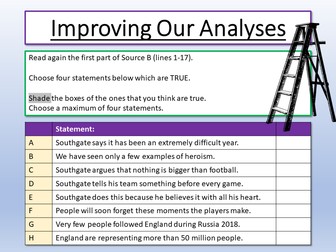
English Language Paper 2 Q3 language analysis lesson designed for KS3 English students but could also be used for GCSE English Language students as well. This resource has a World Cup 2022 theme and explores an extract from Gareth Southgate’s open letter to England fans from 2020. We explore how analytical verbs can help us to improve our analyses and make our explanations and evaluations clearer and more detailed.Includes two pages of analytical verbs with definitions and examples, detailed student and teacher notes, differentiated and engaging activities and source materials that are useful for KS3 and preparing for Paper 2 Section A. Check out our English Shop for loads more free and inexpensive KS3, KS4, KS5, Literacy and whole school resources. **This lesson forms part of our KS3 Complete Pack. Email info@englishgcse.co.uk to find out more. ** AQA English Language Paper 1 and Paper 2 Knowledge Organisers AQA English Language Paper 1 Section A package AQA English Language Paper 1 Sections A and B package AQA English Language Paper 1 package AQA English Language Paper 2 Question 5 package AQA English Language Paper 1 Question 5 package AQA English Language Paper 2 Section A package AQA English Language and English Literature revision package An Inspector Calls whole scheme package An Inspector Calls revision package Macbeth whole scheme package Macbeth revision package A Christmas Carol whole scheme package A Christmas Carol revision package Jekyll and Hyde whole scheme package Jekyll and Hyde revision package Romeo and Juliet whole scheme package Power and Conflict poetry comparing poems package Power and Conflict poetry whole scheme package Love and Relationships poetry whole scheme package Unseen Poetry whole scheme package