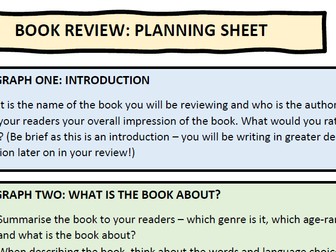
An A4 sheet that explains to students the structure of a book review and what to include in each paragraph.
A great home-learning task to encourage students to keep reading and reflect on their reading.
I made this for KS3 students as a SPaG homework task. However, this could also be used for KS2 and KS4 students.
PDF version as well as editable Word version so that you can edit to meet the needs of your students.
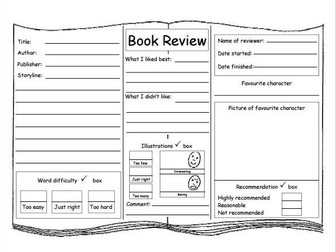
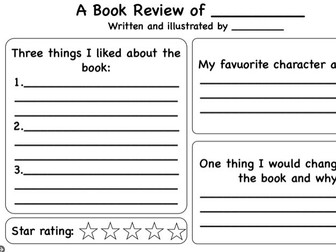
A detailed book review template for KS2 or low ability KS3. This particular one is for Stormbreaker, but feel free to edit the title etc to make it your own! I have successfully used this with a low set Year 7.
PowerPoint format to save on photocopying, this presentation takes your class through writing a review in stages, with opportunities for discussion and for class interaction. Probably a 30-45minute task, depending on the enthusiasm of your class. A handy first lesson after the holidays lesson for key stage 2/3, or for days that celebrate books and reading as a one off lesson.
I use this to encourage my children, my free readers, to read novels and report back on them. They retrieve sheet from me once finished a book and I read review once they have written it, to check.
They are filed into a class wallet folder for all children to read. The class often use this independently to find a 'new book&' that their peers have recommended, should they be struggling to find one for themselves.
I researched book review templates out there and couldn&';t find one I was happy with. This is my version.
I set this for my low-ability year 7 class just before the half-term break (holiday homework!), but you can use this lesson at any point throughout the term.
A lesson that introduces book reviews and provides students with a checklist for writing their own. The worksheet helps students understand how to structure their review. Enjoy!
This interesting and engaging lesson enables students to know what reviews are and why people read them, understand the features that make effective reviews, and write their own interesting and appropriate reviews. In particular, students learn to use a range of appropriate features in writing their own reviews, including facts and opinions, connectives, and statistics. There are easily enough resources here for 2-3 lessons on this topic.
Over the course of their learning journey, students:
- Define and exemplify what reviews are;
- Understand why people read reviews;
- Understand and categorise the different techniques used by reviewers;
- Identify the features of reviews in model examples;
- Analyse the effect of techniques in reviews upon the reader;
- Use a wide-range of techniques in writing their own reviews;
- Peer and self assess each other’s review attempts.
The resources include:
-Visually engaging whole-lesson PowerPoint;
-A colourful and helpful ‘Writing Reviews’ Help-Sheet;
-Techniques cards for defining the key key features of reviews;
-Connectives worksheet;
-Blank book review template and film review template;
-A model example (Harry Potter and the Philosopher’s Stone);
-Helpful and comprehensive step-by-step lesson plan.
All images are licensed for commercial use, and are cited on the final page of the slide.
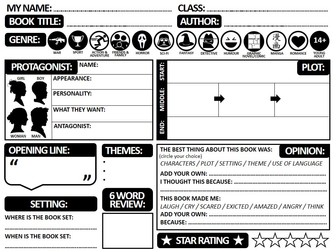
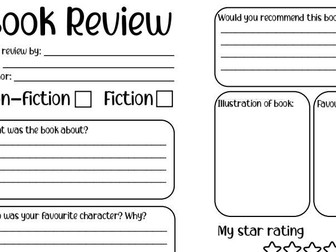
Two visually attractive book review template pages - one for fiction and one for non-fiction - specifically designed for students to fill out once they have completed reading a book.
These book reviews check the student’s comprehension of what they have read, as well as allowing them space to give their opinions on the book’s content.
The reviews contain the following sections to be completed
FICTION:
Book title & author
Protagonist breakdown
Opening line
Setting
Plot
Genre
Themes
Opinion
6 word review
Star rating
NON-FICTION
Book title & author
Subject
I chose this book because…
Three awesome facts that I learned
Two things that I’d like to learn more about
Favourite
Upgrades
Book Ratings
Recommendation
Star rating
Book Review, Book Review Format, Book Review Spinner, Book Review Display
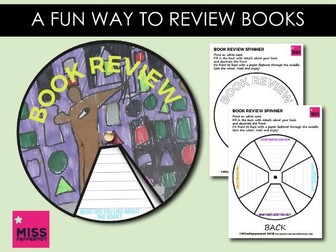
This is a fun way for your pupils to review the books they read. You can use this resource in all sorts of ways - print out and give for homework; make available in the reading corner for independent work or use as an English activity.
Includes 2 A4 PDF sheets.
To make the spinner you’ll also need scissors and a paper fastener.
Happy reviewing!
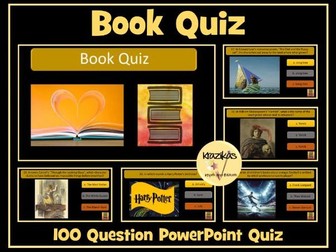
This resource is a highly visual, fully editable, 100-question PowerPoint quiz on books, poems and authors. It is an ideal resource for Book Day.
The quiz contains 100 questions with multiple choice answers, with varying degrees of challenge. It has nine categories.
Classic Books
Harry Potter
Opening and Closing Lines
David Walliams
Authors
Michael Morpurgo
Diaries
Poems
Miscellaneous
The quiz can be administered in a variety of ways - to individuals or teams. The answers can be found by clicking on the book image on the bottom right-hand corner of each slide. Answers can be given either as you go through the quiz or at the end. An answer sheet is included to allow individuals/teams to record their answers.
Sample questions:
Prospero, Miranda, Ariel and Caliban are all characters from which Shakespeare play?
What is the second book of the old testament called?
In Charlotte's Web, what is the name of the pig that Charlotte becomes friends with?
What is the name of the lion in The Lion, The Witch and The Wardrobe?
What name is given to the deadly phantoms that guard Azkaban Prison?
In Michael Morpurgo's Private Peaceful, what is Private Peaceful’s first name?
Please note, the watermark on the preview images is not present on the resource itself.
If you buy this resource and are pleased with your purchase, I would be extremely grateful if you could leave a review. As a token of appreciation, you can have a free resource of your choice up to the same value as your purchased resource. Just email inspireandeducate@aol.co.uk with your user name, the resource you have reviewed and the resource you would like for free.
You may also be interested in:
108 Question Paper-Based Quiz
World Book Day Reading / Book Quotes Posters
Save money and buy all three resources at a discounted rate:
World Book Day Bundle
A lesson (Ofsted ready!) on writing a book review for Year 6 pupils. Aimed at pupils completing a piece of extended writing for the end of KS2 writing. Differentiated throughout. Working towards, working at and greater depth are included throughout and colour coded for pupils.
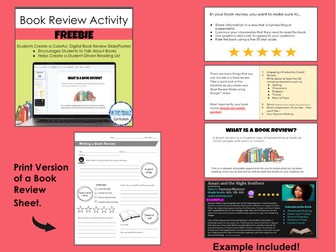
Build a community of readers by getting your students to talk about the books they read! This book review activity is a fun and relaxed way for students to create a book review slide (poster) to share with their classmates. It also helps teachers create a student-driven book list that helps when students are struggling to find their next book to read.
Included in this FREE Resource…
A Book Review Lesson
An Example of a Book Review
A Google Slides Assignment Template to be Shared with Students
A Printable Book Review Activity Page
This book review template is not just about summarising and re-writing. First the comprehension of the book your kiddos have read is grasped. Once sheet one is completed and has been checked by the teacher they can move on to creating their book review booklet.
Comprehension page
The comprehension page ask your students to summarise key parts. I recommend asking them to use bullet points as this will be easier to go back and double check.
Review Booklet
The booklet review will print on letter size paper and fold into four. Once the parts have been filled out your kiddos can decorate the cover and other parts by coloring sections in.
Please note: Watermarks/blurred images will not be in your downloaded file! All files are PDF unless stated otherwise.
>>>>>>>>>>>>>>> **Online Platforms – Stop by and say ‘Hi’ we love to hear from you** <<<<<<<<<<<<<<<<<<<
Have you downloaded a resource recently? We would love to see how you have used it. Take a picture and upload it to one of our social media sites. Don’t forget to tag us! #teachersbestie
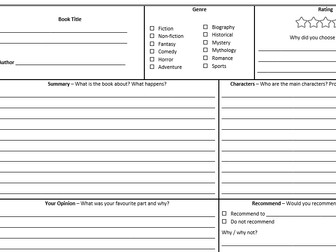
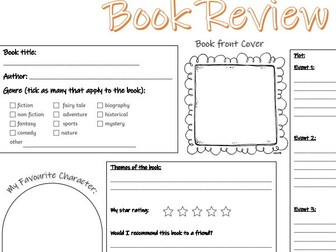
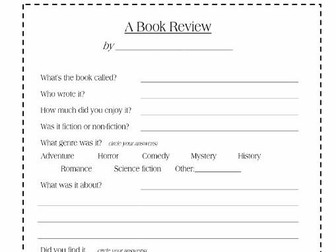
This is a great worksheet that encourages students to think about the book they've just read. It asks them about the genre and plot, and how they found it. It works well for encouraging students to read more - I like to offer a small reward each time they hand in a completed sheet. Included is both a PDF and editable Word file
 Quick View

 Quick View
 Quick View
 Quick View
 Quick View
 Quick View
 Quick View
 Quick View
 Quick View
 Quick View
 Quick View
 Quick View
 Quick View