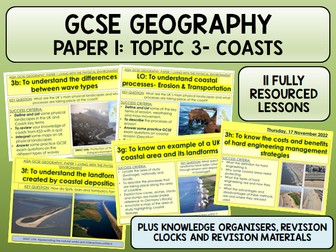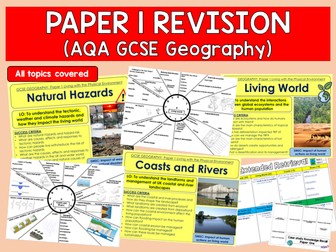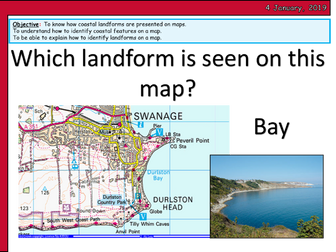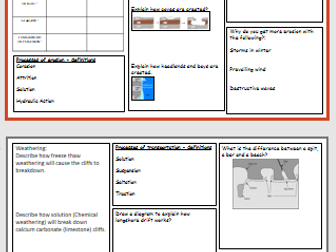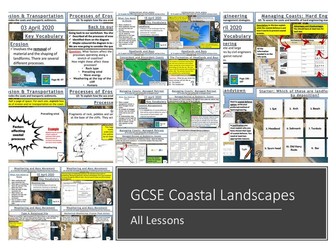
A bundle of all my coasts lessons prepared for the AQA specification, but still useful for other specifications.
Lesson titles in order are:
Types of Waves
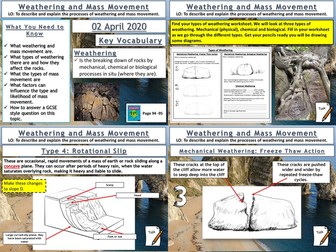
Weathering and Mass Movement
Processes of Erosion and Transportation
Headlands and Bays
Wave Cut-Notches & Platforms, Stacks, Stumps and Arches
Longshore Drift and Deposition
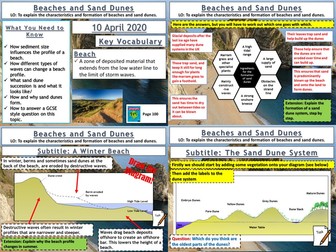
Beaches and Sand Dunes
Spits and Bars
Coastal Landforms at Swanage
Hard Engineering
Soft Engineering
Managed Retreat
Coastal Management at Lyme Regis
https://www.tes.com/teaching-resources/shop/markthegeographer
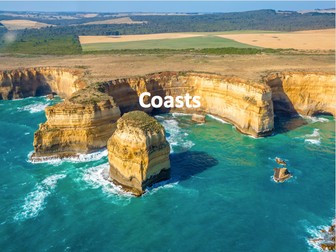
Complete Half-Term Unit on Coasts – Ideal for KS3 Geography
This fully resourced unit covers one half-term and introduces KS3 students to the dynamic topic of coasts. Lessons are clear, varied, and visually rich, exploring both physical processes and human responses to coastal environments.
Whether you’re a specialist or non-specialist, this unit is designed to be flexible and easy to use, saving you time without compromising on quality. This set includes PowerPoints, ready to print worksheets, embedded videos, engaging activities, and an end-of-unit assessment.
Topics covered:
Importance of Coastal Areas
Weathering
Erosion
Coastal Landforms
Coastal Management
Coral Reefs
If you find this unit useful, feel free to browse my shop for a wide range of Geography resources. I keep my prices affordable and offer bundles across a variety of topics and key stages. As a practising classroom teacher with over 20 years of experience, I only share resources I’ve used myself – all lessons have been tried, tested, and enjoyed by my students.
A lot of care goes into creating these resources, so I’d really appreciate it if you could leave a review. Thank you for your support!
Updated May 2025
This SOL contains 9 fully resourced lessons. It follows the progress in Geography book ‘what happens when the land meets the sea’ topic nicely.
Differentiated resources with scaffolding and challenge tasks included. Links made with careers in Geography.
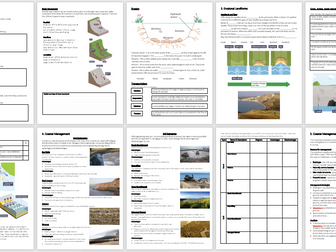
A simple, colourful and easy to use revision workbooklet with activities to help students revise the coasts section to the AQA GCSE specification.
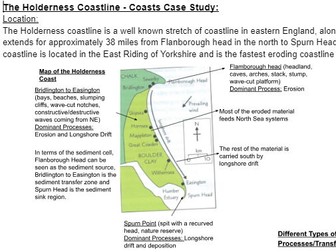
Includes Holderness Coast case study.
AQA GCSE Geography lesson for the new specification Unit 1C: In this lesson we look at spits and bars together with the processes that lead to their formation.
The starter is a true or false type quiz where the pupils have to find the landforms and processes associated with erosion.
We have a brief reminder of what longshore drift and deposition are. We have a quiz around a photo of Spurn Head and then watch a video clip. The pupils then create annotated diagrams of spits, bars and tombolos. This is usually teacher led in my lessons, but would work as an info hunt/share. We then draw an annotated field sketch from a photograph of Dawlish Warren Spit. The pupils then label the feature of the spit and fill in the blanks on the paragraph.
We finish with a 6 mark GCSE-style question: “Explain how the processes of deposition lead to the formation of distinctive landforms”. The pupils have some guidance in answering this.
In a nutshell lesson includes:
Retrieval practice true or false starter
Video clip
Annotated diagrams on formation of spits, bars and tombolos.
Features of a field sketch from photograph with an example.
6 mark GCSE-style question with guidance should the pupils need it.
Hope this saves you some valuable planning time.
https://www.tes.com/teaching-resources/shop/markthegeographer
Topic 12 (Lessons are coded)
Taught to Year 9 pupils
12A: Intro to Coasts
12B: Coastal Processes
12C: Coastal Erosion
12D: Old Harry’s Rocks
12E: Coastal Deposition
12F: Spit formation (Spurn Head)
12G: Why do coasts need protecting?
12H: Hard Engineering
12I: Soft Engineering
12J: Coasts OS Maps
12K: Coasts GIS [Digimaps]
12L: Assessment, Mark Scheme
12M: Close the Gap activity, Feed Forward Task
A Knowledge Organiser and 10 tasks to use as revision.
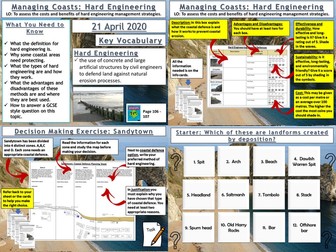
AQA GCSE Geography lesson for the new specification Unit 1C: In this lesson we look at types of hard engineering and where they are best applied.
The starter is a quiz where the pupils need to select the squares that have a depositional landform. There are sound effects too so it’s all very exciting.
We begin by looking at why certain areas of the coast need protecting and what factors go into consideration when planners are deciding whether or not to protect the coastline. The pupils are then given some information cards and a worksheet to fill in on the different types of hard engineering, they also have a visual scale to shade in for each one according to it’s effectiveness and durability, cost and sustainability. This can be done in a number of ways (group work, round the room, carousel etc). We then seek to apply this knowledge though the pupils completing a decision making exercise. This is based on a fictional town (Sandytown). The town has been divided into zones, the pupils read the information on each zone and decide what type fo hard engineering that zone needs and justify this.
We finish with a 6 mark question on hard engineering with some guidance on how they can answer this.
In a nutshell lesson includes:
Interactive starter quiz on depositional landforms.
Video clip.
Hard engineering worksheet with visual scale.
Decision making exercise activity.
6-mark GCSE-style question with guidance should the pupils need it.
Hope this saves you some valuable planning time.
https://www.tes.com/teaching-resources/shop/markthegeographer
AQA GCSE Geography lesson for the new specification Unit 1C: In this lesson we look at beaches and how their profiles can be altered and sand dune succession and formation…
We start with a simple retrieval practice grid which is good for spaced practice.
We then discuss why some beaches have different profiles to other beaches and what difference the size of sediment makes. We then look at the different types of waves and how they affect beach profiles. The pupils will make annotated diagrams of winter and summer beaches. We move onto sand dune systems. The pupils have an outline profile of sand dune succession. We use info slides which can either be teacher led, or use as a round the room activity, group activity etc, the pupils add the appropriate info onto the diagram from the slides. We then look at what conditions are needed for the dune system to form. The pupils have a hexagon task. I usually get the pupils to think about each factor first, the next slide has the answers but they still need to match them up
We finish with a GCSE-style question on the formation of sand dunes with some guidance on how to answer.
In a nutshell lesson includes:
Retrieval practice starter
Beach profile diagram activity
Sand dune succession annotated round the room/group diagram task.
Formation of sand dunes hexagon task.
4 mark GCSE-style question with guidance should the pupils need it.
Hope this saves you some valuable planning time.
https://www.tes.com/teaching-resources/shop/markthegeographer
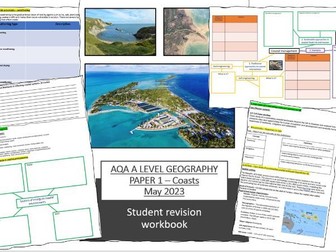
Revision work booklet for students to use to prepare for the coasts topic in Paper 1 - Physical Geography.
Various activities, exam questions and case studies included.
All clearly linked to the specification.
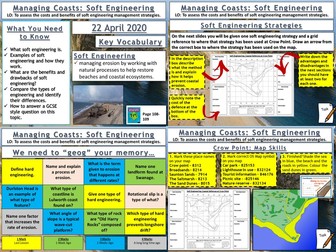
AQA GCSE Geography lesson for the new specification Unit 1C: In this lesson we look at types of soft engineering and look at an example where they have been applied. We also use the lesson as an opportunity to practice some map skills.
The starter is a simple retrieval practice grid based on the coasts unit of work. We begin by locating Crow Point which is an area in North Devon at risk from coastal erosion where soft engineering strategies have been used to prevent further erosion to the fragile dune system. The pupils will be given a large A3 sheet of paper with an outline map of the area including the dune system. The pupils then use grid references to add labels and features onto their map. Once they have completed this we look at the different types of soft engineering strategies and the advantages and disadvantages. The pupils are given grid references to the location these strategies have been applied. They locate them on their map and write the details in the appropriate box. We do this four all four strategies. This could be done as an info gather, round the room, carousel etc.
We finish with a 4 mark question comparing hard and soft engineering with some guidance on how they can answer this.
In a nutshell lesson includes:
Retrieval practice starter
Map skills practice
Soft engineering information gather task
4-mark GCSE-style question with guidance should the pupils need it.
Hope this saves you some valuable planning time.
https://www.tes.com/teaching-resources/shop/markthegeographer
A work booklet for the Coasts topic. This pack includes an editable PowerPoint version, and a PDF version for a more printer friendly option. I have also included a seperate word and PDF copy of the reading task found in the booklet too.
This pack focusses on Happisburgh as a case study, and concludes with an example of a written task which we use as an end of unit assessment.
Perfect for use in lessons or for home learning.
You will find lessons to accompany this uploaded to my resource bank too.
Font: Modern Love, Calibri
Images: Google images
Icons: Noun Project
Withernsea Coasts DME Assessment
DME = Decision Making Exercise
Students must decide how they are going to defend the coastline of Withernsea with £1 million. Students must research the coastline and decide the best way to manage the coastal area of Withernsea.
I have included well-selected on the PowerPoint to provide enough background detail. This can be used as a standard lesson or as an assessment. We have included success criteria.
Students can complete this as a class project and write a mini-report to demonstrate how they are defending the coastline. Suitable for both KS3 and KS4.
My class really enjoyed this project!
A series of 4 activities recently used as a decision-making exercise towards the end of a scheme of work on Coasts. Students were arranged in groups of 4, with each member of the group responsible for an individual task.
Encourages student collaboration as they need information from various members of their group in order to complete their own task. Also covers a range of skills as each task is tailored towards a particular skill set e.g. statistical analysis, sketch maps, extended writing and graph creation.
This pack contains two separate answers to the 2019 20-marker “Shoreline management/integrated coastal zone management can
effectively tackle the expected eustatic sea level change and
associated threat to coastal landscapes over the coming decades. To what extent do you agree with this view?”
**The answers use the Odisha coastline as a case study.
The pack contains the following;
Resources PowerPoint containing two model answers at varying scores and level descriptor from mark scheme.
Lesson PowerPoint outlining tasks and with ‘examiner’ feedback.
This pack contains two separate answers to the Specification 20-marker ‘No amount of coastal intervention by people can halt the natural processes which continue to present potentially serious risks to coastal communities now and even more so in the future.’ To what extent do you agree with this view?.
**The answers predominantly use the Odisha coastline and the Gower coastline as a case studies, but can be easily altered.
The pack contains the following;
Resources PowerPoint containing two model answers at varying scores and level descriptor from mark scheme.
Lesson PowerPoint outlining tasks and with ‘examiner’ feedback.
AQA GCSE Geography lesson for the new specification Unit 1C: In this lesson we look at how waves are formed and different types of waves.
We start with a differentiated photo starter where the pupils can create questions for themselves or the teacher to answer on coastal erosion.
We then introduce waves by watching big wave surfers at Nazare in Portugal. This is where the largest onshore waves in the world are found. The pupils then make an annotated step by step guide to how ripples turn into large waves. We then look at what happens when the waves arrive on-shore. The pupils make an annotated diagram. We then look at constructive and destructive waves. The pupils make pop-up versions of both wave types to go into their books with annotations.
We finish we a simple 4-mark question on the differences between constructive and destructive waves with some guidance.
In a nutshell lesson includes:
Photo interpretation question creator starter
Annotated step by step diagrams of wave formation
Diagram of the process of waves breaking
Pop-up destructive and constructive waves.
Video clips where appropriate
GCSE-style question with guidance
Hope this saves you some valuable planning time.
https://www.tes.com/teaching-resources/shop/markthegeographer
AQA GEOGRAPHY COASTS REVISION QUIZ
End of year / end of term / end of unit quiz
Round 1: Coastal landforms
Round 2: Erosional or Depositional
Round 3: Constructive or Destructive wave
Round 4: Management
Round 5: Processes
Round 6: Keyword definitions
Round 7: Keywords - erosion/deposition
Round 8: Keywords - erosion/deposition