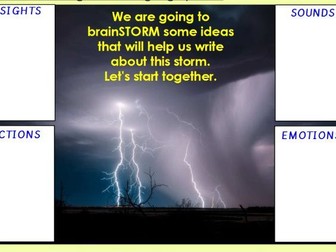
This is a poetry lesson aimed at Year5/6 focusing on identifying and using figurative language in poetry (similes, alliteration and personification).
The lesson begins by getting children to recognise examples of figurative language using Silver by Walter de la Mare. They then go on to write their own poetry using some figurative language. The lesson plan encourages children to respond to thought provoking questions as well as applying their knowledge in their own work.
Download includes: Powerpoint to support explanations of figurative language techniques, challenging questions for HA learners, cloze fill the gap exercise for LA children, differentiated success criteria and a detailed lesson plan.
This lesson has been rated as outstanding.
Ho Ho Ho! Merry Christmas! It’s that time of year when we light the world with our Christmas trees and joy. So, get ready to sleigh the holiday season with English resources that are snow joke! This festive personification figurative language workbook will have your students saying, “Yule love learning this Christmas!”
Why not download this as part of a bundle?
7 Christmas Figurative Language English Workbook Bundle
What’s included?
Information page
Examples
Task 1 – Matching personification to meanings
Task 2 – Filling in the blanks - personification
Task 3 – Draw the personification
Task 4 – Finish the personification
Task 5 – Using personification in action
Are you looking for other English resources and activities this holiday season?
Christmas
6 x Christmas English Writing Bundle
5 Christmas Bitesize Reading Comprehension Bundle
6 Christmas English Activity Bundle
Thanksgiving
5 Thanksgiving English Writing Bundle
4 Thanksgiving Scaffolded English Reading Comprehension Bundle
5 Thanksgiving Bitesize Reading Comprehension
9 Thanksgiving English Activities – Fillers and Starters
7 Thanksgiving Figurative Language English Bundle
General Language
9 Essential Spelling Skills for Upper Primary
Verbal Reasoning Ultimate English Bundle
7 Autumn / Fall Figurative Language English Workbook Bundle
Reading Strategies Pair of Resources
Ultimate Literature Circle Bundle
13 English Classroom Display Bundle
Greek Mythology English Reading, Vocabulary and Activity Bundle
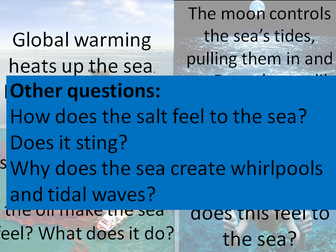
A full powerpoint resource teaching children how to use adverbial phrases, subordinate clauses and figurative language effectively in a poem about the sea. Includes warm up game.
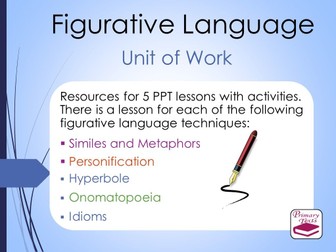
Five figurative language which combined create a unit of work. This resource is linked to the following English national curriculum reading comprehension objectives:
• Discussing words and phrases that capture the reader’s interest and imagination (Year 3 and 4)
• Discuss and evaluate how authors use language, including figurative language, considering the impact on the reader (Year 5 and 6)
This resource is also useful for helping pupils to understand how to use figurative language in their own writing.
The bundle contains lessons on the following figurative language techniques:
• Similes and metaphors
• Personification
• Onomatopoeia
• Hyperbole
• Idioms
Each PPT lesson contains:
• Clear explanation
• Examples of the use of the figurative language technique
• Three activities which require pupils to demonstrate their understanding of and use the figurative language technique
• Reflection questions enabling pupils to recap and consolidate their understanding at the end of the lesson
The PPTs are fully editable giving you the flexibility to adjust aspects of the lesson to suit the needs of your pupils if required.
This fun, engaging group activity combines figurative language with poetry's rhyme schemes. Your students will write their own original raps or songs using specific types of figurative language - simile, metaphor, personification and onomatopoeia. Students will create four verses and a chorus. Your students will then perform these masterpieces!
*Google Classroom Link Included
Figurative Language. Figurative Language Practice Sheets. This figurative language pack includes: types of figurative language, and a handout that first defines metaphors and similes, and gives an example of each. Students then have to tell whether the following ten sentences use metaphors or similes, and underline what is being compared. Secondly, the handout defines hyperbole, and personificaton, and gives examples of each of these. Students then have to tell whether the following ten sentences is an example of hyperbole or personification. Then there are three additional practice sheets with figurative examples from literature. Students have to identify and give their reason for how they know. These are good practice sheets when introducing figurative language. You can have students work in small groups or with partners to try to figure out the figurative language. No prep. Print and go. Keys included. Can be used to supplement a poetry unit, writing unit, or literature unit.
Supports these Common Core Standards, which also need to be reinforced in higher grades as well:
CCSS.ELA-Literacy.L.4.5 Demonstrate understanding of figurative language, word relationships, and nuances in word meanings.
CCSS.ELA-Literacy.L.4.5a Explain the meaning of simple similes and metaphors (e.g., as pretty as a picture) in context.
CCSS.ELA-Literacy.L.4.5b Recognize and explain the meaning of common idioms, adages, and proverbs.
CCSS.ELA-Literacy.L.5.5 Demonstrate understanding of figurative language, word relationships, and nuances in word meanings.
CCSS.ELA-Literacy.L.5.5a Interpret figurative language, including similes and metaphors, in context.
- HappyEdugator
This word mat provides ideas for children to help write their own sentences using personification, similes and metaphors. It also provides some vocabulary for effect.
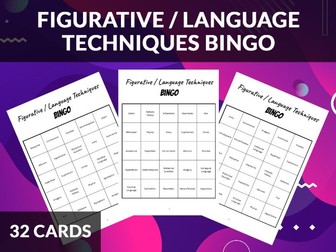
Play bingo with your high school students and recap their figurative / language techniques in a fun and engaging way!
To save paper and space, the bingo cards are ready to be printed as 2 pages per A4 sheet. Once you’ve laminated the cards, students can either use whiteboard markers or counters to play the game.
Students need 5 terms in a row to win (vertically, horizontally or diagonally).
Recommended for: Grades 7–12
Duration: ~20–30 minutes per round
Includes:
✓ 32 unique bingo cards
✓ Master / Instructions card
Which terms are covered?
• Simile
• Metaphor
• Personification
• Oxymoron
• Pathetic fallacy
• Alliteration
• Sibilance
• Pun
• Rhyme
• Irony
• Idiom
• Assonance
• Consonance
• Hyperbole
• Paradox
• Rhetorical question
• Hypophora
• Onomatopoeia
• Imagery
• Colloquial language
• Emotive language
• Symbolism
• Allusion
• Repetition
• Anaphora
• Hyperbaton
• Euphemism
★ UPDATE ★
I’ve revised this bingo to have 2 definitions and 2 examples for each figurative / language technique so that you can play at least 2 rounds with your students.
More Figurative / Language Technique Resources:
➤ Magic School Escape Room – Narrative Structure & Figurative / Language Techniques
➤ Pirate Ship Escape Room – Poetry & Figurative / Language Techniques
➤ 2 Matching Figurative / Language Techniques Worksheets
This is a 1 week writing unit focusing on figurative language.
I would say this is suitable for Year 6/5.
From my experience, the children really enjoy this and produce some great pieces of writing!
These five unseen poetry revision worksheets are designed to help students prepare for the GCSE English Literature exam, specifically targeting the analysis required for the 24 mark question. Each worksheet focuses on key aspects of poetry analysis, including language, structure, and tone, which are essential for crafting a thorough and insightful response.
Language Analysis Focus: Students will examine the poet’s choice of language, including imagery, word choice, and figurative language. Through guided questions, students will explore how specific words or phrases create meaning, convey emotions, and contribute to the overall impact of the poem.
Structure and Form Analysis: These worksheets help students understand how the structure of a poem (such as stanza length, rhyme scheme, or line breaks) influences its meaning and tone. The activities encourage students to consider how the poem’s form complements the themes and feelings expressed by the poet.
Tone and Mood Exploration: Through focused questions, students will explore the tone of the poem—whether it is serious, ironic, joyful, melancholic, etc.—and how the poet uses language and structure to establish and maintain this tone. This section will help students identify the emotional atmosphere of the poem and how it affects the reader’s interpretation.
Comprehensive Poem Analysis: Each worksheet includes a complete poem for students to analyze. The questions guide them through breaking down the poem’s key elements (language, structure, tone), allowing students to practice the skills they will need in the exam to write coherent and focused responses.
These revision worksheets are an excellent resource for students aiming to strengthen their analytical skills in preparation for GCSE English Literature exams, particularly for the unseen poetry section (24 mark question). By focusing on key elements of poetry, students will build confidence in analyzing unfamiliar texts under exam conditions.
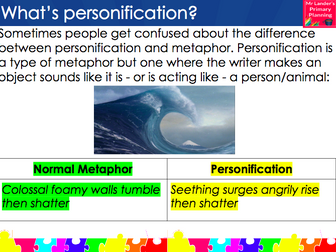
A lesson for lower KS2 on poetic metaphor and personification, using poetry about water as the context. The powerpoint introduces the idea via the concept of similes (so pupils should understand similes before teaching this content). The differences and similarities between metaphor and personification are then explained. The lesson then gets pupils to discuss ‘good’ and ‘not so good’ examples of metaphors and uses this to draw out ‘success criteria’ (guidelines) for writing good metaphors. The main activities are then differentiated 3 ways.
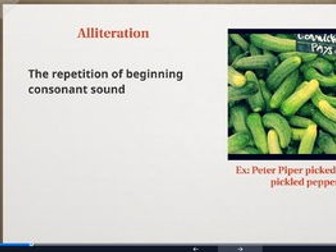
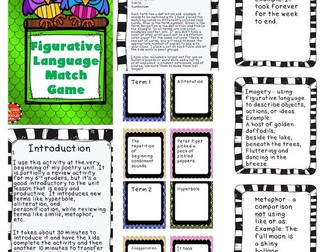
Want to review or introduce poetry terms/figurative language to your class? Don't do the work, I've done it for you! Each term has a definition, example and picture to help your students gain acquisition and mastery of the terms.
Terms Included:
Alliteration
Hyperbole
Imagery
Metaphor
Onomatopoeia
Personification
Simile
Symbolism
This resource consists of :
1 - an original acrostic poem which could be used as a stand alone example of this form of poetry, to be read aloud or used in guided reading.
2 - an A4 sheet with 10 questions which concentrate on the figurative language used in the poem. This could be used as a whole class reading activity or an independent task.
3 - an answer sheet, with marks awarded up to 12 marks.
4 - In addition to the main comprehension, there is a challenge task and extra challenge task!
Need to introduce or review story elements with your kids? Here's the perfect way to do it!
There are 8 key terms:
Alliteration
Hyperbole
Imagery
Metaphor
Personification
Onomatopoeia
Simile
Symbolism
Each term has a matching definition and example. Kids need to match the term with the correct definition and example. Each one is a different color so kids know when they have a set! Great for group work or individual reinforcement.
Also included: a term, definition, example set for each word for use on bulletin boards or word walls and a sheet of all terms, definitions, and examples to be placed in student notebooks.
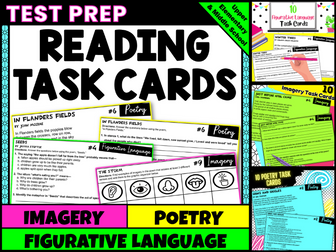
This figurative language, imagery, and poetry task card set is ideal for review, test prep, and continued practice of specific reading comprehension skills. Included are 30 reading task cards that focus primarily on FIGURATIVE LANGUAGE, IMAGERY, and POETRY. These task cards vary in reading levels and difficulty and can be used in 3rd–6th grades. Both fiction and nonfiction texts are included.
Each card contains a short passage, a mix of multiple-choice questions, short-answer questions, and/or graphic organizers to fill in. Task cards are half a page and should be printed double-sided, with the passage on one side and the tasks (questions) on the back. Student response sheets are included if you don’t want students to write on the actual task cards.
This Resource Includes:
10 - Figurative Language Task Cards
Figurative Language Student Response Sheet (1 full sheet)
Figurative Language Answer Key
10 - Poetry Task Cards
Poetry Student Response Sheet (1 full sheet)
Poetry Answer Key
10 - Imagery Task Cards
Imagery Student Response Sheet (1 full sheet)
Imagery Answer Key
Ways to use Task Cards:
Reviewing specific reading skills
Test prep
Small group instruction
Literacy centers / stations
Partner work
Intervention groups
Around the room activity where the students rotate around the room answering questions
Daily test prep review by projecting or printing one card a day
Bell ringers
Warm-up activity
Mini-lesson extension
Exit tickets
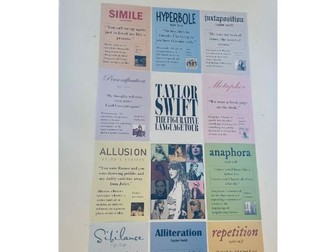
Examples of figurative language posters inspired by Taylor Swift’s era.
Includes:
10x posters for techniques (repetition, simile, metaphor etc.)
1x tour poster print out
1x display title ‘Taylor Swift - The Figurative Language Tour.’
Figurative Language
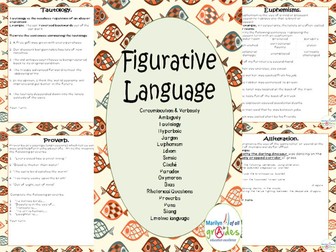
This is a 20 page collection of language features, a requirement of every English curriculum. Each page is a different feature; there is a definition, examples and exercises for the students to complete.
Related terms:
language features and their effects
structural features
sentence forms
emotive language
figurative language types
These pages can be used in a number of ways, homework, class activities, interest groups, formal lessons, booklet style, as an introduction to writing and poetry instruction etc
A PPT where students create their own figurative language glossary and practice identifying the types of figurative language. A follow up activity where students identify figurative language in popular song lyrics.
A ppt resource which could be used across several lessons. The pupils are given the opportunity to remember and consolidate their knowledge of figurative language; to read and understand a winter poem that uses figurative language and then identify language and effect. Following that, they can use the poem as a stimulus to write their own winter poetry.
The pupils have the opportunity to use talk partners to recall and develop ideas and also to work independently or collaboratively on their own poetry.
A resource mainly aimed at year 5 and 6 but can be used with year 4.
Children think more deeply about how the poet uses personification and the meaning behind it. Good for those teachers working on comprehension questions which ask the student to explain the author's choice of words.