Kodu - Kodu Kombat - Lesson 8Quick View
aglasgow

Kodu - Kodu Kombat - Lesson 8

(0)
This resource is the final lesson of 8 lessons for Kodu. There are no exemplar materials with this one as the purpose is for students to consolidate their knowledge from the previous week's lessons. There are differentiated challenges which are set and are contained within the powerpoint to give focus. A great lesson to get students thinking creatively!
Kodu Independent Learning Cards - UPDATEDQuick View
matthew_1987

Kodu Independent Learning Cards - UPDATED

(1)
I have created a set of 8 independent learning cards to be used with the program Kodu. These are designed for pupils to pick up and explore on their own to develop their own programming skills. The cards consist of 5 possible games the children can create, and 3 interesting world maps. They also include a QR code link to a video guide on how to make the game. **The QR codes had failed so this resource has been updated to ensure they are working**
A Kodu Reference GuideQuick View
tox

A Kodu Reference Guide

(0)
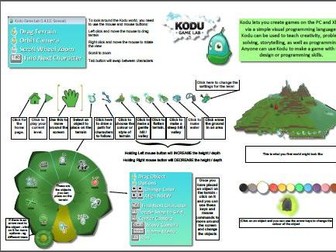
An introduction / reference guide for students starting out with Kodu - it includes the basic controls, an introduction to the When and Do controls and a very basic eat the apple game on page 3. Could be used as a pre-learning sheet, a reference on your VLE, Google Classroom or as a printout.
Differentiated game design in KoduQuick View
mylhughes1990

Differentiated game design in Kodu

(0)
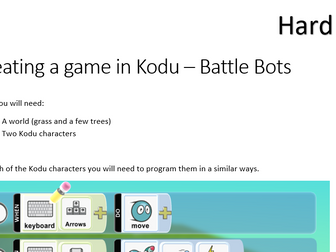
A differentiated Word document with instructions for 3 different games in Kodu (Hard/Harder/Hardest). There are instructions for: A battle bot game A simple racing game A more complex, coin hunting game I have included Kodu game files with this resources as well. All resources in this pack are fully customisable to suit your students.
Kodu Game Creation BundleQuick View
mrfoxinthebox

Kodu Game Creation Bundle

7 Resources
Lesson resources for: Hungry Hungry Kodu Crossy Road/Frogger FIFA Football Kodu kart (Mario Kart) Pacman Kodu Pokémon Kodu Pong Kodu
Kodu - Hungry Hungry Kodu Programming LessonQuick View
mrfoxinthebox

Kodu - Hungry Hungry Kodu Programming Lesson

(0)
All the lesson resources including a copy of the complete game (Zipped file) to create a Hungry Hungry Kodu game based on the popular board game Hungry Hippos. Includes walkthrough of how to create the game along with a Code Helpsheet.
Kodu - Kodu FC FIFA Football Game CreationQuick View
mrfoxinthebox

Kodu - Kodu FC FIFA Football Game Creation

(0)
Full lesson including detailed guide to help students create a two player Kodu FC football style game. Including outfield players and goal keepers. Coding help sheet and a fully programmed version of the game included in this resource (Zipped file).
Kodu - Kodu Pokemon Style Game CreationQuick View
mrfoxinthebox

Kodu - Kodu Pokemon Style Game Creation

(0)
Full lesson resources to teach students how to create their own Pokémon style game in Kodu. Includes all help sheets and a fully programmed version of the Kodu Pokémon game (Zipped file)
Kodu - Kodu Pacman Style Game CreationQuick View
mrfoxinthebox

Kodu - Kodu Pacman Style Game Creation

(0)
All the lesson resources to take students through the creation of a Pacman style game using the Kodu gaming software. Includes starter and help sheets to create the game along with a working version of the game (the zipped file).
Kodu WorkbookQuick View
NextStepComputing

Kodu Workbook

(3)
The following worksheets are targetted at the game programming software called Kodu game lab. The worksheet goes through the key terms /skills linking to the computing curriculum and assessment targets. Interesting unit for learners and they get a lot out of it.
Kodu and EnglishQuick View
Jan_Webb

Kodu and English

(1)
This resource combines giving instructions using visual editing in Kodu (a free download for them to create their own games) with descriptions of character and settings in English.
Programming Using KoduQuick View
samoliver368

Programming Using Kodu

(0)
Students will understand the term ‘programming’ whilst using Kodu. Students will use Kodu to create a world and program Kodu to move. Students will then design and create their own game whilst providing evidence. Lesson One-Six Kodu Lesson Seven Revision Lesson Eight Assessment Lesson Nine Feedback and Improvements This unit has a lesson presentation for every lesson that includes a starter activity, main activity and plenary. Resources also include homework, worksheets, helpsheets and an overall assessment sheet that can be used for self, peer and teacher assessment. A full Scheme of Work is also provided. This unit of work is suitable from Years 6-8 depending on ability.
Kodu - Lesson oneQuick View
sutt202

Kodu - Lesson one

(17)
This is a step by step guide for users to create land using Kodu. This would be ideal as a first lesson using the software for students to become familiar with the controls.
Kodu Game Design UnitQuick View
ChrisBarnes2610

Kodu Game Design Unit

(0)
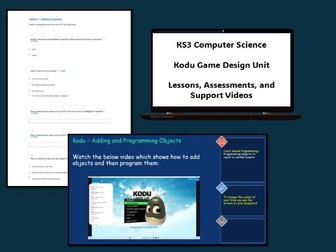
This unit contains 8 lessons in total, as well as help videos, ‘Do Now’ tasks, and two assessments. Lessons cover the below: Lesson 1 - Land and Terrain Lesson 2 -Objects and Event-Driven Programming Lesson 3 -Paths (Literacy task covering AI also included) Lesson 4 - Variables Lessons 5 - 8 - Student Led Project The help videos can either be played by staff (useful for a non-specialist) or provided to students as a means of support.
KODU (Full Unit)Quick View
adammasters

KODU (Full Unit)

(0)
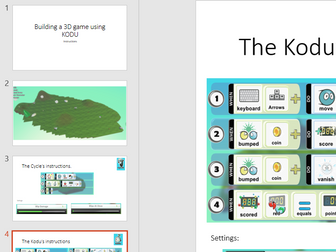
Target year group: Year 5-7 Projected Duration: 7/8 lessons This scheme of work is designed to give learners an introduction to visual programming. Kodu lets students create games on the PC and XBox via a simple visual programming language. Kodu is used for creativity, problem solving, storytelling, as well as programming skills. This is an accessible platform for a range of abilities to use Kodu to make and design games with minimal programming skills. Materials included: 7 week booklet for students (editable in word) 7 week of complimenting smartnotebook teaching slides for each lesson Tutorial links (to promote independent learning for main coding lessons) 4 different starter assignment linked to lessons 4 different homework assignments linked to lessons Kodu challenge competition (editable in PPT) Kodu help cards BONUS - Kodu Racing Game Code PPT walkthrough
Kodu (Schemes of LearningQuick View
adammasters

Kodu (Schemes of Learning

(0)
Schemes of Learning Full breakdown of 7 lessons - editable in word for department use. Includes the following categories: objectives success criteria outcomes literacy, numeracy and keywords student profiles learning skills (LETS) learning styles homework links STARTER MAIN PLENARY SEN support differentiation extension G&T Teacher notes Please note that in my shop are the lesson that compliment these lesson schemes of learning with full student booklet and teacher smartboard resources.
Kodu-Rhythm Lesson 4 (An introduction to coding using kodu)Quick View
chris_vidal

Kodu-Rhythm Lesson 4 (An introduction to coding using kodu)

(0)
Kodu is a friendly graphical programming language where students can build their own world and program objects within. This series of lesson uses kodu to introduce computer science terminology such as algorithm and variables to develop computational thinking skills.
Kodu-Rhythm Lesson 3(An Introduction to coding using Kodu)Quick View
chris_vidal

Kodu-Rhythm Lesson 3(An Introduction to coding using Kodu)

(0)
Kodu is a friendly graphical programming language where students can build their own world and program objects within. This series of lesson uses kodu to introduce computer science terminology such as algorithm and variables to develop computational thinking skills.
Kodu-Rythm Lesson 1(An Introduction to coding using Kodu)Quick View
chris_vidal

Kodu-Rythm Lesson 1(An Introduction to coding using Kodu)

(0)
Kodu is a friendly graphical programming language where students can build their own world and program objects within. This series of lesson uses kodu to introduce computer science terminology such as algorithm and variables to develop computational thinking skills.