Ellipses, Question Marks, and Exclamation Marks!Quick View
TandLGuru

Ellipses, Question Marks, and Exclamation Marks!

(2)
This interesting and engaging lesson enables students to understand what ellipses, question marks, and exclamation marks indicate, and determine where they should be used. They also learn to understand the effect of these punctuation forms in writing, and develop the skills to use these punctuation forms accurately in my own writing. Over the course of their learning journey, students: - Define and exemplify what ellipses, question marks, and exclamation marks are; - Identify where these punctuation marks should be placed in writing; - Correctly place ellipses, question marks, and exclamation marks into unpunctuated sentences; - Analyse the effect of these punctuation marks upon sentences and wider texts; - Use ellipses, question marks, and exclamation marks accurately and with subtlety in their own writing; - Peer and self assess each other’s writing attempts. The resources include: -Visually engaging whole-lesson PowerPoint; -Placing Punctuation worksheet (and teacher answer sheet); -A model example of an ellipsis, question mark, and exclamation mark-filled piece of writing for analysis; -Helpful and comprehensive step-by-step lesson plan. All images are licensed for commercial use, and are cited on the final page of the slide.
DIRT Marking Front SheetQuick View
daisyjackson254

DIRT Marking Front Sheet

(1)
This is a DIRT (didicated improvement and refelction time) marking sheet template. Space provided for: name target grade assessment title mark grade red amber green student rating of various areas red amber green teacher rating of various areas student areas of improvement teacher generic feedback This was designed to use for AQA A level Psychology, however, there is no reason it cannot be adapted for other subjects too.
GCSE Sociology - Assessment Pack: 20x Practice Exam Sections, Mark-Schemes & Model 12-Mark Answers! (AQA)Quick View
godwin86

GCSE Sociology - Assessment Pack: 20x Practice Exam Sections, Mark-Schemes & Model 12-Mark Answers! (AQA)

6 Resources
This bundle contains 20 GCSE Sociology assessments in the form of practice exam sections. It is designed for the latest AQA specification. Each of the 20 exam sections is half a full exam and takes 50 minutes for students to complete. Each of the 20 exam sections contain a standard set of questions including two 12-mark rubrics: a model answer for one of them is included for each assessment. Each of the 20 exam sections is accompanied by a mark-scheme. In short, in this bundle you get 20 exam sections, 20 mark-schemes, and 20 model 12-mark answers. This bundle should take care of most (if not all) of your GCSE Sociology assessment needs: students should ideally complete these 20 assessments over the 2-year course; data-collection of results allows for easy progress tracking. You may prefer to use them in the run-up to formal public exams: they are ideal for this also! There are five assessments for each of the four main topics: Crime & Deviance, Education, Family & Social Stratification. BONUS RESOURCES: Assessment Feedback Worksheets x2 (A4) Please note: These are not official exam scripts, I do not work for AQA: I have aimed to make reasonable practice exam-questions based on the specimen material already provided. The papers follow the official AQA format and look like official papers. All items are editable: if you think the 12-mark model-answers are too intimidating, feel free to reduce them. . Check-out some of our most popular resources on TES! GCSE Religious Studies Buddhism (20 Lesson Unit) Buddhism (Thematic Studies Units) Christianity (Thematic Studies Units) Hinduism (20 Lesson Unit) Hinduism (Thematic Studies Units) Islam (Thematic Studies Units) . .    GCSE Sociology Resources Complete Units (Whole Course) . .  AS/A2 Revision Sessions OCR Religious Studies AQA Philosophy AQA Sociology .  Philosophy for Children (P4C) The Ultimate P4C Resource Pack The Debating Society Toolkit Philosophy Boxes . Other Tools A3 DIRT Worksheet (15+ 5-star ratings!) KS3 RE Units Copyright Adam Godwin (2018) - strictly not for re-distribution.
Introducing Live Marking and Feedback CPD presentationQuick View
robertsad

Introducing Live Marking and Feedback CPD presentation

(1)
‘Live marking and feedback’ is the idea of marking or giving feedback on students’ work ‘in the moment’ - which cognitive science research tells us is incredibly effective in moving learning forward and addressing misconceptions before they become embedded. This presentation takes staff through the rationale behind it, the practicalities in its implementation, and the different ways it can be done. We have introduced it and in addition to helping our students make greater learning gains, it has reduced staff workload dramatically. This policy is for forward thinking schools who are looking to introduce evidence-informed practices into their school environment, benefiting students and staff alike. This was something that was really well received when it was presented and live marking and feedback continues to go form strength to strength as more practitioners begin to see its value when done well. Thanks for taking a look :)
Mark Making DiscsQuick View
jaroudi9

Mark Making Discs

(0)
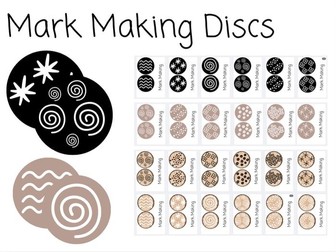
Mark Making Discs – EYFS Fine Motor & Writing Resource Inspire early writing with these Mark Making Discs, designed to build fine motor skills and encourage creativity in EYFS. Each disc features engaging patterns and shapes for children to trace, copy, or explore in mark making activities. With a variety of designs to suit your setting’s style and decor, they’re perfect for continuous provision, sensory play, or outdoor learning. A fun, practical resource to support early handwriting development while brightening your learning space.
Whole Class Feedback/Marking SheetQuick View
AllRoundResources

Whole Class Feedback/Marking Sheet

(0)
Firstly, if you choose to download my resource(s), please take the time to leave a rating (as I know most of don’t really bother) - I do really value your feedback. ***** FOLLOW @AllRoundRes, to stay up-to-date with the latest resources and news! ***** #GetYourLearnOn This resource is a whole class feedback and marking sheet which has a variety of uses for your needs. I like to use this resources when discussing exams, essays, homework tasks and extended pieces of writing. It is designed to significantly reduce teacher workload by having feedback in one place to then be used in lessons as an opportunity to discuss the work and talk about what went well and future opportunities and development. It also provides space for you to outline good pieces of work and methods/key terms/ideas etc students used. As well as providing space to discuss any errors, misconceptions and SPaG issues. At the bottom of the sheet is space to outline any further work students need to do as an enhancement activity, whether that be to redo some questions, research or revise a topic or explore key terms etc. This sheet can be printed off and written on as you work or typed into, which means you can share on a screen with students. If you have any queries, questions or concerns, then please email allroundresources@gmail.com or sendisaunders@gmail.com or alternatively write a comment describing your needs, where I will be happy to help!
EPQ marking gridQuick View
tom9859

EPQ marking grid

(0)
This is a marking grid of help with the marking of the AQA EPQ. The four skills that need to be assessed have been broken down further to aid marking. This can be shown to students so that they understand what they are working towards.
T Level Education and Early Years 12 Mark Question Revision: BrunerQuick View
Donnaw5

T Level Education and Early Years 12 Mark Question Revision: Bruner

(1)
A booklet which breaks down the 12-mark question from a past paper around Bruner and how this thewory can be applied to a reception class. I have uploaded the editable word version and a PDF version. Some content from TWINKL, correct at the time of making the work booklets in October 2025. A powerpoint to go alongside the booklet which breaks down the theory for students to revise. *After examining for NCFE, I have simplifed how to answer the 12 mark questions for students
T Level EYE 12 mark question support for core examQuick View
Patkinsella

T Level EYE 12 mark question support for core exam

(0)
This resource helps students understand how to structure a 12-mark exam question using Jerome Bruner’s theory of learning and development. The activity uses a realistic Early Years scenario and guides students to organise their answer into three clear sections, each worth 4 marks.
GCSE AQA RS Islam: 12-Mark Questions, practice Answers & Revision Planner (2025)Quick View
spectra1646

GCSE AQA RS Islam: 12-Mark Questions, practice Answers & Revision Planner (2025)

(1)
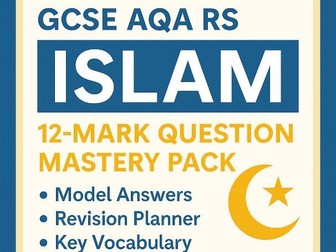
Overview: This GCSE AQA Religious Studies (RS) resource focuses on practicing 12-mark questions in the Islam unit. It’s designed to boost exam technique, deepen understanding of beliefs and practices, and build writing confidenc ideal for teachers, tutors, and students in the 2025 exam cycle. What’s included: 10 fully written 12-mark questions Grade 9 practice answers with sample examiner style commentary Student-friendly 4-week revision planner Self-assessment and peer-marking checklist Key vocabulary reference sheet (beliefs & practices) Topics Covered: ✔ Tawhid ✔ Akhirah (afterlife) ✔ Risalah (prophethood) ✔ Salah, Zakah, Sawm ✔ Hajj and Jihad ✔ Qur’an, Hadith, and Islamic law Ideal for: AQA GCSE RS Paper 1 (Islam) Classroom revision, independent study, or homework Use as an intervention or booster pack Last-minute Year 11 revision prep FAQs Q: Is this suitable for other exam boards? A: It is specifically designed for AQA, but the 12-mark format and content will also support learners studying Islam on Edexcel or OCR with minor adaptation. Q: Can this be used with Year 10 students? A: Yes. It’s great for building 12-mark skills early and can also be broken into homework or in-class tasks across the year. Q: Are the answers differentiated? A: Yes. Each question includes a Grade 9-level response with commentary. You can use these to model or scaffold lower-tier responses. Disclaimer: This resource has been independently created and is not affiliated with, endorsed by, or approved by any official exam board or awarding organisation, including Eduqas, AQA, OCR, or Pearson. All content is based on publicly available specifications and teaching experience. NO gaurantee While every effort has been made to ensure accuracy, users should verify information against official exam board guidance and current specifications. This resource is licensed for individual classroom or personal use only and must not be resold or redistributed without permission.
Marking stickersQuick View
ResourceOwl

Marking stickers

(1)
Improve dialogue, encourage deeper leaning with students and assess how well they have understood their learning. Eight sheets, easy to print off, can be stuck in by students themselves and easily adapted. Mix between teacher and pupil feedback. Feedback through writing and drawing to engage learners.
English Literature: A-Level Assessment Mark Sheets for NEW AQA course.Quick View
kiirstii

English Literature: A-Level Assessment Mark Sheets for NEW AQA course.

(1)
A handy copy of the mark sheet for each component of the NEW A-Level AQA English Literature course. This mark sheet can be attached to the front of any student's piece of work and contains a space for teachers / other students to write their feedback. It also contains a space for student to act upon the advice they have been given to show them making immediate progress and responding to your marking and feedback - a clear Ofsted priority at the moment.
Effective Marking and FeedbackQuick View
PEinnovator

Effective Marking and Feedback

(2)
Based on Dylan William and John Hattie theory. CPD last up to 2 hours. This is a one stop CPD training session for all marking and feedback needs. Taking staff from why we mark/feedback, inclusive of important research to support marking and feedback, whole school feedback strategy manageable strategies to support teachers in the classroom. Aslo deliverable in a fun, inclusive way - speed dating activity, snog marry avoid etc.
EPQ: marking rubricQuick View
ailisk

EPQ: marking rubric

(0)
A rubric to help with marking AQA Extended Project Qualification. Adapted from the EPQ specification.
Geography Marking Tool - Make Marking meaningful and QUICK!Quick View
emmapritchard

Geography Marking Tool - Make Marking meaningful and QUICK!

(0)
This has changed my marking life! Use this resource to cut down time spent marking, focus marking on skills rather than content. In this pack of resources you will find a generic marking tool for all Geography teachers and students to use in lessons, on written tasks and formal assessments; PPT, classroom poster (sent on purchase), assessment grid with mark code system and reflection sheets for use across key stages 3 and 4 to assist in feedback, assessment and marking. This resource will help you (the teacher) to streamline your marking using a generic tool that students will come to know, understand and trust. The tool uses the word DIGEST to encapsulate what makes great Geography and can be applied easily to any topic. I've been using it for 2 years, Geography outcomes have improved and I spend less time marking. You can use this tool to aid meaningful and accurate peer and self assessment and importantly it will help to focus students on their own strengths and improvements, aiding metacognition. It is adaptable to ANY topic. It will help with target setting, tumble marking and feed-forward. It will make your marking efficient and effective. Students love the ease of the tool, parents find it easy to understand.
Marking StickersQuick View
DrM_Lessons

Marking Stickers

(0)
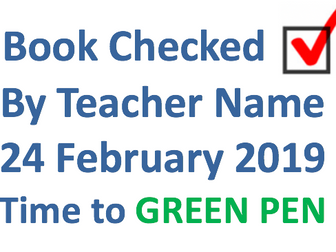
These stickers can be used to show book marking and encourage students to act on feedback in green pen. The text is set to automatically update to the date of printing. Just print off a page, get your red pen out and get those books marked. I find that branding regular tasks, like marking, encourages routines in students and teachers alike. Students love to see these stickers in their books.
Marking ScheduleQuick View
cfitz14

Marking Schedule

(0)
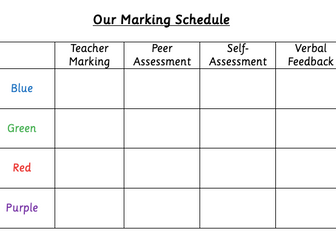
This resource is designed to be laminated and displayed in the classroom to develop teacher, peer and self marking strategies. The teacher will split class into ability groups and give each group a colour. Then mark on the laminated schedule which group will be doing the indicted marking. Teacher marking - The teacher will mark each child’s work in detail. Peer assessment - A child will swap with another child in their group and use 2 stars and a wish. Self assessment - Child will use an emoji to identify how they did on this piece of work and then write a comment. Verbal feedback - Teacher will assess their work and tell them a comment to use from the comment bank to use and write on their work. It is still the responsibility of the teacher to monitor and assess all of the work but allow children to take more ownership of their work.
Marking PolicyQuick View
MrsCStewart

Marking Policy

(0)
Interesting “no pen” approach to marking- the focus is on Pursuit of Excellence tasks. This policy means that feedback models excellence for students and then requires them to improve their work according to the model provided. Students have responded incredibly well to this approach and it has shortened the amount of “wasted” time spent on marking.
Marking SheetQuick View
rolffantom

Marking Sheet

(1)
A generic resource designed to aid marking. Pupils are prompted to make notes, then produce their final piece of work. Space is then provided for a teacher to write a positive comment and targets for improvement. On the rear of the page is half a page for sticking in to the book and half a page for marking improvements, followed by an improved grade. This structures marking to what ofsted are looking for, and when pupils stick it into their book and fold it over, the first thing an observer sees is the improvement and the new grade, making it easy for them to see your good practice.
Marking StickersQuick View
woodwaj1m6

Marking Stickers

(0)
Sticker templates to help with marking of students books pointing out where they have done well and where they have work that is incomplete
Marking gridQuick View
l_birkinshaw

Marking grid

(3)
This is a Marking Grid which can be either be filled in electronically or printed off and filled in to give student feedback. It can then either be stuck in by the teacher or given to the pupils to stick in their books themselves! It includes the following sections: What Went Well, Even Better If, Tasks to Improve. It contains a section where students’ effort and presentation within their class books can be assessed. It also contains a section where potential follow up tasks can be set to students.