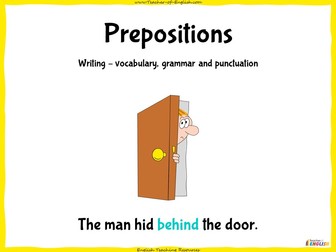
A complete and engaging PowerPoint lesson on les prépositions for your next lesson observation , designed with a clear and structured lesson flow.
This includes :
Full lesson flow from starter to plenary
Engaging observation-based starter activity
Clearly defined lesson objectives
Structured introduction to les prépositions
AFL integrated along with answers
Differentiated tasks to support mixed-ability learners
Interactive and student-friendly slides
Exit ticket included to assess understanding
Ready-to-use resource – ideal for classroom teaching
Suitable for beginners and lower-intermediate learners
A simple worksheet to revise prepositions or check pupil’s understanding.
10 simple sentences for pupils to fill in a preposition from the table which makes sense, although there are various options and not one definitive answer!
Challenge for pupils to use the prepositions that have not already been used, to write another 5 sentences of their own.
Suitable for revision, morning work, homework or short lesson observation activity.
A variety of exercises to give children practice at using prepositions.
See Prepositions and Pronouns for a package on both Prepositions and Pronouns.
Let me know if you have any questions or suggestions, and a BIG BIG thanks for looking (as a full time practicing teacher, I KNOW how time consuming this process can be).
ALL my postings are FULLY "classroom-tested" - before I publish, my lessons are tested by both myself and colleagues, rigorously evaluated and discussed, and continually updated to maximize their effectiveness. But there is always the possibility of error and room for improvement, so do please provide constructive feedback.
Search words: literacy, grammar, prepositions, pronouns, worksheets
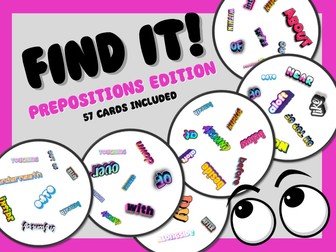
Dobble/ Spot it inspired game for helping children to read and recognise a range of prepositions. There’s a matching word on every card. Can the children spot it?
57 words included on a set of 57 cards
Included:
A4 printable set
individidual cards to print as needed. (suggested 6 per A4 page)
This resource supports Year 6 SPaG revision for prepositions and includes 20 carefully structured questions with a full answer sheet. The questions include identifying prepositions in sentences, selecting and writing prepositions, explaining what prepositions do and applying understanding by writing sentences using prepositions accurately to show time, place and position. Tasks reflect the style and challenge of the KS2 SATs GPS papers. Ideal for revision lessons, intervention groups or independent practice.
There are revision resources covering all areas of SPaG in my TES shop, including a complete SPaG revision bundle and a free sample.
In this powerpoint, it highlights the difference between SUBORDINATING CONJUNCTIONS and PREPOSITIONS looking at past SPAG test examples and other examples to solve using the methods explained.
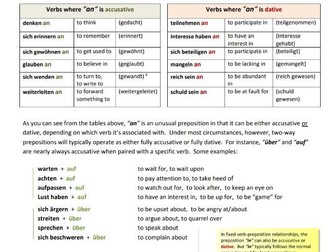
Many verbs in German are used in tandem with specific prepositions. Examples of similar combinations in English are: ��to think about’, ‘to be afraid of’, ‘to suffer from’, etc. Very often, these prepositions have nothing to do with location or direction, but instead link verbs to nouns in a more abstract way.
German has its own set of verb-preposition combinations, but since the German learner doesn’t always have the luxury of hearing them being used in a natural environment, these combinations also have to be studied and memorized. By this point, a student may have already run across some of them: ‘denken an’, ‘sorgen für’, ‘Angst haben vor’, and a number of others. This lesson will introduce the student to verb-preposition combinations in a more deliberate and concentrated way, opening the door to greater fluency in both reading and speaking.
For students wishing to skim the highlights of this topic, the first two pages provide a good introductory view. These students can skip forward to the “More Example Sentences” section at the bottom of page 6. Here, nine frequently occurring verb-preposition combinations are illustrated in different tenses. For students wishing to delve deeper into the subject, the rest of the document provides plenty of information and new vocabulary to help assist in fluency.
Over 70 verb-preposition combinations are provided in this lesson. Twenty of these combinations are illustrated in example sentences, some color coded for clarity. (As a prerequisite, students should already be familiar with how to use reflexive verbs.)
This was originally intended to go with expo 1 and is a simple introduction to French prepositions using pictures of a cat as a memory aid. I have found year 7 classes responded well to this and liked the cat theme! On the slide with a grid of 6 numbered pictures I have played pass the parcel. I put lots of scraps of paper with the numbers 1-6 in a box and pass it round the room to French accordian music. When the music stops the pupil holding the box pulls out a nuber and has to say the relevant French sentence. Works a treat every time!
Please leave feedback :)
This interesting and engaging lesson (there are actually enough resources to fill 2-3 lessons here) enables students to learn a range of different prepositions, to use different prepositions in their writing, and to understand and use prepositional phrases. In particular, students become familiar with the importance of prepositions and prepositional phrases in a wide range of writing, through a number of fun and interactive tasks.
Throughout the lesson, students learn to:
- Define and exemplify prepositions;
- Secure their understanding of different types of prepositions;
- Identify prepositions in writing and analyse their effect;
- Understand what prepositional phrases are, and identify them in writing;
- Accurately use their own prepositions and prepositional phrases;
- Peer/ self assess their partners/ their own prepositions and prepositional phrases.
The resources include:
-Visually engaging and comprehensive whole-lesson/s PowerPoint;
-Prepositions worksheet;
-Prepositional Phrases worksheet
-Model Example;
-Step-by-step lesson plan.
All images are licensed for commercial use, and are cited on the final page of the slide.
PowerPoint on prepositions. Pupils are asked, ‘¿Dónde está el perro?’, and follow the preposition of the dog throughout the PowerPoint. Also contains some activities on bedroom items.
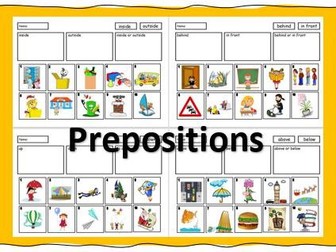
6 prepositions worksheets for KS1.
Each sheet has a theme
on and off
over and under
inside and outside
behind and in front
up and down
above and below
There are 10 pictures on each page for children to discuss with a partner or group. Each picture is numbered.
Children decide e.g if the umbrella picture shows up or down. If up, they can put the number or write the word in the up box. Children may decide an umbrella could be up or down and write in the up or down box.
This resource encourages speaking and listening and thinking skills with minimal writing.
Grammar worksheet looking at the use of prepositional phrases of place. This worksheet enables students to study the use of the structures and use them in sentences of their own.
An introduction to prepositions with simple class activity and 'Preposition wall&' followed by differentiated tasks at 3 levels to print off. please comment if you have time.
This is a pair-work speaking activity to practise prepositions. One pupil has to describe his picture to his partner who draws the objects described in the right place. They then swap and check on each other's sheet at the end.
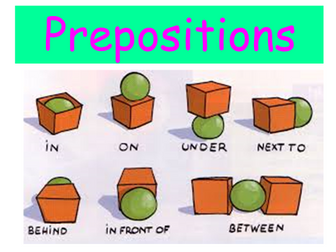
Prepositions {PowerPoint and Worksheets} - Prepositions are easy to teach when you use this no-prep PowerPoint! This is a highly visual, interactive and fun introduction to prepositions. Students discover what prepositions are through games and exercises. Active learning is encouraged throughout the PowerPoint. Students play games and use their whiteboards to maximize engagement.
Included:
52 PowerPoint slides
4 Worksheets (with answer keys)
Common Core Aligned: CCSS.ELA-LITERACY.L.1.1.i
*Please note, this PPT does not cover prepositional phrases*
Created by Lindy du Plessis (store: Lindy loves to teach).
Prepositions - Years 3 and 4
‘Prepositions - Years 3 and 4’ is an English KS2 teaching resource that covers the prepositions objectives in the English programme of study for years 3 and 4. This animated PowerPoint lesson includes:
What are prepositions explanation
How to identify a preposition explanation
Why we use prepositions explanation
Activities to support the teaching of these objectives with two accompanying worksheets
Two further worksheets with answers
‘Prepositions - Years 3 and 4’ is fully editable giving teachers the freedom to adapt the resource, if needed, to suit each class they teach.
This breakout escape room is a fun way for students to practice their skills with prepositions.
Contents:
♦ Teacher Instructions with Usage Guide and FAQ
♦ 20 Multiple Choice Questions
♦ 5 Decoders for each of the 5 Levels
♦ Student Recording Sheet and Teacher Answer Key
♦ Link to an optional, but recommended, digital breakout room
Prepositions: These prepositions cootie catchers are a great way for students to have fun while improving their grammar skills by identifying prepositions. How to Play and Assembly Instructions are included.
This activity has students reading various sentences to each other and then asked to identify the preposition through multiple choice answers..
There are two types of questions within two cootie catchers:
1. Students identify the correct preposition for the blank space within the sentence
2. Students identify the preposition within a completed sentence.
***** Enjoy this Lesson? Do a search for my other Cootie Catchers: *****
♦ Reading Strategies:
Authors Purpose
Cause and Effect
Character Traits
Compare and Contrast with Pictures
Compare and Contrast
Creative and Critical Thinking
Drawing Conclusions
Fact or Opinion
Figurative Language
Fluency
Generalizations
Genre Identification
Genre Types
Idioms
Inference
Literary Devices
Main Idea
Metaphors
Nonfiction Text Features
Paraphrasing
Parts of a Book
Personification
Point of View
Predictions
Reading Comprehension
Reading Response Questions
Restating the Question
Sequencing
Setting
Similes
Story Elements
Summarizing
Text Structures
Text Structures: Informational Text Structures
Theme
Writing Prompts
♦ Vocabulary:
Analogies (Grades 3-5)
Analogies (Grades 6-8)
Analogies (Grade 9)
Antonyms
Compound Words
Context Clues
Greek and Latin Roots
Homophones
Homonyms
Multiple Meaning Words
Prefixes
Root Words
Shades of Meaning
Spelling
Suffixes
Synonyms
Tone and Mood
Transition Words
♦ Grammar:
Adjective Identification
Adjectives: Comparative and Superlative
Adverbs
Appositives
Apostrophes
Capitalization
Clauses
Commas
Conjunctions
Contractions
Mentor Sentences
Nouns: Common, Proper, and Plural
Nouns: Collective
Nouns: Common and Proper
Nouns: Irregular Plural
Nouns: Plural Nouns
Nouns: Possessive Nouns
Parts of Speech
Prepositions
Prepositional Phrases
Pronouns: Identification
Pronouns: Possessive
Pronoun Antecedent Agreement
Quotation Marks
Sentence Types
Sentences: Fragments and Run-Ons
Sentences: Simple, Compound, and Complex
Subject and Predicate: Complete and Compound
Verb Identification
Verb Tenses
Verbs: Helping
Verbs: Irregular
Verbs: Subject Verb Agreement


 Quick View