Here are a few activities to support children who are working well below ARE for Year 3. They are designed to be used in the classroom so that children who require support can be included in all or parts of Literacy lessons based on the book Stone Age Boy.
I made a little booklet for a student in my ASD class who was making his first holy communion. Just insert photographs of your church and details of time and date. A social story about what you might expect when you go into your local church on the day you make your First Holy Communion. It covers when, where, going into the church, sitting in pews, listening, singing songs and going up for the Eucharist.
SOCIAL STORIES are valuable tools for teaching social interaction skills in an exacting way to people with learning difficulties and/or disabilities. They are particularly effective for those individuals with Autistic Spectrum Disorders (ASD).
Thanks.
Empower Special Needs Education: A Comprehensive and Engaging PowerPoint Resource
Are you an educator, parent, or administrator dedicated to supporting individuals with special needs?
This comprehensive PowerPoint presentation offers a visually appealing and interactive resource to enhance your understanding and practice.
Here’s what sets it apart:
Extensive coverage: Over 100 slides covering a wide range of special needs topics, including:
Inclusive Education
Collaboration with Parents/Homeschools
Identifying and Programming for Diverse Learners
Classroom Management & Differentiation Strategies
Specific learning needs (e.g., EBD, ID, ADHD, Autism Spectrum Disorders, Sensory Impairments, Speech/Language Disorders, Gifted/Talented)
Engaging format: Each slide is visually stimulating and interactive, promoting knowledge retention and audience engagement.
Dual functionality: Can be used as a presentation tool or printed as a reference handbook.
Benefits:
Save valuable preparation time with this ready-made resource.
Deepen your understanding of diverse special needs topics.
Enhance your instructional practices with engaging visuals and effective strategies.
Empower students with special needs by fostering an inclusive learning environment.
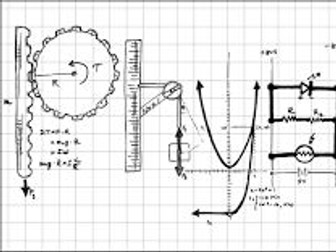
A Comprehensive set of resources to teach and test Galilean and Special Relativity (A5) for IB Diploma Program.
Package includes;
A complete 48-page presentation resource-pack explaining in detail the whole chapter. The presentation comprise of teaser questions, worked exercises, videos and detailed explanations in a separate note section.
A complementary handout which is provided to the students during the lesson. This saves time for students as they don’t have to take intense notes thus enabling them to focus on the lecture. The handout carries questions that are discussed in the class and help teachers detect any knowledge gap in their comprehension of concepts. But more importantly, the handout is a comprehensive summary of the chapter which the student can refer back to when needed.
A 15- page worksheet which includes handpicked 25 structured questions from paper 2 with mark schemes. The questions are carefully selected to keep them relevant to the topic ( Galilean and Special Relativity and intersections of previous topics according to order of syllabus) and avoid chapters that the students have not studied yet.
These sources are compatible with K.A. Tsokos’s book.
Please note that the utilization of this resource is estimated at 8 lesson hours, complemented by 3 hours of homework. This comprehensive package optimizes both teaching and learning efforts, ensuring a thorough grasp of Galilean and Special Relativity concepts in alignment with the IB Physics Syllabus.
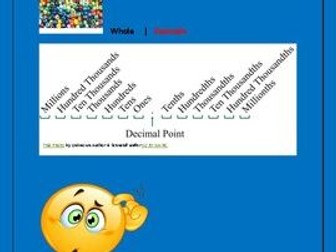
This math lesson is on decimals. Establishing what a decimal is and how to write decimals can be challenging. So, this lesson provides tools and exercises for understanding decimals. This lesson is especially for students with autism (ASD).
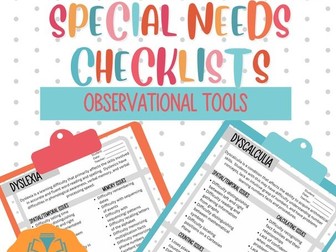
Special Needs Checklists is an essential tool for educators of students with special needs. This comprehensive resource provides checklists for a variety of needs, including behavior, organization, and learning difficulties, making it easier for teachers to identify and support the unique needs of their students.
With its easy-to-use format and detailed information, the Special Needs Checklists by I Heart Grade 3 is designed to make the process of identifying and addressing special needs as seamless and stress-free as possible. The checklists provide teachers with a clear understanding of the student’s needs, allowing them to work together to create individualized support plans that are tailored to the student’s specific requirements.
Whether you are an experienced teacher or just starting out, these checklists will be an invaluable resource. They provide you with the information and guidance you need to make informed decisions about how best to support your students, ensuring that they receive the individualized attention they need to succeed.
Special Needs Checklists by I Heart Grade 3 are available for immediate download and can be easily printed, making it easy to access the information when and where you need it. With its user-friendly format and detailed information, these checklists are the perfect resource for anyone looking to support students with special needs.
So if you’re looking for an easy-to-use tool that can help you better understand and support the special needs of your students, look no further than Special Needs Checklists by I Heart Grade 3.
These checklists are NOT A VALID METHOD FOR DIAGNOSING SPECIFIC LEARNING DISABILITIES but can serve as an important observational tool when referring a child for professional services such as psychological testing, speech therapy, and/ or occupational therapy. It can also help you plan for individualized educational plans and behavior intervention plans for students needing adapted or modified programs.
This file contains:
2 page checklist for dyscalculia
2 page checklist for dysgraphia
2 page checklist for dyslexia
2 page checklist for dyspraxia
Each checklist is broken down into separate parts to give yourself a global view of each special need in order to better understand and help your students.
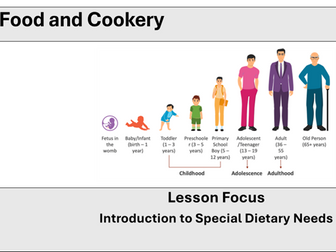
A powerpoint with a range of tasks and answers that introduces students to a range of Special Dietary Needs. Student will explore different aspects of Dietary Need and answer question that will allow them to demonstrate their knowledge.
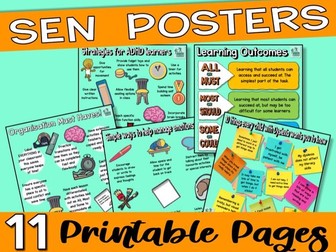
A series of 11 posters focusing on special education learning needs within your classroom. Strategies are included to include and understand some of the most common SEN such as ADHD, ASD, Dyslexia, Auditory processing as well as social and emotional learning and strategies.
Differentiation strategies and information are included to assist teachers in accomodating these learners and undertaking their issues. All of the posters put a positive slant of these SEN and will educate and inform all teachers who may be struggling to deal with these learners.
Included in the pack:
11 x special education needs posters
Instead of you providing the notes get your class to research in small groups, do a 5 minute presentation, and produce a one A4 page hand-out/quiz for the rest of the class. Have a video handy to record them; you might be amazed at their original presentations!
This is a PowerPoint resource to support tutors in teaching the topic SEND or can be given to learners as a standalone resource.
• Can be used to support apprentices in their off the job learning or learners to research as part of their self-study.
• This resource is suitable to train your staff team on the subject.
• Fully editable for customisation to any learner group
• Professionally designed by a Curriculum Quality Manager
• Aligned with current 2025 frameworks and legislation
• Suitable for blended, remote or classroom delivery
• Ready for Ofsted or EQA evidence folders
Great to use as a wider curriculum resource for apprentices and learners.
Please check out our shop for may more resources and if you are looking for a resource on a specific topic, send us a message and we will be happy to help!
You will receive:
1 × Editable Learner PowerPoint
Thank you for your purchase
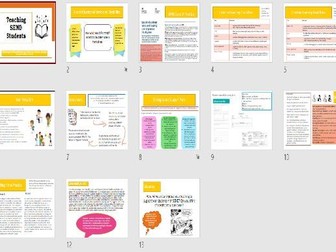
A great and informative PPT to support teachers/relevant staff with SEND. This CPD covers: SEND Code of Practice, common learning difficulties, Strategies, Assessment and Case Studies. It has tasks for teachers to complete to support their understanding and help influence their action.
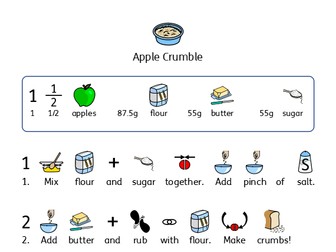
This resource has 10 cooking recipes which are fully written with ingredients and instructions. All these recipes are accessible to students at primary school and/or with special educational needs - they contain affordable ingredients with everyday equipment which can be accessed within a classroom environment with adult support. NO HOBS. They are written with symbol communication software and simplified keyword sentences to encourage students to be independent.
This is suitable for cooking lessons, fine motor exercises, food studies, healthy eating, life skills and preparation for adulthood.
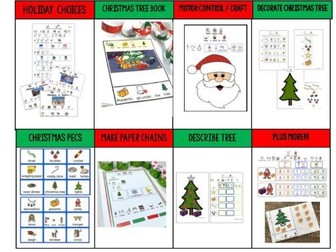
This exciting and fun stocking (bundle) is filled with different Christmas activities for the classroom, including reading, writing and motor control/crafts activities. All activities are supported with Widgit symbols.
Included in this bundle:
Holiday Choices - reading activity developing independent choice making. Students read holiday options and students decide where they want to spend Christmas and answer multiple choice questions about their choice. 2 levels
Interactive/adapted book - book about Christmas trees. Read the sentence on each page, then complete the instruction at the top of the page.
Interactive counting book - read the sentence and put the correct number of presents under the tree. (numbers up to 10) includes addition and subtraction word problems. 2 Levels
Paper Chain Making - follow simple set of instructions to make Christmas paper chains. Patterned paper included.
Make a Beard for Santa - motor control skills / arts and crafts activity
Describe the Christmas Tree - use colourful semantics to compose sentences to describe the Christmas tree. 3 levels
Christmas PECS symbols - + “I see…” symbol and sentence strip
Decorate the Christmas Tree - read the instructions to decorate a Christmas tree. 2 levels
Ispy Worksheets - find the Christmas pictures and tick them off. 3 levels of worksheets. In Colour and Black and White
Where is Santa prepositions - using colourful semantics - Build sentences to say where Santa is. Includes NO PREP version of worksheets.
Widgit symbols used with permission.
Summary: Communication Basics for Children with Special Needs
The “Communication Essentials for Children with Special Needs” guide is a comprehensive resource for parents, teachers, and caregivers, designed to empower children who face communication difficulties. The guide emphasizes the importance of communication as a fundamental skill for self-expression and interaction.
Understanding communication challenges
Children with special needs face various communication challenges, such as:
Speech delay: difficulty producing sounds and forming words.
Language disorders: difficulty understanding or using language appropriately.
Social communication challenges: Difficulty participating in conversations and understanding social cues (especially in people with autism).
Nonverbal communication: Relying on gestures, facial expressions, or alternative methods of communication.
Key strategies for effective communication
The guide provides practical strategies for improving communication:
Use clear, simple language: short, direct sentences and avoid complex vocabulary.
Visual support: Use pictures, symbols, and communication boards to enhance understanding.
Modeling Communication: Demonstrate effective communication skills through appropriate language and a calm tone.
Encourage interaction: Provide opportunities for the child to connect with others through play and group activities.
Be patient and give time: Give the child enough time to process the information and respond.
Use positive reinforcement: Celebrate and encourage attempts to communicate.
Integrate technology: Explore assistive devices such as speech-generating devices and apps for communication.
Activities to support communication development
The guide suggests various activities to enhance communication skills:
Story time: Read books with repetitive language and encourage the child to point and describe what he sees.
Role-playing: practicing social interactions in different scenarios.
Picture Exchange Communication System (PECS): Using pictures to communicate wants and needs, it is especially useful for non-verbal children.
Interactive games: Play games that require communication, such as “Simon Says” or “I Spy.”
Create a daily communication log: Encourage your child to draw or write about their day as a means of self-expression.
This guide aims to provide parents, teachers, and caregivers with the tools and strategies needed to help children with special needs communicate effectively.
This unit includes tons of fun games, printables, flashcards, and an adapted book to help your students learn about geography. Geography is a great social studies theme to work on and this unit allows you to differentiate for a wide range of types of learners!
Here is what's included:
- 16 Flashcards with definitions
- Hunting for a Hamburger: 13 page adapted book with all vocabulary terms; matching pieces included
- 3 comprehension worksheets
- 10 matching worksheets
- I have, who has? Game
- Bingo - with 2 levels of difficulty of calling cards and 10 boards
Vocabulary:
island, peninsula, waterfall, beach, river, ocean, lake, mountain, hill
volcano, desert, country, continent, city, state, capital
Great for children with autism or special needs - these materials are hands on and easy to understand!
This unit lesson will lessen the difficulty students with special needs have learning about and understanding history. By researching family history, students with special needs will realize that history delves in the past and that everyone has a history that can be passed down to families, friends, and
historians. The goals and objectives provide teachers with an outline of this approach.
The suggested activities, starting with each student investigating the history of someone in his/her family which will be displayed and presented by the student to the class.
This will provide a foundation from which to explore historical events by having each student identify any event in the local, state, national, or world history their relative might have witnessed or with which s/he was involved. The teacher then arranges these historic events into a timeline to acquaint the students with how to research and display historical events.
Checklist and assessment strategies for determining the ICT requirements for students and children with Special Education Needs (SEN). Assessing SEN ICT capability.
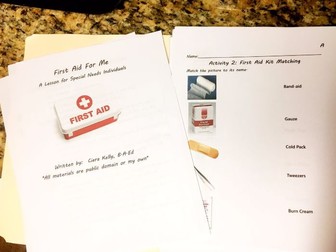
A complete, two week lesson plan for special needs students. It has two different levels of assessment, quizzes, performance checklists and instructions for performance, posters that can be laminated and put up around the classroom or used to enhance learning. It even has a picture step-by-step for proper handwashing. It also has at the end a printable certificate to show the student has completed the entire lesson! It focuses on two levels-students able to care for their own basic first aid needs, and those students whose needs are so severe they probably should focus on telling an adult of any injury. There are procedure cards for the following: cuts/scrapes, insect bites, vomiting, and nosebleeds. Each project has detailed instructions on what to do.