Functional Skills English - SEN SupportQuick View
huwfifield

Functional Skills English - SEN Support

2 Resources
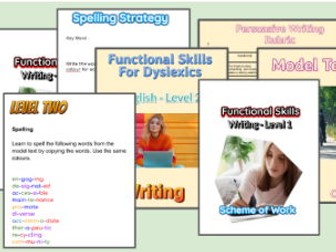
This Functional Skills Level 1/2 Writing and Level 2 Reading and Writing pack contains resources designed to assist students, particularly those with dyslexia, in improving their reading, writing, and critical thinking skills. The dyslexia friendly, functional skills writing workbook includes a structured approach to improve writing by using model answers, questionnaires, plans and colour-coded spelling of key words. The questions are focused on improving a park and reviewing a visit to an amusement park. Each section begins with typical writing questions on the Functional Skills (AQA) Paper. The Level 2 Pack contains Writing model answers with grammar, vocabulary and spelling activities aimed to support struggling students. The reading section is accompanied by a graphic organiser and vocabulary organiser. These Functional Skills materials provide structured, step-by-step approaches to reading and writing, which are crucial for dyslexic students or students with additional needs. By breaking down complex tasks into manageable steps and using visual aids, these resources help students build confidence and competence in their literacy skills. The focus on organization, clear instructions, and practice exercises make these tools especially effective for supporting students with dyslexia in achieving academic success.
SEN Support Plan – SMART Target BankQuick View
SendVision

SEN Support Plan – SMART Target Bank

(0)
This comprehensive 134-page resource provides a wide range of SMART target examples to support teachers and SENDCos in writing effective, measurable targets for children with Special Educational Needs and Disabilities (SEND). Covering all four areas of need outlined in the SEND Code of Practice, this resource is tailored for primary school-aged pupils and is ideal for use when creating SEN Support Plans, Individual Education Plans (IEPs), or Provision Maps. To make navigation simple, the document includes a clickable contents page – just hold Ctrl and click the area you need to jump straight to the relevant section. Covers Communication & Interaction, Cognition & Learning, Social, Emotional & Mental Health (SEMH), and Sensory & Physical Needs. Suitable for mainstream and specialist settings
Friendship Scenarios Resource Pack Elsa SupportQuick View
Elsasupport

Friendship Scenarios Resource Pack Elsa Support

(0)
This Friendship Scenarios Pack contains a variety of Friendship Scenarios, along with solutions, activities, and reflective tools to help pupils explore and understand friendship dynamics. These resources are designed to empower you to guide pupils through challenging social situations, assisting them in identifying and expressing their emotions, understanding others’ perspectives, and practising problem-solving in a safe, supportive environment. This resource is suitable for KS2 and Secondary pupils (There are just one or two that wouldn’t be suitable). The scenarios in this pack are carefully crafted to be flexible, allowing you to tailor your approach to meet the unique needs of each child. For instance, you may choose to use these scenarios in one-to-one sessions or in small group activities. Additionally, you can incorporate them into your regular emotional literacy sessions, reinforcing the importance of friendship, empathy, and communication. Ultimately, these scenarios are meant to be adaptable to different contexts and group dynamics. These include: 30 Friendship Scenarios: Each scenario offers a choice of 3 possible solutions. One solution is a good choice, one is acceptable, and one is not ideal. Reflection Prompts: Thought-provoking questions that help pupils gain a deeper understanding of the situation and themselves. Friendship Fix-It Tools: A collection of strategies designed to help pupils build and maintain stronger friendships. Empathy Boosters: Simple yet effective suggestions for developing and enhancing empathy. Role Play Instructions: Step-by-step guidance on using the cards for role-play exercises, which are especially useful for group work. Coping Strategies: Practical ideas to help pupils cope with the emotional challenges that arise in friendship conflicts. Friendship Qualities: A list of essential qualities that make someone a good friend. Which qualities are being displayed in the scenarios? Which qualities could be improved? Assertiveness Tools: Approaches to help pupils develop and demonstrate more assertive behaviours in their friendships. Traffic Light Problem-Solving: A visual traffic light tool to assist pupils in making informed decisions when faced with friendship issues. Friendship Fix-It Wheel: A simple yet effective visual tool that offers 4 key suggestions when dealing with friendship problems. My Friendship Scenario: An opportunity for pupils to reflect on and work through their own real-life friendship dilemmas. Feelings: Visual characters that can help pupils express and discuss their feelings in greater depth. Emotional Scale: A tool for scaling the intensity of emotions, helping pupils better understand the strength of their feelings.
Attendance Support Bundle - SecondaryQuick View
Hedgehog_Resources

Attendance Support Bundle - Secondary

5 Resources
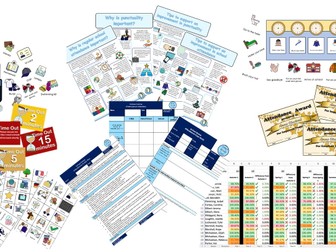
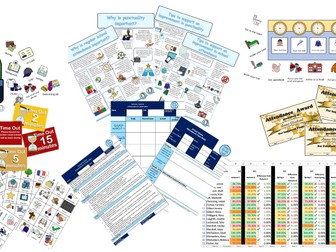
This resource bundle is designed to support both teachers and parents in enhancing student attendance, organisation, and emotional well-being. It includes Case study template Attendance interview document Attendance action plan Information sheets for parents/carers - Tips to support an improvement in school attendance Information sheets for parents/carers - Tips to support an improvement in punctuality Information sheets for parents/carers - Why is regular school attendance important? Information sheets for parents/carers - Why is punctuality important? Whole school attendance spreadsheet- Secondary A Visual Timetable Now & Next Board Getting Ready for School Aid School Bag Packing Aid Time Out Cards Four editable attendance certificates
Inclusive Classroom Support Mat – KS1/KS2 ResourceQuick View
meganmalonex

Inclusive Classroom Support Mat – KS1/KS2 Resource

(0)
This all-in-one English support mat is designed to help children who need a little extra guidance in reading and writing. Perfect for classroom desks, small group work, or home learning, it brings key literacy tools together in one easy-to-use resource. What’s included on the mat: Speed Sound Chart – to support phonics recognition and blending. Common Exception Words – to boost spelling accuracy and reading fluency. Punctuation Guide – clear visual reminders to improve sentence structure. Ideal for KS1 and lower KS2, SEND pupils, EAL learners, and any child who benefits from visual, accessible support. The mat helps build confidence, independence, and accuracy in English tasks, while reducing the need for constant prompting. Perfect for: Daily desk reference Guided reading or phonics sessions Writing activities and independent work Simply print, laminate, and use again and again!
Now and Next Visual Support PackQuick View
YourSENbestie

Now and Next Visual Support Pack

(0)
Support smooth transitions, reduce anxiety, and boost independence with this Now and Next Visual W i d git Support Pack – ideal for mainstream classrooms, SEND settings, and home learning. This pack includes clear, easy-to-understand visual symbols designed to help children know what is happening now and what is coming next. Perfect for pupils with autism, communication needs, or those who benefit from structured routines. What is Included: Ready-to-print Now and Next boards A selection of Widget symbol cards covering common classroom activities, routines, and subjects Blank symbol squares so you can adapt the pack for individual pupils Simple guidance on printing, laminating, and using the boards effectively Benefits: Supports children who are non-verbal or have limited language Reduces uncertainty and promotes calm transitions Encourages independence and visual processing Can be used in whole-class, small-group, or 1:1 support How to Use: Print and laminate the boards and symbols for durability. Use Velcro dots or strips to attach symbols to the boards. Place the current activity under Now and the upcoming activity under Next. Swap symbols throughout the day to keep pupils informed. Format: P D F download ready to print and use immediately. W i d git Symbols W i d git Software Ltd 2 0 0 2 - 2 0 2 5 w w w.w i d git.com used under license
Time Out Support Prompt CardQuick View
LancashireResourcesVault

Time Out Support Prompt Card

(0)
This printable prompt card is designed to help educators and support staff assist students with special educational needs and disabilities (SEND) in effectively managing time out. The resource provides a clear, structured visual aid to support students through requesting time-out, without drawing attention, ensuring they feel supported while practicing emotional regulation. Features: Visual and Text Prompts: Simple, easy-to-understand illustrations and phrases to cater to diverse learning needs, including those with autism, ADHD, or sensory processing difficulties. Portable Format: Compact design for use in classrooms, sensory areas, or at home. How to Use: Present the card and discuss with the student during a calm moment to explain the time-out process. Allow the student to use it as a visual cue when they need time to self-regulate. Encourage the student to follow the steps independently or with minimal guidance. Reflect with the student afterward to reinforce positive outcomes. This resource is ideal for supporting SEND students in mainstream or specialist settings, promoting a positive and inclusive approach to behavior management.
Teen Self-esteem Pack - ELSA SUPPORTQuick View
Elsasupport

Teen Self-esteem Pack - ELSA SUPPORT

(0)
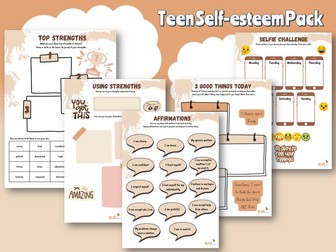
Self-esteem is about how we value and perceive ourselves. There are 24 sheets in the teen self-esteem pack covering the following areas: Top strengths – What are the pupil’s top strengths? A strength you wish for – What do they aspire to? What strength would they like? Using strengths – How do they use their strengths? Strength spotter – Do they recognise strengths in others? Affirmations – read Affirmations – write 3 good things today – What three good things have happened today? This is a daily practice that will boost wellbeing and self-esteem Steps to success – read Steps to success – write Self love Make yourself proud – What makes them feel proud? Helping hand – How do they help others? Fill your cup Gratefulness – What are they grateful for? Jar of positivity Mood tracker – Track their mood daily Selfie challenge Social media feelings A to Z of things that make me happy A to Z of words to describe me Wishes and dreams Build relationships – What does a perfect friend look like? What qualities do they have? Being assertive – read Being assertive – write
Elsa Support, Make a Face -Emotions activityQuick View
Elsasupport

Elsa Support, Make a Face -Emotions activity

(4)
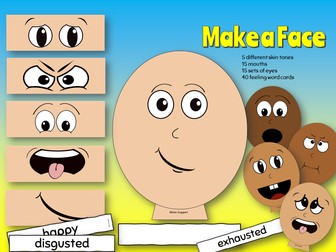
Resource from ELSA SUPPORT Print out the skin tone that you require. This resource has five different skin tones to suit all children. There are also 15 different sets of eyes and mouths and a set of emotions vocabulary flash cards. Laminate all the pieces and keep in a zipped bag for convenience. The aim of this resource is for children to begin to recognise facial expressions and talk about their feelings. It is excellent for children on the autistic spectrum. This resource is also very good for early years settings and can be put into an area of provision, allowing children to experiment and make different faces. Can they match the eyes to the mouth? Can they tell you what the expression is that they have made? Parents would also find this resource helpful for their preschool children. Questions you could ask – can you make me a ‘angry face’? What would ‘angry’ eyes look like? What would ‘sad’ eyes look like? Can you make me a ‘sad face’? Also use other vocabulary such as ‘miserable, frustrated, terrified, proud’. There are so many possibilities for working with this resource. The cards could be used as a matching pairs game. Lay out all the cards and ask a child to choose a mouth and eyes that match – name the emotion. Use the face (laminated) for drawing emotion faces. Put it alongside a mirror so children can make faces themselves. Use the angry eyes and mouth to discuss anger and how to recognise when they are becoming angry. What makes them angry? What could they do when they are angry? Pick an emotions flashcard(included with the pack) and make the appropriate face.
Attendance Support Bundle - PrimaryQuick View
Hedgehog_Resources

Attendance Support Bundle - Primary

5 Resources
This resource bundle is designed to support both teachers and parents in enhancing student attendance, organisation, and emotional well-being. It includes Case study template Attendance interview document Attendance action plan Information sheets for parents/carers - Tips to support an improvement in school attendance Information sheets for parents/carers - Tips to support an improvement in punctuality Information sheets for parents/carers - Why is regular school attendance important? Information sheets for parents/carers - Why is punctuality important? Whole school attendance spreadsheet- Primary A Visual Timetable Now & Next Board Getting Ready for School Aid School Bag Packing Aid Time Out Cards Four editable attendance certificates
Pastoral Support Plan TemplateQuick View
Natashamarley

Pastoral Support Plan Template

(0)
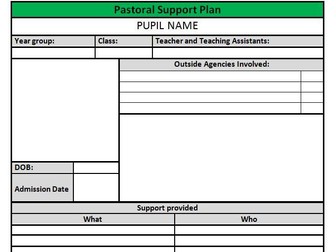
Need a Pastoral Support Plan (PSP) Template that is different from your Individual Education Plans? This PSP template will ensure all pupils in receipt of pastoral support can be tracked and monitored. Easy for any member of staff to complete! Includes: Key details about the pupil, including outside agency involvement Highlights strengths and difficulties Details provision in place and who provides this Space to review the impact of support in line with Assess, Plan, Do, Review cycle
SENDCO Support - Template Forms BookletQuick View
gjcurry

SENDCO Support - Template Forms Booklet

(0)
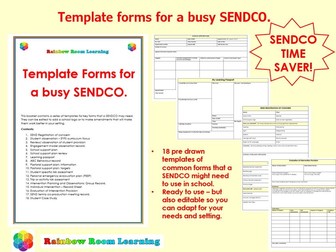
Are you a new or busy SENDCO? Are you looking for examples of forms to make information gathering and management effective in your setting? This time saving booklet contains 18 examples of common forms that schools often need to use. They are ready to go - but also editable in case you would like to add your school logo or make some tweaks to them to make them work better for your needs or context. In the booklet you will find forms for: SEND Registration of concern Student observation – EYFS curriculum focus Review/ observation of student provision Engagement model observation record. School support plan School support plan review Learning passport ABC Behaviour record Pastoral support plan: information Pastoral support plan: targets Student specific risk assessment Personal emergency evacuation plan (PEEP) Trip or activity risk assessment Intervention Planning and Observations: Group Record. Individual Intervention – Record Sheet Evaluation of Intervention Provision SEND termly co-production meeting record. Student Case Study If there is a form you would like to see included that is not here - please do leave a review with a suggestion so that it can be added!
Anger Support Plan ELSA SupportQuick View
Elsasupport

Anger Support Plan ELSA Support

(0)
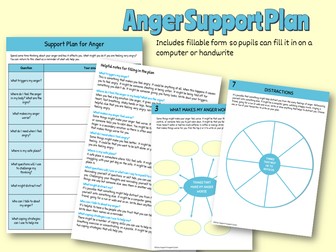
This is an anger support plan resource pack for older pupils who need help with anger. Perfect for ELSA SUPPORT. The plan is a useful reminder for them and others on what they need to look out for, do, or remember when their feelings of anger get too much. The resource is aimed at upper KS2 and Secondary. The plan is meant to be worked through with an adult. When pupils are angry they need that all important one to one or small group support. Helping pupils to manage their anger is the end result of all the work you do with them. The plan must be done with the worksheet pack . Included in the anger support plan pack Fillable form version of the support plan – pupils can fill this in on the computer PDF form for printing and writing out by hand 9 worksheets working through all the points on the plan 3 information sheets with examples of thought challenging questions, assertiveness script and body signs The 9 worksheets and activities included are: Anger triggers Body signs What makes anger worse? What do I need when feeling angry? Where is my safe place? Questions to challenge anger What might distract me? Who can I talk to? What coping strategies can I use?
Individual Behaviour Support PlanQuick View
TheHelpfulSENCo

Individual Behaviour Support Plan

(0)
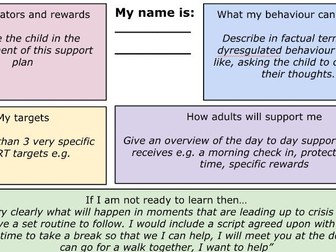
A behaviour support plan to use with children in your class or setting displaying dyregulated behaviour. Guidance is included in the plan to lead your conversation with the pupil. This plan was developed in conjuction with a CAMHS clinician as part of a piece of work on Trauma Informed Practice.
Supporting Those With Dyslexia BookletQuick View
WillsonEducation

Supporting Those With Dyslexia Booklet

(24)
This booklet gives information about dyslexia and how teachers and teaching assistants can support student's within the classroom. The booklet includes: - A quiz to show understanding - Explains what dyslexia is and why its important to identify - How it effects reading and writing, amongst other information
Supporting DyslexiaQuick View
Vphillips21

Supporting Dyslexia

(0)
A ‘cheat sheet’ for dyslexia. Includes a brief description, indicators of this learning need, and strategies for support. Useful for all school staff. Can be printed and stuck into diaries, CPD journals.
Elsa-Support - Playdough emotions and feelings packQuick View
Elsasupport

Elsa-Support - Playdough emotions and feelings pack

(0)
This is a set of 6 mats for using with playdough and emotions and feelings. Although my thoughts were that these would be fab for younger children, I am sure older children would enjoy using them too. Lots of open ended fun where children can be creative and think about colours.