This is a fully resourced, fully differentiated SOW to teach Other Side of Truth. It covers the whole text with a range of activities - reading skills (fiction/ non-fiction), writing skills (create and non-fiction) and speaking and listening. There are linked poems and context and enough lessons to cover a full 12 week term. Taught to year 7 but could be used up to year 9 as there are tasks to challenge high ability students.
Comparing Sade’s experiences of England with Nigeria after reading The Other Side of Truth by Beverly Naidoo. Students reflecting on the novel once they have read it list good and bad things in Sade’s experience of both countries, exploring whether the author presents a balanced view of both countries.
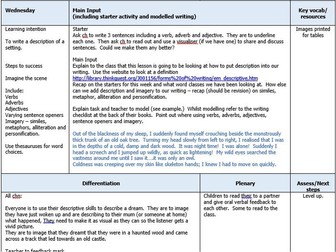
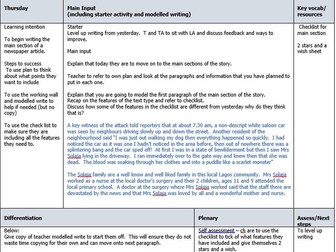
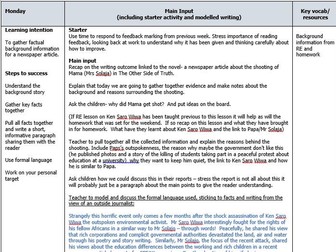
Fully resourced scheme of work to accompany this KS3 text. Power-point and resources combine reading and writing activities and there is plenty of scope for discussion of the key themes arising in the text.
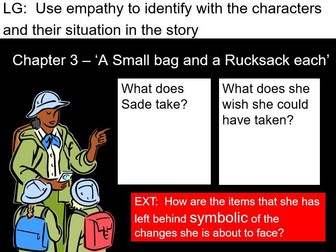
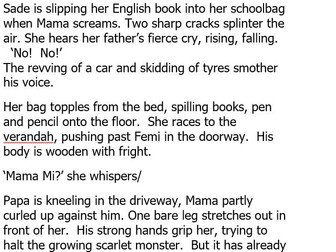
A whole 2nd week's resources around The Other Side of Truth and looking at some key skills to develop their knowledge of newspaper articles as well as learning to empathise with characters.
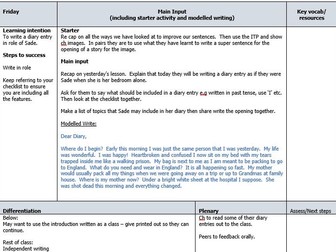
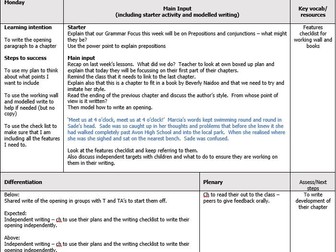
A whole week of lessons covering The Other Side of Truth. The children are writing their own chapter of the story, developing their own characters and peer assessing.
A whole week of lessons covering The Other Side of Truth. The children create story maps, retell stories orally and plan / box-up their writing for the next chapter of the story.
4 days of lesson plans with the focus on the children putting into practice the skills they have been studying over the last 3 weeks and creating their own newspaper reports.
A whole 3rd week's resources around The Other Side of Truth and looking at gathering key facts together, sequencing events and studying direct and indirect speech.
This bundle contains a variety of differentiated models for recounts including models with high quality vocab and low quality vocab for children to discuss the impact of sentence structure and vocabulary on the reader.
These provided a fantastic basis for high quality writing based on the book: The Other Side Of The Truth.
The Other Side of Truth by Beverley Naidoo tells the story of a Nigerian family torn apart by the depth of their mother. Femi and Sade, the children, enter England illegally and the story follows their journey as it explores what truth actually is.
This 12-week scheme works through the book and combines activities linked to Power of Reading and Talk for Writing. Grammar is linked into the scheme based on the type of writing. Weeks are made up of 1/ 2 /3 and 4 lessons allowing for writing to take place over 2 days and also editing lessons.
Text Types
Throughout the 12-week scheme, the children will study in detail and write at length the following text types:
Diary Entry,
Discussion,
Monologue,
Poetry.
If your students enjoyed Under the Same Moon, this film takes the same topic to the next level. 3 stories are intertwined in Mexico, Cuba and Morocco as three children and their families deal with different consequences from the departure of loved ones to the "other side". This film brings up MANY topics of discussion about immigration, dangers of their trips and life for those left behind. Movie guide contains 30 questions in Spanish and English and 7 topics for discussion follow-up. Movie is rated PG-13. A very good film and lots to talk about afterwards with your students!
A powerpoint presentation showing a little storyboard about people seeing a cube from different sides, and how they work out who is telling the truth about what they see. Great for starting discussions about seeing things from other perspectives, and listening to others. Also could be a story starter.
SSEHV lesson plan on telling the truth
1. Quotation on truth
2. Guided visualisation meditation
3. Story and disussion - Tiddler by Julia Donaldson
4. Song - never tell a lie (SSEHV song)
5. Activity/game - pictionary/consequences
I designed to give pupils choice in their outcome. Pupils use resources found for homework or give access to internet to gain as many points as they can before the end of the day at G8 summit. Also works well as a cover lesson.
This is the fifth in a series of lessons on Buddhism for GCSE level students for the 'Beliefs, Teachings & Practices' section of the course [section A]. It is suitable for all exam-boards.
The complete series of GCSE Budhism lessons, as well as learning mats, PLCs and revision sessions can be downloaded at our TES Shop: https://www.tes.com/teaching-resources/shop/godwin86
The topic of the lesson is...
The Second of The Four Noble Truths
• The nature of unsatisfactoriness (samudaya) and the way it creates dukkha
• The nature of craving (tanha) and the way it creates dukkha
• The form and significance in Buddhist teaching of the three poisons/fires (Lobha – attachment, Dosa – aversion/aggression, Moha – ignorance)
• The relationship between the three poisons/fires and suffering
• Issues related to the Second Noble Truth,including the positive or opposite qualities to the three poisons/fires
• Common and divergent emphases placed on the Second Noble Truth by different Buddhist groups, including different ways of understanding ignorance (as confusion or delusion), attachment (as desire, greed or passion) and aversion (as anger or hatred)
• Different interpretations and emphases given to sources of wisdom and authority by different
Buddhist groups
Sources:
• Dhammacakkappavattana sutta (Setting the Wheel of the Dhamma in motion)
• Dhammapada 334–336
The Download includes:
-A PPT Containing a Full Lesson
-A complete lesson plan covering: objectives, key-words, differentiation, and lesson timeline.
-A double-sided worksheet
-A Homework Task
Thank you for your download!
Please download our other lessons as a part of this GCSE Buddhism course from our shop: https://www.tes.com/teaching-resources/shop/godwin86
This is the fourth in a series of lessons on Buddhism for GCSE level students for the 'Beliefs, Teachings & Practices' section of the course [section A]. It is suitable for all exam-boards.
The complete series of GCSE Budhism lessons, as well as learning mats, PLCs and revision sessions can be downloaded at our TES Shop: https://www.tes.com/teaching-resources/shop/godwin86
The topic of the lesson is...
Introduction to The Four Noble Truths , The First Noble Truth about the Nature ofLife as Suffering (dukkha):
• The three different types of suffering:
• Painful experiences (dukkha-dukkha)
• The changing nature of things (viparinama-dukkha)
• All pervasive suffering (sankhara-dukkah)
• The nature and significance of the different forms of suffering in Buddhist teaching
• Issues related to the First Noble Truth, including the interconnections between different forms
of suffering
• Common and divergent emphases placed on dukkha by different Buddhist groups, including whether all sentient beings can be liberated from suffering
• Different interpretations and emphases given to sources of wisdom and authority by different Buddhist groups
Sources: Dhammacakkappavattana sutta (Setting the Wheel of the Dhamma in motion)
The Download includes:
-A PPT Containing a Full Lesson
-A complete lesson plan covering: objectives, key-words, differentiation, and lesson timeline.
-A double-sided worksheet
-A video file for the introductory activity .
-A Homework Task
Thank you for your download!
Please download our other lessons as a part of this GCSE Buddhism course from our shop: https://www.tes.com/teaching-resources/shop/godwin86


![GCSE - Buddhism - Lesson 5 [Second Noble Truth, Types of Craving, Three Poisons] Complete Resource](https://l.imgt.es/resource-preview-imgs/8976966c-9ee9-4191-8e06-a1ef8714c34a%2FLesson5.jpg?profile=res-img-med-legacy-v2)
![GCSE - Buddhism -Lesson 4 [The First of The Four Noble Truths & 3 types of suffering] "Outstanding"](https://l.imgt.es/resource-preview-imgs/eb41bef0-7211-4db0-a62a-d79da6b0285e%2FLesson4.jpg?profile=res-img-med-legacy-v2)