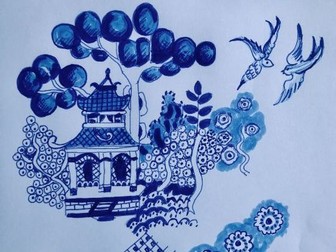
This lesson pack includes a ppt and a worksheet and depending on the age group you could use this for 2 or 3 lessons. The final product is a design created that is inspired by Chinese Willow design and the artist Lei Xue. Students create their own design inspired by their favourite objects in the style of traditional Chinese Willow Design pottery. The worksheet and powerpoint includes visual examples of how the students can answer the challenge.
English and Drama. Three consecutive lessons culminating in script writing in Lesson 3.
Structured drama and role play with opportunity for pupils to work collaboratively in small groups to develop vocabulary, learn Chinese rituals and practise talk fro writing.
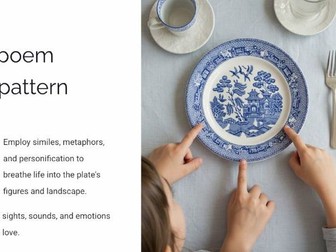
This creative writing lesson invites upper primary and lower secondary pupils to explore the traditional story of the Willow Pattern and express their understanding through poetry.
Learners will be introduced to the features of an ode and guided to write their own, inspired by the themes and imagery of the classic blue-and-white plate design. This cross-curricular resource links Literacy with Art and Culture, making it ideal for an engaging standalone lesson or end-of-term project.
This resource includes:
A structured PowerPoint that tells the Willow Pattern story in a clear, accessible format
A planning sheet to support pupils in crafting their own ode
A poetic word bank to scaffold figurative language use
Plate design templates for a creative visual response
A fully developed lesson structure with WALT and Success Criteria (Second Level, CfE)
Pupils will:
Explore the story behind the Willow Pattern
Learn the features of an ode
Identify and use figurative language such as similes, metaphors, and repetition
Develop creative writing and visual literacy skills
Suitable for high-ability Primary 7 pupils or early secondary learners (S1/S2). The resource encourages thoughtful interpretation, expressive language, and cross-disciplinary learning.
A very colourful, exciting play musical play to act, sing and dance. The price includes a free performance licence for schools.
Target Age Range: 7-13 yrs.
Duration approx 30-35 mins.
THE STORY: Koong-Se is the beautiful daughter of a wealthy Chinese mandarin. He wants Koong-Se to marry a rich husband, but she finds them all vain and boring. Instead, she falls in love with Chang who is merely a gardener. The mandarin is outraged and he banishes Chang from the palace and confines his daughter. During her confinement, the mandarin arranges her wedding, but the lovers escape. They are hunted down, and trapped in a small pagoda. The pagoda is set on fire and the lovers perish, but the garden spirits turn them into immortal white birds.
KS2 Y4 Lesson powerpoint and lesson plan.
Learning Objectives: Speaking & Listening: Increase contextual subject vocabulary. Ask relevant questions to extend subject knowledge. Explore ideas and participate in collaborative conversations.
Reading: Recognising poetry (narrative, cultural), discuss words & phrases which capture imagination, develop prediction from images and inference. Summarise main ideas.
Writing: Compose and rehearse sentences orally, build vocabulary and noun phrases.
The Powerpoint slides include a topic related vocabulary list for pupil use. There is a comprehensive lesson plan for teacher use at the end of the powerpoint on slides 14 and 15.
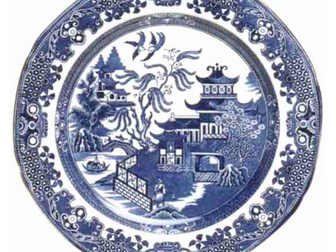
The lesson is created around the story of the Willow Pattern and the image of the plate to generate ideas and collaborative discussion. There are opportunities for pupils to read the poem, extend vocabulary, discuss the characters and watch a short clip of the story on Youtube before creating their own five box storyboard linked to their own collected vocabulary from the lesson.
This is the first in a series of three lessons on the Willow Pattern theme.
Two week unit on the Willow Pattern Story. Year 2, good links with China topic. Based around rewriting the story with their own ending. Features focus on sentence types. Includes presentation of the story and lots of resources.
KS2 English/Drama 36 slide power-point lesson about the Willow Pattern story which includes pupil resources and a lesson plan (slides 29-36). This lesson can be used as a follow up to Lesson 1 (also for sale!) or as a discrete lesson. The lesson start focuses on the poem, vocabulary and meaning of the story linked to corresponding images. The main body of the lesson concentrates on developing key words to describe characters, learning and practising Chinese rituals and greetings for use in the small group drama activity and using drama freeze frames or frozen pictures to depict scenes from the story. There is opportunity for the groups to develop dialogue and use the rituals in their own role play scenarios. At the end of the lesson pupils are encouraged to perform their role play scenario and receive feedback against specific criteria.
Lesson Objectives: Speaking & Listening: Increase contextual subject vocabulary. Ask relevant questions to extend subject knowledge. Explore ideas and participate in collaborative conversations. Reading: Recognising poetry (narrative, cultural), discuss words & phrases which capture imagination, develop prediction from images and inference. Summarise main ideas. Writing: Compose and rehearse sentences orally, build vocabulary and noun phrases through drama and role play.Key Question: Why is it important to know how to pick out (identify) and explain simply (summarise) the main parts of a story?
KS2 English/Drama 25 slide power-point lesson about the Willow Pattern story which includes pupil resources and a lesson. This is the third lesson in a series of three. It can be used as a follow up to Lessons 1 & 2 (also for sale!) or as a discrete lesson. The lesson start recaps the poem and Chinese rituals and greetings The main part of the lesson focuses on writing a script for a section of the story. Included are opportunities for pupils to assess their work using a script features checklist and give feedback . At the end of the lesson each group is encouraged to perform their scripted scene as part of the whole drama/story.
Speaking & Listening: Increase contextual subject vocabulary. Ask relevant questions to extend subject knowledge. Use drama to create conversations for a short play. Reading: Use a short poem to summarise a story into five parts. Identify a clear start, middle and end in each part of the story. Writing: use drama composition to rehearse sentences orally, build vocabulary and noun phrases to write a short playscript /scene (one of the five parts of the story)
Key Question: What is the best way of writing our ‘still photo’ drama scenes?
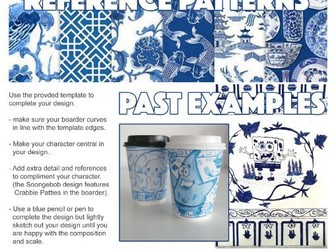
Set of resources challenging students to design their own coffee cup sleeve in the style of artist Lei Xue. Xue mixes traditional Chinese Willow patterns with contemporary, pop art references. Students are asked to create their own take on this design.
The set of sheets include instructions, examples and references for Lei Xue’s work. A Y7 example of the task and the coffee sleeve template.
This task can be extended to develop the design and printed to actually create coffee cup wraps or reusable cups.
Please note, this is a worksheet and template pack only. No presentation is included.
One of a series of downloadable resource packs produced by FACE and the Heritage Crafts Association. Each is introduced by a leading craftsperson and features a step-by-step guide to a heritage craft project, together with background information. The projects are easy to deliver, accessible, fun for pupils and tailored to the national curriculum. Suggested suppliers and useful website links are included.
This unit gives children the opportunity to write stories and poems, as well as writing and performing play scripts.
They'll also get to enjoy one of the best-loved children's books of all time. Surely every child should have the chance to share in the adventures of Mole, Ratty, Badger and Toad?
A full unit of work ready for the 2014 National Curriculum. You can find lots more like it at ShakespeareandMore.com
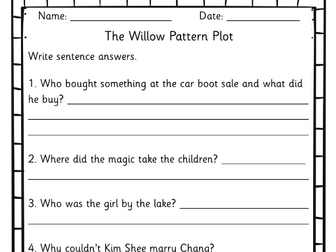
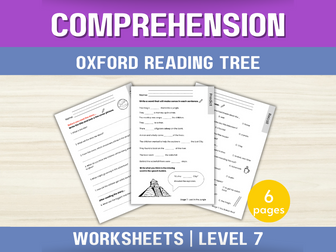
This comprehension pack includes two sheets for each book in the Stage 7 Stories set: The Broken Roof, Lost in the Jungle, The Lost Key, Red Planet, Submarine Adventure and The Willow Pattern Plot. Pupils will be engaged with their tasks while you hear reading or work with groups.
The tasks include fill in the blanks, comprehension questions, definitions, sentence construction and drawing prompts. There are 12 pages in total.
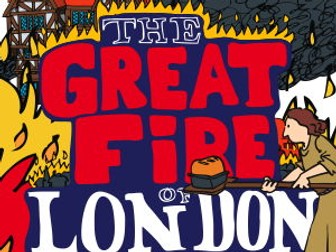
The story that I have written is aimed at UKS1 (though older children would still find it interesting) and I have based it on a character called Willow Goodchild. Willow likes school and has great friends but he has a tendency to daydream. His daydreams take him and his friends to different periods in history/different areas of the globe depending on the topic his teacher is talking about. The story attached is based on ‘The Great Fire of London’. My idea is that each story in the series follows a particular pattern: Willow’s teacher asks him a question that he partially hears as he slips into a daydream, he and his friends explore and learn about a certain topic, Willow slips back into reality and astounds his teacher with a detailed answer of his question.
I have experienced this phenomenon first-hand many times in class and have always wondered how children answer questions with such detail, even though I thought they were daydreaming! Hopefully this story will unlock the mystery!
In my own daydream, other stories might include: ‘Willow and The Romans’, ‘Willow and The Greeks’, ‘Willow and The Great Volcano’, ‘Willow and the Kings’, ‘Willow and the Space Race’.
The possibilities for this resource are vast and could include:
English-Children to write themselves into certain daydream scenarios in history, write a diary entry, write an alternative ending etc.
Art-drawing accompanying illustrations to the page, illustrating characters etc.
History-Researching the events on each page (possible group activity), researching the aftermath of the fire, how London recovered etc.
Geography-Map work or Google Earth locating the area of London.
PSHE-Describing the feeling of the baker, the people of London etc.
P4C-How should the baker be treated by Londoners? Talk about forgiveness.
Technology-Design and make a new safer bakery to replace the Pudding Lane bakery.
Any feedback and comments would be most welcomed.
A selection of comprehension worksheets to go alongside the teaching of the following Oxford Reading Tree Books; The Jigsaw Puzzle, The Willow Pattern Plot, The Joke Machine and Unusual Buildings.
The following worksheets can be used as a follow up to a guided reading session and have been used previously with a focus on the skills outlined in the Reflective Reading programme.
Oxford Reading Tree Level 7 Comprehension Worksheets - Biff, Chip, and Kipper Stories (Stage 7)
Dive into captivating tales with our comprehensive set of six comprehension worksheets, tailored for six beloved stories from the Oxford Reading Tree series. Perfect for developing reading comprehension skills and fostering a love for literature, these worksheets provide engaging activities to deepen students’ understanding of each story.
Stories Included:
The Broken Roof
Lost in the Jungle
The Lost Key
Red Planet
The Willow Pattern Plot
Submarine Adventure
Key Features:
Advanced Comprehension Practice: Each worksheet challenges students with thought-provoking questions and activities designed to develop critical thinking skills.
Aligned with Oxford Reading Tree Level 7: Specifically tailored for the reading level, ensuring age-appropriate content and complexity.
Variety of Critical Thinking Skills: Covering a range of critical thinking skills including clarifying, summarizing, predicting, comparison, and recalling, these worksheets offer a comprehensive approach to literary comprehension.
Teacher-Friendly: Streamline lesson planning with ready-to-use worksheets that facilitate meaningful discussions and promote higher-level thinking in the classroom.
Why Trust Me?
With over 15 years of experience in education, specializing in literacy with the Oxford Reading Tree series, I bring a deep understanding of students’ needs and curriculum requirements. Each resource I create is designed to engage learners, enhance comprehension skills, and foster a lifelong love for reading. Drawing from my expertise and passion for teaching, you can trust that my materials are thoughtfully crafted to empower both educators and students on their learning journey.
Ignite a Love for Reading:
Foster a deeper appreciation for literature and nurture advanced critical thinking skills with our Oxford Reading Tree Level 7 Comprehension Worksheets. Download now and empower your students to become skilled and insightful readers!
Connect Kids
Btec Level 3
Sculpture
Ceramics
wire
Willow
Tissue paper
Mixed media
drawing from observation
HW tasks included
All documentation for running the project is included
Please add comments and any feedback Thanks
 Quick View

 Quick View
 Quick View
 Quick View
 Quick View
 Quick View
 Quick View
 Quick View
 Quick View
 Quick View