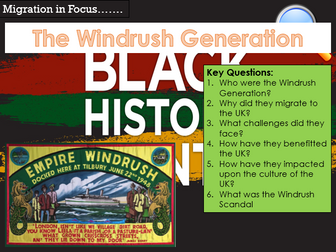
up to 180+ minutes
Pack contains: lesson plan, Windrush worksheet (reading exercise, comprehension, activities, essay writing)
Pack focus: British Culture/History/Politics/immigration (Black British Culture/History/Politics/immigration), BLM.
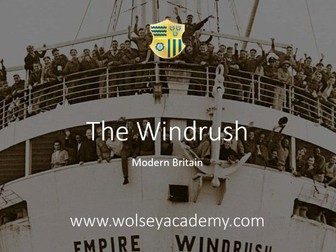
Students learn about the Windrush Generation and the scandal that recently made front-page news. The pack looks at the reason for the immigration, the impact on British culture and how the British government has reacted to the scandal.
Part 2 includes analysis of “Black” lyrics by rapper Dave (lyrics not included, though easily found online), who includes references to Windrush, Grenfell, Reparations, and Meghan Markle’s representation in the press.
Writing exercises include - formal letter writing to MPs, and creative writing, and essay writing.
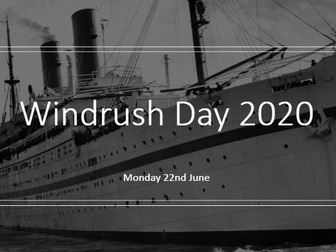
This engaging and age-appropriate assembly PowerPoint is designed to help KS1 and KS2 pupils understand and reflect on the significance of Windrush Day (22nd June). It explores the journey of the Empire Windrush, the experiences of the Windrush Generation, and their lasting contribution to life in Britain.
Perfect for a whole-school assembly or class-based discussion.
What’s included:
10-slide editable PowerPoint
Who the Windrush Generation were and why they came to Britain
Life in the UK during the 1940s–70s
The importance of diversity, resilience and respect
Key discussion questions
BBC Newsround video link for visual context
Celebrate the courage, culture and contributions of the Windrush Generation in a meaningful way.
Targeted at KS3, this lesson on Windrush Child by John Agard introduces the context of the Windrush generation, and is ideal for use as part of a scheme of work on poetry across different cultures. The emphasis in this lesson is on identifying the meaning, themes and ideas implicit in the poem, along with educating students on the cultural, social and political significance of the Windrush generation.
This lesson is particularly idea for a higher ability Year 8 class, or mixed ability Year 9 students.
The skills required for the main task are both creative and transaction writing related, so this lesson serves a multitude of purposes.
Celebrate the legacy of the Windrush Generation with this comprehensive, ready-to-use Primary Assembly and Lesson pack!
On June 22nd, schools across the UK will honour the 75+ year history of the Windrush Generation. This professionally designed 11-slide presentation makes it easy for you to deliver an engaging, respectful, and educational session that meets British Values and History/PSHE curriculum goals.
Why this is a TES “Top Pick” for your classroom:
Time-Saving: A fully structured presentation—just download and click play. Perfect for busy teachers!
Child-Friendly History: Explains the journey of the HMT Empire Windrush, the reasons for the invitation to Britain, and the challenges faced in a clear, age-appropriate way.
Celebrates Contribution: Highlights how the Windrush Generation helped build the NHS, revolutionized public transport, and enriched British culture through music, food, and art.
Promotes Reflection: Includes powerful quotes and discussion prompts about courage, resilience, and belonging.
Visually Stunning: Modern, clean design with clear bullet points to keep students focused.
What’s covered in this pack?
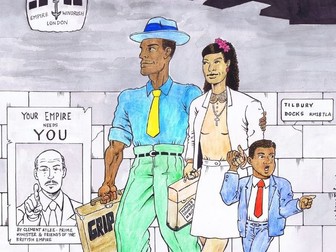
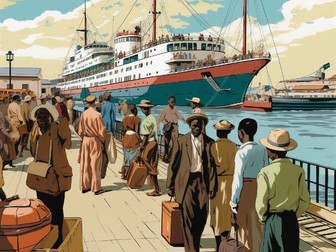
The Journey: Tilbury Docks 1948 and the 500+ passengers from the Caribbean.
The Invitation: Why Britain needed workers after WWII and the jobs the Windrush pioneers did.
Cultural Impact: From Reggae and Calypso to Carnival and Caribbean cuisine.
Overcoming Challenges: A sensitive look at the discrimination faced and the resilience shown.
Modern Legacy: Famous figures and the lasting impact on British society today.
Give your students a meaningful understanding of this vital part of British history. Download this primary assembly today!
This lesson on the Windrush Generation explores the arrival of Caribbean migrants to Britain on the SS Empire Windrush in 1948. It examines the push and pull factors for migration, such as post-war labor shortages in Britain and economic difficulties in the Caribbean. Students analyze the challenges faced by the migrants, including racial discrimination and housing issues, and their cultural contributions to British society. Activities include watching and analyzing a video, discussing a case study, identifying push and pull factors, completing a pre-printed activity sheet, and participating in quizzes to reinforce key concepts and historical context.
Wolsey Academy is a non-profit resource creator. Every penny we make goes to one of our partner charities – from space science education to local sports teams to carbon capture. Please help us, help you, help them by checking out our website and making use of our free and premium resources. We have over 1000 resources covering History, Business, IT, Geography and English.
As a special offer to those with an interest in the Windrush Generation and their history please use the code ‘WINDRUSH’ to get 50% all resources at the our store.
Search for Wolsey Academy on Google.
Thank you and we hope it helps.
Fully resourced 20-lesson English unit based on Windrush Child by Benjamin Zephaniah. Designed for upper KS2, this writing sequence supports pupils in developing empathy, expression, and a clear understanding of post-war migration through a wide range of purposeful writing outcomes. Pupils explore racism, identity and belonging while responding creatively and formally to events in the novel.
✔ Includes:
✔ 20 detailed lesson plans
✔ 20 editable PowerPoint presentations
✔ 39 resources (PDF/Word) including:
– Word banks and writing frames
– Worksheets and support sheets
– Emotions line graph and timeline templates
– Prompt cards and WAGOLLs
– Suggested website links for research
(A massive 60 files in total!)
★ Lesson Sequence Overview:
★ Introduction & Prediction – Read the prologue and raise questions about the text
★ Historical Context – Build a timeline of Jamaica’s history and post-war migration
★ Personal Writing – Diary entries, informal letters, and emotion tracking from Leonard’s perspective
★ Poetry & Performance – Study and perform ‘Windrush Child’ by John Agard; write original poetry
★ Discussion & Empathy – Advice writing for new pupils, formal letters about racist incidents, and speeches responding to injustice
★ Final Outcome – Write a persuasive pitch to the local council for a monument to the Windrush generation
✔ Why This Resource Works:
✔ Fully planned and ready to teach
✔ Wide range of engaging, purposeful writing tasks
✔ Supports history and PSHE links for deeper understanding
✔ Encourages empathy, reflection and real-world application
Ideal For:
KS2 English | Year 5 & 6 writing | Windrush topic | Black British history | Cross-curricular units linking English, History, and PSHE | 30–60 minute literacy lessons
Search tags: KS2 English unit | Windrush Child Benjamin Zephaniah | Year 6 writing plans | Black British history KS2 | racism and migration topic | writing outcomes UKS2 | Windrush monument lesson | outstanding writing planning KS2 | persuasive writing year 6 | poetry diary letters formal writing | Windrush Child English unit | PSHE writing upper key stage 2 black history month
Perfect for Black History Month! This is a 4/5 lesson enquiry; entitled ‘**How far were the Windrush Generation welcomed to Britain?’
This enquiry was initially designed as a compare/ contrast enquiry following a traditional USA Civil Rights enquiry. It could be taught to a higher able year 8 class, but due to the inclusion of GCSE style activities/ questions, it is best suited to teach in year 9.
This enquiry could also be condensed down for stand alone Black History Month lessons in October or for Windrush Day learning activities in June.
The lessons include :
a clear and straight - forward lesson plan on the first slide
clearly labelled student resources on the slides (no fuss of looking through extra docs.)
differentiated/ SEN/ EAL resources included
guidance/ extra info for teachers in the ‘notes’ section
The lesson titles are as follows:
L1: Who were the Windrush Generation and why did they come to Britain?
L2: What challenges did they face?
L3: What was the most significant turning point for improvement of race relations?
L4: How adequately were they commemorated?
NOTE: the 4th lesson was unable to upload in this bundle, you can access it here (reduced price if you buy it with all the other lessons): https://www.tes.com/teaching-resource/windrush-generation-memorials-12154665
A KS3 History lesson on the Empire Windrush.
Students will look at the context for immigration from the West Indies to Britain and the treatment of the immigrants upon their arrival. There are a few first hand accounts of immigrants to analyse.
Students will then answer comprehension questions at the end of the lesson.
SoW: What are the causes and consequences of migration?
L5: What was life like for the first Caribbean migrants?
L1: Why are some areas of the world more densely populated than others? - Free - https://www.tes.com/teaching-resource/-12695361
This unit is created in line with my personal passion for Population & Migration. This unit is framed around the cause and consequences of the global population growth, and the process and systems behind this geographical issue.
A conscience effect has also been made to embed dual coding within this SoW, as well as much differentiation and scaffolding.
This Unit is my favorite to deliver and has been streamlined over the last two years. Happy to answer questions and any feedback appreciated…
TheGeographyShopOriginal@gmail.com
Best FREE Resources (The Geography Shop)
https://www.tes.com/teaching-resource/-12899088 (Climate Change SoW)
https://www.tes.com/teaching-resource/-12899440 (Development SoW)
https://www.tes.com/teaching-resource/-12638984 (Waste SoW)
https://www.tes.com/teaching-resource/-12451443 (Britain Globalisation SoW)
https://www.tes.com/teaching-resource/-12741793 (Local Area Investigation SoW)
https://www.tes.com/teaching-resources/bundler/12949461 (Cambridge International)
https://www.tes.com/teaching-resource/-12922653 (Israel & Palestine)
https://www.tes.com/teaching-resource/resource-12485457 (What is Geography?)
SoW:
L1: Why are some areas of the world more densely populated than others?
L2: How Does Population Structure Differ in Developing and Developed Countries?
L3: Where are the world’s megacities?
L4: How does urban growth create challenges and opportunities?
L5: What was life like for the first Caribbean migrants?
L6:What Impact Does Forced Migration have on Population?
L7 - What does illegal migration into Europe look like?
L8 - What does illegal migration look like in the USA?
It is worth noting that some of these lessons require two lessons to be delivered.
Read the poem Windrush Child by John Agard and get children’s reactions. Give brief history of SS Windrush’s journey to Britain in 1948. Children either mark the journey on a map or answer questions about photographs to do with Caribbean immigration on the Windrush.
This is a 13 slide powerpoint explaining what Windrush is and what the Windrush Scandal is all about.
The powerpoint contains information, pictures, videos and thinking points for the students.
It has been designed to be a virtual assembly but can be adapted for a normal assembly or lesson if needed.
7 PPTs and resources to teach the Windrush Generation to Y5/6
lesson 1: To locate the Caribbean Islands and explain their history
lesson 2: To explain how the people of the Caribbean helped Britain in the war against Nazi Germany and Hitler
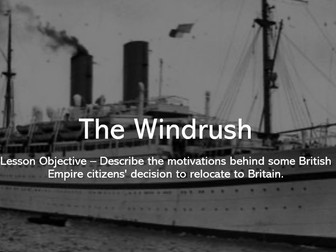
Lesson 3: To find out why people migrated from the Caribbean to Britain in 1948
Lesson 4: To understand what London life was like for the Windrush pioneers
Lesson 5: To learn who Sam King was and what he did
Lesson 6: To learn who Norma Best was and what she did
Lesson 7: To understand how the Windrush Generation changed Britain for the better
Introduce students to the powerful story of Windrush Child with this comprehensive guided reading resource for KS3-KS4. This literacy pack is designed with three adapted levels to support diverse learning abilities:
Beginning: Understanding & Comprehension — This level helps students grasp key events and characters, building foundational literacy skills.
Intermediate: Application & Analysis — Students explore themes like identity and resilience, encouraging deeper analytical thinking and connection to the text.
Advanced: Evaluation & Creation — This level challenges students to express their insights through creative writing and discussions, fostering critical thinking and reflection.
Engaging videos are included to bring the text to life, enhancing comprehension and emotional connection to the material. Comprehensive answers are provided for each level, ensuring effective assessment and feedback. This resource not only promotes critical thinking and empathy but also strengthens essential reading skills.
Carefully laid out in an easy-to-read and print format
Note: “Teacher slides” are AI-generated.
Teacher notes for one lesson with acitivities looking at the poem ‘The Windrush Child’ by John Agard, used as an English lesson on a day where we learnt about The Windrush.
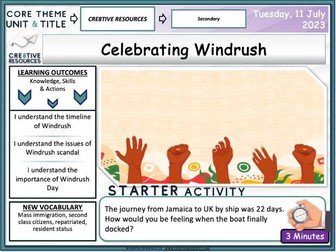
Celebrating Windrush . A fully-resourced lesson (1 hour +) which can be used by teachers to deliver a detailed workshop / session on the importance of this topic.
Learning Outcomes:
I understand the timeline of Windrush
I understand the Windrush scandal
I understand the importance of Windrush Day
Key terms
Mass immigration, second class citizens, repatriated, resident status
Each Lesson Pack Contains:
1 Fully Editable Careers PowerPoint (Learning Outcomes, Confidence Checkers, Assessment of Learning, Variety of Tasks, Video Embedded URL Clips, Engaging Premium Quality Slides, Extra Support Websites, Challenging & Thoughtful Questioning)
Assessment Opportunity (Confidence Checker)
The lesson includes a detailed PowerPoint, variety of student facing tasks and comprehension tasks These resources have been designed to be engaging, informative and pick up and teach.
Why not check out some of our latest super bundles below:
Personal Finance as a young Adult
Online Safety + Staying Safe
Y12 Survival Kit - Personal Safety
Y11 Survival Kit - Revision + Exam Stress
British Values Explored Bundle
Society, Body Image + Peer Pressure
Finance Risk + Online Safety
Listen to a poem written by an immigrant on the SS Windrush. Discuss how he felt about leaving his home and the reactions of some British people. Children compare the climate in the Caribbean with that of Britain and write imaginary letters home from a migrant.
A lesson which introduces the Windrush generation.
Contains guidance for a research project including sources such as videos, books, podcasts and museums.
Taught as part of a geography SOW on the UK which coincides with Black History Month.


 Quick View