The Living World: 14 AQA GCSE Geography LessonsQuick View
otreais

The Living World: 14 AQA GCSE Geography Lessons

(0)
Fourteen ready-to-teach one-hour lessons for AQA GCSE Geography’s The Living World (Paper 1, Section B): PowerPoints, printable resource sheets, teacher notes with answers, and a printed 25-mark assessment paper. It is a complete teaching sequence, planned to fit 60-minute lessons, with a minute-by-minute outline in the teacher notes. What a lesson looks like: a Do Now with answers that revisits earlier lessons, then teaching slides (“Learn it”) built around clear original diagrams, so the explanation sits between the tasks. Each lesson has three or four tasks, each with a stretch for higher-attaining students. Tasks vary: card sorts, data and climate-graph work, a mystery, diamond nines, myth-busters, spot-the-mistakes, map tasks, “take a stand” debates, a development compass and a mark-it-like-an-examiner task. Each lesson contains a video slide linking to a YouTube clip with a QR code and watch-for questions. Lessons 1–13 end with an original exam-style question (2 to 9 marks), a student-friendly mark scheme for peer marking and a Level 3 model answer. An exit ticket with a red/amber/green check closes every lesson. The sequence: (1) a UK pond as a small-scale ecosystem; (2) balance, change and global biomes; (3) rainforest climate, soils and interdependence; (4) adaptations and biodiversity; (5) changing rates and causes of deforestation; (6) impacts of deforestation; (7) value and sustainable management; (8) hot deserts and the Thar; (9) desert adaptations and biodiversity, including the Great Indian Bustard; (10) opportunities in the Thar; (11) challenges in the Thar; (12) desertification; (13) exam technique for 6- and 9-mark questions; (14) topic review and a printed assessment. Specification: AQA GCSE Geography 8035, section 3.1.2, The Living World. Case studies: a UK pond (small-scale ecosystem), the Amazon (tropical rainforest) and the Thar Desert (hot desert). Each teacher-notes file includes a specification map. The cold environments option is not covered. Formats and design: editable PowerPoint and Word files, plus PDFs of the printable pieces and teacher notes. Set in Verdana, with bold rather than italics. All diagrams, maps and charts are original. Before you buy: the exam-style questions are original and are not taken from AQA papers. This pack is not endorsed by AQA.
The Living World: AQA GCSE Topic BundleQuick View
otreais

The Living World: AQA GCSE Topic Bundle

3 Resources
The whole of AQA GCSE Geography’s The Living World (Paper 1, Section B, hot deserts option) in one bundle: fourteen one-hour lessons, a 12-week homework booklet and a spaced retrieval pack. All three follow the same topic order and use the same case studies, key terms and sourced figures, so what you teach in a lesson comes back in homework and in your starters, with spacing built in. What is in the bundle 14 one-hour lessons. Fourteen editable PowerPoints (258 slides in all), six two-sided printable resource sheets, a four-page, 25-mark assessment paper, fourteen sets of teacher notes with answers and mark schemes, and a START-HERE guide. Each lesson has a Do Now with answers that revisits earlier lessons, “Learn it” teaching slides built around original diagrams, three or four varied tasks that each carry a stretch with its answer, a video slide (a YouTube link with a QR code and watch-for questions) and an exit ticket. Lessons 1–13 end with an original exam-style question, a student-friendly mark scheme and a Level 3 model answer. A 12-week homework booklet (89 A4 pages). Each week has five short chunks of about 45 minutes in all: word work with retrieval from earlier weeks, a short reading, check questions, a “think deeper” task and original 4-, 6- and 9-mark exam practice, with the scaffolding withdrawn across the term. It includes full answers, support pages, student trackers and a teacher section. A spaced retrieval pack (38 A4 pages). Twelve weekly “do now” starters, each one side of A4, and two long-gap boosters, with a mark scheme for every question. Starters revisit the previous lesson, then content from two and five weeks earlier, and end with a geographical skills question. Specification and case studies: AQA GCSE Geography 8035, section 3.1.2 The Living World. Case studies: a UK pond (small-scale ecosystem), the Amazon rainforest and the Thar Desert in India and Pakistan. Each product maps its content to the specification. The cold environments option in 3.1.2.3 is not covered.
The Living World: AQA GCSE Geography HomeworkQuick View
otreais

The Living World: AQA GCSE Geography Homework

(0)
A 12-week GCSE Geography homework booklet for AQA’s The Living World. Every week is planned for you: five short chunks of about 45 minutes in total, current sourced data, original exam-style practice and full answers. It gives you a term of purposeful, specification-mapped homework without the planning. The weeks run in this order: Weeks 1–2: ecosystems. A UK pond as the small-scale example, then balance, change and the distribution of global biomes. Weeks 3–7: tropical rainforest. Climate, soils and interdependence; adaptations and biodiversity; rates and causes of deforestation; impacts; value and sustainable management. Weeks 8–12: hot deserts. Characteristics and the Thar; adaptations and biodiversity; opportunities for development; challenges of development; desertification. Case studies: a small-scale UK ecosystem (a pond), the Amazon rainforest, and the Thar Desert in India and Pakistan. Please note that the cold environment option in 3.1.2.3 is not covered. Each week has five chunks: Word work (5 min): key vocabulary, plus two from-memory retrieval questions on earlier weeks from Week 2 onwards. Read it, twice (5 min): a short information box. Check it (10 min): short questions answered from the reading. Think deeper (10 min): a question that asks students to weigh things up. Exam practice (15 min): original 4-, 6- and 9-mark questions. Weeks 1 and 12 end with a short research task instead, each with a printed no-internet alternative. Scaffolding and challenge: Exam-practice support is withdrawn on purpose: a full paragraph plan in Weeks 2–5, the shape only in Weeks 6–10, and no scaffold in Weeks 11–12. Support pages at the back: a Tier 3 vocabulary list with pronunciation, a number bank, sentence starters, and gap-fill versions of the hardest answers. Dyslexia-friendly layout throughout: Verdana, 1.5 line spacing, left-aligned, no italics. Answers and teacher material: answers to every question, matching-task keys, and levels-based success criteria for the extended exam questions. Also included: a student homework tracker and confidence (RAG) tracker a parents’ and carers’ page a specification map a class tracking grid teacher notes on terminology and figures to re-check before reuse a full sources list
The Living World: AQA GCSE StartersQuick View
otreais

The Living World: AQA GCSE Starters

(0)
A spaced retrieval pack for AQA GCSE Geography’s The Living World: twelve weekly “do now” starters and two long-gap boosters, each with a full mark scheme. It gives you ready-made, low-stakes retrieval practice for the whole unit, so you do not have to write a quiz every week or decide what to revisit. How it works: each starter is one side of A4. Section A asks about last lesson’s content. Section B revisits the block from two weeks earlier (one week on Starter 2). Section C revisits the block from five weeks earlier, from Starter 6. Section D is a geographical skills question (range, mean, median, percentage change, ratio, scale, grid references, contours, climate graphs), using real data from the unit, so it never assumes another unit has been taught. Questions are 1 or 2 marks with one ruled answer line, and every sheet ends with a red/amber/green box. Starters 1 and 2 are short while the early blocks build; from Starter 6 a starter takes about 8–10 minutes. The two boosters (a 30-day and a 90-day check) ask one question from every block and suit the end of the unit and the revision period. Specification: AQA GCSE Geography 8035, Paper 1 Section B, 3.1.2 The Living World. It covers ecosystems (a UK pond, balance and change, global biomes), tropical rainforests, and hot deserts. The cold environments option is not covered. A specification map in the teacher section shows which block covers each content bullet. The 12 blocks: a UK pond ecosystem; balance, change and biomes; rainforest characteristics; rainforest adaptations; deforestation rates and causes; deforestation impacts; rainforest management; hot deserts and the Thar; desert adaptations; Thar opportunities; Thar challenges; desertification. Case studies: a UK pond, the Amazon rainforest (Manaus climate, Belo Monte, Carajás, the Soy Moratorium, ARPA, Ecuador’s debt-for-nature swap) and the Thar Desert (Jaisalmer climate, Bhadla Solar Park, Indira Gandhi Canal, the Great Indian Bustard, Aravalli Green Wall). Zaï pits in Burkina Faso appear as an example of water and soil management. Support and accessibility: a 35-word Tier 3 vocabulary list with pronunciation, a number bank, sentence starters by question type, and gap-fill versions of four hard answers. The Word file is set in Verdana at 1.5 line spacing, left-aligned, with no italics. Teacher material: a mark scheme for every starter and booster; a specification map; a class tracking grid; a student confidence tracker; a sources table; and notes on terminology, such as how decomposers and detritivores are credited.
AQA GCSE Geography Homework BundleQuick View
otreais

AQA GCSE Geography Homework Bundle

6 Resources
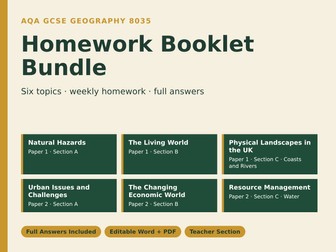
6 12-week homework booklets for AQA GCSE Geography 8035, bundled together: 60 weeks of structured, answer-ready homework covering five of the six content units across Papers 1 and 2. Each booklet is a finished, specification-mapped programme, so you can set a term of homework per topic without planning it. What is in the bundle The Challenge of Natural Hazards (Paper 1 Section A): tectonic hazards, weather hazards and climate change. Case studies: Nepal 2015, Chile 2010, Typhoon Haiyan, Somerset Levels 2013/14. The Living World (Paper 1 Section B): a UK pond, tropical rainforest and hot deserts. Case studies: the Amazon and the Thar Desert. UK Physical Landscapes (Paper 1 Section C): Uk landscapes, Coasts and Rivers. Case Studies: Jurassic Coast, Walton-on-the-Naze, River Tees, Jubilee Flood Relief Channel Urban Issues and Challenges (Paper 2 Section A): urban change worldwide, Rio de Janeiro, London, and sustainable urban living. The Changing Economic World (Paper 2 Section B): measuring development, the development gap, Jamaica, Nigeria and the UK economy. The Challenge of Resource Management, Water option (Paper 2 Section C): the compulsory overview and water resources. Case studies: China’s South–North Water Transfer Project and the Hitosa scheme in Ethiopia. How every booklet works: twelve weeks, each planned to take about 45 minutes in five short chunks: word work with retrieval from earlier weeks, a short reading, check questions, a “think deeper” task, and original exam-style practice. Support for the exam-practice question is withdrawn on purpose across each booklet: a full paragraph plan in the early weeks, the shape only in the middle weeks, and little or none at the end. Each booklet also has two short research tasks, each with a printed alternative so no internet is needed. Support and accessibility: support pages in every booklet (Tier 3 vocabulary with pronunciation, number bank, sentence starters and gap-fill versions of the hardest answers), a student tracker and a parents’ and carers’ page. The layout is dyslexia-friendly throughout: Verdana, 1.5 line spacing, left-aligned, no italics. Teacher material: every booklet includes a full answer section, success criteria for the extended questions, a specification map, a class tracking grid and a sources list. Each also has a table of commonly taught figures that are out of date or disputed, with what the evidence now says. Data in each booklet is dated and sourced; the booklets were checked in September–October 2026.
Changing Economic World: AQA GCSE Topic BundleQuick View
otreais

Changing Economic World: AQA GCSE Topic Bundle

3 Resources
The whole of AQA GCSE Geography’s The Changing Economic World (Paper 2 Section B) in one bundle: fourteen one-hour lessons, a 12-week homework booklet and a spaced retrieval pack. The three resources use the same key terms, case studies and figures, so what you teach in lessons comes back in homework and in starters, with spacing built in. What is in the bundle 14 lessons. Fourteen editable PowerPoints (236 slides in all) with twelve two-sided printable resource sheets, a six-page, 30-mark assessment paper (plus 3 SPaG marks) and fourteen sets of teacher notes. Each lesson has a Do Now with answers, tasks with stretch activities, a video slide (a YouTube link with watch-for questions), an original exam-style question with a student-friendly mark scheme, and an exit ticket. A 12-week homework booklet (about 108 pages). Each week has five short chunks of about 45 minutes in all: word work with retrieval from earlier weeks, a reading, check questions, a “think deeper” task and original exam practice with the support withdrawn across the term. Full answers and a teacher section are included. A spaced retrieval pack (about 40 pages). Twelve weekly do-now starters and two boosters with a mark scheme for every question. Starters revisit earlier content at one-, two- and five-week gaps. Topics and case studies: measuring development; the Demographic Transition Model and causes of uneven development; closing the development gap; Jamaica and tourism; Nigeria, including its changing economy and Shell in the Niger Delta; UK deindustrialisation and the post-industrial economy, including Cambridge Science Park; rural change in South Cambridgeshire and the Outer Hebrides, with Torr Works; UK infrastructure and the north–south divide; and the UK’s links with the wider world. How they fit together: lessons 1–12 follow the same topic order as homework weeks 1–12 and retrieval blocks 1–12. Lesson 13 teaches exam technique for 6- and 9-mark questions, and lesson 14 is a review with a printed assessment. A suggested order is: teach the lesson, set the matching homework week, then use the retrieval starters in the weeks that follow.
AQA GCSE Geography Retrieval Starters BundleQuick View
otreais

AQA GCSE Geography Retrieval Starters Bundle

6 Resources
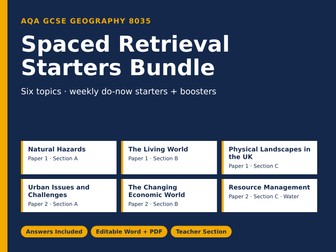
Six spaced retrieval packs for AQA GCSE Geography 8035, bundled together. Between them they cover every content unit in Paper 1 and Paper 2, with ready-made weekly “do now” starters, long-gap boosters and a mark scheme for every question. It gives you low-stakes retrieval practice for the whole course without writing a quiz each week or deciding what to revisit. What is in the bundle The Challenge of Natural Hazards (Paper 1 Section A) The Living World (Paper 1 Section B) Physical Landscapes in the UK, coasts and rivers (Paper 1 Section C) Urban Issues and Challenges (Paper 2 Section A) The Changing Economic World (Paper 2 Section B) The Challenge of Resource Management, Water option (Paper 2 Section C) How each pack works: twelve weekly starters, each on one side of A4, built around spacing. Section A tests last lesson’s content. Section B revisits the block from two weeks earlier, and Section C the block from five weeks earlier. Section D is a geographical skills or linked-unit question. Questions are 1 or 2 marks with ruled answer lines, and every sheet ends with a red/amber/green confidence box. Two boosters per pack (30-day and 90-day checks) ask one question from every block and suit the end of the unit and the revision period. The blocks in each pack follow a sensible teaching order, so you can run a pack alongside first teaching. Case studies covered include: Nepal and Chile earthquakes, Typhoon Haiyan and the Somerset Levels; a UK pond, the Amazon and the Thar Desert; Dorset, Walton-on-the-Naze, the River Tees and the Jubilee River; Rio de Janeiro and London; Jamaica, Nigeria and the UK economy; China’s South–North Water Transfer Project and the Hitosa scheme. Support and accessibility: in every pack, a Tier 3 vocabulary list with pronunciation, a number bank, sentence starters and gap-fill versions of the hardest answers, plus a student confidence tracker. The layout is dyslexia-friendly: Verdana, 1.5 line spacing, left-aligned, no italics. Teacher material: a full mark scheme, a specification map, a class tracking grid and a sources list in every pack, plus notes on terminology and a table of commonly taught figures that are out of date or disputed. Data was checked in September–October 2026, and the teacher sections flag items to re-check before reuse.
Changing Economic World: 14 AQA GCSE LessonsQuick View
otreais

Changing Economic World: 14 AQA GCSE Lessons

(0)
14 ready-to-teach one-hour lessons for AQA GCSE Geography’s The Changing Economic World (Paper 2, Section B): PowerPoints, printable resource sheets, teacher notes with answers, and a printed assessment paper. It is a complete teaching sequence, so you don’t have to build the topic lesson by lesson. Each lesson is planned to fit 60 minutes, and the teacher notes give a minute-by-minute outline. What a lesson looks like: a Do Now with answers, then three to six tasks, each with a stretch activity for higher-attaining students. Tasks vary from lesson to lesson. They include sorting and classifying, data and graph work, puzzles, matching, timeline ordering, odd-one-out, “take a stand” debates and a “Shell on trial” role task. Each lesson contains a video slide linking to a YouTube clip with a QR code and watch-for questions. Lessons 1–13 end with an original exam-style question, a student-friendly mark scheme for self- or peer-marking, and (in Lessons 1–12) a Level 3 model answer. An exit ticket with a red/amber/green check closes every lesson. The sequence: (1) measuring development; (2) the Demographic Transition Model and causes of uneven development; (3) consequences and strategies for closing the gap; (4) Jamaica: tourism; (5–8) Nigeria: why it matters, its changing economy, Shell in the Niger Delta, and Nigeria’s place in the world; (9) UK deindustrialisation and the post-industrial economy, including Cambridge Science Park; (10) Torr Works and rural change in South Cambridgeshire and the Outer Hebrides; (11) UK infrastructure and the north–south divide; (12) the UK’s links with the wider world; (13) exam technique for 6- and 9-mark questions; (14) topic review and a printed assessment. Resource sheets and paper: Lessons 1–12 each have a two-sided A4 sheet with the maps, graphs and data that students need on paper. Everything else is done in exercise books, so you only print what you must. Lesson 14 has a six-page, 30-mark paper in the style of a Paper 2 Section B (plus 3 SPaG marks), with a full mark scheme and an indicative grade guide in the teacher notes. Formats and design: editable PowerPoint and Word files, plus PDFs of the printable pieces. The files are set in Verdana, with bold rather than italics, to suit a wide range of readers. Maps and charts are original. Before you buy: the exam-style questions are original and are not taken from AQA papers. This pack is not endorsed by AQA. The lessons link to YouTube videos, so you need internet access and a school network that does not block YouTube. Please preview each clip before you teach it. The slides contain original maps, charts and icons, but no photographs. It does not include a homework booklet or a retrieval pack.
AQA GCSE Geography: Changing Economic World HomeworkQuick View
otreais

AQA GCSE Geography: Changing Economic World Homework

(0)
A complete 12-week homework pack for AQA GCSE Geography (8035) on The Changing Economic World (Paper 2, Section B). It gives Key Stage 4 Geography teachers a full term of print-ready, scaffolded homework with answers, so you do not have to write weekly tasks from scratch. How it works Each week has five short chunks, about 45 minutes in total, or roughly nine hours across the pack: Retrieval practice on earlier weeks. Word work. A short reading with questions. A data task with “Think deeper” and “Challenge” prompts. An original 6- or 9-mark exam-style question. Weeks 1 and 12 end with a research task instead. Each has a no-internet alternative, so no student is disadvantaged by home access. What it covers Weeks 1–3: Measuring development, why the development gap exists, and its consequences and the strategies used to reduce it. Week 4: Jamaica, using tourism to reduce the development gap, including Hurricane Melissa and leakage. Weeks 5–8: Nigeria as a country experiencing economic change, including its changing industry and Shell in Nigeria. It also covers trade, aid and quality of life. Weeks 9–12: The UK economy. This includes the shift from industry to services, Cambridge Science Park, Torr Quarry, South Cambridgeshire and the Outer Hebrides. It also covers transport and the north–south divide, and the UK’s place in the wider world. Differentiation and support Scaffolding is withdrawn over the pack. Weeks 2–5 give a full paragraph plan, Weeks 6–10 give the shape only, and Week 11 is unscaffolded. The Support Pages contain a vocabulary list with pronunciation (about 42 terms), a number bank, and eight sentence starters. They also hold fill-in-the-gap versions of the Week 4, 7 and 11 reading tasks. The pack is set in a dyslexia-friendly format: Verdana in the Word file, 1.5 line spacing, left-aligned text, and bold in place of italics. Before you buy The case studies are Jamaica, Nigeria, Shell and Torr Quarry. If your department teaches different case studies, the general development and UK weeks will still work, but the case-study weeks will not. Data is checked to September 2026. Some items are live and will date, and they are listed in the teacher section. All exam-style questions are original. None come from past papers. The pack contains no photographs, maps or logos. This resource is independent. It is not affiliated with or endorsed by AQA. The pack needs only a printer. The research tasks are the only ones that use the internet, and each has an offline alternative.
Changing Economic World GCSE Geography StartersQuick View
otreais

Changing Economic World GCSE Geography Starters

(0)
Twelve weekly spaced-retrieval starters and two long-gap boosters for AQA GCSE Geography Paper 2, “The Changing Economic World”. Written for GCSE teachers who want a ready-made, low-prep way to keep this content from fading, and who are tired of writing a new starter every week. Each starter fits on one side of A4 and takes about 5 to 10 minutes. Every sheet asks about last lesson, about two weeks ago, and about five weeks ago, plus one interleaved question from a different unit. Each block of content comes back at increasing intervals, so students keep retrieving it rather than re-reading it. Where a block is taught too late in the unit to be retrieved three times, the two boosters cover the gap, and the teacher section says so. What is included: Cover and a one-page “how this works” explanation for students 12 weekly starters, one side of A4 each 2 boosters, a 30-day check and a 90-day check Support pages: a Tier 3 vocabulary list with pronunciation, a number bank, sentence starters by question stem, and cloze versions of the hardest extended answers A RAG confidence tracker Full answers and mark guidance (7 pages) A teacher section (10 pages): print notes, live items, teaching sequence, retrieval schedule, coverage check, class tracking grid, specification mapping, a table of figures commonly given in textbooks that are now out of date or disputed, and a source list Content covered: Measuring development and the Demographic Transition Model Causes and consequences of uneven development, and strategies to reduce the gap Jamaica (tourism and the development gap) Nigeria as a lower-income country or newly emerging economy: location, industry, trade, aid, environment and quality of life Shell in Nigeria (the role of a TNC) UK economic change and the post-industrial economy, including Cambridge Science Park Torr Quarry and changing rural areas, including the Outer Hebrides UK infrastructure and the north–south divide The UK’s place in the wider world Differentiation and skills: questions run from recall to application, interpretation and short extended answers. Support pages are built in for every student and are not a separate version. The teacher section shows how to credit an answer for its idea rather than its exact wording. Please note: All questions are original. The pack contains no photographs or maps, and uses no copyrighted exam questions. Statistics were checked against World Bank, ONS, ILO, NBS, WTTC and other published sources and were current at 30 September 2026. Some are news-reported figures, and the source table says which. Figures and “live items” such as recent events will date, and the teacher section tells you which to refresh. It is designed to print on plain A4, black and white. No special equipment is needed. It supports your teaching and does not replace it. It does not include a lesson sequence or teaching slides.
Resource Management Water: AQA GCSE HomeworkQuick View
otreais

Resource Management Water: AQA GCSE Homework

(0)
A 12-week GCSE Geography homework booklet for AQA’s The Challenge of Resource Management with the Water option. Every week is planned: five short chunks of about 45 minutes in total, real dated data, original exam-style practice and full answers. It gives you a term of purposeful, specification-mapped homework without the planning. Weeks 1–4 cover the compulsory 3.2.3.1 overview: why food, water and energy matter, global inequalities, and UK food, water and energy. Weeks 5–12 cover 3.2.3.3 Water: global surplus and deficit, reasons for rising demand, factors affecting availability, impacts of water insecurity, strategies to increase supply, and a sustainable water future. A specification map shows which week covers each content bullet. Please note that the Food and Energy options (3.2.3.2 and 3.2.3.4) are not covered. Case studies: China’s South–North Water Transfer Project (the large-scale transfer scheme). Two weeks cover why it was built, how the three routes work, and its advantages and disadvantages. The Hitosa gravity-fed scheme, Ethiopia (the local scheme in an LIC). Supporting examples include Cape Town, the Aral Sea, Chennai, the Nile (GERD), the Indus, Singapore NEWater, Israel’s desalination, and UK transfers and reservoirs. Each week has five chunks: Word work (5 min): key vocabulary. From week 3 it adds two from-memory questions on earlier weeks. Read it (5 min): a short information box. Check it (10 min): short questions answered from the reading. Think deeper (10 min): a question that asks students to weigh things up. Exam practice (15 min): eight original 6-mark questions across the booklet, plus a data-skills set. Weeks 2 and 11 are short research tasks instead. Scaffolding and challenge: Exam-practice support is withdrawn on purpose: a full paragraph plan in weeks 1–5, the shape only in weeks 6–10, and an unscaffolded question in week 12. The support pages include a 48-word Tier 3 vocabulary list with pronunciation, a number bank, sentence starters by AQA command word, and gap-fill versions of the three hardest answers. The layout is dyslexia-friendly throughout: Verdana, 1.5 line spacing, left-aligned text and no italics. Answers and teacher material: Answers for every question. Indicative content and levels-based success criteria for each 6-mark question. Answers to the gap-fills. A specification map. A class tracking grid. A student homework tracker and confidence (RAG) tracker. A parents’ and carers’ page. Teacher notes on terminology and on figures to re-check before reuse. A full sources list.
Resource Management Water: AQA GCSE StartersQuick View
otreais

Resource Management Water: AQA GCSE Starters

(0)
A spaced retrieval pack for AQA GCSE Geography’s The Challenge of Resource Management (Water option): twelve weekly “do now” starters and two long-gap boosters, each with a full mark scheme. It gives you ready-made, low-stakes retrieval practice for the whole unit, so you don’t have to write a quiz every week or decide what to revisit. How it works: each starter is one side of A4. Section A asks about last lesson’s content; Section B revisits the block from two weeks earlier; Section C the block from five weeks earlier (from Starter 6); Section D links to a different unit, such as natural hazards, rivers or urban issues. Questions are 1 or 2 marks with one ruled answer line, and every sheet ends with a red/amber/green box. Starters 1–5 are short, while the early blocks are still building. From Starter 6 a starter takes about 8–10 minutes. The two boosters (a 30-day and a 90-day check) ask one question from every block and suit the end of the unit and the revision period. The 12 blocks: resources and global inequality; UK food; UK water; UK energy; global surplus, deficit and rising demand; factors affecting availability; impacts of water insecurity; strategies to increase supply; the South–North Water Transfer Project (why and how); SNWTP advantages and disadvantages; a sustainable water future; the Hitosa scheme. Case studies: China’s South–North Water Transfer Project (large-scale transfer) and the Hitosa gravity-fed scheme, Ethiopia (local scheme in an LIC). Supporting examples include Cape Town, the Aral Sea, the Nile (GERD), Singapore NEWater, Windhoek, Israeli desalination, Kielder and other UK reservoirs and transfers. Support and accessibility: a 38-word Tier 3 vocabulary list with pronunciation, a number bank, sentence starters by question type, and gap-fill versions of three hard answers. The Word file is set in Verdana at 1.5 line spacing, left-aligned, with no italics. Teacher material: a mark scheme for every starter and booster; a specification map; a class tracking grid; a student confidence tracker; sources; and notes on terminology (LIC and NEE as AQA uses them). Before you buy: this is a retrieval resource. It tests recall and short explanations, but doesn’t teach content, and has no 6-mark questions or slides. The questions are original and are not taken from AQA papers. Prints on A4, black and white; cream or pastel paper is recommended. No internet or equipment needed.
Coasts and Rivers Homework – AQA GCSE GeographyQuick View
otreais

Coasts and Rivers Homework – AQA GCSE Geography

(0)
A 12-week GCSE Geography homework booklet for AQA 8035 Physical Landscapes in the UK, covering coasts and rivers. It gives a class a full term of structured homework that follows first teaching of the unit, so you do not have to write, source and mark a new task every week. Key stage and year group: GCSE (KS4). It is written for Year 10 alongside first teaching, and also works as Year 11 revision homework. Exam board and specification: AQA GCSE Geography (8035), Paper 1, Section C: Physical landscapes in the UK. It covers UK physical landscapes including the Coastal landscapes and River landscapes options. Glacial landscapes are not included. A mapping table links every specification bullet to the week that teaches it. Case studies: Dorset and the Jurassic Coast — the UK coastline example. Walton-on-the-Naze — the coastal management scheme, updated to include the November 2025 works. The River Tees — the river valley example. The Jubilee River — the flood management scheme, including the disputed downstream claims, presented fairly. Smaller examples include Spurn, Slapton Sands, Medmerry, Pickering and the River Quaggy. The document contains: the student booklet; support pages; a teacher booklet with full answers with success criteria How it works: Each week takes about 45 minutes, in five short chunks. Across the unit that is about nine hours of student work. Exam practice: Ten original exam-style questions at AQA Section C tariffs: five 4-mark and five 6-mark. Each has a levelled mark scheme with indicative content. Scaffolding is withdrawn over the term: a full paragraph plan in Weeks 2–5, the shape of an answer in Weeks 6–10, and no plan in Week 12. Weeks 1 and 11 are research tasks, each with a printed no-internet alternative. The Week 11 task uses the school’s postcode, never a home address. Support and challenge: 45 Tier 3 words with a pronunciation column. A number bank of every figure in the booklet. Sentence starters organised by command word. Gap-fill versions of the four hardest answers. A support box on the data and exam tasks, plus Challenge and Think Deeper tasks. A dyslexia-friendly layout: Verdana, 1.5 line spacing, left-aligned, no italics. Skills practised: recall and definition; describing and explaining physical processes; using named, located case-study evidence; interpreting data, including real river-flow and coastal-monitoring figures; drawing sequence diagrams and a storm hydrograph; calculation; extended evaluative writing. Please note: this resource is independent and is not produced or endorsed by AQA. It contains no maps or photographs, so pair Week 1 with your own outline map if you want a labelling task.
AQA GCSE Natural Hazards Retrieval StartersQuick View
otreais

AQA GCSE Natural Hazards Retrieval Starters

(0)
A spaced retrieval pack for AQA GCSE Geography (8035) Paper 1, Section A: The Challenge of Natural Hazards. Twelve weekly do-now starters and two long-interval boosters help Year 10 and 11 students keep recalling the case-study detail that fades between lessons: Nepal 2015, Chile 2010, Typhoon Haiyan 2013 and the Somerset Levels 2013/14. Answers, support pages and a teacher pack are included. HOW IT WORKS Each starter is a single side of A4 of short-answer questions from different points in the past. Section A covers last lesson, Section B two weeks ago and, from Starter 6, Section C five weeks ago. From Starter 3, Section D links to other parts of the AQA course (for example development, urbanisation, hot deserts, rivers and coasts). Two boosters, a 30-day check and a 90-day check, ask one question from every block. Questions test recall, definition, description, short explanation and use of figures, and are worth one or two marks. TOPICS (12 blocks) 1 Natural hazards and hazard risk; 2 Plate tectonics and plate margins; 3 Nepal 2015: the event and primary effects; 4 Nepal 2015: secondary effects and responses; 5 Chile 2010: the event and its effects; 6 Chile 2010: responses, and comparing the two; 7 Living with tectonic hazards and reducing risk; 8 Global atmospheric circulation and storm formation; 9 Tropical storms: structure, distribution and climate change; 10 Typhoon Haiyan 2013; 11 UK extreme weather and the Somerset Levels; 12 Climate change: evidence, causes and management WHAT YOU GET Student Pack: 12 starters, 2 boosters, 106 questions worth 203 marks, support pages, a confidence tracker and answers at the back. Teacher Pack (Word and PDF, about 8 pages): the teaching sequence the starters assume, retrieval schedule, coverage check, printable class tracking grid, AQA 3.1.1 specification mapping, a table of commonly taught figures that have been corrected, and the sources used. SUPPORT AND DIFFERENTIATION Support pages are for every student: a Tier 3 vocabulary bank (37 key terms), a number bank of case-study figures, sentence starters by command word, and gap-fill versions of five of the hardest answers. Students colour a red, amber or green box after each section, so the tracker shows what to reteach. The layout follows dyslexia-friendly principles: Verdana, 1.5 line spacing, left-aligned text, no italics. USING IT Use a starter as a do-now (later ones take about eight to ten minutes), mark in green pen from the answers, then colour the tracker. Use the boosters about four weeks after the unit and again in the revision period. Also suitable for homework, cover or intervention.
UK Coasts and Rivers Retrieval Pack – GCSE GeographyQuick View
otreais

UK Coasts and Rivers Retrieval Pack – GCSE Geography

(0)
A spaced retrieval pack for AQA GCSE Geography (8035) Paper 1, Section C: Physical Landscapes in the UK, covering coasts and rivers. Twelve weekly do-now starters and two long-interval boosters help Year 10 and 11 students keep recalling the landforms, processes and case-study detail that fade between lessons: the Dorset coast, Walton-on-the-Naze, the River Tees and the Jubilee River. Answers, support pages and a teacher pack are included. HOW IT WORKS Each starter is a single side of A4 of short-answer questions from different points in the past. Section A covers last lesson, Section B two weeks ago and, from Starter 6, Section C five weeks ago. From Starter 3, Section D revisits the Urban Issues and Challenges unit (Paper 2: Rio de Janeiro and London). Two boosters, a 30-day check and a 90-day check, ask one question from every block. Questions test recall, definition, description, explanation of how landforms form and use of figures. They are worth one, two or three marks (20 are three-mark explain questions). TOPICS (12 blocks) 1 UK physical landscapes: uplands, lowlands and rivers; 2 Waves, weathering, mass movement and coastal processes; 3 Coastal landforms of erosion; 4 Coastal landforms of deposition; 5 The Dorset coast; 6 Coastal management and Walton-on-the-Naze; 7 River processes, long profile and cross profile; 8 River landforms of erosion; 9 Meanders, ox-bow lakes and depositional landforms; 10 The River Tees; 11 Flood risk and hydrographs; 12 River management and the Jubilee River WHAT YOU GET Student Pack: 12 starters, 2 boosters, 106 questions worth 193 marks, support pages, a confidence tracker and answers at the back. Teacher Pack (Word and PDF, about 9 pages): the teaching sequence the starters assume, retrieval schedule, coverage check, printable class tracking grid, AQA 3.1.3 specification mapping, a table of commonly taught figures that have been corrected, and the sources used SUPPORT AND DIFFERENTIATION Support pages are for every student: a Tier 3 vocabulary bank (42 key terms, with pronunciation guides for the harder ones), a number bank of case-study figures, sentence starters by command word, and gap-fill versions of four of the hardest answers (Lulworth Cove, the Naze cliffs, High Force and the Jubilee River debate). Students colour a red, amber or green box after each section, so the tracker shows what to reteach. The layout follows dyslexia-friendly principles: Verdana, 1.5 line spacing, left-aligned text, no italics. USING IT Use a starter as a do-now (later ones take about eight to ten minutes), mark in green pen from the answers, then colour the tracker. Use the boosters about four weeks after the unit and again in the revision period. Also suitable for homework, cover or intervention.
AQA GCSE Urban Issues Retrieval StartersQuick View
otreais

AQA GCSE Urban Issues Retrieval Starters

(0)
A spaced retrieval pack for AQA GCSE Geography (8035) Paper 2, Section A: Urban Issues and Challenges. Twelve weekly do-now starters and two long-interval boosters help Year 10 and 11 students keep recalling the case-study detail that fades between lessons, for Rio de Janeiro (the NEE city) and London (the UK city), including the Stratford regeneration. Answers, support pages and a teacher pack are included. HOW IT WORKS Each starter is a single side of A4 of short-answer questions from different points in the past. Section A covers last lesson, Section B two weeks ago and, from Starter 6, Section C five weeks ago. From Starter 3, Section D links to other parts of the AQA course (for example development, water, transnational corporations, the UK economy and climate change). Two boosters, a 30-day check and a 90-day check, ask one question from every block. Questions test recall, definition, description, short explanation and use of figures, and are worth one or two marks. TOPICS (12 blocks) 1 Urbanisation: the global picture; 2 Megacities and urban trends; 3 Rio: location and importance; 4 Rio: why the city grew; 5 Rio: social opportunities and challenges; 6 Rio: economic and environmental challenges; 7 Rio: planning for the urban poor; 8 London: location, importance and migration; 9 London: opportunities; 10 London: challenges; 11 London: regeneration at Stratford; 12 Sustainable urban living and transport WHAT YOU GET Student Pack: 12 starters, 2 boosters, 106 questions worth 172 marks, support pages, a confidence tracker and answers at the back Teacher Pack: the teaching sequence the starters assume, retrieval schedule, coverage check, printable class tracking grid, AQA 3.2.1 specification mapping, a table of commonly taught figures that have been updated, and the sources used. SUPPORT AND DIFFERENTIATION Support pages are for every student: a Tier 3 vocabulary bank (28 key terms), a number bank of Rio and London figures, sentence starters by command word, and gap-fill versions of five of the hardest answers (Rio’s population change, the Guanabara Bay sewage promise, the Alemão cable car, London’s poverty rate and the Olympic Park debate). Students colour a red, amber or green box after each section, so the tracker shows what to reteach. The layout follows dyslexia-friendly principles: Verdana, 1.5 line spacing, left-aligned text, no italics. USING IT Use a starter as a do-now (later ones take about eight to ten minutes), mark in green pen from the answers, then colour the tracker. Use the boosters about four weeks after the unit and again in the revision period. Also suitable for homework, cover or intervention.
Natural Hazards Homework BookletQuick View
otreais

Natural Hazards Homework Booklet

(0)
A Complete, Homework-Ready 12-Week Pack Covering AQA GCSE Geography 8035, Paper 1 Section A: The Challenge of Natural Hazards Built for teachers who want homework that actually reinforces what’s being taught in lessons, not generic worksheets. All case studies are named, dated and sourced: Nepal earthquake, 2015 — a lower-income country at the time Chile earthquake, 2010 — a high-income country Typhoon Haiyan, 2013 Somerset Levels floods, 2013/14 Every week includes: Support routes Word banks Sentence starters organised by question stem Cloze/gap-fill versions of the hardest tasks Stand-alone challenge tasks “Think deeper” extension tasks Scaffolding for the extended exam-style question is deliberately withdrawn across the twelve weeks: Early weeks: full written plans Middle weeks: a bare structure Final week: an unscaffolded question This means the pack can be used with a class from early in Year 10 through to more independent GCSE work. The pack assesses: Definition and recall of key terms Description and explanation of physical processes Use of named examples and located case-study evidence Comparison of case studies Interpretation and use of data Extended, mark-scheme-style writing Short independent research tasks Each research task includes a no-internet alternative. The pack includes a a print-ready PDF student booklet and Teacher Answer Pack.
Urban Issues Homework Booklet (Rio & London)Quick View
otreais

Urban Issues Homework Booklet (Rio & London)

(0)
This homework booklet covers the whole of Urban Issues and Challenges in twelve structured weeks, built around two fully worked city case studies — Rio de Janeiro (an NEE city) and London (a UK city) — with every figure sourced, dated, and independently fact-checked before publication. Written for Year 10 to be set alongside the first teaching of the topic (it works equally well as a pre-reading pack if you teach the case studies before setting the homework, or as a structured revision resource in Year 11). What’s Covered Urban growth, megacities, and the causes of urbanisation worldwide; Rio de Janeiro as an NEE case study (location and importance, causes of growth, opportunities, challenges, and urban planning through Favela-Bairro); the UK’s population and the pull of London; London as a case study (migration and the changing character of the city, opportunities and challenges, and regeneration through the Olympic Park/Stratford); and sustainable urban living and transport, including BedZED. Structure Each of the twelve weeks follows the same five-step rhythm (about 45 minutes total): a short vocabulary task, a chunked information box to read twice, short “check it” comprehension questions, one “think deeper” extended-response task, and a timed exam-style question (weeks 1 and 12 substitute a research task, with a fully creditable printed alternative for students without internet access). This consistency means pupils and parents know exactly what a week involves after the first one, and you never have to explain the format twice. Differentiation and Scaffolding The exam-question scaffolding is deliberately withdrawn as the twelve weeks progress — full paragraph plans in weeks 2–5, the shape of the answer only in weeks 6–10, no scaffold at all by week 11 — so the same booklet stretches from first attempt to independent exam technique without you having to write a second version. Answer space matches question demand throughout (extended lines for extended answers), and two-mark “explain” questions are deliberately given more space than two-mark “state” questions. Retrieval and Independent Practice A self-assessment RAG tracker lets pupils rate their own confidence topic by topic across the whole 12 weeks, a support section at the back holds a 28-term glossary (with a pronunciation column), a 24-entry number bank of the key statistics, and four gap-fill passages for lower-stress recall practice, plus a bank of sentence starters for the extended-writing questions. Skills Assessed Knowledge recall, data interpretation (including a real, sourced statistics table), extended writing and evaluation, and exam technique under timed conditions. This includes a print ready PDF student booklet and Teacher answer pack.
Changing Economic World: Measuring Development (Lesson 1)Quick View
otreais

Changing Economic World: Measuring Development (Lesson 1)

(0)
A free, complete one-hour lesson for AQA GCSE Geography’s The Changing Economic World (Paper 2, Section B): how do we measure development, and what do those measures hide? It is Lesson 1 of a 14-lesson sequence, and it works as a stand-alone lesson. Try it with a class before deciding whether to use the rest. The big question: is a richer country always a more developed one? Students answer it with data. They compare the UK, Jamaica, India, Nigeria and Malawi using World Bank and UNDP figures, and finish by writing an exam-style answer. What is in the lesson: A 22-slide PowerPoint with a Do Now (and answers), think–pair–share, HIC / NEE / LIC classification, and a sorting task on the nine measures in the specification. Definitions of GNI per head and HDI, then worked examples of the calculations students need: mean, “how many times as large” and range. A data task using a table and a chart, a puzzle on why Malawi’s death rate is lower than the UK’s, a matching task on the limitations of measures, and a map task on the “North–South” divide. A stretch activity with every task, for higher-attaining students. Two original exam-style questions (01.1 [2] and 01.2 [4]) with a writing frame, a student-friendly mark scheme, a model answer with a checklist, and an exit ticket with a red/amber/green check. A video slide linking to a short YouTube clip (Hans Rosling’s “200 Countries, 200 Years, 4 Minutes”), with a QR code and three watch-for questions. A two-sided printable resource sheet (Word and PDF). Students work in exercise books, so this is the only printing. Teacher notes: a minute-by-minute plan for 60 minutes, answers to every task and stretch, the mark scheme, a specification map, common misconceptions, and a table of commonly taught figures that are now out of date. Want the rest? Lessons 2–14 cover the DTM, closing the gap, Jamaica, Nigeria, the UK economy, exam technique and an end-of-topic assessment: Changing Economic World: 14 AQA GCSE Lessons.
The Living World: The UK Pond EcosystemQuick View
otreais

The Living World: The UK Pond Ecosystem

(0)
A free, complete one-hour lesson for AQA GCSE Geography’s The Living World (Paper 1, Section B): how does a pond work as a system? It is Lesson 1 of a 14-lesson sequence, and it works as a stand-alone lesson. Try it with a class before deciding whether to use the rest. The big question: how does a pond work as a system? Students sort a pond’s parts into living and non-living, name the roles of producers, consumers, decomposers and detritivores, trace energy through a food web, and explain how nutrients are cycled, using named pond species such as algae, water fleas, three-spined sticklebacks and grey herons. What is in the lesson: A 24-slide PowerPoint with a Do Now (and answers), a think–pair–share, and short “Learn it” teaching slides built around original diagrams, so the explanation sits between the tasks. Four tasks: sort 12 cards into biotic and abiotic; read a pond food web and build food chains; a fact-or-fiction task that tackles common misconceptions (for example, which organisms are decomposers); and a nutrient-cycle diagram task. A stretch activity with every task, for higher-attaining students, with its answer. Two original exam-style questions (01.1 [1 mark], 01.2 [4 marks]) with a writing frame, a student-friendly mark scheme for peer marking, a model answer, and an exit ticket with a red/amber/green check. A video slide linking to a short YouTube clip (tutor2u, “Small-scale Ecosystems”), with a QR code and watch-for questions. A two-sided printable resource sheet (Word and PDF). Students work in exercise books, so this is the only printing. Teacher notes: a minute-by-minute plan for 60 minutes, answers to every task and stretch, the mark scheme, a specification map, common misconceptions and sources. Want the rest? Lessons 2–14 cover balance, change and biomes, the Amazon rainforest, the Thar Desert, exam technique and an end-of-topic assessment: The Living World: 14 AQA GCSE Geography Lessons