


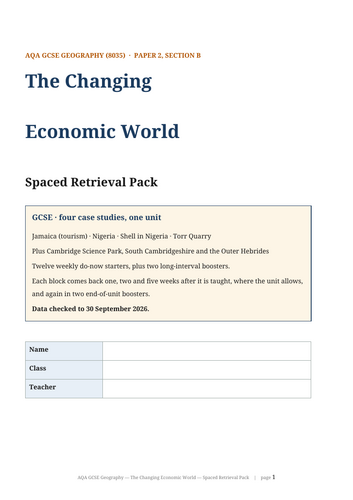
Twelve weekly spaced-retrieval starters and two long-gap boosters for AQA GCSE Geography Paper 2, “The Changing Economic World”. Written for GCSE teachers who want a ready-made, low-prep way to keep this content from fading, and who are tired of writing a new starter every week.
Each starter fits on one side of A4 and takes about 5 to 10 minutes. Every sheet asks about last lesson, about two weeks ago, and about five weeks ago, plus one interleaved question from a different unit. Each block of content comes back at increasing intervals, so students keep retrieving it rather than re-reading it. Where a block is taught too late in the unit to be retrieved three times, the two boosters cover the gap, and the teacher section says so.
What is included:
- Cover and a one-page “how this works” explanation for students
- 12 weekly starters, one side of A4 each
- 2 boosters, a 30-day check and a 90-day check
- Support pages: a Tier 3 vocabulary list with pronunciation, a number bank, sentence starters by question stem, and cloze versions of the hardest extended answers
- A RAG confidence tracker
- Full answers and mark guidance (7 pages)
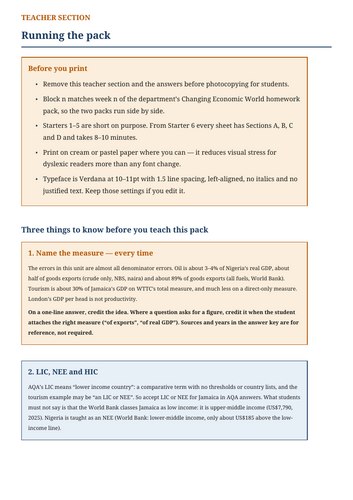
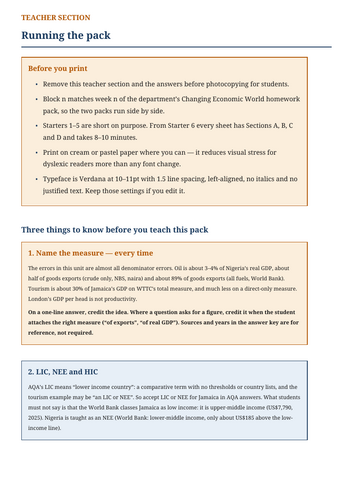
- A teacher section (10 pages): print notes, live items, teaching sequence, retrieval schedule, coverage check, class tracking grid, specification mapping, a table of figures commonly given in textbooks that are now out of date or disputed, and a source list
Content covered:
- Measuring development and the Demographic Transition Model
- Causes and consequences of uneven development, and strategies to reduce the gap
- Jamaica (tourism and the development gap)
- Nigeria as a lower-income country or newly emerging economy: location, industry, trade, aid, environment and quality of life
- Shell in Nigeria (the role of a TNC)
- UK economic change and the post-industrial economy, including Cambridge Science Park
- Torr Quarry and changing rural areas, including the Outer Hebrides
- UK infrastructure and the north–south divide
- The UK’s place in the wider world
Differentiation and skills: questions run from recall to application, interpretation and short extended answers. Support pages are built in for every student and are not a separate version. The teacher section shows how to credit an answer for its idea rather than its exact wording.
Please note:
- All questions are original. The pack contains no photographs or maps, and uses no copyrighted exam questions.
- Statistics were checked against World Bank, ONS, ILO, NBS, WTTC and other published sources and were current at 30 September 2026. Some are news-reported figures, and the source table says which. Figures and “live items” such as recent events will date, and the teacher section tells you which to refresh.
- It is designed to print on plain A4, black and white. No special equipment is needed.
- It supports your teaching and does not replace it. It does not include a lesson sequence or teaching slides.
Get this resource as part of a bundle and save up to 17%
A bundle is a package of resources grouped together to teach a particular topic, or a series of lessons, in one place.
Bundle
AQA GCSE Geography Paper 1 + 2 Topic Bundle
Everything you need to teach AQA GCSE Geography Papers 1 and 2 in one bundle: 96 one-hour lessons, six 12-week homework booklets and six spaced retrieval packs. It covers all six topics taught in this series: Paper 1 (Living with the physical environment) Natural Hazards, The Living World and Physical Landscapes in the UK; Paper 2 (Challenges in the human environment) Urban Issues and Challenges, The Changing Economic World and Resource Management. **How the parts fit together:** each unit has three pieces. The lessons teach it. The homework booklet sets about 45 minutes a week of independent practice, with help withdrawn across the term. The retrieval pack gives a weekly do-now that brings earlier blocks back, then two long-interval boosters. A table in each unit's START-HERE guide shows how lessons, homework weeks and retrieval blocks line up. [Do not add "block n follows week n" until blocking item 2 is settled.] **The lessons (96):** editable PowerPoints with timings in the notes, a video slide (linked, not embedded), original exam-style questions with mark schemes and example answers, teacher notes with answers and a specification map, printable resource sheets (Natural Hazards 6, Living World 6, Physical Landscapes 7, Urban 8, Changing Economic World 12, Water 11) and a printed assessment paper per unit. Every unit ends with an exam-technique lesson and a review lesson. Natural Hazards, Physical Landscapes, Urban and Water follow the structure (starter quiz, three learning cycles with checks and practice, exit quiz). The Living World and Changing Economic World lessons use a shorter format (do now, learn-it slides, tasks with stretch, exit ticket). **The homework booklets (6 x 12 weeks)**: about 45 minutes a week in five short chunks: retrieval and word work, a dated reading, check questions, a "think deeper" task and exam-style practice. Support pages, trackers, full answers and a teacher section. **The retrieval packs (6 x 12 starters + 2 boosters)**: weekly do-nows, early ones short, later ones eight to ten minutes, with answers and class tracking. Later starters interleave questions from other units on purpose. **Please note:** * Not included: the cold environments option, glacial landscapes, the food and energy options in Section C, and Paper 3. Living World covers hot deserts; Physical Landscapes covers coasts and rivers; Resource Management covers water. * Lesson videos link to YouTube and a few other sites; please preview each before teaching. * Maps and charts are original. * Exam-style questions are original, not taken from AQA papers. Not endorsed by AQA. * Each part is also sold separately.
£60.00
Bundle
AQA GCSE Geography Paper 2: Complete Topic Bundle
Everything you need to teach AQA GCSE Geography Paper 2 (Challenges in the human environment) in one bundle: 47 one-hour lessons, three 12-week homework booklets and three spaced retrieval packs, covering Urban Issues and Challenges (Section A), The Changing Economic World (Section B) and The Challenge of Resource Management, water option (Section C). **How the parts fit together:** each unit has the same three pieces. The lessons teach it. The homework booklet sets about 45 minutes a week of independent practice, with the help withdrawn as the unit goes on. The retrieval pack gives a weekly do-now that brings each block back one, two and five weeks later, then two long-interval boosters. In every unit, retrieval block n is written to follow homework week n, and the lessons' title and exit slides name the homework week. A table in the bundle shows which lesson goes with which week and block. **Section A: Urban Issues and Challenges (18 lessons)**. Rio de Janeiro (NEE), with Favela-Bairro, and London (HIC), with the Queen Elizabeth Olympic Park; sustainable urban living and transport. 8 printable resource sheets, an exam-technique lesson, and a printed 30 + 3 SPaG Section A-style assessment with mark scheme. **Section B: The Changing Economic World (14 lessons)**. Measuring development, the development gap, Jamaica (tourism), Nigeria and Shell, the UK economy (including Torr Quarry, the north–south divide and the UK in the wider world), with rural change in South Cambridgeshire and the Outer Hebrides. 12 printable resource sheets, an exam-skills lesson, and a printed 30-mark assessment paper. **Section C: Resource Management, water option (15 lessons)**. The overview (food, water and energy; UK food, water and energy), global water supply and demand, factors affecting availability, impacts and strategies, the South–North Water Transfer Project (China) and Hitosa (Ethiopia). 11 printable resource sheets, a Section C technique lesson, and a printed 25-mark Section C paper. **Every lesson:** an editable PowerPoint with timings in the notes, a video slide (linked, not embedded), original exam-style questions with a mark scheme, and teacher notes with answers and a specification map. **The homework booklets (3 x 12 weeks)**: five chunks a week (5/5/10/10/15 minutes): retrieval and word work, a dated reading box, check questions, a Think Deeper task and an exam-style question. Weeks with a research task have a printed no-internet alternative. Support pages give Tier 3 vocabulary with pronunciation, a number bank, sentence starters and cloze versions of the hardest answers. Each booklet has a parent page, a confidence tracker and a removable teacher section with answers, level descriptors and a specification map. **The retrieval packs (3 x 12 starters + 2 boosters):** one starter per week for a do-now (short at first, then 8–10 minutes), with answers, a class tracking grid, vocabulary, a number bank and a specification map. Later starters include a section that interleaves a question from another unit; this is deliberate.
£30.00
Bundle
Changing Economic World: AQA GCSE Topic Bundle
The whole of AQA GCSE Geography's The Changing Economic World (Paper 2 Section B) in one bundle: fourteen one-hour lessons, a 12-week homework booklet and a spaced retrieval pack. The three resources use the same key terms, case studies and figures, so what you teach in lessons comes back in homework and in starters, with spacing built in. **What is in the bundle** * 14 lessons. Fourteen editable PowerPoints (236 slides in all) with twelve two-sided printable resource sheets, a six-page, 30-mark assessment paper (plus 3 SPaG marks) and fourteen sets of teacher notes. Each lesson has a Do Now with answers, tasks with stretch activities, a video slide (a YouTube link with watch-for questions), an original exam-style question with a student-friendly mark scheme, and an exit ticket. * A 12-week homework booklet (about 108 pages). Each week has five short chunks of about 45 minutes in all: word work with retrieval from earlier weeks, a reading, check questions, a "think deeper" task and original exam practice with the support withdrawn across the term. Full answers and a teacher section are included. * A spaced retrieval pack (about 40 pages). Twelve weekly do-now starters and two boosters with a mark scheme for every question. Starters revisit earlier content at one-, two- and five-week gaps. **Topics and case studies:** measuring development; the Demographic Transition Model and causes of uneven development; closing the development gap; Jamaica and tourism; Nigeria, including its changing economy and Shell in the Niger Delta; UK deindustrialisation and the post-industrial economy, including Cambridge Science Park; rural change in South Cambridgeshire and the Outer Hebrides, with Torr Works; UK infrastructure and the north–south divide; and the UK's links with the wider world. **How they fit together:** lessons 1–12 follow the same topic order as homework weeks 1–12 and retrieval blocks 1–12. Lesson 13 teaches exam technique for 6- and 9-mark questions, and lesson 14 is a review with a printed assessment. A suggested order is: teach the lesson, set the matching homework week, then use the retrieval starters in the weeks that follow.
£10.00
Bundle
AQA GCSE Geography Retrieval Starters Bundle
Six spaced retrieval packs for AQA GCSE Geography 8035, bundled together. Between them they cover every content unit in Paper 1 and Paper 2, with ready-made weekly "do now" starters, long-gap boosters and a mark scheme for every question. It gives you low-stakes retrieval practice for the whole course without writing a quiz each week or deciding what to revisit. **What is in the bundle** * The Challenge of Natural Hazards (Paper 1 Section A) * The Living World (Paper 1 Section B) * Physical Landscapes in the UK, coasts and rivers (Paper 1 Section C) * Urban Issues and Challenges (Paper 2 Section A) * The Changing Economic World (Paper 2 Section B) * The Challenge of Resource Management, Water option (Paper 2 Section C) * **How each pack works:** twelve weekly starters, each on one side of A4, built around spacing. Section A tests last lesson's content. Section B revisits the block from two weeks earlier, and Section C the block from five weeks earlier. Section D is a geographical skills or linked-unit question. Questions are 1 or 2 marks with ruled answer lines, and every sheet ends with a red/amber/green confidence box. Two boosters per pack (30-day and 90-day checks) ask one question from every block and suit the end of the unit and the revision period. The blocks in each pack follow a sensible teaching order, so you can run a pack alongside first teaching. **Case studies covered include:** Nepal and Chile earthquakes, Typhoon Haiyan and the Somerset Levels; a UK pond, the Amazon and the Thar Desert; Dorset, Walton-on-the-Naze, the River Tees and the Jubilee River; Rio de Janeiro and London; Jamaica, Nigeria and the UK economy; China's South–North Water Transfer Project and the Hitosa scheme. **Support and accessibility:** in every pack, a Tier 3 vocabulary list with pronunciation, a number bank, sentence starters and gap-fill versions of the hardest answers, plus a student confidence tracker. The layout is dyslexia-friendly: Verdana, 1.5 line spacing, left-aligned, no italics. **Teacher material**: a full mark scheme, a specification map, a class tracking grid and a sources list in every pack, plus notes on terminology and a table of commonly taught figures that are out of date or disputed. Data was checked in September–October 2026, and the teacher sections flag items to re-check before reuse.
£10.00
Something went wrong, please try again later.
This resource hasn't been reviewed yet
To ensure quality for our reviews, only customers who have purchased this resource can review it
Report this resourceto let us know if it violates our terms and conditions.
Our customer service team will review your report and will be in touch.
£2.00