


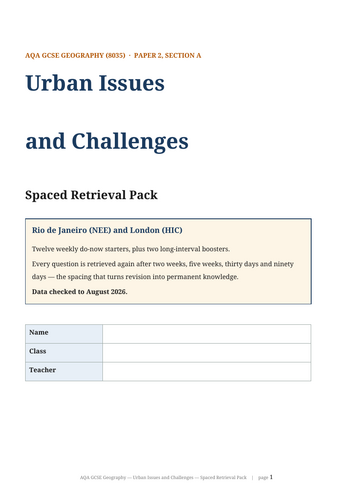
A spaced retrieval pack for AQA GCSE Geography (8035) Paper 2, Section A: Urban Issues and Challenges. Twelve weekly do-now starters and two long-interval boosters help Year 10 and 11 students keep recalling the case-study detail that fades between lessons, for Rio de Janeiro (the NEE city) and London (the UK city), including the Stratford regeneration. Answers, support pages and a teacher pack are included.
HOW IT WORKS
Each starter is a single side of A4 of short-answer questions from different points in the past. Section A covers last lesson, Section B two weeks ago and, from Starter 6, Section C five weeks ago. From Starter 3, Section D links to other parts of the AQA course (for example development, water, transnational corporations, the UK economy and climate change). Two boosters, a 30-day check and a 90-day check, ask one question from every block. Questions test recall, definition, description, short explanation and use of figures, and are worth one or two marks.
TOPICS
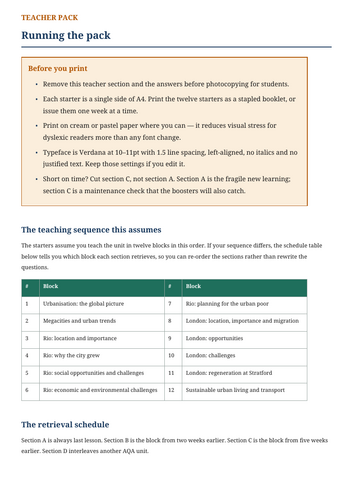
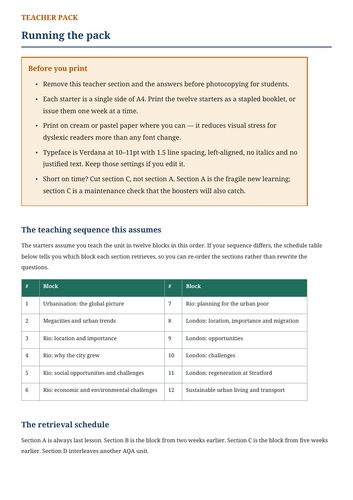
(12 blocks) 1 Urbanisation: the global picture; 2 Megacities and urban trends; 3 Rio: location and importance; 4 Rio: why the city grew; 5 Rio: social opportunities and challenges; 6 Rio: economic and environmental challenges; 7 Rio: planning for the urban poor; 8 London: location, importance and migration; 9 London: opportunities; 10 London: challenges; 11 London: regeneration at Stratford; 12 Sustainable urban living and transport
WHAT YOU GET
- Student Pack: 12 starters, 2 boosters, 106 questions worth 172 marks, support pages, a confidence tracker and answers at the back
- Teacher Pack: the teaching sequence the starters assume, retrieval schedule, coverage check, printable class tracking grid, AQA 3.2.1 specification mapping, a table of commonly taught figures that have been updated, and the sources used.
SUPPORT AND DIFFERENTIATION
Support pages are for every student: a Tier 3 vocabulary bank (28 key terms), a number bank of Rio and London figures, sentence starters by command word, and gap-fill versions of five of the hardest answers (Rio’s population change, the Guanabara Bay sewage promise, the Alemão cable car, London’s poverty rate and the Olympic Park debate). Students colour a red, amber or green box after each section, so the tracker shows what to reteach. The layout follows dyslexia-friendly principles: Verdana, 1.5 line spacing, left-aligned text, no italics.
USING IT
Use a starter as a do-now (later ones take about eight to ten minutes), mark in green pen from the answers, then colour the tracker. Use the boosters about four weeks after the unit and again in the revision period. Also suitable for homework, cover or intervention.
Something went wrong, please try again later.
This resource hasn't been reviewed yet
To ensure quality for our reviews, only customers who have purchased this resource can review it
Report this resourceto let us know if it violates our terms and conditions.
Our customer service team will review your report and will be in touch.
£2.00