


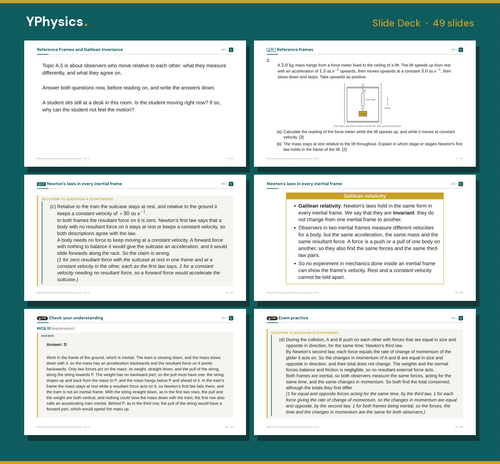
IB DP Physics lesson pack on reference frames and Galilean relativity, Topic A.5 Galilean and special relativity, HL only, first assessment 2025. The topic’s first lesson: what makes a reference frame inertial, and that Newton’s laws hold in the same form for every observer moving at a constant velocity. Editable worksheet, 49-slide lesson deck, teacher key, worked solutions and a questions-only assessment, supplied as self-contained HTML plus colour and black-and-white PDF.
What students learn
- What a speed is measured relative to, and so whether a body is moving.
- What makes a frame inertial, Newton’s first law as the test, and when the ground can be treated as one.
- The velocity, acceleration and resultant force that observers in two inertial frames measure for one body.
- Whether any experiment in mechanics can show the velocity of an inertial frame.
IB skills (Tool 3: Mathematics):
- Appreciate when an effect can be neglected (practised).
What’s included:
- Student Worksheet - 17 pages
- Teacher Key - 28 pages
- Worked Solutions - 18 pages
- Assessment - 13 pages
- Lesson deck - 49 slides
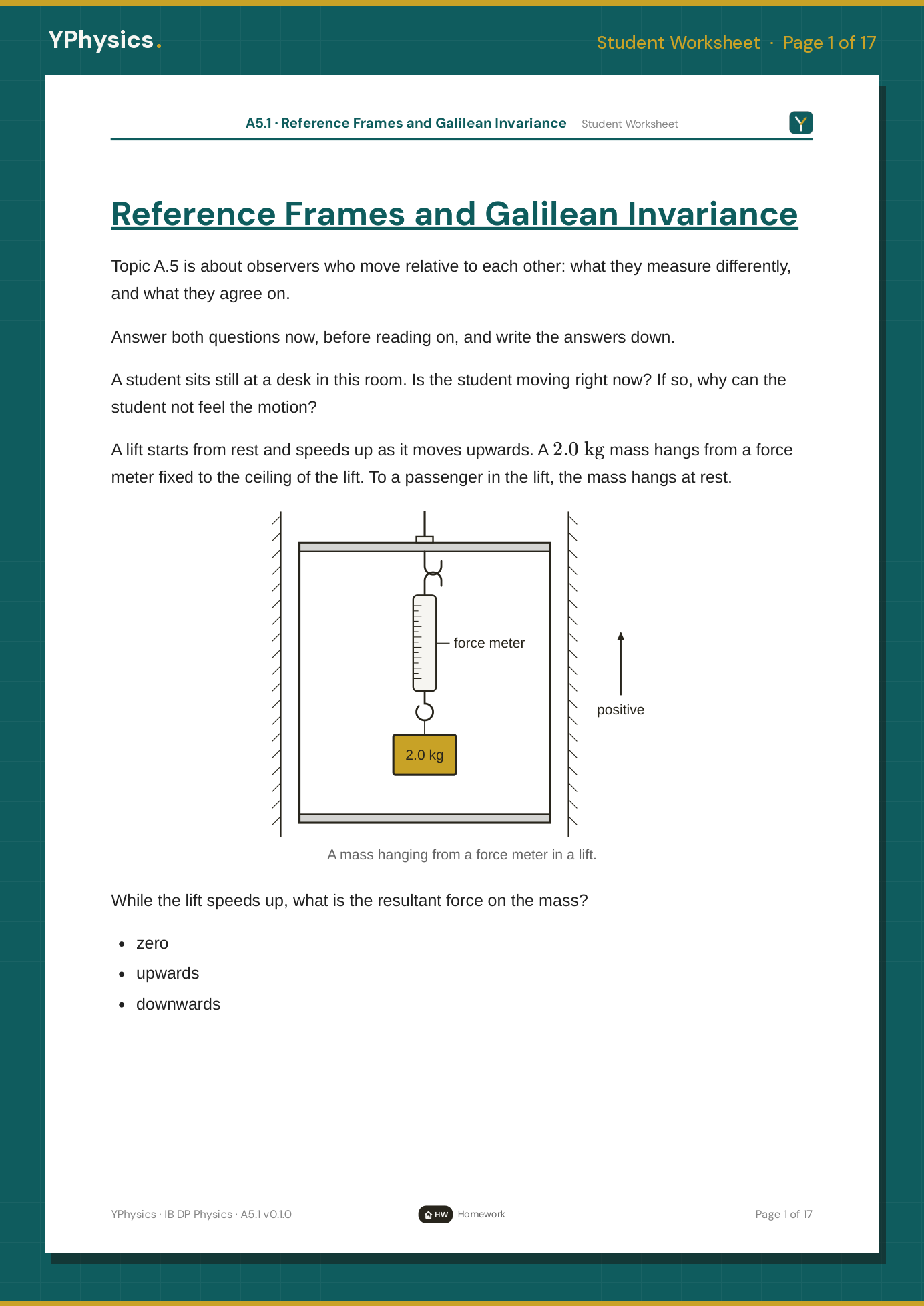
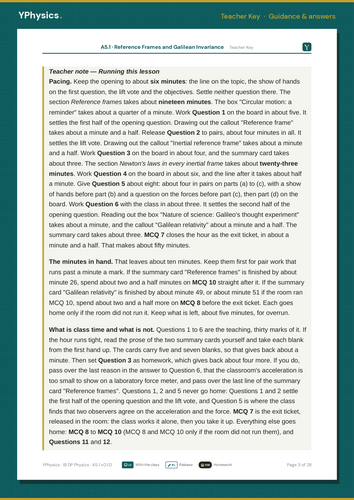
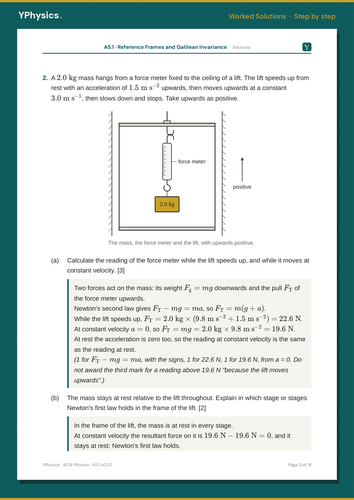
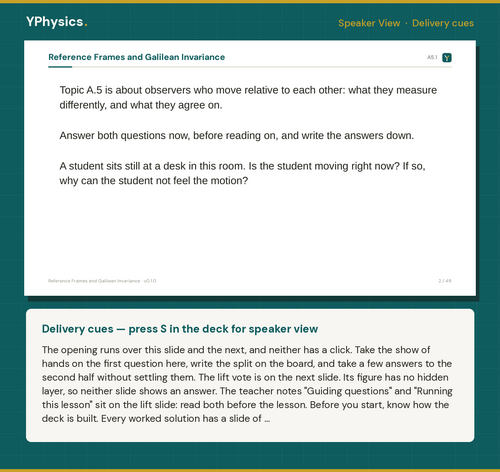
Eight structured questions and four multiple-choice items: 50 marks across 24 parts, and seven figures. It opens on two questions: whether a student sitting still at a desk is moving, and the resultant force on a mass hanging in a lift that speeds up. Questions 1, 2 and 6 settle them. The class works six questions, 30 marks, in the lesson, then a multiple-choice exit ticket. The rest goes home, including two exam-style questions: a train journey read from a phone’s acceleration record, and a collision on an air track filmed from a moving glider. A Nature of Science box tells Galileo’s thought experiment of a closed cabin on a ship.
Accelerating frames appear only as frames where Newton’s first law fails, and each is explained from an inertial frame: no fictitious forces, and no transformation equations, which come later in the topic. Newton’s laws, momentum and circular motion are used, not retaught. Worksheet and deck open in any browser, with nothing to install. SI units, IB notation and IB command terms throughout. Suitable for grades 11-12 (ages 16-19) as a lesson, cover lesson, homework or revision.
Related resources:
- Resultant Force, Inertia and Newton’s First Law, the law every frame here is tested with
- Newton’s Second Law: F = ma, which the lift and cyclist questions use
- Circular Motion I: Angular Velocity and Centripetal Acceleration, behind the Earth’s orbit questions
- Unit Conversion, the skill pack behind the time and speed conversions (free)
A rating helps other teachers find this.
Something went wrong, please try again later.
This resource hasn't been reviewed yet
To ensure quality for our reviews, only customers who have purchased this resource can review it
Report this resourceto let us know if it violates our terms and conditions.
Our customer service team will review your report and will be in touch.
£9.00