


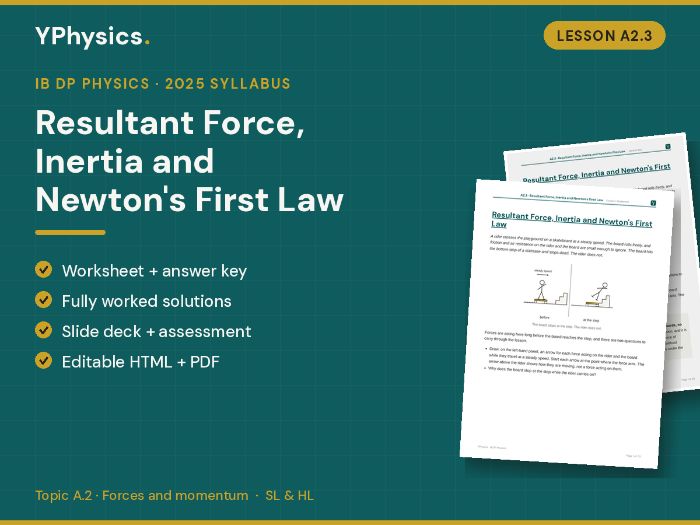
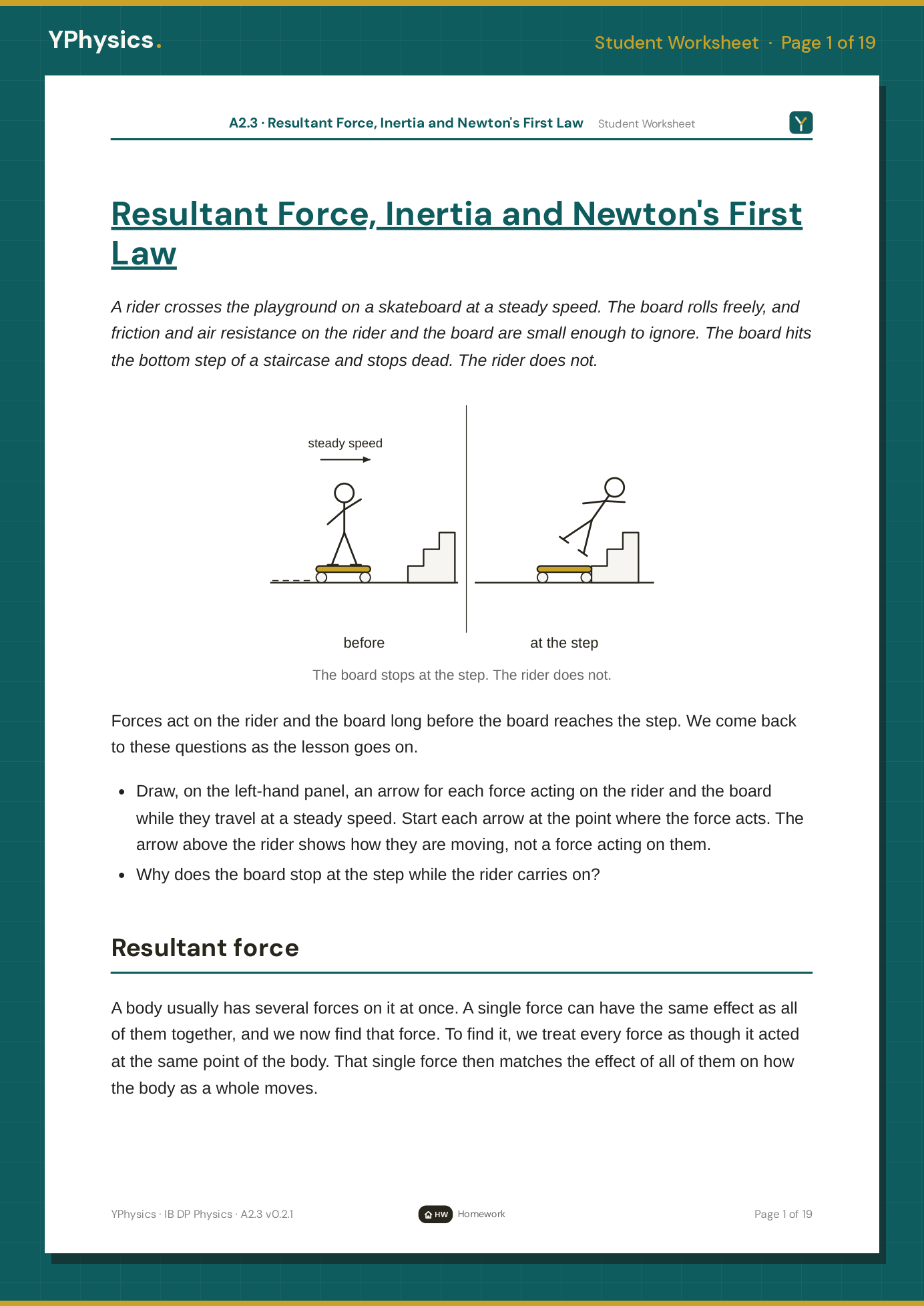
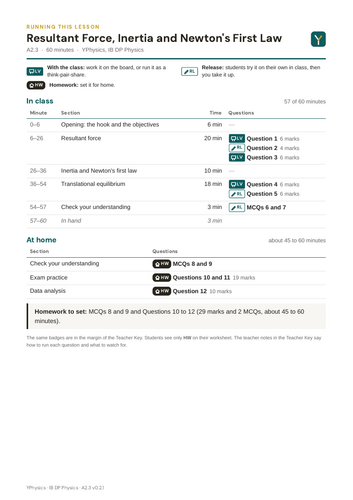
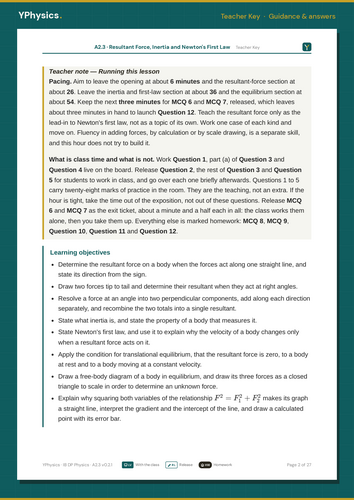
IB DP Physics lesson pack on resultant force, inertia and Newton’s first law for Topic A.2 Forces and momentum, SL and HL, first assessment 2025. It covers how to add forces, and why a moving body needs no resultant force to keep moving. Editable worksheet, 50-slide lesson deck, teacher key, worked solutions and a questions-only assessment, supplied as self-contained HTML plus colour and black-and-white PDF.
What students learn
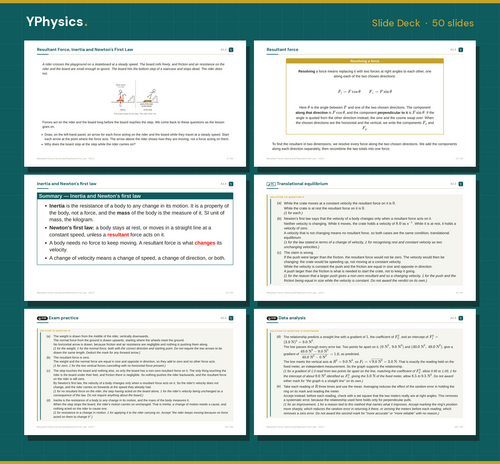
- The resultant force is one force with the same effect as all the forces on a body. On one line, forces add as signed numbers.
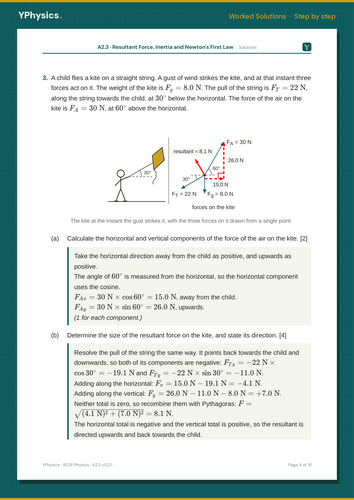
- Two forces at right angles go tip to tail, and Pythagoras gives the resultant. A force at any angle resolves into F cos θ and F sin θ.
- Inertia is a body’s resistance to any change in its motion. Mass measures it. It is not a force.
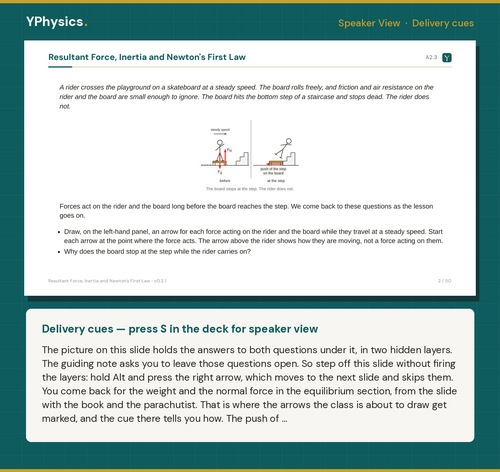
- Newton’s first law: a body’s velocity changes only when a resultant force acts on it.
- In translational equilibrium the resultant force is zero. Students show it in components and as a closed force triangle to scale.
IB skills (Tool 3: Mathematics, with Inquiry 3), all practised:
- Draw and interpret free-body diagrams.
- Add and subtract vectors in the same plane.
- Resolve vectors into two perpendicular components.
- Construct and use scale diagrams.
- Linearize graphs, only where appropriate.
- Interpret features of graphs: gradient and intercepts.
- Propagate uncertainties in processed data.
- Draw and interpret uncertainty bars.
- Explain realistic improvements to an investigation.
What’s included:
- Student Worksheet - 19 pages
- Teacher Key - 27 pages
- Worked Solutions - 18 pages
- Assessment - 13 pages
- Lesson deck - 50 slides
Eight written questions carry 57 marks across 26 parts, and four more are multiple choice. Students draw onto six of the 11 figures: force arrows, a force triangle to scale or an error bar. The pack ends with a 10-mark data question, built like a Paper 1B question.
Equilibrium is about the forces, not the speed. A crate pushed at a constant 8.0 m s⁻¹ is in equilibrium, and so is the same crate at rest. SI units, IB notation and IB command terms throughout. Use it with grades 11-12 (ages 16-19) as a lesson, cover lesson, homework or revision.
Part of the A.2 Forces and Momentum Complete Unit Bundle, 30% off buying the packs separately.
Related resources:
- Free-Body Diagrams and Force Pairs, the lesson before this one
- Newton’s Second Law: F = ma, the lesson that comes next
- Friction: Static and Dynamic, where the resultant force includes friction
- Measuring the Acceleration of Free Fall, free, with the same graph work
Updated 13 Nov 2026: reprint unless yours is v0.2.0+, 5 Nov 2026.
A rating helps other teachers find this.
Something went wrong, please try again later.
This resource hasn't been reviewed yet
To ensure quality for our reviews, only customers who have purchased this resource can review it
Report this resourceto let us know if it violates our terms and conditions.
Our customer service team will review your report and will be in touch.
£9.00