pdf, 219.38 KB
pdf, 219.38 KB
pdf, 6.23 MB
pdf, 6.23 MB
pdf, 100.69 KB
pdf, 100.69 KB

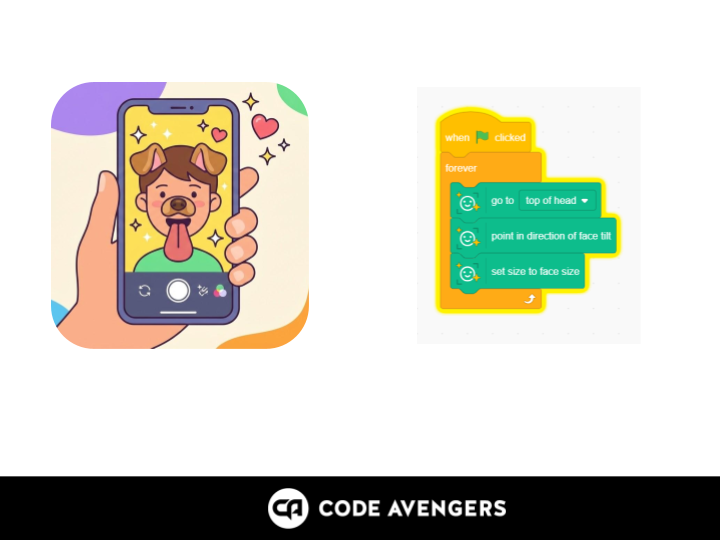
Create a Scratch face filter project using face sensing, sprites, positioning, sequencing and real-time AI responses.

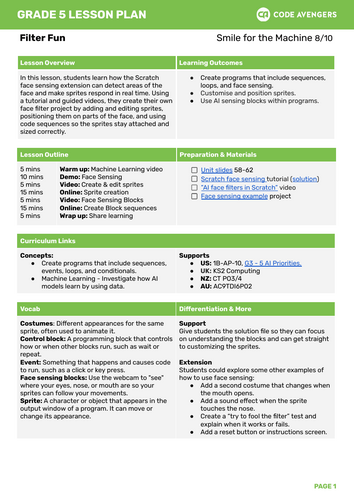
This Year 6–8 artificial intelligence and Scratch lesson teaches students how face sensing can detect areas of the face and make sprites respond in real time. Students follow a guided tutorial to build their own face filter project.

Students add and edit sprites, position them on parts of the face, and use code sequences so sprites stay attached and sized correctly. This lesson combines AI concepts with creative coding and gives students a practical way to see how face filters work.

This resource supports Scratch programming, face sensing, AI literacy, sprites, sequencing, image recognition, creative coding, digital technologies, and computational thinking.

Included file type: PDF.

Keywords: Scratch face sensing, face filters, AI face filters, Scratch project, sprites, sequencing, artificial intelligence, creative coding, Year 6 Scratch, Year 7 Scratch, Year 8 Scratch.

Get this resource as part of a bundle and save up to 26%

A bundle is a package of resources grouped together to teach a particular topic, or a series of lessons, in one place.

Bundle

How Artificial Intelligence works

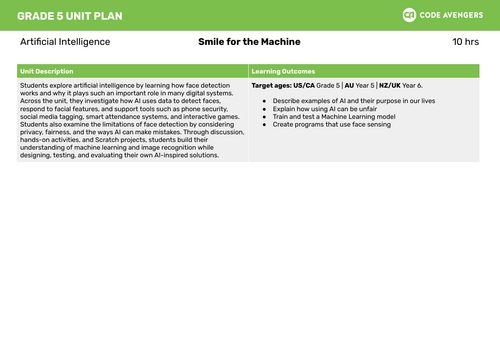
This bundle includes a complete set of PDF resources for teaching students how Artificial Intelligence works, with a focus on face data, face detection, machine learning, image classification, and Scratch face sensing. Students explore how AI uses data to detect faces, respond to facial features, and support tools such as phone security, photo tagging, smart attendance systems, face filters, and interactive games. They also consider the limitations of AI by investigating privacy, fairness, accuracy, bias, false positives, false negatives, and the ways AI systems can make mistakes. Included in this bundle: 10 detailed lesson plans with starter and plenary activities 73 teaching slides Unplugged activities including sorting tasks, system design, class presentations, ethical discussions, and group problem-solving Digital activities involving AI tools, Machine Learning for Kids, Scratch face sensing blocks, and AI-inspired game controls Student worksheets and activity resources Opportunities for discussion, design, testing, evaluation, and reflection The unit introduces students to key AI and computing concepts, including: artificial intelligence in everyday life human vs AI decision-making face detection vs face recognition face data and privacy machine learning models training data and testing data image classification pattern recognition AI bias, fairness, and mistakes Scratch programming with face sensing variables, loops, clones, events, and game controls The resources were written to align with Grade 3–5 AI priorities for K–12 curriculum and are suitable for Year 6–8 students who are new to learning how AI works. They can be used as a full AI unit, a digital technologies/computing project, a Scratch programming extension, or a cross-curricular technology and ethics unit. This resource supports AI literacy, machine learning, classification, training data, testing data, data labels, image recognition, computational thinking, digital technologies, programming, and responsible technology use. Included file type: PDF Keywords: artificial intelligence, AI lesson, AI unit, machine learning, face detection, face recognition, face data, Scratch face sensing, Machine Learning for Kids, training data, testing data, data labels, classification, image sorting, pattern recognition, AI ethics, AI bias, digital technologies, computing, Year 6 AI, Year 7 AI, Year 8 AI.

£10.00

Reviews

Something went wrong, please try again later.

This resource hasn't been reviewed yet

To ensure quality for our reviews, only customers who have purchased this resource can review it

Report this resourceto let us know if it violates our terms and conditions.
Our customer service team will review your report and will be in touch.