IB SEHS Topic 1.2.2: Environmental Adaptations — Complete 5-Hour HL
**IB SEHS Topic 1.2.2: Environmental Adaptations — Complete 5-Hour HL Teaching Bundle**
* Elevate your Year 12 IB Sports, Exercise and Health Science (SEHS) curriculum with this comprehensive, higher-level teaching bundle for Topic 1.2.2: Environmental Adaptations.
* Designed specifically for rigorous classroom instruction at institutions like St George's, Cologne, this complete 5-hour unit kit seamlessly integrates acute physiological responses and long-term adaptations across thermal and hypoxic stressors.
* Every lesson is built directly around the IB framework, explicitly embedding command terms (AO1–AO4) such as Outline, Describe, Explain, Discuss, Compare and contrast, and Evaluate.
**What Is Included in the Bundle**
* Complete Lesson 1: Heat Acclimatization (1.5 Hours)Focus: Thermoregulation, plasma volume expansion, evaporative cooling, and metabolic preservation.
* Activities: Step-by-step teacher delivery sequence, acute vs. long-term distinction tasks, system-by-system adaptation breakdowns, sex difference considerations, past-paper "Discuss" practice (Nov 2013 style prompts), and applied pre-cooling/hydration strategy tasks.
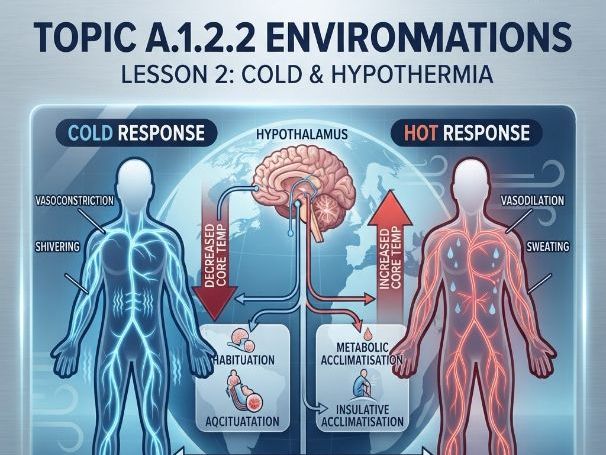
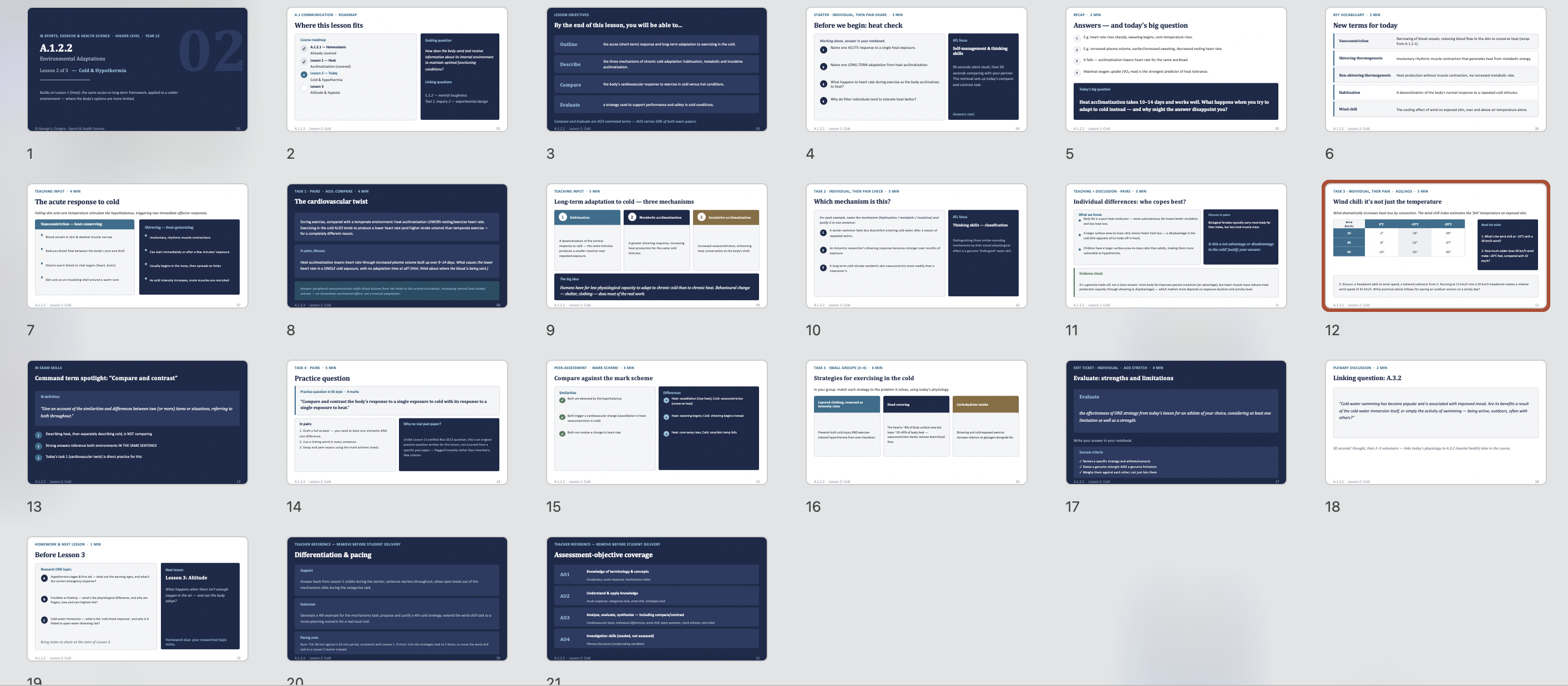
* Complete Lesson 2: Cold & Hypothermia (1.5 Hours)Focus: Hypothalamic detection, peripheral vasoconstriction, shivering thermogenesis, wind chill, and the three chronic cold mechanisms (habituation, metabolic, and insulative acclimatization). Activities: Detailed cardiovascular comparative analysis (contrasting heart rate behaviors in cold vs. hot environments), convection and wind chill calculation workflows, structured "Compare and contrast" command-term writing frameworks, and cold-weather clothing/glycogen strategy tasks.
* Complete Lesson 3: Altitude & Hypoxia (1.5 Hours)Focus: Barometric pressure drops, partial pressure of oxygen, respiratory alkalosis, renal erythropoietin (EPO) release, capillary density, and Levine & Stray-Gundersen’s Living High-Training Low (LHTL) paradigm.
* Activities: Altitude-band classifications, quantitative diffusion-gradient analysis, classical research paper dissection (1997 LHTL study variables and control groups), event-specific performance evaluations (e.g., endurance vs. sprint impacts), and structured exit tickets.
**Consolidated Review Matrix**
* A structured cross-environmental comparison table synthesizing primary triggers, acute responses, adaptation timelines, and mitigation strategies across heat, cold, and altitude.
* Key Features & BenefitsRigorous IB Alignment: Mapped explicitly to the Higher Level (HL) SEHS syllabus with built-in exam technique training for qualitative evaluation and quantitative justification.
* Ready-to-Teach Structure: Features clear timing breakdowns, starter/retrieval checks, teacher input blocks, student task loops, and exit tickets for every session.
* Evidence-Based Content: Integrates landmark physiological studies (e.g., Levine & Stray-Gundersen, Yanovich et al.) directly into student tasks to foster critical thinking and analytical evaluation.