


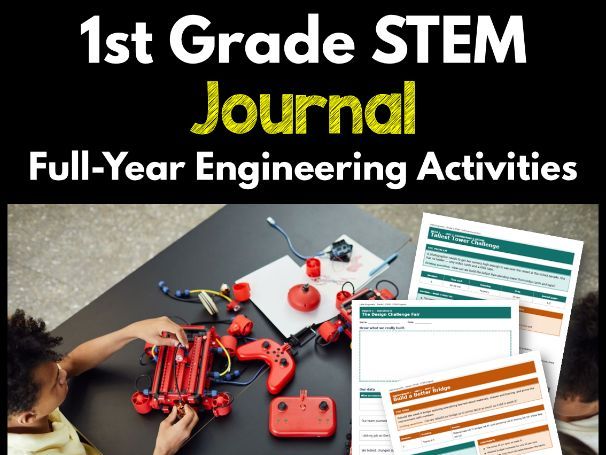
Grade 1 STEM Journal | 36 Hands-On Engineering Challenges
Make Grade 1 STEM easier to organize, document, and assess with a hands-on journal featuring 36 engineering challenges and 180 student pages. Designed to pair with the Grade 1 STEM Full-Year Curriculum, the journal guides students through a consistent engineering process while keeping their investigations, designs, test results, and reflections together.
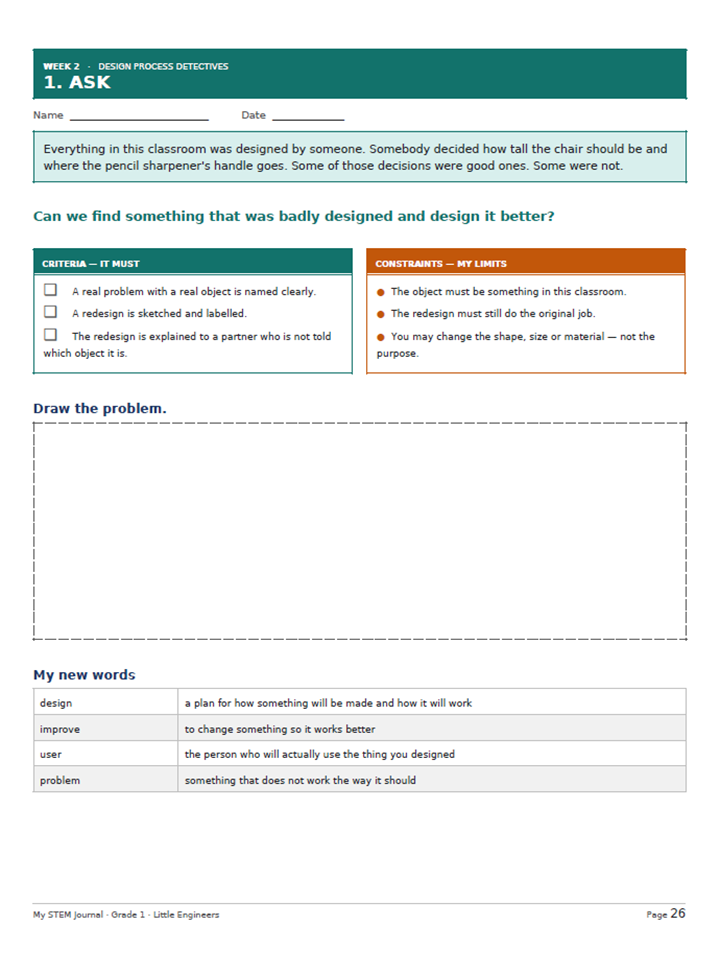
Each challenge includes five journal pages, covering investigation, planning, building, testing, improvement, data recording, and reflection. Students sketch and label designs, make predictions, identify criteria and constraints, record observations, measure results, compare data, and complete self-assessments. STEM vocabulary is integrated throughout the year.
The 36 challenges span six units:
Engineering & Design
Students explore basic engineering concepts through construction and problem-solving challenges.
Materials & Structures
Activities investigate materials, structures, bridges, towers, and design strength.
Forces & Motion
Students experiment with ramps, boats, balloon-powered vehicles, and other moving designs.
Plants & Animals
Challenges connect engineering with living things, habitats, and biological structures.
Weather & Earth
Students investigate weather instruments, erosion, shelters, and Earth-related problems.
STEM Problem Solving
Students apply their engineering knowledge to practical challenges involving signals, playgrounds, and other solutions.
Every challenge follows a predictable five-session sequence:
ASK → INVESTIGATE → IMAGINE → BUILD & TEST → IMPROVE & REFLECT
Students first understand the problem and relevant vocabulary, then investigate the science behind it. They sketch a proposed solution and make a prediction before building and testing. After recording their first results, they change one element, retest, compare the results, and reflect on what they learned.
The journal develops engineering design, problem-solving, prediction, fair testing, measurement, data collection, evidence-based reasoning, redesign, communication, and STEM vocabulary. The emphasis is on thinking and evidence rather than handwriting or spelling, making the journal accessible to developing writers through drawing, dictation, invented spelling, and written responses.
The consistent format makes the resource suitable for whole-group instruction, STEM centers, engineering stations, partner activities, or independent work. Completed pages can also be collected into year-end STEM portfolios, providing a visible record of student learning and design improvement.
With 180 ready-to-use pages and minimal preparation, this journal provides a structured way for Grade 1 students to ask questions, investigate, design, build, test, improve, and reflect throughout the school year.
Get this resource as part of a bundle and save up to 35%
A bundle is a package of resources grouped together to teach a particular topic, or a series of lessons, in one place.
Bundle
K - 5 STEM Journal Bundle | Full-Year Engineering Activities
K–5 STEM Journal Bundle | Full-Year Engineering Design Journals | 216 Challenges, 1,588 Pages Six full-year student STEM journals — 36 hands-on engineering challenges per grade, one for every week of the school year — with the recording pages, data tables, reflection prompts, and portfolios already built in. Print, staple, and your students have a year of documented engineering. These are the student-facing journals for the K–5 STEM program: the place where kids plan, sketch, predict, record trials, graph results, and explain what their evidence shows. The engineering process grows with the student — from four picture-supported steps in Kindergarten to a ten-step optimize-and-communicate cycle in 5th Grade — so a school running all six gets one coherent progression instead of six unrelated notebooks. What's Included Six complete grade-level journals (1,588 pages total): Kindergarten STEM Journal (152 pages) — 36 challenges, 3 pages each. Ask → Imagine → Build → Share. Drawing, tracing, circling, and counting prompts; minimal writing. Ends with an Invention Convention. 1st Grade STEM Journal (211 pages) — 36 challenges, 5 pages each. Adds Investigate and a two-test format (build, test, improve one thing, test again). Exit tickets, self-assessments, year-end portfolio. 2nd Grade STEM Journal (251 pages) — 36 challenges, 6 pages each. Adds three design ideas before choosing one, repeated trials, blank graph grids, and evidence-with-numbers prompts. 36 exit tickets, 6 unit self-assessments. 3rd Grade STEM Investigator's Journal (253 pages) — 36 investigations, 6 pages each. Adds testable questions, independent/dependent/controlled variables, typical values, and claim–evidence–reasoning–limitations. Teacher notes and pacing guide included. 4th Grade STEM Designer's Journal (324 pages) — 36 projects, 8 pages each. Adds client briefs, budgets with running totals, weighted decision matrices, measurable criteria, and cost-per-performance analysis. 5th Grade STEM Innovator's Journal (397 pages) — 36 projects, 10 pages each. Adds stakeholder analysis, test protocols, trade-off curves, optimization ("what did your design make worse, and why was that worth it?"), one-page technical summaries, flowchart and pseudocode practice, innovator badges, and a capstone showcase. Across the bundle: 216 weekly challenges and roughly 1,370 student journal pages, plus exit tickets, self-assessments, and year-end portfolio pages at every grade from 1st up. The Challenges The same six-unit arc runs through every grade — Engineering Design, Materials/Matter, Forces & Motion or Energy, Life Science, Earth & Weather/Space, and Engineering for Communities. A few examples: K: Tower Power · A Chair for Teddy · Three Little Houses · Bridge for a Toy Car · Magnet Movers · Playground Designers 1st: Towers, bridges, boats, balloon-powered cars, weather instruments, erosion barriers, signal devices 2nd: Stronger bridge, water filter, marble run, parachute, pollinator garden, water-saving device 3rd: Solar oven, wind-powered vehicle, earthquake-resistant structure, model ecosystem, weather station 4th: Food packaging, renewable energy, communication networks, earthquake-resistant buildings, shelters, biomimicry 5th: Water purification, wind turbines, energy storage, Mars habitats, assistive technology, sustainable cities How It Works in the Classroom Each challenge runs on a five-session weekly rhythm (K uses a simpler single-session routine). Students carry one journal all year, so their thinking, sketches, data, and improvements stay together — a complete record of growth you can send home, use for conferences, or grade against a rubric. Two printing options at every grade: print and bind the whole journal once, or print just that week's 3–10 pages to cut copying costs and let you skip or reorder weeks freely. How the Process Grows K — Ask · Imagine · Build · Share (3 pages/week): count and compare results 1st — adds Investigate, Test, Improve (5 pages/week): change one thing, test again 2nd — adds Plan (6 pages/week): three ideas, trials, graphs, numbers as evidence 3rd — adds Create, Analyze (6 pages/week): variables, fair tests, claim–evidence–reasoning 4th — 8-step design cycle (8 pages/week): clients, budgets, decision matrices, measurable criteria 5th — 10-step innovation cycle (10 pages/week): trade-offs, optimization, technical summaries, pseudocode What Students Practice, K–5 Observing, building, and sharing (K) → predicting, testing twice, and comparing (1st) → generating multiple ideas, running trials, graphing, and explaining with numbers (2nd) → controlling variables and writing claim–evidence–reasoning (3rd) → budgeting, scoring options, and writing measurable criteria (4th) → optimizing across trade-offs and communicating a recommendation someone could act on (5th). By Week 36 of 5th Grade, students independently define a problem, research it, run all ten steps, and report a result. Format 6 PDF files, 1,588 pages total Print-and-go; designed for whole-journal binding or week-by-week printing Teaching duration: 1 full school year per grade Materials for the challenges are everyday classroom supplies Pairs With the K–5 STEM Curriculum The journals contain the student pages. The teacher-facing lesson plans for every weekly challenge are in the grade-level STEM Full-Year Curricula, sold separately or together in the K–5 STEM Curriculum Bundle. Every journal is also usable on its own — the criteria, constraints, data structures, and prompts are printed on the student pages. Want the student-facing challenge cards too? See the K–5 STEM Challenge Cards Bundle. Want everything for all six grades? The K–5 STEM Mega Bundle includes the journals, curricula, challenge cards, and every other grade-level STEM resource in the store. Why Buy the Bundle Six journals bought separately cost $84.00. This bundle is $58.80 — and gives a STEM specialist, a grade-level team, or a whole elementary building one documented engineering progression from the first tower in Kindergarten to the final technical summary in 5th Grade. Ask. Imagine. Build. Test. Improve. Communicate — and write it all down.
$58.80
Bundle
1st Grade STEM Bundle | Full-Year Engineering Activities
1st Grade STEM Bundle | Full-Year STEM Curriculum | Engineering Activities, Projects, Task Cards & More Make STEM and engineering easy to teach all year long with this comprehensive 1st Grade STEM Curriculum Bundle! Packed with multiple formats for hands-on learning, this collection gives first grade students repeated opportunities to explore engineering, problem-solving, creativity, and design through engaging, age-appropriate STEM activities. With curriculum lessons, challenge cards, STEM journals, projects, task cards, early-finisher activities, and substitute plans all included, this 1st Grade STEM Bundle provides flexible resources for keeping young learners engaged while saving teachers valuable planning time. What's Included This bundle includes 7 first grade STEM resources: • STEM Curriculum — 36 weekly challenges across 6 units, 5 sessions each • STEM Journal — 180 student recording pages • Challenge Cards — 96 student-facing cards including 36 Level Up extensions • STEM Projects — 6 unit capstones plus 12 standalone mini-projects • Task Cards — 80 math, science and coding skill cards • Early Finishers — 40 no-prep challenges with choice board and bin labels • Sub Plans — 12 emergency lessons with word-for-word scripts Together, these resources provide multiple formats for introducing, practicing, applying, documenting, and extending STEM and engineering learning throughout the school year. How It Works in the Classroom Use this 1st Grade STEM Curriculum Bundle for: • Daily or weekly STEM instruction • Engineering challenges • STEM centers and stations • Whole-group lessons • Small-group activities • Independent STEM practice • Hands-on projects • STEM journals and reflection • Early-finisher activities • Substitute teacher plans • Enrichment and extension • Flexible no-prep or low-prep STEM learning The variety of resources makes it easy to adjust instruction based on your schedule and classroom needs. Use the curriculum for structured instruction, challenge cards and task cards for shorter activities, projects for hands-on application, journals for student reflection, and early-finisher resources for meaningful extension. Standards & Learning Goals Students build foundational STEM and engineering skills through age-appropriate challenges and activities, including: Engineering Design • Identifying problems • Brainstorming solutions • Designing and building • Testing ideas • Improving solutions Problem-Solving • Thinking creatively • Trying different strategies • Learning from mistakes • Making decisions • Explaining solutions STEM Thinking • Observing and investigating • Asking questions • Making predictions • Applying reasoning • Connecting ideas to real-world situations Communication & Reflection • Describing designs • Sharing ideas • Recording learning • Reflecting on challenges • Explaining how solutions can be improved Why Teachers Love It * Uses common classroom and recycled materials — full materials list included * Complete first grade STEM resource collection * Seven complementary STEM resources in one bundle * Full-year engineering activities * Multiple instructional formats * Supports hands-on STEM learning * Encourages creativity and problem-solving * Includes projects, task cards, challenge cards, and journals * Provides early-finisher activities * Includes substitute teacher plans * Flexible for whole-group, small-group, centers, and independent learning * Saves valuable planning time Instead of searching for different STEM activities throughout the year, teachers can use this 1st Grade STEM Bundle as a flexible resource library with options for instruction, practice, enrichment, projects, and unexpected schedule changes. Download Today Add this 1st Grade STEM Curriculum Bundle to your classroom and give students a full year of opportunities to design, build, explore, problem-solve, and think like engineers! Whether you need a structured STEM curriculum, a quick challenge, a hands-on project, an independent activity, an early-finisher option, or a substitute plan, this bundle gives you resources you can reach for throughout the school year.
$48.00
Something went wrong, please try again later.
This resource hasn't been reviewed yet
To ensure quality for our reviews, only customers who have purchased this resource can review it
Report this resourceto let us know if it violates our terms and conditions.
Our customer service team will review your report and will be in touch.
$14.50