


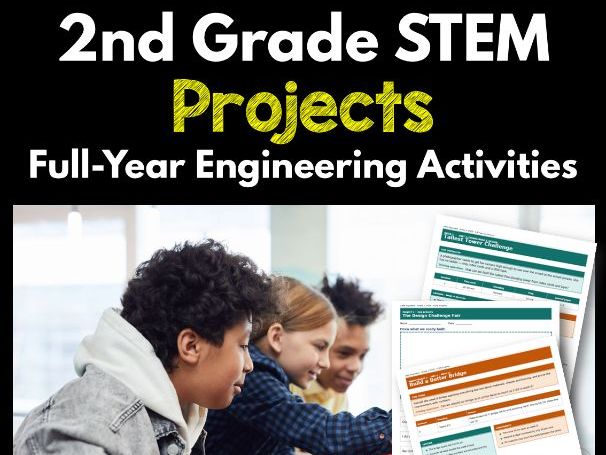
Give Grade 2 students meaningful opportunities to apply STEM learning through 18 hands-on engineering projects focused on designing, building, testing, measuring, improving, and communicating. Designed to pair with the Grade 2 STEM Full-Year Curriculum, the resource combines six major projects with twelve flexible mini-projects.
The six major projects run for five sessions and provide extended, project-based experiences at the end of each curriculum unit:
The Engineering Fair
The Materials Expo
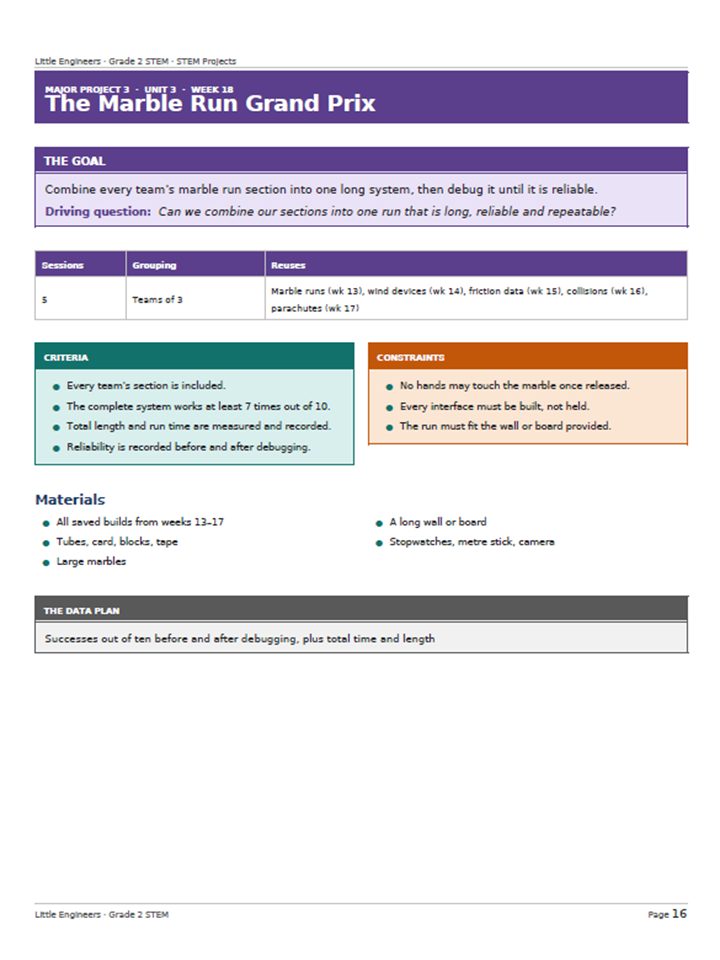
The Marble Run Grand Prix
The Living Systems Museum
The Earth Engineers Summit
STEM Problem Solvers Showcase
The 12 standalone mini-projects run for three sessions and include Bridge Trials, the Insulation Challenge, Water Filter Lab, Paper Airplane Lab, Seed Dispersal Trials, Recycled Robot, Waste Audit, Sound Barrier Test, Grow Lab, and other hands-on investigations.
Every project includes clear criteria and constraints, a purposeful data plan, teacher directions, preparation notes, student planning pages, results pages, reflection opportunities, and documentation suitable for assessment.
Students work individually, with partners, or in teams depending on the activity. Major projects intentionally build on earlier classroom experiences, allowing students to reuse observations, previous designs, and class data while developing more sophisticated engineering habits.
Throughout the projects, students practice a consistent process:
ASK → DEFINE → IMAGINE → PLAN → BUILD → TEST → IMPROVE → COMMUNICATE
The emphasis is on evidence rather than simply completing a construction task. Students collect measurements, compare results, create and interpret graphs, identify patterns, and use observations and numerical data to explain their conclusions.
Key learning goals include:
Engineering design and problem solving
Defining criteria and constraints
Planning and prototyping
Observation and investigation
Fair testing and repeated trials
Data collection and measurement
Graphing and data interpretation
Evidence-based reasoning
Iteration and redesign
Collaboration and communication
Understanding systems and interdependence
The projects also provide opportunities for authentic audiences through fairs, expos, museums, showcases, and presentations. Students can share their designs and findings with classmates, families, other classes, or school leaders.
Teachers can use major projects as unit finales and mini-projects during shorter weeks, spare STEM periods, or as flexible extensions. Detailed directions and built-in student documentation reduce planning time while maintaining a consistent STEM routine.
Overall, this resource helps transform Grade 2 STEM into purposeful engineering experiences where students learn not only to make something, but to investigate whether it works, collect evidence, improve it, and explain how they know.
Get this resource as part of a bundle and save up to 33%
A bundle is a package of resources grouped together to teach a particular topic, or a series of lessons, in one place.
Bundle
K - 5 STEM Projects Bundle | Full-Year Engineering Activities
K–5 STEM Projects Bundle | 108 Engineering Projects | Unit Capstones + Mini-Projects for Every Grade 36 multi-session capstone projects and 72 standalone mini-projects across Kindergarten through 5th Grade — the fairs, expos, grand prix races, summits, and showcases that turn a year of STEM challenges into something students build together and present to a real audience. Every grade follows the same pattern: six major projects, one to close each curriculum unit, that extend the unit's capstone challenge into a full team project with a data plan and a presentation, plus twelve mini-projects that stand alone and drop into any spare week. Materials are everyday classroom supplies. What's Included Six grade-level project collections (429 pages total, 108 projects): Kindergarten STEM Projects — Big Builds (59 pages) — 6 class projects in four short sessions each, where pairs build individual parts and combine them into one shared class creation, plus 12 twenty-minute Quick Builds. Picture-page recording for every project. Rubric included. 1st Grade STEM Projects (74 pages) — 6 five-session major projects + 12 three-session mini-projects, each with criteria, constraints, a data plan, teacher directions, student planning and results pages, and reflection. 2nd Grade STEM Projects (74 pages) — same structure; adds graphing and rubric-ready documentation. 3rd Grade STEM Projects (74 pages) — adds project rubrics, self-assessment, peer review, and panel presentations; teams of 3–4. 4th Grade STEM Projects (74 pages) — adds budgeting and costing challenges, source audits, and one shared rubric covering all 18 projects. 5th Grade STEM Projects (74 pages) — adds trade-off analysis, optimization, stakeholder thinking, and a capstone where students independently run the full engineering process for an authentic audience. The Capstones Each grade's six major projects deliberately reuse builds and data from earlier in the unit, so students see their learning accumulate. Every grade ends with a year-long showcase. K: Our Tallest Tower · The Big Bridge · The Great Marble Race · Our Class Garden · The Weather Station · Invention Convention 1st: The Design Challenge Fair · Build a Better Bridge · The Motion Machine · The Biomimicry Museum · The Weather Report · Young Engineers Showcase 2nd: The Engineering Fair · The Materials Expo · The Marble Run Grand Prix · The Living Systems Museum · The Earth Engineers Summit · STEM Problem Solvers Showcase 3rd: The Engineering Challenge · The Vehicle Grand Prix · The Solar Cooker Challenge · The Ecosystem Investigation · The Hazard Summit · STEM Investigators Showcase 4th: The Design Review · The Energy Challenge · The Communication Network · The Resilience Report · The Biomimicry Expo · STEM Designers & Innovators Showcase 5th: The Innovation Pitch · The Food Preservation System · The Energy Grid · The Mars Habitat · The Sustainability Audit · STEM Innovators Showcase The Mini-Projects Twelve per grade, three sessions each (20 minutes each in K), all new and standalone. A sample of the range: K: Cup Stack Race · Float or Sink · Magnet Hunt · Nest Test · Umbrella Test · Ice Watch 1st: The Great Egg Drop · Cardboard Arcade · Zip Line Challenge · Catapult Challenge · Straw Rocket Lab · Shadow Clock 2nd: Bridge Trials · Water Filter Lab · Seed Dispersal Trials · Recycled Robot · Waste Audit · Sound Barrier Test 3rd: The Replication Study · The Outlier Hunt · Bridge Efficiency Rematch · The Germination Rate Study · The Biodiversity Survey · The Energy Audit 4th: The Budget Squeeze · The Source Audit · The Signal Race · The Mirror Maze · The Payback Calculation · The Product Teardown 5th: The Trade-off Curve · The Replication Test · The Separation Challenge · The Demand Profile · The Decomposition Rate · The Pseudocode Relay How It Works in the Classroom Run a capstone at the end of each unit. Students work in teams (pairs in K, 3–4 in upper grades), plan before building, test and retest, collect data against a plan, and present to an audience — a buddy class, families, school leaders, or a panel that asks them to defend their evidence. Drop a mini-project into any spare week. Use one to replace a regular challenge, fill a short week, prep for a STEM night, or give a data-hungry class more practice. Nothing depends on what came before. What Students Practice, K–5 Counting, measuring, and combining parts into a shared build (K) → data plans, comparing results, and presenting to an audience (1st–2nd) → controlling variables, peer review, and claim–evidence–reasoning (3rd) → budgets, cost-benefit studies, and source reliability (4th) → trade-offs, optimization, and communicating a recommendation someone could act on (5th). Format 6 PDF files, 429 pages total Print-and-go teacher directions, student planning and results pages, and rubrics Teaching duration: 1 full school year per grade Pairs With the K–5 STEM Curriculum The six capstones in each grade are extended, project-based versions of the unit capstone challenges in the grade-level STEM Full-Year Curricula, available together in the K–5 STEM Curriculum Bundle. The 72 mini-projects are new and appear nowhere else. Every project works on its own — the criteria, constraints, and data plans are on the pages. Also available: the K–5 STEM Challenge Cards Bundle and the K–5 STEM Journal Bundle. The K–5 STEM Mega Bundle includes the projects, curricula, cards, journals, and every other grade-level STEM resource in the store. Why Buy the Bundle Six collections bought separately cost $46.94. This bundle is $32.86 — and gives a STEM specialist or a whole elementary building six unit finales and a year-end showcase at every grade, plus 72 ready-to-run projects for the weeks that don't go to plan. Build it together. Test it. Present it. Defend it.
$32.86
Bundle
2nd Grade STEM Bundle | Full-Year Engineering Activities
2nd Grade STEM Bundle | Full-Year STEM Curriculum | Engineering Activities, Projects, Task Cards & More Make STEM learning engaging, hands-on, and easy to plan all year long with this comprehensive 2nd Grade STEM Curriculum Bundle! This collection brings together multiple formats of age-appropriate STEM and engineering activities designed to help second grade students explore, create, problem-solve, test ideas, and think like young engineers. With a full-year curriculum, challenge cards, STEM journals, projects, task cards, early-finisher activities, and substitute plans included, this 2nd Grade STEM Bundle gives teachers a flexible collection of resources for instruction, enrichment, independent practice, and unexpected classroom needs. What's Included This bundle includes 7 second grade STEM resources: • STEM Curriculum — 36 weekly challenges across 6 units, 5 sessions each • STEM Journal — 180 student recording pages • Challenge Cards — 96 student-facing cards including 36 Level Up extensions • STEM Projects — 6 unit capstones plus 12 standalone mini-projects • Task Cards — 80 math, science and coding skill cards • Early Finishers — 40 no-prep challenges with choice board and bin labels • Sub Plans — 12 emergency lessons with word-for-word scripts Together, these resources provide multiple ways to introduce, practice, apply, document, and extend STEM and engineering learning throughout the school year. How It Works in the Classroom Use this 2nd Grade STEM Curriculum Bundle for: • Daily or weekly STEM instruction • Engineering design challenges • STEM centers and stations • Whole-group lessons • Small-group activities • Hands-on STEM projects • Independent practice • STEM journals and reflection • Early-finisher activities • Substitute teacher plans • STEM enrichment and extension • Flexible classroom activities Use the curriculum for structured STEM instruction, challenge cards and task cards for shorter learning experiences, projects for hands-on application, journals for recording and reflecting on learning, and early-finisher resources for meaningful extension. Standards & Learning Goals Students develop foundational STEM and engineering skills through engaging, age-appropriate activities, including: Engineering Design • Identifying problems and needs • Brainstorming possible solutions • Designing and building • Testing ideas • Evaluating results • Improving designs Problem-Solving • Thinking creatively • Using logical reasoning • Trying different approaches • Learning from unsuccessful attempts • Making decisions and solving challenges STEM Thinking • Observing and investigating • Asking questions • Making predictions • Exploring cause and effect • Applying knowledge to real-world challenges Communication & Reflection • Explaining ideas and solutions • Sharing designs • Recording observations • Reflecting on challenges • Describing ways to improve a solution Why Teachers Love It * Uses common classroom and recycled materials — full materials list included * Complete second grade STEM resource collection * Seven complementary STEM resources in one bundle * Full-year engineering activities * Multiple ways to teach and practice STEM * Supports hands-on learning and creativity * Builds problem-solving and critical-thinking skills * Includes curriculum, projects, task cards, challenge cards, and journals * Provides meaningful early-finisher activities * Includes substitute teacher plans * Flexible for whole-group, small-group, center, and independent learning * Saves valuable planning time This 2nd Grade STEM Bundle gives teachers a ready-to-use collection they can pull from throughout the school year. Whether you need a structured lesson, a quick challenge, a hands-on engineering project, an independent task, an early-finisher activity, or a substitute plan, you'll have a STEM resource ready to go. Download Today Add this 2nd Grade STEM Curriculum Bundle to your classroom and give students a full year of opportunities to explore, design, build, test, problem-solve, and think like engineers! With multiple resource formats included, you can keep STEM learning fresh and flexible while giving second graders meaningful opportunities to develop creativity, collaboration, critical thinking, and engineering skills.
$49.00
Something went wrong, please try again later.
This resource hasn't been reviewed yet
To ensure quality for our reviews, only customers who have purchased this resource can review it
Report this resourceto let us know if it violates our terms and conditions.
Our customer service team will review your report and will be in touch.
$8.00