pdf, 21.1 MB
pdf, 21.1 MB

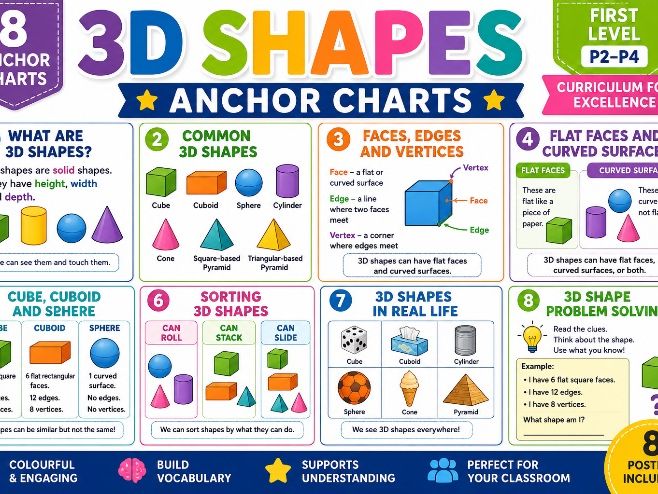
A bright and engaging set of 8 3D Shapes Anchor Charts designed for pupils working within First Level Curriculum for Excellence.

This colourful, child-friendly resource helps learners recognise, name, describe and compare common 3D shapes. Pupils explore faces, edges and vertices, flat and curved surfaces, how 3D shapes can roll, stack and slide, and where different solid shapes can be found in everyday life.

Each poster uses clear explanations, colourful visual examples and simple mathematical vocabulary to support understanding and independent learning.

WHAT IS INCLUDED?
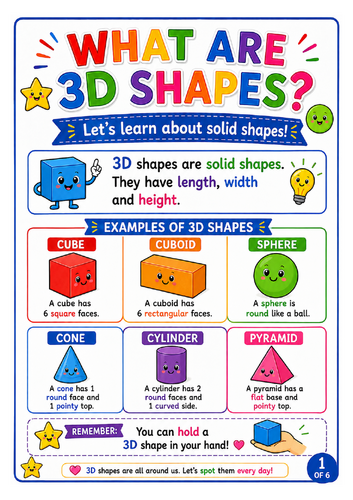
What Are 3D Shapes?
Common 3D Shapes
Faces, Edges and Vertices
Flat Faces and Curved Surfaces
Cube, Cuboid and Sphere
Sorting 3D Shapes
3D Shapes in Real Life
3D Shape Problem Solving

SKILLS COVERED
Understanding what a 3D shape is
Recognising that 3D shapes are solid
Naming common 3D shapes
Identifying cubes and cuboids
Identifying spheres
Identifying cones
Identifying cylinders
Identifying pyramids
Understanding faces
Understanding edges
Understanding vertices
Counting faces, edges and vertices
Identifying flat faces
Identifying curved surfaces
Comparing different 3D shapes
Recognising which shapes can roll
Recognising which shapes can stack
Recognising which shapes can slide
Sorting shapes according to their properties
Matching 3D shapes to real-life objects
Using clues to identify shapes
Describing shapes using mathematical vocabulary
Developing visual reasoning
Solving simple shape problems

EACH ANCHOR CHART FEATURES
Bright, primary-friendly design
Clear child-friendly explanations
Colourful 3D shape illustrations
Simple definitions
Faces, edges and vertices clearly identified
Real-life examples
Shape-property comparisons
Sorting activities
Helpful reminders and tips
Problem-solving opportunities
Consistent visual layout
Visual support for independent learning

PERFECT FOR
P2–P4
First Level Numeracy and Mathematics
Shape, Position and Movement topics
Maths working walls
Classroom displays
Whole-class teaching
Guided maths
Independent pupil reference
Revision and consolidation
Supporting visual learners
Shape hunts
Practical maths activities
Early-finisher reference
Developing mathematical vocabulary
Building confidence with geometry

Curriculum: Curriculum for Excellence
Level: First Level
Suggested Stage: P2–P4
Subject: Numeracy and Mathematics
Topic: 3D Shapes
Pages: 8

A practical and colourful classroom resource for helping pupils confidently recognise, describe, sort and compare 3D shapes while developing a secure understanding of faces, edges, vertices, surfaces and real-life shape properties.

Get this resource as part of a bundle and save up to 57%

A bundle is a package of resources grouped together to teach a particular topic, or a series of lessons, in one place.

Bundle

Shape, Position and Movement KS1/First Level Anchor Chart Bundle

A bright and comprehensive collection of 48 Shape, Position and Movement Anchor Charts designed for pupils working within First Level Curriculum for Excellence. This colourful, child-friendly bundle brings together 6 complete maths topics, covering 2D Shapes, 3D Shapes, Symmetry, Position & Movement, Turns & Angles, and Maps & Directions. The posters support pupils in recognising and describing shapes, exploring their properties, understanding symmetry, using positional and directional language, following routes, navigating maps and grids, and developing an understanding of turns and angles. Each anchor chart uses clear explanations, colourful visual examples, key mathematical vocabulary and practical real-life connections, making the bundle ideal for maths working walls, classroom displays, whole-class teaching and independent pupil reference. WHAT IS INCLUDED? 2D SHAPES – 8 ANCHOR CHARTS What Are 2D Shapes? Common 2D Shapes Sides and Vertices Triangles Quadrilaterals Regular and Irregular Shapes Circles and Curved Shapes 2D Shapes in Real Life 3D SHAPES – 8 ANCHOR CHARTS What Are 3D Shapes? Common 3D Shapes Faces, Edges and Vertices Flat Faces and Curved Surfaces Cube, Cuboid and Sphere Sorting 3D Shapes 3D Shapes in Real Life 3D Shape Problem Solving SYMMETRY – 8 ANCHOR CHARTS What Is Symmetry? Lines of Symmetry Symmetry in 2D Shapes Reflective Symmetry Rotational Symmetry Complete the Symmetrical Picture Symmetry Around Us Symmetry Problem Solving POSITION & MOVEMENT – 8 ANCHOR CHARTS What Is Position and Movement? Positional Language Direction Words Turns and Movement Movement on a Grid Compass Directions Following Routes Position and Movement Problem Solving TURNS & ANGLES – 8 ANCHOR CHARTS What Is a Turn? Quarter Turns Half Turns Three-Quarter Turns Full Turns Left and Right Turns What Are Angles? Turns and Angles in Real Life MAPS & DIRECTIONS – 8 ANCHOR CHARTS What Are Maps and Directions? Direction Words Compass Points The 8 Compass Points Map Symbols and Keys Following a Route on a Map Giving Directions Maps in Real Life SKILLS COVERED Recognising and naming common 2D shapes Identifying sides and vertices Describing triangles and quadrilaterals Recognising regular and irregular shapes Identifying circles and curved edges Recognising and naming common 3D shapes Identifying faces, edges and vertices Comparing flat faces and curved surfaces Sorting 3D shapes by their properties Recognising 2D and 3D shapes in everyday life Understanding symmetry Finding and counting lines of symmetry Exploring reflective symmetry Exploring rotational symmetry Completing symmetrical pictures Using positional vocabulary Understanding above, below, beside and between Using in front of and behind Understanding left and right Following forwards and backwards directions Moving on simple grids Understanding quarter, half, three-quarter and full turns Recognising how turns create angles Developing an understanding of angle size Using north, south, east and west Exploring the eight compass points Reading simple maps Understanding map symbols and keys Following routes Giving clear directions Identifying landmarks Comparing routes Applying position and movement skills to problem solving Developing spatial awareness and mathematical reasoning EACH ANCHOR CHART FEATURES Bright, primary-friendly design Clear child-friendly explanations Colourful visual examples Key mathematical vocabulary Worked examples Practical real-life connections Helpful reminders and top tips Simple diagrams, maps and grids Shape-property illustrations Directional arrows and compass visuals Problem-solving opportunities Consistent design across the full bundle Visual support for independent learning PERFECT FOR P2–P4 First Level Numeracy and Mathematics Curriculum for Excellence Shape, Position and Movement Maths working walls Classroom displays Whole-class teaching Guided maths Independent pupil reference Revision and consolidation Supporting visual learners Practical maths lessons Shape and symmetry investigations Map and direction activities Early finishers Additional support and intervention Developing spatial reasoning Building mathematical vocabulary and confidence Curriculum: Curriculum for Excellence Level: First Level Suggested Stage: P2–P4 Subject: Numeracy and Mathematics Curriculum Area: Shape, Position and Movement Individual Packs: 6 Anchor Charts: 48 Pages: 48 A comprehensive, ready-to-use classroom resource for supporting pupils across the key areas of shape, symmetry, position, movement, turns, angles, maps and directions. The consistent colourful design makes it perfect for building an engaging First Level maths working wall while giving pupils accessible visual support throughout their learning.

£5.99

Reviews

Something went wrong, please try again later.

This resource hasn't been reviewed yet

To ensure quality for our reviews, only customers who have purchased this resource can review it

Report this resourceto let us know if it violates our terms and conditions.
Our customer service team will review your report and will be in touch.