


What Students Will Learn
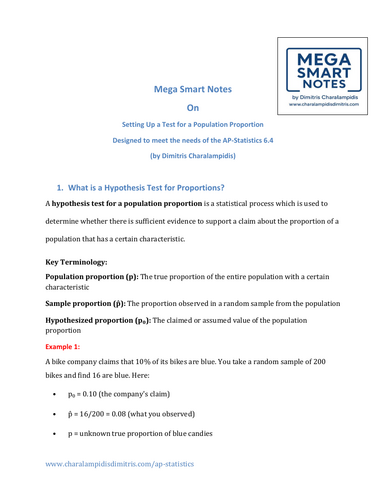
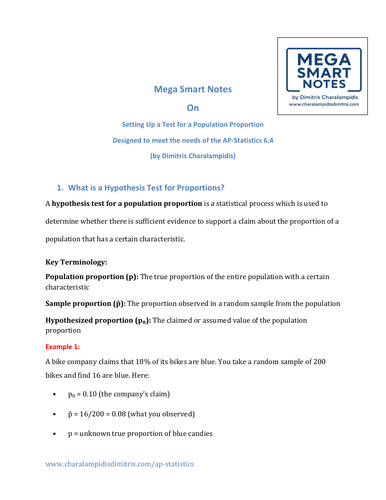
• What a hypothesis test for a proportion is and when to use it
• How to correctly define:
✔ Population proportion §
✔ Sample proportion (p̂)
✔ Hypothesized value (p₀)
• How to identify and use a one-sample z-test for proportions
• The meaning of the p-value and how it is interpreted
• How to set up hypotheses correctly:
✔ H₀: p = p₀
✔ Hₐ: p > p₀, p < p₀, or p ≠ p₀
• How to determine the correct direction of the test
• How to check all required conditions:
✔ Random
✔ Independence (10% condition)
✔ Normality (np₀ ≥ 10 and n(1 − p₀) ≥ 10)
Topics Covered
• One-sample z-test for proportions
• Understanding p-values
• Setting up null and alternative hypotheses
• Right-tailed, left-tailed, and two-tailed tests
• Conditions for valid inference
• Step-by-step test setup process
• Fully worked examples
• Common mistakes and exam traps
Get this resource as part of a bundle and save up to 50%
A bundle is a package of resources grouped together to teach a particular topic, or a series of lessons, in one place.
Something went wrong, please try again later.
This resource hasn't been reviewed yet
To ensure quality for our reviews, only customers who have purchased this resource can review it
Report this resourceto let us know if it violates our terms and conditions.
Our customer service team will review your report and will be in touch.
£3.00