


Save hours of planning with my purpose made premium teaching resources —designed by an experienced educator who understand what really works.
All powerpoints are designed to fully cover the criteria within the up to date syllabus for the subject and help you engage students instantly while maintaining rigorous academic standards.
Perfect for in-person, hybrid, or fully online learning, our resources are customizable, curriculum-aligned, and built to boost student confidence and results. Stop spending late nights creating materials from scratch and start focusing on what matters most — inspiring your students.
This powerpoint contains a starter, 5 topic related Activities, 3 ipad Activities, revision questions, a mark scheme, and a plenary. All the content is differentiated and scaffolded to be suitable for EAL students.
This powerpoint is purposefully made for A Level Chemstry using the most recent Cambridge syllabus.
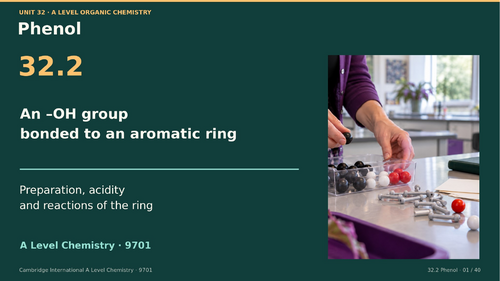
It fully covers - 32.2 Phenol
Learning outcomes
Candidates should be able to:
-
recall the reactions (reagents and conditions) by which phenol can be produced:
(a) reaction of phenylamine with HNO₂ or NaNO₂ and dilute acid below 10°C to produce the diazonium salt; further warming of the diazonium salt with H₂O to give phenol -
recall the chemistry of phenol, as exemplified by the following reactions:
(a) with bases, for example NaOH(aq) to produce sodium phenoxide
(b) with Na(s) to produce sodium phenoxide and H2(g)
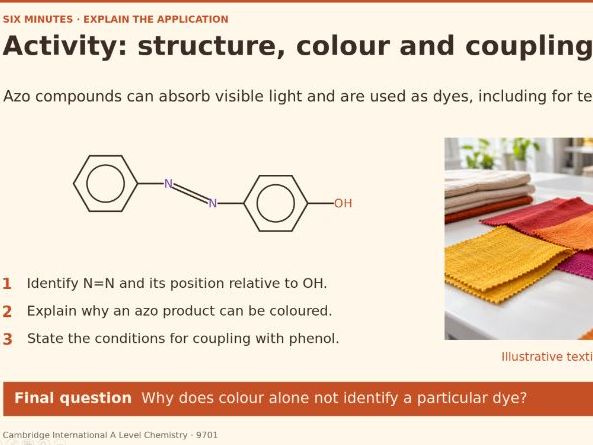
© in NaOH(aq) with diazonium salts, to give azo compounds
(d) nitration of the aromatic ring with dilute HNO₃(aq) at room temperature to give a mixture of 2-nitrophenol and 4-nitrophenol
(e) bromination of the aromatic ring with Br₂(aq) to form 2,4,6-tribromophenol -
explain the acidity of phenol
-
describe and explain the relative acidities of water, phenol and ethanol
-
explain why the reagents and conditions for the nitration and bromination of phenol are different from those for benzene
-
recall that the hydroxyl group of a phenol directs to the 2-, 4- and 6-positions
-
apply knowledge of the reactions of phenol to those of other phenolic compounds, e.g. naphthol
Something went wrong, please try again later.
This resource hasn't been reviewed yet
To ensure quality for our reviews, only customers who have purchased this resource can review it
Report this resourceto let us know if it violates our terms and conditions.
Our customer service team will review your report and will be in touch.
£4.00