


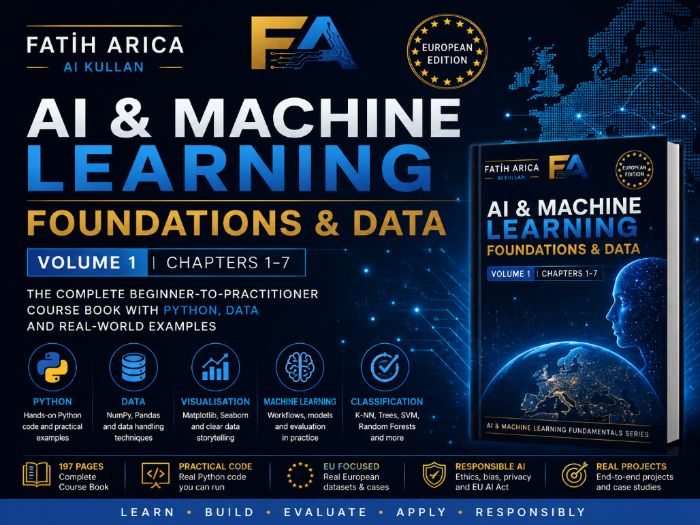

AI & Machine Learning: Foundations & Data – Volume 1 is a complete 197-page course book designed to take learners from the fundamentals of artificial intelligence to practical machine learning with Python.
Written for secondary, post-16, vocational and introductory computing learners, the book combines clear explanations, worked examples, Python code, European datasets, practice exercises and extended projects. It helps students understand not only how AI and machine learning tools work, but how to use them responsibly and evaluate results critically.
Volume 1 covers Chapters 1–7:
• Chapter 1 – What is Artificial Intelligence?
AI history, major branches of AI, European applications, the EU AI Act and a first machine learning programme.
• Chapter 2 – Setting Up Your AI Environment
Python, Anaconda, conda environments, Jupyter, Google Colab, Kaggle and VS Code.
• Chapter 3 – Data Handling with NumPy and Pandas
Arrays, DataFrames, filtering, grouping, merging, missing data, cleaning workflows and European datasets.
• Chapter 4 – Data Visualisation
Matplotlib, Seaborn, chart selection, distributions, relationships, heatmaps and publication-ready visualisation.
• Chapter 5 – Introduction to Machine Learning
Supervised, unsupervised and reinforcement learning, the ML workflow, overfitting, feature engineering, train/validation/test splits and evaluation metrics.
• Chapter 6 – Scikit-learn in Depth
The Estimator API, datasets, linear and ensemble models, GridSearchCV, RandomizedSearchCV, Pipelines, custom transformers, model persistence and imbalanced data.
• Chapter 7 – Classification Algorithms
K-Nearest Neighbours, Decision Trees, Support Vector Machines, Random Forests, Gradient Boosting, model comparison and an EU telecom churn case study.
Students work with realistic scenarios and build complete workflows rather than isolated code snippets. Exercises and mini projects include AI in European cities, EU labour-market analysis, climate-data visualisation, apartment-price prediction, telecom churn prediction and cardiovascular disease risk classification.
The European Edition keeps responsible AI visible throughout the learning journey, including bias, privacy, explainability, human oversight and the regulatory context of the EU AI Act.
By the end of Volume 1, learners will have experience with Python, NumPy, Pandas, Matplotlib, Seaborn and Scikit-learn, and will be able to move from raw data through preprocessing, modelling, evaluation and responsible interpretation.
Ideal for:
• Computer Science and Computing courses
• AI and Machine Learning introductions
• Data Science foundations
• Python programming pathways
• Vocational and post-16 computing
• Independent study and enrichment
Volume 1 | Chapters 1–7 | European Edition
A practical foundation for learners ready to move from understanding AI to building and evaluating machine learning systems.
Something went wrong, please try again later.
This resource hasn't been reviewed yet
To ensure quality for our reviews, only customers who have purchased this resource can review it
Report this resourceto let us know if it violates our terms and conditions.
Our customer service team will review your report and will be in touch.
£7.00