


AQA GCSE Conflict and Tension 1918-1939
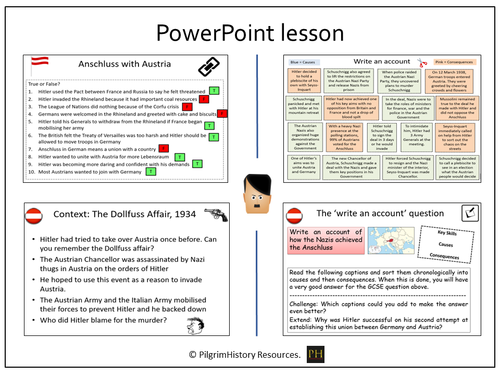
The aim of this lesson is to anaylse how Hitler united Germany with Austria in 1938.
Students will learn how Hitler fulfilled one of his aims of uniting Germans, the Volksdeutsche, by invading Austria.
This time, Hitler has learned from his mistakes from the Dollfuss affair, but is now in a position of strength.
Students have to decide how ruthless he is in his demands from the Austrian Prime Minister, Schuschnigg.
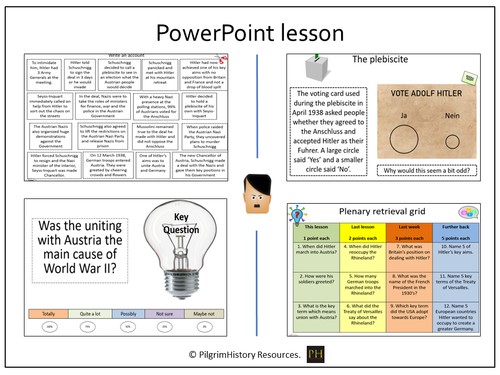
Students complete a true or false quiz, before analysing video footage and undertaking a card sort activity to determine the causes of consequences of the invasion.
This will enable the students to tackle the ‘write an account’ question.
There is a retrieval grid to complete for the plenary.
The lesson is enquiry based with a key question using a lightbulb posed at the start of the lesson and revisited to show the progress of learning.
The resource includes suggested teaching strategies, some retrieval practice, differentiated materials and comes in PowerPoint format if there is a wish to adapt and change.
Get this resource as part of a bundle and save up to 30%
A bundle is a package of resources grouped together to teach a particular topic, or a series of lessons, in one place.
Bundle
AQA Conflict and Tension 1918-1939 Complete Bundle
These lessons have been written to deliver the AQA GCSE (9–1) Conflict and Tension, 1918–1939 unit in a clear and accessible way for students. By the end of the unit, students will have a secure understanding of the competing interests of different nations and individuals in the aftermath of the First World War, including the challenges of maintaining peace and the creation of the League of Nations. They will explore key ideas such as national self-determination, international cooperation, and the difficulties surrounding the Versailles Peace Settlement. Students also build an understanding of how tensions developed in the interwar period, leading to the outbreak of the Second World War. This includes evaluating the causes of the war and considering why attempts to prevent further conflict ultimately failed. Throughout, students study the role of key individuals, nations and events in shaping international relations during this period. Each lesson includes a range of differentiated tasks alongside suggested teaching approaches to support delivery. A variety of GCSE-style questions are included throughout, including source analysis, “write an account” questions, and extended 16-mark responses. Guidance, mark schemes and tips are also provided to help students access the higher levels. The lessons in this bundle are: L1: Aims of the Peacemakers L2: Compromise at the Paris Peace Conference L3: The Terms of the Treaty of Versailles L4: Was the Treaty of Versailles Fair? L5: The Wider Peace Settlement (FREE) L6: Introduction to the League of Nations L7: Structure of the League of Nations L8: The Commissions L9: How Successful Was the League in the 1920s? L10: Decline of International Cooperation L11: The Manchurian Crisis L12: The Abyssinian Crisis L13: Was the League Destined to Fail? L14: Hitler’s Foreign Policy Aims L15: Reactions to Hitler’s Foreign Policy L16: German Rearmament and the Road to War L17: Reoccupation of the Rhineland (FREE) L18: The Anschluss L19: The Sudeten Crisis L20: The Nazi-Soviet Pact L21: Why Did the Second World War Break Out? All lessons include retrieval practice activities and are provided in editable PowerPoint format, making them easy to adapt for different classes. Please note, due to TES bundle size limits, Lesson 17 (Reoccupation of the Rhineland – free resource) is available separately here: https://www.tes.com/teaching-resource/resource-12830949 No AI has been used in the creation of these resources. Reviews are always appreciated and help improve future resources.
£40.00
Bundle
AQA GCSE Conflict and Tension Lessons and Resources Bundle
**AQA GCSE Conflict and Tension 1918-1939** This series of eight lessons introduce the third part of the AQA Conflict and Tension course 1918-39 and focus on the origins and outbreak of World War II. Lessons come complete with suggested teaching strategies and differentiated learning tasks. I have included many of the typical GCSE questions AQA have so far supplied, from source analysis, write an account to the longer 16+4 mark questions. The last lesson also gives some GCSE practice questions and examples of how to answer them. The lessons are broken down into the following: L1: Hitler’s Aims & Foreign Policy L2: Reactions to Hitler’s Foreign Policy L3: The road to war and German rearmament L4: Reoccupation of the Rhineland (free resource) L5: The Anschluss L6: The Sudeten Crisis L7: The Nazi-Soviet Pact L8: Why did World War II break out? Lessons also include some retrieval practice activities and come in PowerPoint format if there is a wish to adapt and change. Any reviews would be gratefully received.
£17.00
Something went wrong, please try again later.
This resource hasn't been reviewed yet
To ensure quality for our reviews, only customers who have purchased this resource can review it
Report this resourceto let us know if it violates our terms and conditions.
Our customer service team will review your report and will be in touch.
£3.00